

Phase 1: Empathy & Storytelling Opening
안녕하세요! 매일한글 에디터입니다. (Hello! This is your Daily Hangul Editor.)
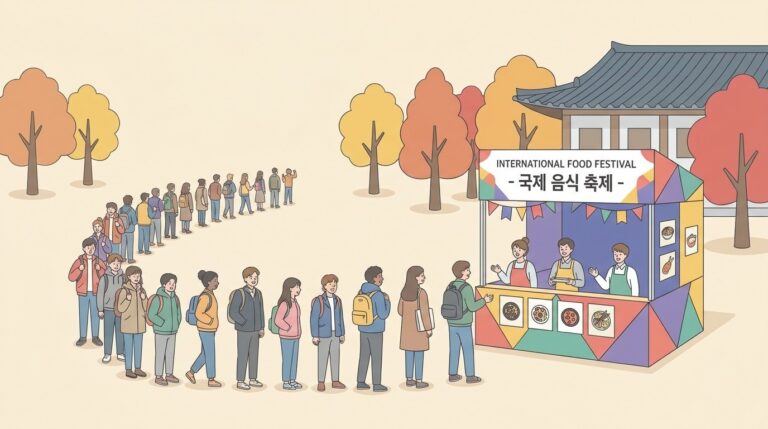
Imagine this: the spring air on a Korean university campus is buzzing with bass-heavy beats from the main stage, the scent of sizzling street food fills every pathway, and colorful department banners flap in the breeze. It’s the legendary university festival known as 대동제 (Daedongje). You and your fellow international classmates decided to open a global snack booth, proudly representing your home countries’ beloved street foods. You prepared what you thought was enough for two days.
Then, 1:00 PM strikes. Suddenly, a sea of students spots your booth, and within twenty minutes, your queue stretches an astonishing 50 meters down the hill! You feel a thrill of excitement, but panic strikes immediately after. Orders are flying in Korean, people are asking how long the wait is, your team is scrambling for extra tongs, and the Student Council patrol walks up to ask about your line management. Your textbook taught you formal phrases like “여기 앉으세요” (Sit here), but how on earth do you handle crowd control, announce early sell-outs, and shout energetic encouragement with your teammates in natural, fast-paced Korean?
Don’t worry—you are not alone. Many exchange students tell us this exact moment was both their proudest campus triumph and their most tongue-tied challenge. Today, we’re unlocking the field-tested, B2-level Korean expressions that will transform you from a flustered booth helper into the coolest booth captain on campus. Let’s dive in!
Phase 2: Top 3 Core Expressions Deep Dive
1. 줄이 줄어들 기미가 안 보여요 (Juri jureodeul gimiga an boyeoyo)
- Pronunciation: [Ju-ri ju-reo-deul gi-mi-ga an bo-yeo-yo] (Think: “Jew-ree joo-ruh-deul gee-mee-gah ahn bo-yuh-yo”)
- Meaning: Literal: “There is no sign of the line decreasing.” / Actual Nuance: “The queue is endless! We are swamped (in a good, mind-blowing way)!”
- K-Culture Moment: You will hear this exact sentence in campus K-Dramas like Weightlifting Fairy Kim Bok-joo or food variety shows like Kang’s Kitchen whenever a food stall unexpectedly explodes with viral popularity.
- Editor’s Insight: The noun 기미 (gimi) means “a trace, inkling, or symptom of something changing.” When paired with ~ㄹ 기미가 안 보이다, it shows seasoned, B2-level expressive ability to describe an overwhelming situation with humor and nuance.
- Situation Spectrum: Casual: ✅ | Semi-formal: ✅ | Formal: ⚠️
- 🤔 Think About It: In English, we might say “The line isn’t budging.” How does using the word “inkling/sign” (기미) reveal the Korean tendency to look for subtle environmental cues before making a statement?
2. 재료 소진으로 조기 마감될 수 있습니다 (Jaeryo sojineuro jogi magamdoel su itseumnida)
- Pronunciation: [Jae-ryo so-jin-eu-ro jo-gi ma-gam-doel su it-seum-ni-da] (Think: “Jeh-ryo so-jeen-ew-ro jo-gee mah-gahm-doel soo eet-seum-nee-dah”)
- Meaning: Literal: “Early closing is possible due to ingredient exhaustion.” / Actual Nuance: “Heads up everyone, we might sell out and close earlier than scheduled!”
- K-Culture Moment: The holy grail phrase of trendy pop-up stores in Seongsu-dong or hot food trucks at Hongik University. When customers hear this, their FOMO kicks in and they get even more eager to order!
- Editor’s Insight: A clean, professional Sino-Korean compound (재료 소진 = ingredient depletion + 조기 마감 = premature closing). Shouting this politely to waiting customers prevents frustration and elevates your customer-service authority.
- Situation Spectrum: Casual: 🚫 | Semi-formal: ⚠️ | Formal: ✅
- 🤔 Think About It: Notice how Korean customer announcements frame shortages as a natural consequence (“due to ingredient depletion”) rather than a personal failure (“we didn’t prep enough”).
3. 손발이 척척 맞아서 다행이에요 (Sonbari cheokcheok majaseo dahaeng-ieyo)
- Pronunciation: [Son-ba-ri cheok-cheok ma-ja-seo da-haeng-i-e-yo] (Think: “Sohn-bah-ree chuk-chuk mah-jah-suh dah-heng-ee-yo”)
- Meaning: Literal: “It’s a relief that our hands and feet fit tick-tock.” / Actual Nuance: “Thank goodness our teamwork is in absolute sync!”
- K-Culture Moment: Seen often in idol reality shows (Run BTS, Going Seventeen) when members crush a fast-paced cooking or serving challenge through unspoken chemistry.
- Editor’s Insight: The idiom 손발이 맞다 means “to coordinate harmoniously.” Adding the onomatopoeia/mimetic word 척척 (cheokcheok) portrays prompt, seamless cooperation without friction.
- Situation Spectrum: Casual: ✅ | Semi-formal: ✅ | Formal: ⚠️
- 🤔 Think About It: Why do you think Korean uses physical extremities (hands and feet) to describe intellectual and operational synchronization?
Phase 3: Textbook Korean vs. Real Korean
Situation 1: Asking customers to stand neatly in line
- 📖 교과서 한국어 (Textbook): 여기에 줄을 서서 기다려 주십시오. (Yeogie jureul seoseo gidaryeo jusipsio.) — Please stand in line here and wait.
- 🗣️ 진짜 한국어 (Real-life): 뒤쪽으로 줄 서주시면 차례대로 도와드릴게요! (Dwijjogeuro jul seojusimyeon charyedaero dowadeurilgeyo!) — If you could line up toward the back, we’ll help you in turn!
- 💡 왜 다를까? (Why the difference?): The textbook version is an impersonal command. Real university booth leaders soften imperatives by offering proactive assistance (~도와드릴게요) as a reward for orderly queueing.
Situation 2: Announcing that an item is completely gone
- 📖 교과서 한국어 (Textbook): 이 음식은 다 팔렸습니다. (I eumsigeun da pallyeotseumnida.) — This food has been completely sold.
- 🗣️ 진짜 한국어 (Real-life): 죄송해요, 이 메뉴 방금 완판됐어요! (Joesonghaeyo, i menyu banggeum wanpandoesseoyo!) — So sorry, this menu item just completely sold out!
- 💡 왜 다를까? (Why the difference?): “다 팔렸습니다” sounds flat and bureaucratic. University students and young vendors love the energetic buzzword 완판 (wanpan – complete sellout), which celebrates the popularity of the dish while apologizing warmly.
Phase 4: K-Culture Deep Dive & Non-Verbal Manners
4-1. Nunchi (눈치) & Body Language Behind the Counter
When your booth is packed with a 50-meter line, eye contact and non-verbal cues carry half the conversation:
1. The ‘Two-Hand Direction’ Guide: Never point with a single index finger when directing the line. Sweep an open hand palm-up toward the designated area. Pointing feels scolding; open hands feel like hospitality.
2. The 15-Degree Apology Nod: When a customer has waited 30 minutes only to hear their favorite snack is gone, bow your head slightly around 15 degrees, hold one hand over your chest, and say, “어쩌죠, 죄송해요!” (Oh no, I’m so sorry!). This instant humility diffuses any irritation.
4-2. Cultural Code: The Spirit of Campus 대동제 (Daedongje)
The word 대동제 (Daedongje) translates literally to “Great Togetherness Festival.” Unlike commercial street fairs, a university festival in Korea is run completely by student autonomy (학생회 자치 활동). When an international booth is mobbed with customers, it’s not just a business win—it’s a massive point of cultural pride. Fellow Korean students view visiting global exchange booths as a friendly cultural exchange, meaning customers are generally patient, curious, and excited to cheer you on!
Phase 5: Real-Life Roleplay Scenario
- Setting: 2:30 PM at the central plaza. The student line has wrapped around the chemistry building. Min-jae, the Student Council Festival Director wearing an organizer vest, rushes over with a clipboard.
-
Min-jae: 🎭 (Looking at the massive crowd with wide eyes) 저기, 글로벌 부스 팀장님 맞으시죠? 여기 줄이 도로까지 넘어왔어요!
(Jeogi, geullobeol buseu timjangnim majeosijyo? Yeogi juri dorokkaji neomeowasseoyo!)
“Excuse me, you’re the head of the Global Booth, right? Your queue has spilled over into the main walkway!” -
You: 🎭 (Wiping forehead with a towel, smiling politely) 네, 맞아요! 저희도 이렇게까지 대박 날 줄 몰랐어요.
(Ne, majayo! Jeohido ireokekkaji daebak nal jul mollasseoyo.)
“Yes, that’s me! We had no idea it would blow up into such a huge hit either.” -
Min-jae: 🎭 (Checking the line) 안전요원 배치가 필요한 수준인데요. 지금 대기 시간이 얼마나 되나요?
(Anjeonyowon baechiga pil-yohan sujuninde-yo. Jigeum daegi sigani eolmana doenayo?)
“This level needs safety marshal deployment. How long is the current wait time?” -
You: 🎭 (Checking the ticket numbers) 지금 주문하시면 최소 40분은 기다리셔야 할 것 같아요.
(Jigeum jumunhasimyeon choeso sasipbuneun gidarisyeoya hal geot gat-ayo.)
“If people order now, they’ll likely have to wait at least 40 minutes.” -
Min-jae: 🎭 (Nodding seriously) 뒤쪽 통행로가 막히면 본부에서 부스 운영 중단 권고가 나올 수도 있어요.
(Dwijjok tonghaengnoga makimyeon bonbueseo buseu un-yeong jungdan gwon-goga naol sudo isseoyo.)
“If the rear passage is blocked, student headquarters might issue a warning to suspend operations.” -
You: 🎭 (Gesturing promptly toward the lawn) 아, 그건 안 되죠! 잔디밭 쪽으로 줄 꺾어서 정리하도록 번호표 나눠드릴게요.
(A, geugeon an doejo! Jandibat jjogeuro jul kkeok-eoseo jeongnihadorok beonhopyo nanwo deurilgeyo.)
“Ah, we can’t let that happen! We’ll hand out numbered tickets and bend the queue toward the grass area to clear the path.” -
Min-jae: 🎭 (Impressed) 오, 대처가 빠르시네요! 재료는 넉넉해요?
(O, daecheoga ppareusineyo! Jaeryoneun neongneokhaeyo?)
“Oh, quick thinking! Do you have plenty of ingredients left?” -
You: 🎭 (Chuckling) 아니요, 재료 소진으로 조기 마감될 것 같아서 공지 띄우려던 참이에요!
(Aniyo, jaeryo sojineuro jogi magamdoel geot gat-aseo gongji tti-uryeodeon cham-ieyo!)
“No, actually, we’re likely to close early due to running out of ingredients, so I was just about to put up a notice!”
🔀 Interactive Decision Point
Min-jae asks you to limit queue entry right now. How do you announce this to the 30 people waiting at the end of the line?
- Option A: “야, 너희들 이제 줄 서지 마! 재료 없어!” (Hey you guys, stop lining up! No ingredients!)
- Option B: “죄송하지만 저희 재료가 거의 끝나서, 여기까지 줄을 마감하도록 하겠습니다!” (We apologize, but our ingredients are almost finished, so we must cut off the line here!)
- Option C: “몰라요, 학생회가 그냥 가라고 했어요.” (I don’t know, the Student Council told you to just leave.)
Selection Feedback:
* Option A [Bad]: Using informal panmal (너희들, 야) to campus peers you don’t know personally can spark serious arguments and ruin the booth’s reputation.
* Option B [Best]: Polite, clear, professional. It acknowledges regret (죄송하지만) and sets a firm operational boundary (마감하도록 하겠습니다).
* Option C [Risk]: Blaming the student council makes you look unaccountable and creates unnecessary friction between customers and festival staff.
Phase 6: 10-Second Emotional Shadowing Drill
- Drill 1:
[😊 땀 흘리면서도 보람차고 신나게]
“손발이 척척 맞아서 / 벌써 300인분 완판했어요!”
(Sonbari cheokcheok majaseo / beolsseo sambaek-inbun wanpanhaesseoyo!)
“Our teamwork clicked so well / we already sold out all 300 servings!” -
Drill 2:
[😅 눈치껏 미안함과 다급함을 담아]
“손님, 정말 죄송한데요 / 여기서 주문 마감해야 할 것 같아요!”
(Sonnim, jeongmal joesonghandeyo / yeogiseo jumun magamhaeya hal geot gat-ayo!)
“Dear customer, I’m truly sorry / but I think we have to cut off orders right here!” -
Drill 3:
[📣 활기차고 당당하게 crowd를 통솔하며]
“통행로 확보를 위해 / 잔디 쪽으로 한 줄로 서주세요!”
(Tonghaengno hwakboreul wihae / jandi jjogeuro han jullo seojuseyo!)
“To keep the pathway clear / please form a single line toward the lawn!”
Phase 7: K-Culture Mini Dictionary
- 대동제 (Daedongje) — University Festival of Great Unity. The official traditional name for Korean university campus festivals, emphasizing community, sharing, and shared student governance.
- 완판 (Wanpan) — Total Sell-Out. Formed from 완전 (Complete) + 판매 (Sales). A slang and business term used proudly when all prepared food or merchandise is completely gone.
- 웨이팅 (Weiting) — The Queuing / Waiting Culture. From English “waiting,” but used as a concrete noun in Korea (e.g., “웨이팅 있어요?” = Is there a waitlist?). Long lines at festivals are often referred to as “역대급 웨이팅” (unprecedented wait).
- 주점 (Jujeom) — Campus Festival Pubs / Stalls. Pop-up outdoor bars and food stalls set up by university departments and student clubs during festival nights.
Phase 8: Traveler & Campus Survival Kit
Survival Expressions TOP 3
- 결제 계좌번호 여기 적혀 있어요! (Gyeolje gyejwabeonho yeogi jeokhyeo isseoyo!) — “Our payment bank account number is written right here!” (Pro Tip: Most university festival booths operate via instant bank transfers or Toss rather than cash).
- 앞팀 주문 나가고 바로 만들어 드릴게요! (Aptim jumun nagago baro mandeureo deurilgeyo!) — “We’ll make yours right after the order ahead of you is served!”
- 재료 조금만 더 가져다줄 수 있어? (Jaeryo jogeumman deo gajyeodajul su isseo?) — “Could you bring over a little more ingredients?” (Essential kitchen walkie-talkie phrase between booth partners).
Editor’s Campus Practical Note
- Payment Logistics: Almost nobody uses cash at university festivals now. Set up your booth’s QR code linked to KakaoPay or an open Toss transfer sheet.
- Navigation Guide: Campuses during Daedongje can become maze-like with temporary stages and barricades. Ensure all your friends install and navigate through the Naver Map official application download page to share exact live pin drops for booth locations.
Phase 9: Going One Step Deeper (Reflective Essay)
In traditional Korean culture, there is an ancient practice known as 품앗이 (Pumasi)—a communal system of reciprocal labor exchange where villagers worked together during intense harvest periods. When you run a university festival booth in Korea, you are stepping directly into the modern reincarnation of this cultural DNA.
Standing over a scorching hot grill for seven hours, shouting until your voice cracks, and splitting cardboard boxes with your Korean classmates melts away social barriers faster than any formal language class ever could. In Korea, true camaraderie (정, Jeong) isn’t forged over quiet small talk; it’s forged when your 손발이 척척 맞는다 (hands and feet move in sync) while surviving a crazy 50-meter rush together.
💬 Your Turn: Have you ever managed a crazy line or festival booth in your home country? What was the hardest part to communicate under stress? Let’s discuss in the comments below!
Phase 10: FAQ & Avoiding Misunderstandings
Q: Can I use 반말 (informal speech) with students standing in my line if they look like my age?
A: No, absolutely not! Even though Korean university students call each other 학우 (fellow student), customer-facing situations always require 존댓말 (polite/honorific speech). Address them warmly with expressions ending in ~요 or ~세요. Casual talk (반말) can make customers feel disrespected.
Q: What should I say when people cut the queue?
A: Avoid shouting aggressively. Instead, calmly use indirect polite guidance: “죄송하지만 줄은 이쪽 뒤편부터 서 계셨어요! 뒤로 이동 부탁드릴게요.” (Excuse me, but the line starts from the back here! Please move to the end). It asserts the rule without attacking their character.
Q: What is the difference between ‘매진’ and ‘완판’?
A: Both mean sold out! However, 매진 (Maejin) is a standard, formal term typically used for concert tickets, train seats, or formal retail inventory. 완판 (Wanpan) has a punchier, celebratory vibe suited for pop-ups, festival stalls, and viral merchandise that was cleared out by high demand.
🚨 Common Mistakes Alert
- Mistake: Shouting “우리 음식 다 죽었어요!” (Our food is all dead!).
- Correction: To express running out of stock, say “재료가 다 떨어졌어요!” (We ran out of ingredients) or “완판됐어요!”.
- Mistake: Directing lines by saying “거기 가세요!” (Go there!).
- Correction: Say “이쪽 뒤편으로 줄 서주시면 감사하겠습니다!” (We’d appreciate it if you lined up toward the back here!).
- Mistake: Staying silent when overwhelmed.
- Correction: When orders get backed up, communicate progress! Say “지금 5분 정도 지연되고 있습니다. 조금만 양해 부탁드립니다!” (We are delayed by about 5 minutes. Thank you for your patience!).
Phase 11: Action Missions & Engagement
- 🥉 Bronze Mission (Solo Practice): Practice the shadowing drill sentence: “손발이 척척 맞아서 다행이에요!” aloud 5 times until you can say it under 3 seconds with a bright smile.
- 🥈 Silver Mission (Community Challenge): Write a 2-sentence comment below pretending to be a booth manager cutting off a line politely using the phrase 조기 마감 (early closing).
- 🥇 Gold Mission (Real-world Execution): Visit a Korean campus festival or outdoor street pop-up this semester. Congratulate a busy food booth operator by telling them: “와, 줄 진짜 기네요! 대박 나셨네요!” (Wow, the line is so long! You guys hit the jackpot!).
-
🎮 K-Culture Mission: Search YouTube for “대학 축제 브이로그 부스” (University festival vlog booth). Watch 5 minutes of real university students running stalls and spot how many times they say “완판” or “주문 도와드릴게요”!
Phase 12: Interactive Quiz Challenge
Q1. [Context Choice] Your international food booth has only 3 servings of tacos remaining, but 15 people are waiting. What is the most culturally adept phrase to say to the waiting crowd?
* A) 이제 그만 오세요. 피곤해요.
* B) 손님 여러분, 재료 소진으로 곧 조기 마감될 예정입니다!
* C) 줄 서지 마시고 저기 다른 부스로 가세요.
Q2. [Fill in the Blank] Fill in the onomatopoeia that means working in smooth, perfect coordination:
* “우리 팀은 호흡이 좋아서 일이 ( ? ) 맞아요!”
Q3. [True or False] At Korean university festivals (대동제), using informal language (반말) toward customer peers is encouraged to build friendly energy.
* (True / False)
👉 Click here to reveal answers & explanations!
- Q1 Answer: B. “손님 여러분, 재료 소진으로 곧 조기 마감될 예정입니다!” is polite, gives fair advance warning, and maintains professional hospitality.
- Q2 Answer: 척척 (Cheokcheok). The full idiom is 손발이 척척 맞다 or 일이 척척 맞다.
- Q3 Answer: False. Even though you are university peers, interacting between service providers and customers requires polite register (존댓말) to show mutual respect.
🎬 Watch Our Daily Videos! (Daily Hangul Official Instagram)
Review the expressions you learned in this article with our fun daily short videos! Check out native pronunciation and real-life nuances in action.
- Instagram @dailyhangul_en







