

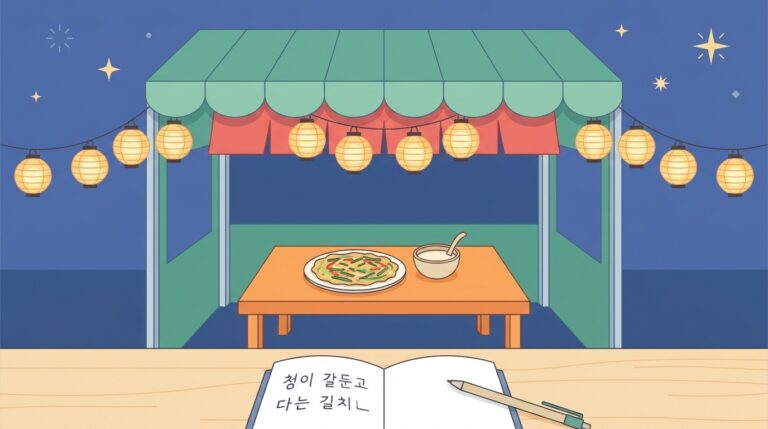
Korean Festival Food Survival: How to Order Pajeon and Makgeolli Like a Local
Phase 1: Empathy (Welcome to the Festival Tent!)
안녕하세요! 매일한글 에디터입니다. (Annyeonghaseyo! I’m your Daily Hangul editor.)
Picture this: the sun has set over a spring cherry blossom festival along the riverbank in Gyeongju, or maybe the crisp autumn air at the Jinju Lantern Festival is chilling your cheeks. You wander into a glowing maze of outdoor tent stalls—the vibrant festival night market (야시장, yasijang). The air is thick with the mouthwatering sizzle of crispy seafood scallion pancakes (pajeon), savory nutty scents of seasoned acorn jelly (dotorimuk), and laughter echoing around bright orange plastic tables.
You want to sit down and order, but your heart starts racing. The menus are handwritten on cardboard, the stall owner (imonim) is shouting over sizzling pans, and other patrons are clinking small golden bowls filled with cloudy local rice wine (makgeolli). How do you ask for that specific regional drink without freezing up? Many A2 learners tell us, “I studied restaurant ordering, but street festival tents felt like an entirely different universe!”
Don’t worry! Today, we will equip you with simple, confidence-boosting phrases tested and perfected by real students. By the end of this guide, you will slide into a plastic stool, order the ultimate Korean festival feast, and toast with locals without breaking a sweat.
Phase 2: Key Expressions Breakdown
Here are the 3 essential expressions you need at any Korean festival food stall.
1. 파전 하나랑 막걸리 한 병 주세요. (Pajeon hana-rang makgeolli han byeong juseyo.)
- Pronunciation: [Pah-jeon ha-na-rang mahk-geol-li han byeong joo-seh-yo] (Think of ‘pajeon’ like ‘pie-jeon’ and ‘rang’ like ‘rung’ in English)
- Meaning: Literal: “Please give one pajeon and one bottle of makgeolli.” / Nuance: “We’d like one green onion pancake and a bottle of makgeolli, please!”
- K-Culture Moment: In K-Dramas like Hospital Playlist or Reply 1988, whenever rain pours or friends gather at a street tent, this exact combination is the undisputed champion of comfort food.
- Editor’s Insight: At outdoor festival stalls, menus can be chaotic. Combining items with
~랑/이랑(-rang / -irang, “and”) along with counting units (하나= one,한 병= one bottle) makes your order crystal clear to a busy vendor. - Situation Spectrum:
- Casual (Friends): ⚠️ (Use 파전 하나랑 막걸리 하나 줘)
- Semi-formal (Night market vendor): ✅ (Perfect! Polite and friendly)
- Formal (Upscale dining): 🚫 (Too casual for fine dining, but ideal for market tents)
- 🤔 Think About It: In English, you might say “Can I get a pancake and a beer?” Why do you think Korean builds politeness into the end of the verb (
주세요) rather than framing it as a question of ability (“Can I…”)?
2. 이 지역 특산 막걸리는 어떤 맛이에요? (I jiyeok teuksan makgeolli-neun eotteon masi-eyo?)
- Pronunciation: [Ee jee-yeok teuk-sahn mahk-geol-li-neun uh-tteon mah-she-eh-yo?]
- Meaning: Literal: “This region’s specialty makgeolli is what taste?” / Nuance: “What does your local specialty makgeolli taste like?”
- K-Culture Moment: On travel reality shows like 2 Days & 1 Night, cast members travel to rural towns and always sample the local makgeolli—whether it’s chestnut makgeolli in Gongju or corn makgeolli in Gangwon province.
- Editor’s Insight: Korean regional festivals take huge pride in their local breweries. Asking this question instantly turns you from an ordinary tourist into a culturally curious guest!
- Situation Spectrum:
- Casual: ⚠️
- Semi-formal: ✅
- Formal: ✅
- 🤔 Think About It: Notice how Korean places the topic at the very beginning with the topic marker
~는(-neun). Does organizing the topic first change how you frame questions in your own language?
3. 도토리묵 양념이 살짝 매콤한가요? (Dotorimuk yangnyeom-i saljjak maekomhangayo?)
- Pronunciation: [Doh-toh-ree-mook yahng-nyeom-ee sahl-jjak meh-kohm-hahn-gah-yo?]
- Meaning: Literal: “Is acorn jelly seasoning slightly spicy?” / Nuance: “Is the seasoning on the acorn jelly a little spicy?”
- K-Culture Moment: Acorn jelly salad (dotorimuk-muchim) tossed with wild greens, sesame oil, and chili powder is the iconic mountain and festival snack. Foreign visitors often wonder if dark brown jelly is savory or spicy.
- Editor’s Insight:
살짝(saljjak, “slightly/a little bit”) and매콤하다(maekomhada, “pleasantly spicy”) show high emotional nuance. It sounds much more natural than just asking매워요?(Maewoyo?, “Is it spicy?”). - Situation Spectrum:
- Casual: ⚠️
- Semi-formal: ✅
- Formal: ✅
- 🤔 Think About It: Korean has dozens of words for spice: maepda (plain spicy), maekomhada (sweet & savory spicy), eolkeunhada (deep, broth-like spicy). What does this reveal about Korean food culture?
Phase 3: Textbook Korean vs. Real Korean
| Situation | 📖 Textbook Korean | 🗣️ Real Korean | 💡 Why Is It Different? |
|---|---|---|---|
| Ordering Food at Busy Tents | 이것과 이것을 주문하고 싶습니다. (Igeot-gwa igeos-eul jumunhago sipseumnida) – “I wish to order this and this.” | 이모님! 파전 하나, 묵 하나 주세요! (Imo-nim! Pajeon hana, muk hana juseyo!) – “Auntie! One pajeon and one acorn jelly, please!” | Festival tents are loud and fast-paced. Drop formal verb conjugations and use affectionate address terms like 이모님 (imonim) to grab attention quickly. |
| Asking for Bill / Payment Method | 신용카드로 결제해도 됩니까? (Sinyongkadeu-ro gyeoljehaedo doepnikka?) – “May I settle the payment via credit card?” | 사장님, 카드 돼요? 계좌이체 할게요! (Sajangnim, kadeu dwaeyo? Gyejwa-iche halgeyo!) – “Boss, does card work? I can do a bank transfer!” | Outdoor festival booths sometimes struggle with card readers. Real conversation uses simple ~돼요? (dwaeyo?, “Does it work?”) rather than formal procedural vocabulary. |
Phase 4: K-Culture Deep Dive & Non-Verbal Manners
4-1. Nunchi & Table Gestures
- The Makgeolli Swirl: Makgeolli is unfiltered rice wine, meaning rice sediment naturally settles at the bottom of the plastic bottle. Turn the bottle upside down gently and swirl it in circles. Never shake it vigorously like champagne, or it will explode over your festival outfit!
- Two-Handed Pouring: When someone pours makgeolli into your small brass or ceramic bowl (makgeolli-jan), lift your bowl with two hands. When pouring for someone older, support your right wrist or forearm with your left hand.
- Eye Contact & Clinking: Unlike Western toasts where making deep eye contact is mandatory, in Korea, gently tap bowls near the rim and turn slightly sideways when taking your first sip if drinking with an elder.
4-2. Cultural Code: Why Pajeon & Makgeolli?
Why do Koreans crave Pajeon and Makgeolli during rainy days and outdoor autumn/spring festivals? Historically, farmers drank filling, low-alcohol makgeolli as an energy booster during harvests. Culturally, the sizzling sound of frying batter in hot oil resembles the sound of raindrops hitting a canvas tent. Today, sharing a large circular pancake in the middle of a festival tent represents jeong (affectionate bonding)—nobody eats pajeon alone!
Phase 5: Real-World Roleplay Scenario
Setting: A bustling outdoor tent booth at the Yeouido Spring Flower Festival. Steaming griddles, chatter, and yellow string lights overhead. You and a friend step inside.
NPC: Imo-nim (Stall Owner, warm and energetic, wearing an apron)
- 이모님 (Imo-nim): 어서 와요! 두 명이에요? 안쪽에 앉아요! (Eoseo wayo! Du myeong-ieyo? Anjjok-e anjayo!)
🎭 Wiping down a round plastic table with a clean cloth and smiling warmly.
(Welcome! Two people? Have a seat inside!) - You: 네, 감사합니다! (Ne, gamsahamnida!)
🎭 Taking off your jacket and sitting on the round plastic stool.
(Yes, thank you!) - 이모님 (Imo-nim): 오늘 벚꽃 구경 잘했어요? 뭐 줄까요? (Oneul beotkkot gugyeong jalhaesseoyo? Mwo julkkayo?)
🎭 Holding a notepad and pointing at the sizzling griddle.
(Did you enjoy the cherry blossoms today? What can I get you?) - You: 이모님, 해물파전 하나랑 도토리묵 하나 주세요. (Imo-nim, haemulpajeon hana-rang dotorimuk hana juseyo.)
🎭 Pointing politely at the menu board.
(Auntie, one seafood scallion pancake and one acorn jelly, please.) - 이모님 (Imo-nim): 막걸리는 안 마셔? 우리 집 알밤 막걸리 진짜 달고 맛있는데! (Makgeolli-neun an masyeo? Uri jip albam makgeolli jinjja dalgo masinneunde!)
🎭 Tapping a chilled bottle of regional chestnut makgeolli.
(No makgeolli? Our chestnut makgeolli is super sweet and delicious!) - You: 오, 그럼 알밤 막걸리도 한 병 주세요! (O, geureom albam makgeolli-do han byeong juseyo!)
🎭 Nodding enthusiastically with an excited smile.
(Oh, then please give us one bottle of chestnut makgeolli too!) - 이모님 (Imo-nim): 그래요! 금방 부쳐줄 테니까 조금만 기다려요~ (Geuraeyo! Geumbang buchyeojul tenikka jogeumman gidaryeoyo~!)
🎭 Lifting a ladle of batter and pouring it onto the smoking hot pan.
(Alright! I’ll fry it up right away, so wait just a moment~) - You: 네! 기대돼요. 감사합니다! (Ne! Gidaedwaeyo. Gamsahamnida!)
🎭 Setting down two pairs of wooden chopsticks for you and your friend.
(Yes! Looking forward to it. Thank you!)
🔀 Interactive Decision Point
When the food arrives, the makgeolli bottle is unopened, and there are two yellow metal bowls. What do you do?
- Option A: Shake the bottle vigorously like a soda bottle and open it immediately at the table.
- Option B: Gently swirl the bottle in a smooth circular motion, untwist the cap slightly to let carbonation out, and pour your friend’s bowl with both hands.
- Option C: Leave the bottle alone, pour only clear liquid from the top without mixing, and drink straight from the bottle.
[Feedback]
* Option A (Risk!): Makgeolli is naturally carbonated! Shaking it hard will cause milky rice wine to spray across your table and neighboring guests.
* Option B (Best!): Spot on! A gentle tilt and swirl integrates the sweet rice sediment safely. Pouring with two hands displays pitch-perfect Korean table manners.
* Option C (Bad): Drinking directly from a makgeolli bottle at a dining table looks jarring, and leaving the sediment behind strips makgeolli of its signature rich flavor.
Phase 6: 10-Second Emotion Shadowing Drill
Read these lines aloud, matching the rhythm markers (/) and the emotional cue!
[😋 군침 돌며 기대하듯 - Salivating with excitement]
이모님, / 해물파전 하나랑 / 막걸리 한 병 주세요!
(Imo-nim, / haemulpajeon hana-rang / makgeolli han byeong juseyo!)-
[🤔 호기심 가득하게 - Curious and engaged]
이 지역 특산 막걸리는 / 어떤 맛이에요?
(I jiyeok teuksan makgeolli-neun / eotteon masi-eyo?) -
[😊 다정하고 감사하게 - Sweet and appreciative]
도토리묵이 / 진짜 고소하고 / 맛있어요!
(Dotorimuk-i / jinjja gosohago / masisseoyo!)
Phase 7: K-Culture Mini Dictionary
- 막걸리잔 (Makgeolli-jan) | Traditional drinking bowl for rice wine
Usage: Unlike shot glasses for soju or tall glasses for beer, makgeolli is served in shallow round bowls made of brass or earthenware. Clinking these yellow bowls (jan) creates a distinct, cheerful chime. - 도토리묵무침 (Dotorimuk-muchim) | Seasoned acorn jelly salad
Usage: A quintessential Korean mountain and outdoor festival appetizer. Brown acorn jelly cubes are tossed with shredded perilla leaves, cucumbers, chili flakes, and toasted sesame oil. - 야시장 (Yasijang) | Festival night market
Usage: Pop-up food stalls and craft vendors that open during cultural celebrations. These offer a rare communal dining atmosphere where strangers often sit side-by-side on long benches. - 이모님 (Imo-nim) | “Auntie” (Affectionate honorific for female stall owners)
Usage: Literally means maternal aunt, but throughout Korea’s informal food stalls, it is the warmest way to address middle-aged female owners and waitstaff.
Phase 8: Survival Kit for Travelers
Top 3 Survival Phrases
- 종이컵 두 개만 더 주세요. (Jong-ikeop du gae-man deo juseyo.) – “Please give us two more paper cups.”
Pro Tip: Great for sharing water or extra snacks among friends at tent booths. - 계좌이체 가능한가요? (Gyejwa-iche ganeunghangayo?) – “Is bank transfer possible?”
Pro Tip: In remote rural festival stalls, wireless card terminals sometimes drop reception. Every stall has their bank account details written on a board. - 휴지 어디에 있어요? (Hyuji eodie isseoyo?) – “Where are the tissues?”
Pro Tip: At outdoor stalls, tissue rolls are frequently hung from tent ceiling poles above the tables!
Editor’s Travel Note
Before heading to local festivals outside Seoul, install the official 네이버 지도 앱 다운로드 to search for pop-up festival grounds and bus routes, because foreign map apps lack local transit detail. Additionally, prepare for festival transportation using the 카카오 T 앱 다운로드 to book local regional taxis after the fireworks show ends. While most booths accept credit cards nowadays, keeping 20,000 to 30,000 KRW in crisp cash will save you when buying street delicacies.
Phase 9: “One Step Deeper” (Cultural Reflection)
In modern cities, people frequently eat alone behind smartphone screens. Yet, seasonal Korean festivals preserve a vibrant, communal spirit known as Jeong (정). Sharing a circular pajeon requires tearing pieces off with your chopsticks together, rather than cutting neat individual slices with a knife. Sitting elbow-to-elbow on plastic stools under a canvas roof reminds us that food is primarily a tool for human connection.
💬 Your Turn: What is your country’s equivalent of comfort festival food shared among friends? How does it compare to sitting under a Korean tent with pajeon and makgeolli? Share in the comments below!
Phase 10: FAQ & Common Mistakes
Q: Can I sit down at an outdoor festival tent if I only want to drink makgeolli without ordering food?
A: Generally, no. Festival tent vendors pay hefty stall fees and rely on food sales. Ordering at least one main food item (안주, anju, like pajeon or dotorimuk) per table is expected standard etiquette.
Q: How do I call the server if there is no bell on the festival plastic table?
A: Raise your hand lightly to make brief eye contact and call out cheerfully: “이모님!” (Imo-nim!) or “사장님!” (Sajangnim!). Avoid snapping your fingers, whistling, or shouting “Hey!”
Q: Is all makgeolli sweet?
A: Not all! While fruit-flavored and chestnut makgeolli (albam makgeolli) are sweet, traditional dry makgeolli from rural craft breweries can be tart, earthy, and tangy with minimal residual sugar.
🚨 Common Mistakes
- Mistake: Shaking the makgeolli bottle vigorously like cocktail mix.
Correct Action: Turn the bottle upside down once or twice and roll it gently on the table to mix the sediment without building explosive gas. - Mistake: Calling young male or female servers Ajjuma or Ajossi.
Correct Action: Use Jeogiyo (Excuse me) or Sajangnim (Boss). Calling festival staff Ajumma can sound blunt or impolite. - Mistake: Throwing wooden chopsticks and napkins on the open dirt floor.
Correct Action: Look for large blue plastic trash bins placed at the tent entrance or ask: “쓰레기 어디에 버려요?” (Where do I throw away trash?).
Phase 11: Action Missions
- 🥉 Bronze Mission (Solo Practice): Stand in front of your mirror with a water bottle and practice saying: “이모님! 파전 하나랑 막걸리 한 병 주세요!” with high, friendly energy.
- 🥈 Silver Mission (Social Connection): Snap your next snack photo, post it on Instagram or TikTok, and caption it: “오늘 저녁은 파전과 막걸리! (Tonight is pajeon and makgeolli!)”
- 🥇 Gold Mission (Real-world Challenge): Visit your local K-town restaurant or festival booth in Korea, order one food item and one drink using
~하나랑 ~하나 주세요, and toast using both hands! - 🎮 K-Culture Bonus Mission: Watch 1 episode of any food-travel K-Drama (like Let’s Eat) and spot how characters hold their glasses when clinking drinks!
Phase 12: Interactive Quiz Challenge
1. Situation Judgment:
You sit down at a cherry blossom festival night market stall. The owner approaches you with a smile. Which sentence is the most natural and polite way to order one seafood scallion pancake and one bottle of makgeolli?
(A) 파전과 막걸리를 내놔라.
(B) 해물파전 하나랑 막걸리 한 병 주세요!
(C) 막걸리 마시고 싶어서 주문을 합니다.
2. Fill-in-the-Blank:
To ask if the acorn jelly seasoning is a little bit spicy, complete the phrase:
도토리묵 양념이 (________) 매콤한가요?
3. True or False:
Shaking a carbonated makgeolli bottle vigorously right before opening it at a crowded festival booth is recommended to mix the rice particles well. (True / False)
👉 Click to view Answers & Explanations!
- Answer: (B)
Explanation:해물파전 하나랑 막걸리 한 병 주세요!uses natural conversational numbers and polite phrasing. (A) is an aggressive, impolite command, while (C) sounds unnatural and overly literal. - Answer: 살짝 (saljjak)
Explanation:살짝means “slightly” or “a little bit,” giving your question a natural and soft nuance. - Answer: False
Explanation: Makgeolli contains active carbonation. Shaking it vigorously will cause the drink to erupt all over your clothes and table. Swirl it gently instead!
🎬 Watch Our Daily Videos! (Daily Hangul Official Instagram)
Review the expressions you learned in this article with our fun daily short videos! Check out native pronunciation and real-life nuances in action.
- Instagram @dailyhangul_en







