

Phase 1: Empathy & Storytelling
안녕하세요! 매일한글 에디터입니다. (Annyeonghaseyo! It’s your Daily Hangul editor here!)
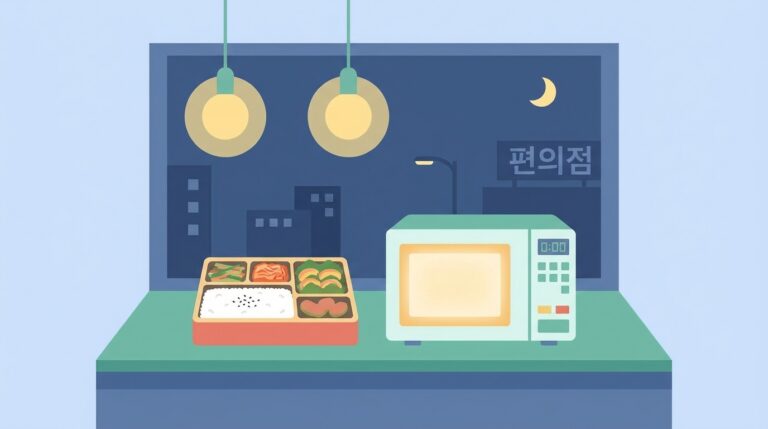
Picture this: It is 11:30 PM in Seoul. You just stepped out of Hongik University Station after walking over 15,000 steps. Your feet are aching, your stomach is rumbling, and the neon sign of a CU convenience store shines like an oasis in the dark. You walk in, greeted by the crisp chime of the door bell and the comforting scent of roasted sweet potatoes.
You spot an incredible dosirak (Korean boxed lunch) loaded with spicy pork bulgogi, stir-fried kimchi, and steamed rice for just 4,900 won. Next to it, an iced coffee pouch has a bright red 1+1 tag. Score!
You pick them up, walk proudly to the register, and place them down. But then, freeze mode sets in. The clerk looks at your cold lunchbox, scans it, and says something fast. You want to ask them to heat it up in the microwave, but you do not know the words. Do they do it behind the counter? Do you do it yourself? Flustered, you just tap your card, grab the cold food, and walk back to your hotel eating chilled rice in defeat.
Take a deep breath—we have all been there! Convenience stores are the beating heart of modern Korean life, and learning just three survival phrases will transform you from an intimidated tourist into an effortless local. Based on feedback from hundreds of our beginner students, this guide will give you the exact words, body language, and cultural secrets you need to conquer any Korean convenience store.
Phase 2: Top 3 Core Expressions
1. 데워 주세요 (Deweoju-seyo)
- Pronunciation: [De-wo-ju-se-yo] (Think: “Day-wah-joo-say-yo”)
- Meaning: Literal: “Please warm up.” | Actual Nuance: “Could you please heat this up for me?”
- K-Culture Moment: Seen in almost every slice-of-life K-drama when exhausted characters grab a late-night bite after a long workday.
- Editor’s Insight: You do not even need to say “microwave” (jeonjare-inji). In Korean, context is everything. Just gently pointing to your lunchbox, burger, or pastry and saying “데워 주세요” makes you sound like a seasoned resident.
- Situation Spectrum: Casual 🚫 | Semi-formal ✅ | Formal ⚠️
- 🤔 Think About It: Notice how Korean sentences often drop words like “it” or “this item” when both speakers are looking right at the object. How does this compare to your native language?
2. 이거 원플러스원이에요? (Igeo won-peulleoseu-won-ieyo?)
- Pronunciation: [I-geo won-peul-leo-seu-won-i-e-yo?] (Think: “Ee-gaw one-plus-one-ee-ay-yo?”)
- Meaning: Literal: “Is this one-plus-one?” | Actual Nuance: “Is this item buy-one-get-one-free?”
- K-Culture Moment: Idol reality shows where trainees raid convenience stores on a strict budget, hunting for promotion tags.
- Editor’s Insight: Koreans refer to “Buy One Get One Free” as “1+1” (won-peulleoseu-won), or in slang, won-peul-won. Crucial rule: You must bring both items to the checkout counter yourself. The cashier will not fetch the free one for you!
- Situation Spectrum: Casual ⚠️ | Semi-formal ✅ | Formal ⚠️
- 🤔 Think About It: Retail slang in Korea frequently adapts English phrases to create snappy commercial terms. Why do you think “1+1” became more popular than traditional Korean number words?
3. 봉투 필요 없어요 (Bongtu piryo eopseoyo)
- Pronunciation: [Bong-tu pi-ryo eop-seo-yo] (Think: “Bong-too pee-ryo up-saw-yo”)
- Meaning: Literal: “Bag not needed.” | Actual Nuance: “I don’t need a plastic bag, thank you.”
- K-Culture Moment: Every Korean citizen declining a disposable bag to avoid the mandatory government surcharge.
- Editor’s Insight: By Korean law, convenience stores cannot give away single-use plastic bags for free (they cost 20 to 100 won). Cashiers will almost always ask: “봉투 필요하세요?” (Do you need a bag?). Answering with “봉투 필요 없어요” saves money and stops awkward guessing games.
- Situation Spectrum: Casual 🚫 | Semi-formal ✅ | Formal ✅
- 🤔 Think About It: Korea has strict recycling and waste management systems. How does daily shopping language reflect a society’s environmental policies?
Phase 3: Textbook Korean vs. Real Korean
Situation 1: Getting your meal heated up
- 📖 교과서 한국어 (Textbook): “이 도시락을 전자레인지에 데워 주시겠습니까?” (I dosirakeul jeonjare-injie deweo jusigesseumnikka? – Would you please warm this lunchbox in the microwave?)
- 🗣️ 진짜 한국어 (Real-life): “이거 데워 주세요.” (Igeo deweoju-seyo. – Please heat this.) or “전자레인지 어디 있어요?” (Jeonjare-inji eodi isseoyo? – Where is the microwave?)
- 💡 왜 다를까? Korean convenience stores move at breakneck speed. Long, stiff grammar formulas cause bottlenecks in line. A concise, polite request using ~주세요 is clean, warm, and natural.
Situation 2: Inquiring about promotional tags
- 📖 교과서 한국어 (Textbook): “이 제품은 하나를 사면 하나를 더 주는 행사 상품입니까?” (I jepumeun hanareul samyeon hanareul deo juneun haengsa sangpumimnikka? – Is this product a promotional item where buying one gives one more?)
- 🗣️ 진짜 한국어 (Real-life): “이거 원플원이에요?” (Igeo won-peul-won-ieyo? – Is this 1+1?)
- 💡 왜 다를까? Locals shorten 원플러스원 down to 원플원 (won-peul-won). It is punchy, friendly, and instantly understood by cashiers across Seoul.
Phase 4: K-Culture Deep Dive & Non-Verbal Manners
4-1. 눈치 (Nunchi) & Gestures
- Two-Handed Courtesy: When handing over your credit card or cash, always hold it with both hands, or support your right wrist/forearm lightly with your left hand. Tossing your payment card onto the counter tray is considered disrespectful.
- The Counter Scan: As soon as you enter, look around the perimeter. In large GS25, CU, or 7-Eleven branches, microwaves are often set up at a customer counter near the window, making them self-service. If you spot rows of microwaves with trash bins below them, you are expected to warm the meal yourself! If there are none in the dining area, hand your food to the clerk at checkout.
4-2. Culture Code: The 24/7 Culinary Sanctuary
Korean convenience stores (pyeon-ui-jeom) are not mere pit stops; they are cultural hubs for honbap (dining solo). Korean convenience store lunchboxes feature premium ingredients and partnerships with Michelin-rated restaurants or culinary giants like chef Baek Jong-won. Grabbing a warm lunchbox and sitting at the window bar looking out at the nighttime city lights is a quintessential K-life experience.
Phase 5: Real-Life Roleplay Scenario
Setting: 11:45 PM at a busy GS25 branch near Sinchon. The clerk, Minho, is working the register with brisk efficiency.
- Minho (Clerk): “어서 오세요! 계산 도와드릴게요.” (Eoseo oseyo! Gyesan dowadeurilgeyo.)
Translation: “Welcome! I can help you check out here.”
🎭 행동 지문: Scans the dosirak with a loud beep! -
You (Learner): “안녕하세요! 이거 원플러스원이에요?” (Annyeonghaseyo! Igeo won-peulleoseu-won-ieyo?)
Translation: “Hello! Is this buy-one-get-one?”
🎭 행동 지문: Pointing to the banana milk bottle with a yellow 1+1 tag. -
Minho: “네, 맞아요. 하나 더 가져오셔야 돼요!” (Ne, majayo. Hana deo gajyeo-osyeoya dwaeyo!)
Translation: “Yes, that is right. You need to grab one more!”
🎭 행동 지문: Holds up two fingers with a smile. -
You: “아, 잠시만요! … 여기요!” (A, jamsimanyo! … Yeogiyo!)
Translation: “Oh, one moment! … Here it is!”
🎭 행동 지문: Quickly jogs to the shelf, grabs the second bottle, and sets it on the counter. -
Minho: “도시락 데워 드릴까요?” (Dosirak deweo deurilkkayo?)
Translation: “Shall I warm up the lunchbox for you?”
🎭 행동 지문: Places his hand on the dosirak lid. -
You: “네, 데워 주세요. 감사합니다!” (Ne, deweoju-seyo. Gamsahamnida!)
Translation: “Yes, please heat it up. Thank you!”
🎭 행동 지문: Gives a slight polite nod. -
Minho: “봉투 필요하세요?” (Bongtu piryohaseyo?)
Translation: “Do you need a plastic bag?”
🎭 행동 지문: Reaches toward the plastic bag rack under the counter. -
You: “아니요, 봉투 필요 없어요. 카드로 할게요.” (Aniyo, bongtu piryo eopseoyo. Kadeuro halkeyo.)
Translation: “No, I don’t need a bag. I’ll pay by card.”
🎭 행동 지문: Offers the credit card using both hands.
🔀 Interactive Decision Point
Suppose the cashier scans your food, slides it back, and says:
“전자레인지는 뒤쪽에서 셀프로 이용하시면 됩니다!” (You can use the microwave yourself in the back!)
- Choice A: Stand still, look confused, and push the lunchbox back to the cashier.
- Choice B: Say “아, 네! 감사합니다!” (Ah, okay! Thank you!), take your meal to the back microwave counter, and press the 1-minute button.
- Choice C: Frown and say loudly: “데워 줘!” (Heat it!).
Feedback:
* Choice A (Bad): Causes an awkward pause while a line builds behind you. Stores with self-serve stations rely on customers heating their own food.
* Choice B (Best): Pure local mastery! You acknowledge the instruction politely and handle your meal independently.
* Choice C (Risk/Disrespectful): Using the informal 데워 줘 without honorifics sounds rude and demanding to a store clerk.
Phase 6: 10-Second Emotion Shadowing Drill
Practice these lines aloud with the emotional cues and natural rhythm pauses marked by /.
[😊 Brightly & Inquiring]
이거 / 원플러스원 / 맞아요?
(Igeo / won-peulleoseu-won / majayo?)
“Is this 1+1, right?”-
[🙋 Polite & Clear]
도시락 / 데워 주세요!
(Dosirak / deweoju-seyo!)
“Please heat up the lunchbox!” -
[👋 Casual & Relaxed]
봉투는 / 괜찮아요!
(Bongtuneun / gwaenchanayo!)
“A bag is totally fine (I don’t need one)!”
Phase 7: K-Culture Mini Dictionary
-
도시락 (Dosirak)
Translation: Packed lunchbox / meal kit
Real-World Usage: Pre-packaged, balanced meals containing rice, main meat dishes, and 4-6 side dishes (banchan). Available 24/7 across Korea. -
원플원 (Won-peul-won)
Translation: Buy 1 Get 1 Free (1+1)
Real-World Usage: The ultimate retail savings slang. You will also frequently spot 2+1 (투플원 / tu-peul-won), meaning buy two, get one free. -
전자레인지 (Jeonjare-inji)
Translation: Microwave oven
Real-World Usage: Most convenience store microwaves run at a powerful 1000W (commercial grade). They heat meals twice as fast as typical household units. -
봉투 (Bongtu)
Translation: Bag (plastic, paper, or biodegradable)
Real-World Usage: Essential vocabulary at any checkout counter in South Korea due to national anti-plastic bag regulations.
Phase 8: Traveler’s Survival Kit
Top 3 Survival Phrases
- 영수증 버려 주세요 (Yeongsujeung beoryeo juseyo)
Pronunciation: [Yeong-su-jeung beo-ryeo ju-se-yo]
Pro Tip: Means “Please throw away the receipt.” Clerks will appreciate not having to hand you paper you do not want. - 카드로 할게요 (Kadeuro halkeyo)
Pronunciation: [Ka-deu-ro hal-ke-yo]
Pro Tip: Means “I will pay by card.” South Korea is virtually cashless; almost all convenience stores prefer card transactions. - 나무젓가락 챙겨도 돼요? (Namujeotgarak chaenggyeodo dwaeyo?)
Pronunciation: [Na-mu-jeot-ga-rak chaeng-gyeo-do dwae-yo?]
Pro Tip: Means “May I take wooden chopsticks?” When heating food yourself, look for the chopstick drawer located under the microwave counter.
Editor’s Travel Note
Before wandering through Seoul’s back alleys at 2 AM, install and set up the Naver Map navigation application to pinpoint nearby 24-hour convenience stores within seconds. Note: Commercial microwaves at Korean marts feature pre-programmed buttons. For a standard dosirak, simply press the button labeled 도시락 or type 1:30 to 2:00 minutes. Remove any raw side-dish plastic inserts (like salad cups or kimchi cups) before hitting start!
Phase 9: Step Deeper (Reflection)
In Korean society, the convenience store represents the intersection of the legendary Ppalli-ppalli (빨리빨리, “hurry-hurry”) mindset and community care. Despite the rapid pace of urban life, convenience store interactions balance speed with profound mutual consideration. Dropping words to say “데워 주세요” is not blunt; it is an efficient social dance where both sides respect each other’s time.
💬 Your Turn: Have you ever stumbled into an international convenience store and felt confused by the checkout process? What is the most exciting item you want to try in a Korean convenience store? Share your stories in the comments below!
Phase 10: FAQ & Avoiding Misunderstandings
Q: Can I heat up my cup ramen in the convenience store microwave?
A: Only if the packaging specifically says 전자레인지용 (For Microwave Use)! Traditional Styrofoam cups will melt and release chemicals. If it is not marked microwave-safe, always use the hot water dispensers (onsugi) provided at the noodle counter.
Q: If an item has a 1+1 tag, can I just take one and pay half price?
A: No. In Korea, “1+1” means you get two items for the price of one. If you only bring one item to the register, you still pay full price for that single item. Always grab both items!
Q: What do I do with my trash after eating at the store counter?
A: Korea strictly enforces trash sorting. Do not dump your leftovers into a single can. Empty excess soup broth into the liquid drain bucket (gukmul beorineun got), place clean plastic containers in the 플라스틱 (Plastic) bin, and toss paper napkins into 일반 쓰레기 (General Waste).
🚨 Common Mistakes Board
- Mistake 1: Leaving the bonus 1+1 product on the shelf expecting the cashier to run and get it.
Correct Action: Bring both matching items to the counter together. - Mistake 2: Microwaving the lunchbox with transparent sauce packets or raw side dishes trapped inside.
Correct Action: Open the lid, remove cold side containers (like pickled radish or sauce cups), place the lid loosely on top, and microwave. - Mistake 3: Saying “데워 줘” (Deweojo) to the clerk.
Correct Action: Always keep the polite ending: 데워 주세요 (Deweoju-seyo).
Phase 11: Action Missions
- 🥉 Bronze Mission (Solo Practice): Stand before a mirror with an item in hand. Practice offering it forward while smoothly saying “이거 데워 주세요” three times without stumbling.
- 🥈 Silver Mission (Social Share): Snap a photo of your favorite Korean snack or drink and post it on your Instagram Story with the caption: “원플러스원 주세요! #DailyHangul”.
- 🥇 Gold Mission (Real-World Application): On your next visit to a Korean mart or Asian supermarket, purchase a ready-to-eat item and handle the entire interaction in Korean using today’s phrases!
- 🎮 K-Culture Mission: Watch an episode of a contemporary Korean drama (such as My Liberation Notes or Extraordinary Attorney Woo) and look for the convenience store scene. Notice whether the characters microwave their food at the register or at the self-serve counter.
Phase 12: Interactive Quiz Challenge
1. Situational Judgment:
You pick up a cold bulgogi burger at a CU convenience store and take it to the checkout counter. What is the most natural, polite sentence to say to the cashier?
(a) 이거 먹어라. (Igeo meogeora.)
(b) 이거 데워 주세요. (Igeo deweoju-seyo.)
(c) 버거를 뜨겁게 조리하여 주실 수 있으십니까? (Beogoreul tteugeopge jorihayeo jusil su isseusimnikka?)
2. Fill in the Blank:
To ask if an item is part of a Buy 1 Get 1 Free deal, you say:
“이거 ______________이에요?”
3. True or False:
In South Korea, single-use plastic bags are provided for free at convenience stores if your purchase exceeds 10,000 won. (True / False)
Click to Reveal Answers and Explanations
- 1. Answer: (b)
Explanation: “이거 데워 주세요” is the standard, natural, and polite way to ask to heat an item. Choice (a) is an impolite command, and choice (c) is unnaturally formal. -
2. Answer: 원플러스원 (or 원플원)
Explanation: “이거 원플러스원이에요?” (Is this 1+1?) is the authentic retail phrase. -
3. Answer: False
Explanation: Under Korean environmental protection laws, disposable plastic bags always cost a small fee (usually 20-100 KRW) regardless of your total bill.
🎬 Watch Our Daily Videos! (Daily Hangul Official Instagram)
Review the expressions you learned in this article with our fun daily short videos! Check out native pronunciation and real-life nuances in action.
- Instagram @dailyhangul_en







