

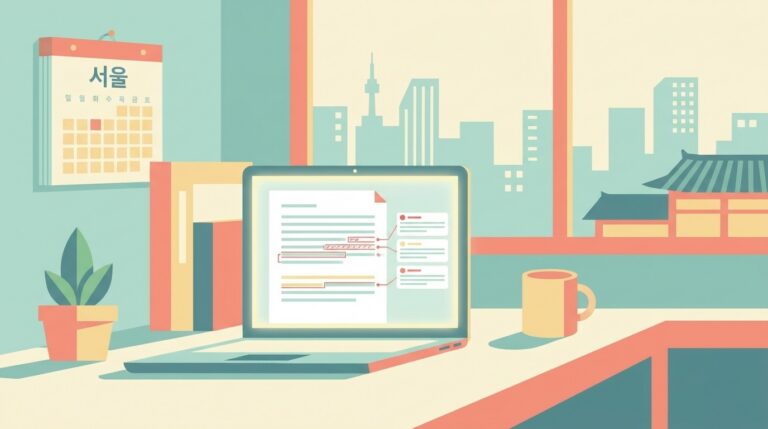
Navigating Korean Business Contracts: How to Request NDA Reviews, Spot Toxic Clauses, and Share Redlines Like a Pro
Phase 1: Empathy (Story-Driven Opening)
안녕하세요! 매일한글 에디터입니다. (Annyeonghaseyo! It is your Daily Hangul editor.)
Picture this: You are sitting in a sleek glass conference room in Teheran-ro, Gangnam. The air smells faintly of roasted Americano and high-stakes negotiation. Your Korean partner firm just sent over an updated joint venture contract. You open the file, and your stomach sinks. There are vague non-disclosure stipulations (비밀유지협약), a steep penalty clause (위약벌), and you have no idea whether your edits from yesterday were incorporated or swept under the rug. In typical K-drama boardrooms—think of the intense executive standoffs in Queen of Tears or Misaeng—a misplaced word or an untracked draft can trigger chaos.
Many intermediate (B2) learners freeze here. How do you respectfully tell a Korean partner that you turned on Word’s ‘Track Changes’ feature and sent back redlined edits without sounding accusatory or distrustful? How do you say “Please double-check this toxic clause” without shattering business etiquette? Based on real-world experiences from our corporate coaching alumni, this guide breaks down the exact terminology, polite workplace buffers, and non-verbal nuances you need to safeguard your interests while keeping business relationships harmonious.
Phase 2: 3 Key Expressions Deep Dive
1. 변경 내용 추적 기능을 켜 두었습니다 (한글)
- Pronunciation: [Byeong-gyeong nae-yong chu-jeok gi-neung-eul kyeo du-eot-seum-ni-da] (Think: Byung-gyung neh-yong choo-juck gee-neung-ul kyo doo-utt-seum-nee-dah)
- Meaning: Literally “I left the Track Changes function turned on,” but contextually: “To maintain complete transparency, all our revisions are visible for your easy comparison.”
- K-Culture Moment: In modern legal dramas like Extraordinary Attorney Woo, lawyers always emphasize clear audit trails. Sending a redline draft with this phrase conveys respect for the other party’s time.
- Editor’s Insight: By framing the action with
~어 두었습니다(completed and maintained for convenience), you present the tracking not as suspicion, but as professional courtesy. - Situation Spectrum: Casual: 🚫 | Semi-formal: ⚠️ | Formal: ✅
- 🤔 Think About It: In English, we often say “See attached redline.” Why does Korean business communication prefer highlighting the mutual convenience (
~해 두었습니다) rather than a direct command?
2. 독소 조항이나 위약벌 규정 확인 부탁드립니다 (한글)
- Pronunciation: [Dok-so jo-hang-i-na wi-yak-beol gyu-jeong hwa-gin bu-tak-deu-rim-ni-da] (Think: Doke-so jo-hang-ee-nah wee-yahk-bull gyoo-jung hwahg-in boo-tahk-deu-rim-nee-dah)
- Meaning: Literally “Please verify toxic clauses or penalty provisions,” contextually meaning: “Let us carefully review and align on high-risk liability and termination terms.”
- K-Culture Moment: Often uttered behind closed doors in business thrillers like Agency before putting signatures on high-stakes advertising contracts.
- Editor’s Insight:
독소 조항(toxic clause) is standard corporate vocabulary, but when addressing external partners, softening the sentence with~확인 부탁드립니다prevents you from sounding confrontational. - Situation Spectrum: Casual: 🚫 | Semi-formal: ⚠️ | Formal: ✅
- 🤔 Think About It: Notice the combination of
독소(poison/toxin) with조항(clause). How does using metaphorical terms like “poison” sharpen analytical vigilance in contracts?
3. 투명하게 수정 이력을 공유하고자 레드라인으로 전달드립니다 (한글)
- Pronunciation: [Tu-myeong-ha-ge su-jeong i-ryeo-geul gong-yu-ha-go-ja re-deu-ra-in-eu-ro jeon-dal-deu-rim-ni-da] (Think: Too-myung-hah-geh soo-jung ee-ryuh-gool gong-yoo-hah-go-jah reh-doo-rah-in-oo-ro jun-dahl-deu-rim-nee-dah)
- Meaning: Literally “In order to transparently share revision history, I am forwarding this as a redline draft.”
- K-Culture Moment: Used in multinational joint ventures where mutual trust is being established between Korean conglomerates and international partners.
- Editor’s Insight:
~하고자is an elegant B2/C1 connecting suffix that clearly states positive intent (transparency) before specifying the action. - Situation Spectrum: Casual: 🚫 | Semi-formal: ⚠️ | Formal: ✅
- 🤔 Think About It: Why is establishing
투명성(transparency) explicitly mentioned in Korean business emails rather than simply assumed?
Phase 3: 교과서 한국어 vs 진짜 한국어
Situation 1: Informing your counterpart about file modifications
- 📖 교과서 한국어: 계약서를 고쳤으니 파일을 보십시오. (Gye-yak-seo-reul go-chyeot-seu-ni pa-i-reul bo-sip-si-o. / I altered the contract, so please look at the file.)
- 🗣️ 진짜 한국어: 수정 이력을 확인하실 수 있도록 워드 변경 내용 추적을 켜서 회신드렸습니다. (Su-jeong i-ryeo-geul hwa-gin-ha-sil su it-do-rok wo-deu byeong-gyeong nae-yong chu-jeo-geul kyeo-seo hoe-sin-deu-ryeot-seum-ni-da. / I have replied with Track Changes turned on in Word so you can review the revision history.)
- 💡 왜 다를까? Textbook imperatives like
보십시오sound harsh and detached. Real Korean business communication uses considerate causal connectors (~하실 수 있도록) and professional vocabulary (회신드렸습니다).
Situation 2: Raising concerns about an excessive penalty clause
- 📖 교과서 한국어: 위약금이 너무 많아서 계약을 못 합니다. (Wi-yak-geu-mi neo-mu ma-na-seo gye-ya-geul mot ham-ni-da. / The penalty is too high, so we cannot sign.)
- 🗣️ 진짜 한국어: 해당 위약벌 조항은 다소 부담스러운 측면이 있어 문구 조율을 제안드리고자 합니다. (Hae-dang wi-yak-beol jo-hang-eun da-so bu-dam-seu-ro-un cheuk-myeon-i it-seo mun-gu jo-yu-reul je-an-deu-ri-go-ja ham-ni-da. / That penalty clause presents a somewhat burdensome aspect, so we would like to propose fine-tuning the wording.)
- 💡 왜 다를까? Instead of flatly refusing (
못 합니다), corporate Korean employs buffering expressions like다소 부담스러운 측면(somewhat burdensome aspect) and collaborative verbs like조율하다(to tune/coordinate).
Phase 4: K-Culture 딥다이브 & 비언어적 매너
4-1. 눈치 (Nunchi) & Corporate Manners
In Korea, redlining a document is fundamentally an exercise in Nunchi (tactful situational awareness). When you return a document covered in red strikes, you risk making the drafter feel publicly criticized.
* The Email Buffer: Never send a redline file without a warm opening greeting (환절기에 건강 유의하시기 바랍니다) and an appreciative acknowledgment of their draft (초안 검토 기회를 주셔서 감사합니다).
* Delivery Tone: In meetings, do not point your finger directly at an offending clause. Instead, lay the open laptop or printed document between both parties and use an open palm to indicate the section: “이 조항의 취지를 조금 더 여쭙고 싶습니다” (I would like to ask a bit more regarding the intent of this clause).
4-2. Cultural Code: The Art of Contract Negotiation in K-Drama
In shows like Misaeng, contract review is not just legal clerical work—it is corporate chess. Korean business culture traditionally valued relationship-driven trust (신뢰), but modern legal compliance has transformed corporate life into meticulous paper trails. Using ‘Track Changes’ (변경 내용 추적) is no longer seen as petty; it is respected as the hallmark of an organized, trustworthy counterparty.
Phase 5: 실전 롤플레이 시나리오
Setting: A modern conference room at Pangyo Techno Valley. You are negotiating an overseas distribution agreement with Team Lead Min-woo Kang (강민우 팀장).
- Turn 1 (강 팀장): 보내주신 비밀유지협약(NDA) 초안 잘 받았습니다. 바로 날인해서 진행할까요? (Bo-nae-ju-sin bi-mil-yu-ji-hyeop-yak cho-an jal ba-dat-seum-ni-da. Ba-ro nal-in-hae-seo jin-haeng-hal-kka-yo? / We received the draft NDA you sent. Shall we stamp our seal and proceed right away?)
- Turn 2 (You): 🎭 Politely adjusting posture and opening laptop 강 팀장님, 신속한 피드백 감사드립니다. 다만 서명 전에 몇 가지 확인 부탁드릴 조항이 있습니다. (Gang tim-jang-nim, sin-sok-han pi-deu-baek gam-sa-deu-rim-ni-da. Da-man seo-myeong jeon-e myeot ga-ji hwa-gin bu-tak-deu-ril jo-hang-i it-seum-ni-da. / Team Lead Kang, thank you for the prompt feedback. However, before signing, there are a few provisions we would like to ask you to verify.)
- Turn 3 (강 팀장): 아, 그렇습니까? 혹시 어떤 부분에 수정 의견이 있으신가요? (A, geu-reot-seum-ni-kka? Hok-si eo-tteon bu-bun-e su-jeong ui-gyeon-i it-seu-sin-ga-yo? / Ah, is that so? Which parts do you have revision comments on?)
- Turn 4 (You): 🎭 Screening the track changes draft 5조 비밀정보 유지 기간과 8조 위약벌 항목이 다소 엄격하게 규정되어 있어 조율안을 준비했습니다. (O-jo bi-mil-jeong-bo yu-ji gi-gan-gwa pal-jo wi-yak-beol hang-mogi da-so eom-gyeok-ha-ge gyu-jeong-doe-eo it-seo jo-yul-an-eul jun-bi-haet-seum-ni-da. / Article 5 on the NDA duration and Article 8 regarding penalties are framed somewhat strictly, so we prepared an adjusted proposal.)
- Turn 5 (강 팀장): 위약벌 조항은 저희 본사 표준 양식이라 쉽게 바꾸기는 어려울 텐데요. (Wi-yak-beol jo-hang-eun jeo-hui bon-sa pyo-jun yang-sik-i-ra swip-ge ba-kku-gi-neun eo-ryeo-ul ten-de-yo. / The penalty clause follows our HQ standard template, so it won’t be easy to alter.)
- Turn 6 (You): 🎭 Maintaining calm and professional eye contact 네, 이해합니다. 그래서 수정 이력이 투명하게 남도록 워드 파일의 ‘변경 내용 추적’을 켜고 레드라인으로 수정안을 반영해 두었습니다. (Ne, i-hae-ham-ni-da. Geu-rae-seo su-jeong i-ryeog-i tu-myeong-ha-ge nam-do-rok wo-deu pa-i-ri byeong-gyeong nae-yong chu-jeog-eul kyeo-go re-deu-ra-in-eu-ro su-jeong-an-eul ban-yeong-hae du-eot-seum-ni-da. / Yes, I understand. Therefore, to keep the revision history transparent, we turned on Track Changes in Word and reflected our amendments via redline.)
- Turn 7 (강 팀장): 🎭 Nodding thoughtfully while reviewing the screen 아, 변경 내용 추적이 켜져 있군요. 수정 취지가 한눈에 보여서 내부 법무팀과 상의하기 훨씬 수월하겠네요. (A, byeong-gyeong nae-yong chu-jeog-i kyeo-jyeo it-gun-yo. Su-jeong chwi-ji-ga han-nun-e bo-yeo-seo nae-bu beop-mu-tim-gwa sang-ui-ha-gi hwol-ssin su-wol-ha-gen-ne-yo. / Ah, Track Changes is on. The intent of your revisions is visible at a glance, making it much easier to discuss with our in-house legal team.)
- Turn 8 (You): 🎭 Offering a respectful slight bow 확인해 주셔서 감사합니다. 검토 후 의견 주시면 원만하게 합의점을 찾길 기대합니다. (Hwa-gin-hae ju-syeo-seo gam-sa-ham-ni-da. Geom-to hu ui-gyeon ju-si-myeon won-man-ha-ge hap-ui-jeom-eul chat-gil gi-dae-ham-ni-da. / Thank you for checking. After your review, we look forward to reaching an amicable consensus.)
🔀 인터랙티브 분기점 (Choose Your Action)
When Team Lead Kang says the penalty clause cannot easily change (Turn 5), how do you respond?
* Option A: “이 조항 안 빼주시면 계약 못 합니다. 법무팀에 그냥 빼달라고 하세요.” (If you don’t remove this, we can’t sign. Just tell legal to cut it.)
* Feedback (Bad): High risk. Confrontational language breaks corporate harmony and creates defensive resistance.
* Option B: “표준 양식이라도 저희 회사 입장에서는 독소 조항이 될 수 있어, 투명하게 변경 내용 추적을 켜고 레드라인으로 절충안을 남겼습니다.” (Even if standard, it can be a toxic clause from our perspective, so we turned on Track Changes and left a compromise draft in redlines.)
* Feedback (Best): Direct, polite, assertive, and points straight to constructive redline solutions.
* Option C: “네, 그럼 본사 표준 양식대로 위약벌 조항은 그대로 두겠습니다.” (Okay, we will just leave the penalty clause as-is per your template.)
* Feedback (Risk): Avoids friction but leaves your organization legally vulnerable to heavy financial penalties.
Phase 6: 10초 감정 섀도잉 드릴
Practice these lines out loud with appropriate business cadence and pauses (/).
[💼 침착하고 명확하게]
투명한 검토를 위해 / 워드의 변경 내용 추적 기능을 / 켜 두었습니다.
(Tu-myeong-han geom-to-reul wi-hae / wo-deu-ui byeong-gyeong nae-yong chu-jeok gi-neung-eul / kyeo du-eot-seum-ni-da.)
“For transparent review, / Word’s Track Changes feature / has been turned on.”-
[🤝 정중하지만 단호하게]
독소 조항 방지를 위해 / 위약벌 규정의 세부 문구를 / 함께 조율하고 싶습니다.
(Dok-so jo-hang bang-ji-reul wi-hae / wi-yak-beol gyu-jeong-ui se-bu mun-gu-reul / ham-kke jo-yul-ha-go sip-seum-ni-da.)
“To avoid toxic terms, / the specific wording of the penalty clause / is something we wish to coordinate together.” -
[😊 신뢰감을 주며 산뜻하게]
수정안을 레드라인으로 정리해 두었으니 / 편하게 검토 후 / 피드백 부탁드립니다.
(Su-jeong-an-eul re-deu-ra-in-eu-ro jeong-ni-hae du-eot-seu-ni / pyeon-ha-ge geom-to hu / pi-deu-baek bu-tak-deu-rim-ni-da.)
“We arranged the revisions in redline, / so please review at your convenience / and share your feedback.”
Phase 7: K-Culture 미니 사전
- 독소 조항 (Dok-so Jo-hang) | Toxic clause / Poison pill provision | Contractual clauses that impose disproportionately one-sided burdens, heavy liabilities, or unilateral cancellation rights.
- 위약벌 (Wi-yak-beol) | Punitive penalty for breach | Distinct from simple liquidated damages (
손해배상액의 예정), wiyakbeol acts as an outright private punishment where courts rarely intervene to reduce the amount. Clarifying this clause is critical in Korean commercial contracts. - 비밀유지협약 / NDA (Bi-mil-yu-ji-hyeop-yak) | Non-Disclosure Agreement | Essential standard agreement signed prior to sharing proprietary tech, trade secrets, or client data.
- 수정 이력 (Su-jeong I-ryeok) | Revision history / Audit trail | The cumulative chronological log of edits made to official documents.
Phase 8: 여행자를 위한 생존 키트 (Expat & Business Traveler Survival Kit)
서바이벌 표현 TOP 3
- “워드 파일로 주실 수 있나요?” (Wo-deu pa-i-ro ju-sil su it-na-yo?)
- Pro Tip: Many Korean firms default to sending
.hwpx(Hangul Word Processor) or locked PDFs. Ask for.docxearly so you can use Track Changes.
- Pro Tip: Many Korean firms default to sending
- “이 부분은 본사 법무팀 확인이 필요합니다.” (I bu-bun-eun bon-sa beop-mu-tim hwa-gin-i pil-yo-ham-ni-da.)
- Pro Tip: A polite, face-saving buffer phrase whenever an aggressive clause is pushed on you at the table.
- “레드라인 표시된 최신본으로 확인 부탁드립니다.” (Re-deu-ra-in pyo-si-doen choe-sin-bon-eu-ro hwa-gin bu-tak-deu-rim-ni-da.)
- Pro Tip: Prevents version control mishaps when multiple colleagues are emailing drafts back and forth.
Editor’s Travel & Workflow Note
- When managing Korean contracts, utilize platforms like Modusign Electronic Contract Solution for cloud authentication.
- Download the official document viewer by checking the Hancom Office Viewer Portal if local partners share Hancom
.hwpfiles.
Phase 9: “한 발 더 깊이” (생각 질문)
In traditional Korean commercial interactions, business partners prioritized Jeong (정, emotional connection) and assumed that mutual benevolence would solve future disputes. However, contemporary Korea’s ultra-competitive corporate ecosystem demands meticulous legal safeguards. Today, insisting on reviewing 독소 조항 (toxic provisions) and exchanging redline revisions is no longer perceived as distrust; it demonstrates that you treat the partnership with genuine legal accountability and respect.
💬 Your Turn: Have you ever experienced a negotiation where asking for contractual changes felt culturally awkward? How do professionals in your home country introduce redlines without sounding confrontational? Share your thoughts below!
Phase 10: FAQ & 오해 방지
Q: Is asking to change a Korean corporate standard contract template considered offensive?
A: Not if framed properly. Korean firms expect negotiations, especially on international accounts. Avoid blunt statements like “이 조항은 틀렸습니다” (This clause is wrong). Instead, frame edits around mutual benefit: “상호 리스크 최소화를 위해 조항 일부를 조율하고자 합니다” (We wish to tune some clauses to minimize mutual risks).
Q: What is the difference between 위약금 (Wiyakgeum) and 위약벌 (Wiyakbeol)?
A: Wiyakgeum is typically presumed to be liquidated damages; if it is excessively high, Korean courts can exercise judicial discretion to lower it. Wiyakbeol, however, is a punitive penalty on top of actual damages. Korean courts rarely reduce wiyakbeol, making redlining this term paramount.
Q: Why do Koreans use the English loanword ‘레드라인’ (Redline) instead of a purely Korean word?
A: While ‘수정본’ (revised draft) or ‘변경 내용 추적본’ are used, ‘레드라인’ has become universal among tech startups, legal departments, and corporate teams because it instantly communicates marked-up revisions.
🚨 흔한 실수 (Common Mistakes) 경고판
- Sending a clean copy without tracking: Sending an amended file with changes silently baked in causes significant mistrust. Always leave Track Changes visible.
- Confusing 손해배상 (Damages) with 위약벌 (Penalties): Agreeing to uncapped punitive penalties without negotiation can expose your team to severe liabilities.
- Demanding revisions in Korean with informal low-respect verbs: Using words like
고쳐라or바꿔주세요instead of수정 요청드립니다or조율을 제안드립니다sounds disrespectful in professional contexts.
Phase 11: 액션 미션 & 참여 유도
- Bronze Mission (Self Practice): Open an MS Word document in Korean, turn on 변경 내용 추적 (Track Changes), and type: “제10조 위약벌 조항 수정안을 제안합니다.” (Proposing amendment to Article 10 Penalty Provision).
- Silver Mission (Social Sharing): Share this guide with a study partner and record yourself reading the Phase 6 Shadowing drill with clear corporate intonation.
- Gold Mission (Real Application): In your next Korean business email or simulated roleplay, send an attachment using the phrase: “투명한 검토를 위해 변경 내용 추적을 켜 두었습니다.”
- 🎮 K-Culture Mission: Watch an episode of a Korean legal/corporate drama (Misaeng, Hyena, or Suits Korea) and identify when lawyers or executives discuss 계약서 (contract), 조항 (clause), or 합의 (agreement)!
Phase 12: 인터랙티브 퀴즈 챌린지
1. Situation Judgment: You found an unreasonable clause that forces your company to pay heavy damages without arbitration. What is the most professional email line?
– A: 계약서가 너무 나빠서 수정해야 합니다.
– B: 독소 조항 및 위약벌 관련하여 문구 조율을 제안드리고자 레드라인 버전을 전달드립니다.
– C: 이 조항은 불법이니 당장 지워주십시오.
2. Fill-in-the-Blank:
투명한 수정 이력 확인을 위해 워드의 ‘_______ 내용 추적’ 기능을 켜 두었습니다.
3. True or False:
In Korean law, courts easily and automatically lower ‘위약벌’ (punitive penalty) amounts if you complain after signing. (True / False)
👉 정답 및 해설 확인하기 (Click to reveal answers)
- 정답: B
- 해설: Option B maintains high professionalism, uses accurate legal terms (독소 조항, 위약벌, 문구 조율), and politely notes the attached redline.
- 정답: 변경 (Byeong-gyeong)
- 해설: The full feature name in Korean MS Word is ‘변경 내용 추적’ (Track Changes).
- 정답: False
- 해설: Unlike standard liquidated damages (손해배상액의 예정), Korean judicial precedent holds that ‘위약벌’ is a private penalty, and courts are extremely reluctant to reduce it. You must catch and adjust it before signing!
- 해설: Unlike standard liquidated damages (손해배상액의 예정), Korean judicial precedent holds that ‘위약벌’ is a private penalty, and courts are extremely reluctant to reduce it. You must catch and adjust it before signing!
🎬 Watch Our Daily Videos! (Daily Hangul Official Instagram)
Review the expressions you learned in this article with our fun daily short videos! Check out native pronunciation and real-life nuances in action.
- Instagram @dailyhangul_en







