

Phase 1: Empathy & Story Opening
안녕하세요! 매일한글 에디터입니다. (Hello! I’m your Daily Hangul editor.)
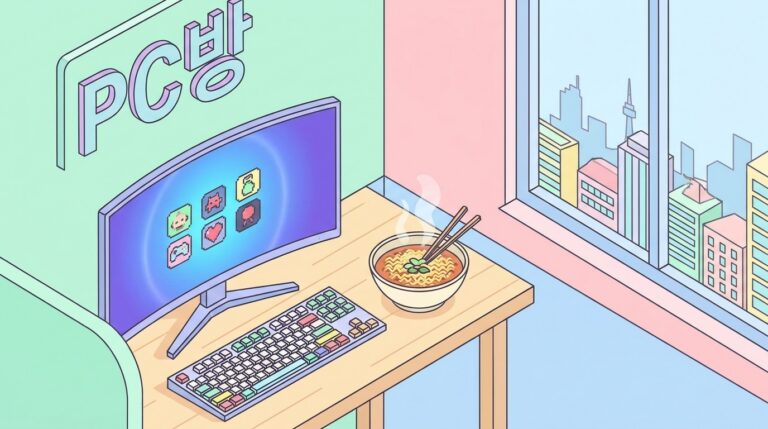
Picture this: You step down the stairs into a bustling Seoul basement, greeted by the cool rush of air conditioning, the rhythmic clack-clack of mechanical gaming keyboards, and the mouthwatering aroma of freshly cooked Shin Ramyeon and hot dogs. You’ve finally arrived at an authentic Korean PC Bang (피씨방)! Whether you want to play League of Legends with Korean ping, watch your favorite K-pop music videos on a massive curved monitor, or simply catch up on K-dramas with a giant iced Americano, you head toward the glowing counter.
Then suddenly—freeze. A giant touchscreen kiosk blocks your path. Flashing options like ‘회원 충전’ (Member recharge) and ‘비회원 충전’ (Non-member recharge) appear, demanding phone numbers you don’t have and Korean words you’ve never heard. Panic sets in: Can I even use a computer here without a Korean ID? Will the staff be annoyed if I ask?
Take a deep breath! You are definitely not alone. Over the past ten years coaching absolute beginners, the “PC Bang Kiosk Panic” is one of the top three real-world hurdles our travelers face. Today, we will conquer this together. With just three ultra-simple, beginner-friendly Korean phrases, you’ll walk in, load up your gaming hours like a seasoned local, and order snacks straight to your seat. Let’s jump in!
Phase 2: Key Expressions Analysis (Top 3)
1. 시간 충전해 주세요 (Sigan chungjeon-hae juseyo)
- Pronunciation: [See-gahn choong-jeon hae joo-say-yo] (Think of ‘see-gone’ + ‘choong’ like ‘choose’ with an ‘-ng’ ending + ‘jun’ like June)
- Meaning: Literal: “Please recharge time.” vs Real Nuance: “I’d like to buy hours for the computer, please.”
- K-Culture Moment: Just like your favorite Korean esports pros stocking up on gaming hours before an all-night rank grind, this is the master phrase that unlocks your seat.
- Editor’s Insight: In Korean, you don’t ‘buy’ time (사다); you ‘recharge’ (충전) it—just like charging a smartphone battery or a T-money transit card.
- Situation Spectrum:
- Casual (Friends): ⚠️ (시간 충전해 줘)
- Semi-formal (Kiosk/Counter): ✅ (시간 충전해 주세요)
- Formal: ✅ (시간 충전 부탁드립니다)
- 🤔 Think About It: In English, we say “buy time” or “pay for hours.” Why do you think Korean conceptualizes digital time as something you charge (충전) into a battery rather than just purchase?
2. 비회원으로 할게요 (Bi-hoe-won-eu-ro hal-ge-yo)
- Pronunciation: [Bee-hway-won-oo-ro hal-gay-yo] (Sounds like ‘bee’ + ‘way’ + ‘one’ + ‘oo-ro’ + ‘hal-gay-yo’)
- Meaning: Literal: “I will do as a non-member.” vs Real Nuance: “I’ll use a guest pass / I don’t have an account.”
- K-Culture Moment: Seen in college K-dramas when students drop by a random PC bang near campus and skip the tedious member registration.
- Editor’s Insight: Most Korean websites and kiosks require a Korean domestic phone carrier for identity verification (본인인증). Saying this phrase instantly saves you 15 minutes of confusion by switching you straight to guest mode!
- Situation Spectrum:
- Casual: ⚠️
- Semi-formal: ✅
- Formal: ✅
- 🤔 Think About It: Many systems in Korea cater to tight-knit member communities. Using the guest option is a smart hack for international travelers to bypass national ID hurdles.
3. 몇 번 자리예요? (Myeot beon jari-yeyo?)
- Pronunciation: [Myut bun jah-ree-yay-yo] (Think ‘mutt’ with a ‘y’ sound: ‘myut’ + ‘bun’ + ‘jah-ree-yay-yo’)
- Meaning: Literal: “Which number seat is it?” vs Real Nuance: “Where should I sit? / What’s my computer number?”
- K-Culture Moment: When you pay at the kiosk or counter and receive a slip of paper, looking around at 150 glowing monitors trying to locate your station.
- Editor’s Insight: Myeot beon (몇 번) means ‘which number,’ and jari (자리) means ‘seat.’ You can use jari everywhere—in cafes, subways, and restaurants!
- Situation Spectrum:
- Casual: ⚠️
- Semi-formal: ✅
- Formal: ✅
- 🤔 Think About It: Notice how polite Korean questions often end in ‘-yeyo’ (예요). It creates an instant friendly cushion between you and the busy staff.
Phase 3: Textbook Korean vs Real Korean
Situation 1: Telling the staff you want to pay for PC usage
- 📖 교과서 한국어 (Textbook): 컴퓨터 사용 시간을 결제하고 싶습니다. (Kompyuteo sayong siganeul gyeolje-hago sipseumnida. / “I wish to pay for computer usage time.”)
- 🗣️ 진짜 한국어 (Real-life): 시간 충전할게요! (Sigan chungjeon-halgeyo! / “I’ll charge some time!”)
- 💡 왜 다를까? (Why is it different?): Textbook phrasing is stiff and sounds like an official corporate contract. Real Koreans keep it snappy using the verb 충전하다 (to recharge).
Situation 2: Asking if you can play without an account
- 📖 교과서 한국어 (Textbook): 회원 가입을 하지 않고 이용할 수 있습니까? (Hoewon gaeibeul haji anko iyonghal su osseumnikka? / “Is it possible to utilize the service without registering for membership?”)
- 🗣️ 진짜 한국어 (Real-life): 비회원도 돼요? (Bi-hoewon-do dwaeyo? / “Does non-member work too?”)
- 💡 왜 다를까? (Why is it different?): The magic pattern
[Noun] + 도 돼요?(Does [Noun] work / Is [Noun] okay?) is the ultimate real-life shortcut across all retail shops in Korea.
Phase 4: K-Culture Deep Dive & Non-Verbal Manners
4-1. 눈치 (Nunchi) & Polite Gestures
- Two-Hand Card Handoff: If paying at the counter rather than the automated kiosk, always present your credit card using both hands (or your right hand supported under the elbow by your left hand). This shows warm respect.
- Headset Decibel Check: PC bangs are lively, but people don’t yell across the room. Keep your voice at a moderate volume and use your headset’s mic. If you need to answer a phone call, step out to the hallway or keep it under 30 seconds.
- Monitor Boundary: Korean gamers value their screen privacy. Avoid standing directly behind someone’s chair to stare at their gameplay unless you are with a close friend.
4-2. Cultural Code: The PC Bang Gourmet Experience
Did you know modern Korean PC bangs are practically five-star casual diners? Back in the 2000s, PC bangs offered just instant cup noodles and canned sodas. Today, competitive culinary battles rage among PC bang chains! You can sit in an ergonomic leather gaming chair, open the desktop software, and order Kimchi Fried Rice with a runny fried egg, Tteokbokki, grilled pork belly sausages (Sotteok Sotteok), and 1-liter iced teas delivered right to your keyboard. Loading time (시간 충전) is simply your golden ticket to the ultimate comfort sanctuary.
Phase 5: Real-World Roleplay Scenario
Setting: A vibrant, neon-accented PC bang near Sinchon Station. The air smells like sweet iced tea and savory ramen.
Characters:
* Alex: A beginner-level traveler visiting a Korean PC bang for the first time.
* 민수 (Minsu): A friendly young PC bang staff member wearing a gaming headset around his neck.
- Turn 1 (Alex): 저기요, 비회원 카드 있어요? (Jeogiyo, bi-hoe-won kadeu isseoyo?)
“Excuse me, do you have a non-member card?”
🎭 Looking around hesitantly while pointing toward the kiosk. -
Turn 2 (민수): 네! 키오스크에서 ‘비회원 충전’ 누르시면 돼요. (Ne! Ki-o-seu-keu-eseo ‘bi-hoe-won chungjeon’ nureusimyeon dwaeyo.)
“Yes! You can just press ‘Non-member recharge’ on the kiosk.”
🎭 Pointing politely toward the brightly glowing touchscreen terminal. -
Turn 3 (Alex): 아, 키오스크요! 시간 충전 어떻게 해요? (A, ki-o-seu-keu-yo! Sigan chungjeon eotteoke haeyo?)
“Ah, the kiosk! How do I recharge time?”
🎭 Approaching the screen and squinting at the buttons. -
Turn 4 (민수): 화면에서 시간 누르고 결제하시면 영수증 나와요. (Hwamyeon-eseo sigan nureugo gyeolje-hasimyeon yeongsujeung nawayo.)
“Tap your desired hours on screen, pay, and your receipt will print.”
🎭 Stepping over to tap the English language toggle in the corner. -
Turn 5 (Alex): 두 시간 충전할게요. 해외 카드 돼요? (Du sigan chungjeon-halgeyo. Hae-oe kadeu dwaeyo?)
“I’ll charge two hours. Do overseas credit cards work?”
🎭 Showing an international Visa card with both hands. -
Turn 6 (민수): 네, 여기에 카드 꽂아 주세요. (Ne, yeogie kadeu kkoja juseyo.)
“Yes, please insert your card right here.”
🎭 Tapping the blinking IC chip slot. -
Turn 7 (Alex): 영수증 나왔어요! 몇 번 자리예요? (Yeongsujeung nawasseoyo! Myeot beon jari-yeyo?)
“The receipt came out! Which seat number is it?”
🎭 Holding up the printed paper containing a 6-digit guest login code. -
Turn 8 (민수): 빈자리 아무 데나 앉아서 영수증 번호 입력하세요. 즐겜하세요! (Binjari amu de-na anjaseo yeongsujeung beonho ipryeok-haseyo. Jeul-gem-haseyo!)
“You can sit at any empty seat and type in that receipt number. Have a fun game!”
🎭 Giving a friendly thumbs-up and smiling.
🔀 Interactive Decision Branch
You just printed your non-member receipt slip with your login digits, but all the seats look identical. What do you do?
- Choice A (Best): Look for an empty PC with a monitor showing the login box, sit down, and type the number printed on your receipt. If stuck, ask: “저기요, 로그인 도와주세요!” (Jeogiyo, rogeu-in dowajuseyo! / “Excuse me, please help me log in!”).
Feedback: Perfect! Non-member cards let you pick any unoccupied seat. - Choice B (Bad): Walk up to a computer where a jacket is resting on the chair, sit down, and try to press the power button.
Feedback: Watch out! A jacket or drink cup on a seat means another customer stepped away to the restroom or snack counter. - Choice C (Risk): Leave the printed slip behind on top of the kiosk and wander off hoping the screen automatically recognizes you.
Feedback: Risky! Without your printed non-member number, your purchased hours can be claimed by someone else!
Phase 6: 10-Second Emotion Shadowing Drill
Practice these three lines aloud with rhythm, breathing at the / marks:
[😊 밝고 당당하게 - Cheerful & Confident]
저기요, / 비회원 시간 / 충전할게요!
(Jeogiyo, / bi-hoe-won sigan / chungjeon-halgeyo!)
“Excuse me, I’d like to load non-member time!”-
[🤔 호기심 가득하게 - Curious & Inquiring]
몇 번 / 자리로 / 가면 돼요?
(Myeot beon / jari-ro / gamyeon dwaeyo?)
“Which seat number should I go to?” -
[😋 설레는 마음으로 - Excited & Hungry]
라면도 / 자리에서 / 주문돼요?
(Ramyeon-do / jari-eseo / jumun-dwaeyo?)
“Can I order ramen from my seat too?”
Phase 7: K-Culture Mini Dictionary
-
충전 (Chungjeon)
Meaning: Recharging / Topping up.
Usage: Used universally in Korea for recharging your transit card (교통카드 충전), smartphone battery (배터리 충전), and PC bang time (시간 충전). -
비회원 (Bi-hoe-won)
Meaning: Non-member / Guest.
Usage: Look for this exact word on any ticket machine or restaurant order kiosk to skip the resident ID registration screen. -
먹거리 (Meokgeori)
Meaning: Food, snacks, and refreshments.
Usage: In the top right corner of your PC bang computer desktop, click the tab labeled ‘먹거리 주문’ to open the instant digital restaurant menu. -
즐겜 (Jeul-gem)
Meaning: “Have fun gaming!” (Short for 즐거운 게임).
Usage: Slang swapped between gamers or said cheerfully by staff when your session starts.
Phase 8: Traveler’s Survival Kit
Top 3 Survival Expressions
- 카드 돼요? (Kadeu dwaeyo?)
Pronunciation: [Kah-deu dway-yo?]
Pro Tip: Use this anytime you aren’t sure if your foreign credit card will be accepted at the kiosk. - 한국 번호 없어요. (Hanguk beonho eopseoyo.)
Pronunciation: [Hahn-gook bun-ho up-say-yo]
Pro Tip: Tell the clerk this if a system asks for SMS phone verification. - 도와주세요. (Dowajuseyo.)
Pronunciation: [Doh-wah-joo-say-yo]
Pro Tip: The universal emergency phrase meaning “Please help me.” Staff will gladly step over to your screen.
Editor’s Travel Note
- Finding Top-Rated PC Bangs: Don’t rely on global maps, which frequently miss underground gaming cafes. Check 네이버 지도 앱 다운로드 (Naver Map app download) and search “PC방” to see real customer reviews, photos of high-end graphics cards, and snack menus.
- Payment Tip: Nearly 95% of modern kiosks take international chip cards. Always insert your card chip facing upward into the slot below the screen.
Phase 9: A Step Deeper (한 발 더 깊이)
In Korean society, the word 충전 (Chungjeon – recharge) holds a special cultural weight. It represents more than simply transferring money into a machine; it symbolizes restoring your energy after a exhausting day of studying or working in Korea’s fast-paced Pali-Pali (빨리빨리 – hurry, hurry) culture. When Koreans say “나 오늘 PC방에서 충전 좀 하고 올게” (I’m going to recharge at the PC bang today), they mean they are replenishing their spirit with good food, gaming camaraderie, and cozy digital comfort.
💬 Your Turn: Does your home country have modern internet cafes or gaming lounges, or do most people game strictly at home? What snack would you order first at a Korean PC bang? Share in the comments below!
Phase 10: FAQ & Common Mistakes
Q: Can foreign tourists use Korean PC bangs without an Alien Registration Card (ARC)?
A: Yes, absolutely! Always select the ‘비회원’ (Non-member) button on the kiosk. You do not need an ARC or a Korean phone number to purchase non-member hourly time.
Q: What happens if my purchased hours run out while playing?
A: About 10 minutes before your time expires, a reminder box pops up on your screen. You can easily add more hours either by clicking the recharge button on your desktop or by returning to the kiosk with your slip.
Q: How do I pay for the food I order from my desktop computer?
A: When you order food via the PC launcher, you will see payment options: cash at delivery, credit card at your seat (the staff will bring a wireless card terminal right to your desk!), or prepaid balance.
🚨 Common Mistakes Alert
- Trying to create an account at the kiosk: Foreign phone numbers won’t receive the SMS OTP code. Correct Action: Always press ‘비회원 충전’ (Non-member recharge).
- Throwing away the printed paper receipt: The receipt has your temporary login ID and password. Correct Action: Keep the slip beside your mouse pad or snap a photo with your smartphone immediately.
- Leaving without logging off: If you have leftover time on a guest card, some systems hold your session active for a few minutes. Correct Action: Click the red ‘사용 종료’ (End Usage / Log Out) button on your desktop when finished.
Phase 11: Action Missions
- 🥉 Bronze Mission (Solo Practice): Say aloud three times: “비회원 두 시간 충전해 주세요!” (Non-member 2 hours recharge, please!).
- 🥈 Silver Mission (Social Media): Take a screenshot of our Mini Dictionary and save it to your travel folder, or share this guide with your travel buddy who loves gaming.
- 🥇 Gold Mission (Real World): Walk into a PC bang in Korea, find the kiosk, press ‘비회원’, charge 1 hour, and log into a PC!
- 🎮 K-Culture Mission: Watch an episode of a modern youth K-drama (like Twenty-Five Twenty-One or Racket Boys) and spot how the characters interact inside an internet cafe or arcade.
Phase 12: Interactive Quiz Challenge
Test your PC bang survival skills! Click the toggles below to verify your answers.
1. Situation Judgment: You walk into a PC bang and don’t have a Korean SIM card. Which button should you press on the touchscreen?
* A) 회원 가입 (Member sign-up)
* B) 비회원 충전 (Non-member recharge)
* C) 관리자 호출 (Call manager)
👉 Click to see the answer & explanation!
Correct Answer: B) 비회원 충전 (Non-member recharge)
Explanation: Member registration requires a domestic Korean phone verification number. Choosing 비회원 (Non-member) allows you to pay instantly with your credit card or cash without signing up!
2. Fill in the blank: Complete the sentence to order 2 hours of time:
“두 시간 ________해 주세요.” (Please recharge two hours.)
👉 Click to see the answer & explanation!
Correct Answer: 충전 (Chungjeon)
Explanation: 시간 충전해 주세요 (Sigan chungjeon-hae juseyo) means “Please recharge time.”
3. True or False: In Korea, you must walk up to the kitchen counter every time you want to order ramen or drinks at a PC bang.
👉 Click to see the answer & explanation!
Correct Answer: False (거짓)
Explanation: You can order delicious meals, snacks, and iced beverages directly from your seat monitor via the desktop software, and the staff will bring it straight to your desk!
🎬 Watch Our Daily Videos! (Daily Hangul Official Instagram)
Review the expressions you learned in this article with our fun daily short videos! Check out native pronunciation and real-life nuances in action.
- Instagram @dailyhangul_en







