

Navigating Crossfire: Advanced Korean for Geopolitical Compliance and Export Controls
Phase 1: Empathy (Immersive Story Opening)
안녕하세요! 매일한글 에디터입니다.
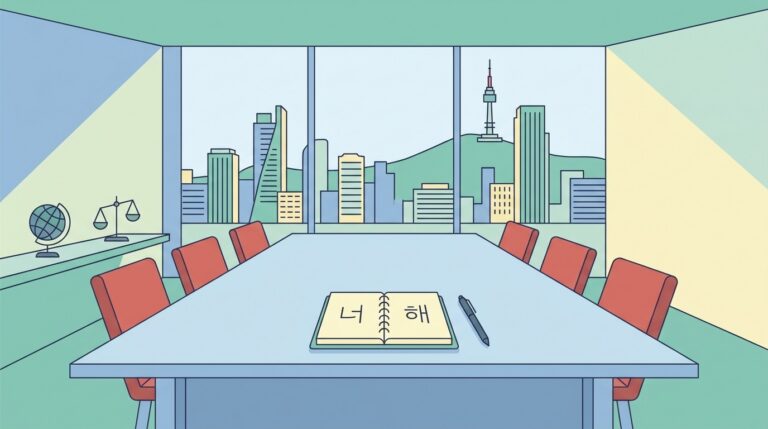
Picture this: You are sitting on the 32nd floor of a glass skyscraper overlooking Teheran-ro in Gangnam. Across the sleek mahogany boardroom table, the Executive Managing Director (전무님) slides a tablet toward you with a grim expression. Washington just expanded its extraterritorial secondary sanctions on semiconductor lithography, while Beijing concurrently activated its Anti-Foreign Sanctions Law (반외국제재법). Your multinational company’s supply chain is wedged dead center. One wrong shipment, one misworded end-user certificate, and your firm faces either catastrophic exclusion from US dollar clearing or crippling counter-tariffs and executive blacklists in overseas manufacturing hubs.
In high-stakes Korean corporate environments, panic is never an option. What your board expects is not textbook legal jargon, but calculated, sophisticated corporate diplomacy—the razor-sharp linguistic ability to articulate “지정학 컴플라이언스” (geopolitical compliance) with poise, nuance, and strategic composure.
Having coached C-suite expatriates, general counsels, and global trade directors in Seoul for over a decade, I have seen brilliant legal minds freeze because they relied on stiff machine translations or generic business terms that failed to capture the high-wire act of Korean corporate strategy. Mastering these C2-level expressions won’t just elevate your executive presence; it will give you the precise strategic vocabulary to bridge conflicting sovereign mandates, safeguard supply chains, and steer multinational leadership through weaponized interdependence.
Phase 2: Core Expressions Deep Dive
1. 고래 싸움에 새우 등 터지는 격입니다 (Gorae ssaume saeu deung teojineun gyeogimnida)
- Pronunciation: Go-rae ssa-um-e sae-u deung teo-ji-neun gyeok-im-ni-da (Think of it as: Go-ray sah-oom-eh seh-oo doong tuh-jee-neun gyuk-eem-nee-dah).
- Meaning: Literal: “Like a shrimp whose back bursts during a fight between whales.” / Executive Nuance: To be vulnerable collateral damage caught in the fierce crossfire of two rival superpowers.
- K-Culture Moment: Seen in prestige legal-political dramas like Vincenzo or Agency, where corporate strategists describe the agony of small and mid-size suppliers crushed during retaliatory trade disputes between global powers.
- Editor’s Insight: While the proverb itself is an age-old Korean idiom, modern trade lawyers and macro strategists use it with dry gravitas to candidly diagnose a company’s existential squeeze between conflicting extraterritorial sanctions.
- Situation Spectrum: Casual: ⚠️ | Semi-formal: ✅ | Formal: ✅ (Used frequently in boardroom diagnostics and op-eds)
- 🤔 Think About It: Does your native tongue characterize vulnerability through passive legal definitions, or does it utilize vivid ecological metaphors to capture structural asymmetry like Korean does?
2. 전략적 모호성을 탈피하고 선제적 컴플라이언스를 구축해야 합니다 (Jeollyakjeok mohoseong-eul talpihago seonjejeok keompeullai-eonseureul guchukhaeya hamnida)
- Pronunciation: Jeol-lyak-jeok mo-ho-seong-eul tal-pi-ha-go seon-je-jeok keom-peul-la-i-eon-seu-reul gu-chuk-hae-ya ham-ni-da (Sounds like: Jol-lyahk-jok mo-ho-song-ool tahl-pee-hah-go sun-jeh-jok com-ply-un-soo-rool goo-chook-heh-yah hahm-nee-dah).
- Meaning: Literal: “We must shed strategic ambiguity and establish proactive compliance.” / Executive Nuance: Moving past non-committal hedging to build a preemptive, multi-jurisdictional geopolitical risk mitigation program.
- K-Culture Moment: Common in boardroom showdowns in series like Reborn Rich, where forward-looking corporate heirs convince conservative family elders to abandon outdated wait-and-see policies.
- Editor’s Insight: 전략적 모호성 (strategic ambiguity) was historically a pillar of diplomacy. Declaring that a firm must 탈피하다 (shed/break away from) it signals a decisive, proactive governance pivot.
- Situation Spectrum: Casual: 🚫 | Semi-formal: ⚠️ | Formal: ✅ (C-suite briefings, regulatory filings)
- 🤔 Think About It: In many Western legal cultures, compliance is treated as black-letter rule-following. Why does Korean business vocabulary view compliance as an active, structural shield against geopolitical friction?
3. 상충하는 제재 법령 사이에서 절충점을 모색하다 (Sangchunghaneun jejae beomnyeong saieseo jeolchungjeomeul moseokhada)
- Pronunciation: Sang-chung-ha-neun je-jae beom-nyeong sa-i-e-seo jeol-chung-jeom-eul mo-saek-ha-da (Sounds like: Sahng-choong-hah-noon jeh-jeh buhm-nyung sah-ee-eh-suh jol-choong-jum-ool mo-sek-hah-dah).
- Meaning: Literal: “To seek a point of compromise between conflicting sanctions legislation.” / Executive Nuance: Harmonizing mutually irreconcilable legal regimes through sophisticated contractual carve-outs and operational firewalls.
- K-Culture Moment: The signature line delivered by international corporate lawyers in corporate thrillers negotiating cross-border joint ventures amidst trade embargos.
- Editor’s Insight: 절충점 implies a balanced equilibrium where neither sovereignty is directly defied, preserving commercial continuity without triggering blocking statute penalties.
- Situation Spectrum: Casual: 🚫 | Semi-formal: ⚠️ | Formal: ✅ (High-level negotiations, compliance audits)
- 🤔 Think About It: How does seeking a 절충점 differ from simply finding an exemption or loophole (우회로) in your legal culture?
Phase 3: Textbook Korean vs. Real Native Korean
Situation 1: Describing a sudden regulatory conflict during an executive committee meeting
- 📖 Textbook Korean: 법이 서로 달라서 회사가 아주 곤란합니다. (Beobi seoro dallaseo hoesaga aju gollanhamnida. / The laws are different from each other, so the company is very troubled.)
- 🗣️ Real Native Korean: 양대 교역국의 제재 규범이 첨예하게 대립하고 있어, 섣부른 조달 변경은 심각한 후폭풍을 부를 수 있습니다. (Yangdae gyoyeokguk-ui jejae gyubeomi cheom-yehage daeriphago isseo, seotbureun jodal byeong-gyeong-eun simgakan hupokpungeul bureul su itseumnida. / The sanctions regimes of the two major trading partners are in sharp conflict, so premature procurement shifts could trigger severe blowback.)
- 💡 Why the Difference?: At the C2 level, vague words like 곤란하다 (troubled) sound amateurish. C-suite discourse favors precise terms like 첨예하게 대립하다 (sharply conflict) and metaphorical risk indicators like 후폭풍 (severe aftermath/blowback).
Situation 2: Proposing a supply chain risk assessment framework
- 📖 Textbook Korean: 우리는 규칙을 잘 지키는 시스템을 만들어야 합니다. (Urineun gyuchigeul jal jikineun siseutemeul mandeureoya hamnida. / We must create a system that obeys the rules well.)
- 🗣️ Real Native Korean: 공급망 전반의 세컨더리 보이콧 노출도를 실시간으로 추적하는 다층적 스크리닝 체계를 내재화해야 합니다. (Gonggeupmang jeonban-ui sekeondeori boikot nochuldoreul silsiganeuro chujeokhaneun dacheungjeok seukeurining chegyereul naejaehwahae-ya hamnida. / We must institutionalize a multi-layered screening mechanism to monitor our supply chain’s secondary boycott exposure in real time.)
- 💡 Why the Difference?: Elementary verbs like 규칙을 지키다 fail to capture corporate governance architecture. Native Korean executives prefer Sino-Korean technical expressions like 노출도 (exposure level) and 내재화하다 (institutionalize/internalize).
Phase 4: K-Culture Deep Dive & Non-verbal Etiquette
4-1. Nunchi & Executive Non-Verbal Gravitas
In Korean corporate compliance, 눈치 (nunchi—situational discernment) isn’t about guessing what food people want; it’s about discerning implicit regulatory red lines and geopolitical sensitivities before they are voiced.
* The Deliberate Pause: When asked by a senior executive whether a contested export transaction can go through, never answer with an immediate “안 됩니다” (That is impossible). An abrupt negative conveys inflexibility and disrespect. Instead, hold your hands loosely clasped on the table, pause for two seconds, lower your vocal pitch slightly, and say: “리스크 요인을 다각도로 면밀히 검토할 필요가 있습니다” (We need to meticulously scrutinize the risk factors from multiple angles).
* Eye Contact Protocol: Direct, unblinking eye contact during high-stakes compliance debates can be interpreted as aggressive pushback. Maintain eye contact while speaking, but glance down briefly at your dossier when the Managing Director speaks to signal thoughtful deference to their responsibility.
4-2. Cultural Code Analysis: Chaebol Geopolitics in K-Media
In contemporary K-Dramas revolving around conglomerate boardrooms (such as Reborn Rich or Numbers), you will notice that external regulatory crackdowns are rarely treated merely as legal matters—they are treated as existential tests of corporate sovereignty. Korean conglomerates (재벌) developed historically through export-oriented industrialization, meaning trade restrictions trigger generational institutional memory. Expressing empathy for this corporate vulnerability elevates you from a mere outside counsel to an indispensable, trusted strategist (신임받는 참모).
Phase 5: Real-World Roleplay Scenario
Setting: A private meeting room at NeoTech Korea headquarters in Yeouido.
Characters:
* 박 전무 (Executive Director Park): Veteran operations chief under intense pressure to maintain dual-market deliveries.
* 알렉스 (Alex): Chief Geopolitical Compliance Officer (You).
박 전무: 알렉스 이사, 해외 지사에서 이번 핵심 부품의 우회 수출 방안을 계속 타진해 오고 있는데, 어떻게 보십니까?
(Alex Isa, hae-oe jisa-eseo ibeon haeksim bupum-ui uhoe suchul bang-an-eul gyesok tajinhae ogo inneunde, eotteoke bosimnikka?)
🎭 안경을 벗고 미간을 찌푸리며 테이블에 몸을 기울인다.
“Director Alex, our overseas branch keeps probing for alternative transshipment workarounds for these core components. What is your assessment?”
알렉스: 전무님, 현 상황에서의 우회 수출은 세컨더리 보이콧을 직접적으로 촉발할 위험성이 농후합니다.
(Jeonmunim, hyeon sanghwang-eseoui uhoe suchureun sekeondeori boikoteul jikjeopjeogeuro chokbalhal wiheomseongi nonghuhamnida.)
🎭 침착한 어조로 준비해 온 규제 대조 분석표를 정갈하게 펼쳐 보이며
“Director, pursuing transshipment routes in this environment carries a severe risk of directly triggering secondary sanctions.”
박 전무: 하지만 현지 합작 법인의 가동률이 절반 이하로 떨어지면 당장 3분기 실적이 위태롭습니다!
(Hajiman hyeonji hapjak beobinor-ui gadongnyuri jeolban iharo tteoreojimyeon dangjang sambungi siljeogi witaeropseumnida!)
🎭 초조하게 손가락으로 서류를 톡톡 두드린다.
“However, if the utilization rate of our local joint venture drops below half, our Q3 earnings are immediately in jeopardy!”
알렉스: 단기적 실적 보전보다 거래 차단에 따른 본사 차원의 라이선스 박탈 리스크가 비교할 수 없을 만큼 막대합니다.
(Dangijeok siljeok bojeonboda georae chadane ttareun bonsa chaweon-ui raiseonseu baktal riseukeuga bikyohal su eopseul mankeum makdaehamnida.)
🎭 시선을 단단하게 맞추며 차분하게 설득한다.
“Compared to short-term earnings preservation, the risk of headquarters-level license revocation and financial blacklisting is exponentially greater.”
박 전무: 그럼 우리는 그저 손을 놓고 본사 공정까지 멈춰 세워야 한다는 말입니까?
(Geureom urineun geujeo soneul noko bonsa gongjeongkkaji meomchwo seowoya handaneun marimnikka?)
🎭 답답한 듯 깊은 한숨을 내쉰다.
“So are you saying we should just sit with our hands folded and halt our home production lines as well?”
알렉스: 결코 아닙니다. 규제 예외 조항을 원용할 수 있도록 최종 사용자(End-User) 실사를 즉각 강화해야 합니다.
(Gyeolko animnida. Gyuje yewoe johang-eul wonyonghal su itdorok choejong sayongja silsareul jeukgak ganghwahaeya hamnida.)
🎭 신뢰감 있는 미소를 띠며 대안 문건을 가리킨다.
“Far from it. We must immediately bolster end-user due diligence so we can invoke legitimate regulatory exemptions.”
박 전무: 예외 조항 원용이라… 관계 당국과의 사전 협의 채널은 확보되어 있습니까?
(Yewoe johang wonyong-ira… gwangye danggukgwaui sajeon hyeobui chaeneoreun hakbwodoeeo itseumnikka?)
🎭 호기심을 보이며 자세를 바로잡고 안경을 고쳐 쓴다.
“Invoking an exemption clause… Do we have an active prior consultation channel with the relevant authorities?”
알렉스: 네, 지정학적 리스크 전담 태스크포스를 통해 규범 간 충돌을 최소화하는 절충안을 제출해 둔 상태입니다.
(Ne, jijeonghakjeok riseukeu jeondam taeseukeuposeureul tonghae gyubeom gan chungdoreul choesohwahaneun jeolchung-aneul jechulhae dun sangtae-imnida.)
🎭 서류철을 덮고 단호하지만 안정적인 눈빛을 보낸다.
“Yes, through our dedicated Geopolitical Risk Task Force, we have already submitted a compromise framework that minimizes friction between jurisdictions.”
🔀 Interactive Decision Point
How should Alex conclude this briefing to ensure the Executive Director signs off on the compliance freeze?
- Option A: “규제 당국의 지침을 어기면 벌금이 어마어마하니 무조건 중단해야 합니다.” (If we violate agency guidelines, the fines are enormous, so we must halt unconditionally.)
- Option B: “법률적 방패 없이는 단 하나의 컨테이너도 통관할 수 없다는 점을 전사 지침으로 천명해 주십시오.” (Please declare across the entire enterprise that not a single container moves without our legal shield in place.)
- Option C: “상대국이 알아채지 못하게 서류 명의만 제3국 페이퍼컴퍼니로 바꾸시죠.” (Let’s just switch the paperwork to a third-country shell company before they notice.)
Detailed Feedback:
* Option A [Bad]: Too blunt and fatalistic. It frames compliance as a passive roadblock rather than a strategic protector, losing executive buy-in.
* Option B [Best]: Authoritative, executive-level rhetoric. Using 법률적 방패 (legal shield) and 전사 지침으로 천명하다 (proclaim as company-wide policy) frames compliance as strategic empowerment.
* Option C [Catastrophic Risk]: Illegal evasive tactics (우회 시도) directly invite criminal prosecution under anti-circumvention provisions.
Phase 6: 10-Second Emotion Shadowing Drill
Train your intonation and breath control using these authentic boardroom cadences. Note the pause markers (/).
- [⚖️ Cold, analytical composure]
미국의 세컨더리 제재와 / 상대국의 반외국제재법이 정면충돌하는 구도이므로, / 당사는 엄정한 중립적 컴플라이언스를 관철해야 합니다.
(Miguk-ui sekeondeori jejaewa / sangdaeguk-ui ban-oeguk-jejaebeobi jeongmyeon-chungdolhaneun gudoyimeuro, / dangsaneun eomjeonghan jungripjeok keompeullai-eonseureul gwancheolhaeya hamnida.)
“Since this is a direct clash between US secondary sanctions and the counter-sanctions statute, our firm must steadfastly maintain strict, neutral compliance.” -
[🚨 High-alert urgency without panic]
공급망의 무기화가 현실화된 이상, / 1차 협력업체뿐만 아니라 / n차 벤더에 이르는 추적 시스템을 / 즉시 가동해야 합니다!
(Gonggeupmang-ui mugihwaga hyeonsilhwadoen isang, / ilcha hyeopryeok-eopcheppunman anira / encha bendore ireuneun chujeok siseutemeul / jeuksi gadonghaeya hamnida!)
“Now that supply chain weaponization is a reality, we must instantly deploy our tracking system down to Tier-N suppliers, not just Tier-1!” -
[🤝 Persuasive, diplomatic resolve]
규범 간 딜레마를 이유로 주저하기보다는, / 공식적인 유예 승인을 획득하는 / 선제적 정공법을 택해야 합니다.
(Gyubeom gan dillemareul iyuro jujeohagibodaneun, / gongsikjeokin yuye seung-ineul hoekdeukhaneun / seonjejeok jeonggongbeobeul taekhaeya hamnida.)
“Rather than hesitating over normative dilemmas, we must pursue the proactive, direct path of securing formal regulatory waivers.” -
[🛡️ Firm, authoritative closing]
선제적 리스크 관리가 담보되지 않는 해외 수주는 / 기업의 영속성을 뒤흔드는 독배가 될 수 있습니다.
(Seonjejeok riseukeu gwanriga dambodoeji anneun hae-oe sujuneun / gieop-ui yeongsokseong-eul dwiheundeuneun dokbaega doel su itseumnida.)
“Overseas orders unsecured by proactive risk governance can turn into a poisoned chalice that destabilizes the corporation’s longevity.”
Phase 7: K-Culture Mini Dictionary
-
세컨더리 보이콧 (Sekeondeori Boikot)
Translation: Secondary Boycott / Secondary Sanctions
Usage: Refers to punitive measures targeting third-country individuals or corporations conducting business with a sanctioned entity, effectively cutting them off from US capital and trade markets.
Executive Context: Frequently discussed in strategic planning: “세컨더리 보이콧 리스크를 철저히 차단하십시오” (Thoroughly firewall all secondary boycott risks). -
공급망 무기화 (Gonggeupmang Mugihwa)
Translation: Weaponization of Supply Chains (Weaponized Interdependence)
Usage: The strategic withholding or legal embargoing of critical raw materials, semiconductors, or transit corridors to achieve geopolitical ends.
Executive Context: Used in industrial reports: “핵심 광물의 공급망 무기화에 대비한 대체선 확보가 시급합니다” (Securing alternative sourcing against the weaponization of critical mineral supply chains is urgent). -
전략물자 수출통제 (Jeollyangmulja Suchultongje)
Translation: Strategic Goods Export Controls
Usage: State-administered licensing regimes preventing dual-use technology (commercial and defense applications) from falling into unauthorized hands.
Executive Context: Common in regulatory filings: “전략물자 판정 절차를 거친 후 통관을 진행하겠습니다” (We will proceed with customs clearance after completing the strategic goods classification process). -
차단법령 (Chadanbeomnyeong)
Translation: Blocking Statute
Usage: Domestic legislation enacted by a country to nullify the extraterritorial effects of another nation’s sanctions on its own domestic companies.
Executive Context: “상대국의 차단법령과 정면 충돌하지 않도록 컴플라이언스 프로토콜을 정교화해야 합니다” (We must refine our compliance protocol to avoid running afoul of the counterparty country’s blocking statutes).
Phase 8: Survival Kit for High-Level Business Visitors
Survival Expressions TOP 3
- 법률 자문단을 소집하여 유권해석을 요청하겠습니다.
(Beomnyul jamundaneul sojiphayeo yugwonhaeseogeul yocheonghagetsseumnida.)
Pro Tip: Use this when caught in an impasse during a contract signing. It means: “I will convene our legal advisory team to request an authoritative regulatory interpretation,” saving face without yielding. - 규제 준수 여부를 재확인한 후 가부를 말씀드리겠습니다.
(Gyuje junsu yeobureul jaehwaghinhanoe gabureul malsseumdeurigetsseumnida.)
Pro Tip: The ultimate polite demurral: “I will state whether this is feasible after re-verifying regulatory compliance.” - 상호 절충 가능한 컴플라이언스 가이드라인을 제안해 주십시오.
(Sangho jeolchung ganeunghan keompeullai-eonseu gaideuraineul jeeanhae jusipsio.)
Pro Tip: Shifts the burden back to the counterpart: “Please propose mutually reconcilable compliance guidelines.”
Editor’s Travel Note: Power Meeting Navigation
If your compliance emergency lands you in Seoul for urgent ministry consultations or board meetings:
* Navigating the Power Centers: Most high-level economic security briefings take place either around the Government Complex Seoul (광화문) or in the financial center of Yeouido (여의도). For transport, skip roadside hailing—download the local ride app via 카카오 T 택시 호출 및 대중교통 안내 to guarantee arrival logs and business card expense receipts.
* Local Meeting Protocol: High-stakes boardroom meetings typically begin with exchange of business cards using both hands with the text facing the recipient. Place the received card carefully on the table at your upper left corner throughout the meeting; never slip it into your back pocket or write notes on it in front of the counterparty.
Phase 9: “One Step Deeper” (Cultural Reflection)
Throughout centuries situated between continent and maritime empires, Korean diplomacy evolved around the philosophical doctrine of 화이부동 (和而不同)—seeking harmony, but without blindly assimilating. This historic survival instinct is profoundly visible in contemporary Korean corporate leadership. When facing conflicting sanctions between trading superpowers, modern Korean executives rarely resort to reckless defiance or total surrender. Instead, they operate dynamic, hyper-precise compliance architectures designed to preserve operational continuity while scrupulously observing the outer boundaries of international law.
Understanding this subtle dynamic changes how you work with Korean leadership: strategic delay or exhaustive legal reviews are not indecisiveness, but seasoned institutional resilience.
💬 Your Turn: How does your organization manage normative conflicts between extraterritorial sanctions and domestic mandates? Do you lean toward total disengagement or calibrated compromise? Share your experience below!
Phase 10: FAQ & Common Pitfalls
Q: Can I use the English word “Compliance” directly in Korean corporate settings?
A: Yes, absolutely! The loanword 컴플라이언스 is standard in every Korean boardroom. However, pairing it with Korean strategic nouns—such as 선제적 컴플라이언스 (preemptive compliance) or 지정학 컴플라이언스 체계 (geopolitical compliance system)—instantly conveys advanced native fluency.
Q: What is the difference between “우회 수출” (Uhoe suchul) and “우회로 모색” (Uhoero mosaek)?
A: While 우회로 모색 means exploring pragmatic commercial solutions or legal paths around a deadlock, 우회 수출 specifically denotes sanctions-evasion transshipment. Be cautious: inadvertently using 우회 수출 during a formal presentation suggests illicit circumvention, which will trigger alarm bells for your compliance auditors!
Q: How do I diplomatically reject an executive’s proposal on legal sanctions grounds without sounding disrespectful?
A: Never use blunt refusals like “불법입니다” (That is illegal) or “안 됩니다” (That cannot be done). Frame the constraint through systemic corporate protection: “해당 방안은 본사의 글로벌 결제망 접근을 위태롭게 할 우려가 있어, 보완적 대안이 필요합니다” (That approach could jeopardize headquarters’ access to global clearing networks, so a complementary alternative is required).
🚨 Common Mistakes Warning Board
- ❌ Mistake 1: Translating “secondary boycott” as 두 번째 불매운동 (Second boycott).
✅ Correct Action: Always use the established legal-economic term 세컨더리 보이콧 or 제3자 제재. - ❌ Mistake 2: Using informal idioms like 새우 등 터지다 during an official regulatory audit filing.
✅ Correct Action: Reserve vivid proverbs for internal strategic meetings. In formal briefs, use 강대국 간 규제 상충에 따른 중대한 기업 피해 (Significant corporate damage due to regulatory conflict between superpowers). - ❌ Mistake 3: Treating 절충점 (compromise point) as an admission of legal wrongdoing.
✅ Correct Action: Clearly distinguish between illegal concessions and sovereign legal harmonization by framing it as 규범 간 조화로운 절충점 도출 (Deriving a harmonious equilibrium between legal frameworks).
Phase 11: Action Missions
- 🥉 Bronze Mission (Solo): Read the Phase 6 Shadowing Drills out loud three times, matching the cadence and emotional markers for each scenario.
- 🥈 Silver Mission (Community): Leave a comment using the phrase 고래 싸움에 새우 등 터지는 격입니다 to describe a current event or business challenge in your field.
- 🥇 Gold Mission (Executive Execution): In your next international corporate or legal meeting, incorporate 선제적 컴플라이언스 into your English-Korean presentation or strategic memo.
- 🎮 K-Culture Mission: Watch an episode of a Korean business-themed drama (e.g., Misaeng or Reborn Rich) and listen for when characters discuss corporate survival (기업의 존폐) amidst external regulations.
Phase 12: Interactive Quiz Challenge
1. Situational Judgment:
During a strategic committee meeting, a director suggests routing dual-use items through an unlisted intermediary to bypass strategic export licensing. As Legal Counsel, what is your most sophisticated response?
(A) 상관없습니다. 걸리지만 않으면 됩니다.
(B) 그런 방식의 우회 시도는 세컨더리 보이콧을 유발하여 전사적 영업을 중단시킬 수 있는 심각한 위법 행위입니다.
(C) 네, 제 개인 명의로 컨테이너를 부치겠습니다.
2. Fill in the Blank:
우리는 각국의 상충하는 규범 사이에서 소극적으로 표류하기보다, 치밀한 법리 검토를 통해 실현 가능한 ________을(를) 모색해야 합니다.
(A) 먹방
(B) 절충점
(C) 복불복
3. True or False Culture Check:
True or False: In Korean corporate boardroom communication, directly telling a Managing Director “That is completely illegal and will never happen” is considered the most respected form of compliance leadership.
👉 Click to view Answers and Strategic Explanations
- Answer: (B)
Explanation: Option (B) cleanly exposes the catastrophic regulatory vulnerability (우회 시도, 세컨더리 보이콧 유발) while maintaining uncompromising corporate gravitas. (A) and (C) invite criminal liability. -
Answer: (B) 절충점 (Jeolchungjeom – Compromise/Middle Ground)
Explanation: The sentence discusses moving past passive drift between conflicting norms to actively seek a viable point of balance through rigorous legal analysis. -
Answer: False
Explanation: Professional non-verbal and linguistic etiquette dictates that advanced legal leaders guide executives by highlighting systemic organizational risk (라이선스 박탈, 기업의 영속성 저해) and proposing viable strategic alternatives rather than delivering blunt, confrontational dismissals.
🎬 Watch Our Daily Videos! (Daily Hangul Official Instagram)
Review the expressions you learned in this article with our fun daily short videos! Check out native pronunciation and real-life nuances in action.
- Instagram @dailyhangul_en







