

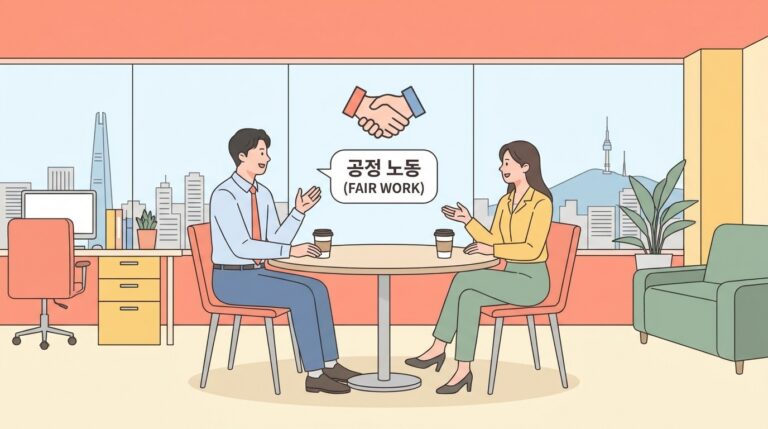
Navigating Korea’s Labor Market Debate: How to Discuss Fair Work Like an Insider
Phase 1: Empathy (Story-Driven Opening)
안녕하세요! 매일한글 에디터입니다. (Hello! I’m your Daily Hangul editor.)
If you have ever watched the iconic K-Drama Misaeng (Incomplete Life), you probably remember the heart-wrenching tension surrounding Jang Geu-rae’s contract renewal. In Korea, the distinction between permanent staff (정규직, jeonggyujik) and contract workers (비정규직, bijeonggyujik), alongside the canyon-like gap between massive conglomerates (대기업, daegieop) and small-and-medium enterprises (중소기업, jung-sogieop), is not merely an abstract economic concept. It is a deeply personal, everyday reality that dictates career trajectories, social status, and even marriage prospects.
Many of our advanced C1 learners tell me: “Editor, when Korean colleagues at dinners bring up working-hour flexibility (근로시간 유연화) or labor market dualism (노동시장 이중구조), I freeze. I have opinions, but I sound like a robotic textbook, or worse, I worry about using overly blunt words that disrupt the room’s harmony!”
Take a deep breath—I have been guiding foreign professionals through Seoul’s corporate corridors for ten years, and this guide is custom-built from real boardroom debates and after-work chicken-and-beer chats. By mastering the nuanced vocabulary and socio-cultural subtext in this article, you will transition from a hesitant listener into a sophisticated conversationalist who can articulate systemic workplace equity with cultural tact, empathy, and flawless precision.
Phase 2: Core Expressions In-Depth Analysis
Here are three high-level C1 phrases indispensable for any discussion on modern Korean labor ethics.
1. 노동시장 이중구조 (Nodongsijang Ijung-gujo)
- Pronunciation: [Nodong-sijang I-jung-gu-jo] (Think: “No-dong see-jang ee-joong-goo-jo”)
- Meaning: Literal: “Labor market dual structure” | Actual: The entrenched institutional division separating privileged tier-one employees (regular workers at large firms and public agencies) from marginalized tier-two workers (subcontractors, platform workers, and temporary staff).
- K-Culture Moment: You will hear this phrase frequently in Korean investigative journalism programs like SBS Unanswered Questions (그것이 알고 싶다) and in high-stakes boardroom meetings portrayed in dramas like Agency (대행사).
- Editor’s Insight: Using this phrase immediately signals that you understand macro-economic issues in Korea beyond simple surface-level complaints about overtime.
- Situation Spectrum: Casual 🚫 | Semi-formal ⚠️ | Formal ✅
- 🤔 Think About It: Does your native culture categorize labor primarily by contract duration, firm prestige, or specific trade skills? How does this alter social perceptions of self-worth?
2. 동일가치노동 동일임금 (Dong-il Gachi Nodong Dong-il Imgeum)
- Pronunciation: [Dong-il Ga-chi No-dong Dong-il Im-geum] (Think: “Dong-il gah-chee no-dong dong-il eem-geum”)
- Meaning: Literal & Nuance: “Equal pay for work of equal value.” In Korea, it specifically targets the practice where regular and non-regular employees carry out virtually identical duties at the same workstation yet experience stark wage disparities.
- K-Culture Moment: In legal dramas like Extraordinary Attorney Woo or Hyena, public interest lawsuits fighting for outsourced subcontracted cleaners often hinge on this precise statutory principle.
- Editor’s Insight: This phrase carries significant progressive weight. When articulating it, deliver it with measured conviction rather than aggressive confrontation.
- Situation Spectrum: Casual ⚠️ | Semi-formal ✅ | Formal ✅
- 🤔 Think About It: Is “equal work” measured strictly by billable output in your home country, or does seniority (호봉제, hobongje) play a historical role like it often does in East Asia?
3. 상생 협력 (Sang-saeng Hyeop-ryeok)
- Pronunciation: [Sang-saeng Hyeop-ryeok] (Think: “Sahng-saeng hyeop-ryeok” – note that the final ‘p’ transitions smoothly into the rolled ‘r’ sound)
- Meaning: Literal: “Living together mutual cooperation” | Actual: Symbiotic partnership and equitable risk-sharing between primary contractors (원청) and secondary subcontractors (하청), or between labor unions and management.
- K-Culture Moment: Corporate ESG press briefings, CEO New Year addresses, and governmental policy summits on creating an equitable economic safety net.
- Editor’s Insight: If you find yourself in a heated business debate, dropping “상생 협력의 관점에서 접근해야 합니다” (We must approach this from the perspective of symbiotic cooperation) is the ultimate de-escalation move that earns nods from both sides.
- Situation Spectrum: Casual ⚠️ | Semi-formal ✅ | Formal ✅
- 🤔 Think About It: How does the Confucian value of collective harmony (화, hwa) influence modern business negotiations compared to Western transactional contracts?
Phase 3: Textbook Korean vs. Real Korean
Situation 1: Calling out wage discrimination based on employment status
- 📖 교과서 한국어 (Textbook Korean):
고용 형태에 따른 불합리한 차별을 금지해야 합니다.
(Goyong hyeongtae-e ttareun bulhabrihan chabyeol-eul geumjihaeya hamnida. / Unreasonable discrimination based on employment form must be prohibited.) - 🗣️ 진짜 한국어 (Real Native Korean):
비정규직이라고 대우 깎는 관행은 이제 진짜 뿌리 뽑아야죠.
(Bijeonggyujig-irago daeu kkangneun gwanhaeng-eun ije jinjja ppuri ppobayajo. / Treating people as lesser just because they’re contract workers is a practice we really need to uproot once and for all.) - 💡 왜 다를까? (Why the difference?): Native speakers use punchy, visceral idioms like 대우를 깎다 (slash fair treatment) and 뿌리 뽑다 (uproot/eradicate) to convey ethical urgency rather than relying on dry, passive legalese.
Situation 2: Debating flexible work hours vs. chronic overtime
- 📖 교과서 한국어 (Textbook Korean):
근로시간 유연화 제도의 도입에는 신중을 기해야 합니다.
(Geunrosigan yuyeonhwa jedo-ui doip-eneun sinjung-eul gihaeya hamnida. / We must exercise caution regarding the introduction of flexible working hours.) - 🗣️ 진짜 한국어 (Real Native Korean):
유연근무 취지는 좋아도, 자칫하면 야근 폭탄 맞기 십상이에요.
(Yuyeongeunmu chijineun joado, jachithamyeon yageun poktan matgi sipsang-ieyo. / The intent behind flexible hours is fine, but if things go sideways, workers will easily get slammed with an overtime bomb.) - 💡 왜 다를까? (Why the difference?): In spontaneous discussions, Koreans prefer colorful metaphors such as 야근 폭탄 맞다 (get bombed with overtime) and nuanced constructions like ~기 십상이다 (be prone to / liable to).
Phase 4: K-Culture Deep Dive & Non-Verbal Manners
4-1. 눈치 (Nunchi) & Delicate Body Language
When discussing workplace discrimination and systemic labor dualism in Korea, how you physically deliver your words matters as much as the grammar:
* The Empathetic Tilt: Tilt your head slightly forward and offer slow, repetitive nods (고개 끄덕임) while listening to someone detail workplace grievances. Never maintain rigid, unbroken eye contact, which can read as prosecutorial.
* The Softening Buffer: Before voicing a firm stance on labor reform, begin with an audible inward breath and a cushioning phrase like “물론 양쪽 입장이 다 이해는 갑니다만…” (Of course, I understand both sides’ stances, but…). This displays cultural tact (눈치) by establishing that you do not see the issue in simplistic black-and-white terms.
4-2. Cultural Code: The Drama of the Two Badges
In the acclaimed workplace drama Misaeng, contract workers carry generic lanyards while full-time employees wear company-branded cardholders. This small visual marker illustrates the emotional toll of Korea’s “two-tier labor market.” The public debate over working-hour flexibility (such as the contentious discussions over weekly work caps) sparks visceral passion because many workers fear that “flexibility” without an airtight employment safety net (고용 안전망) will simply revert the office culture back to unconditional late-night work culture (야근 문화). Highlighting mutual empathy across corporate divides is considered the highest form of intellectual maturity in Korean society.
Phase 5: Real-World Roleplay Scenario
Setting: A quiet rooftop café in Yeouido overlooking the financial district. Kevin (a foreign strategy consultant) is discussing employment policy over iced Americanos with Park Dae-ri (an experienced HR deputy manager at a Korean tech enterprise).
- 박 대리 (Park Dae-ri):
케빈 씨, 요즘 정부랑 학계에서 노동시장 이중구조 개혁 얘기가 계속 나오는데, 솔직히 현장에서는 체감이 잘 안 돼요.
(Kebin ssi, yojeum jeongburang hakgye-eseo nodongsijang ijung-gujo gaehyeok yaegiga gyesok naoneunde, soljikhi hyeonjang-eseoneun chegami jal an dwaeyo.)
🎭 [sighing, lightly swirling his coffee cup]
“Kevin, the government and academia keep talking about reforming the labor market’s dual structure, but honestly, on the ground, we don’t feel any real change.” -
케빈 (Kevin):
맞아요. 원청과 하청, 혹은 정규직과 비정규직 사이의 격차가 워낙 오랜 관행이라 단기간에 풀긴 쉽지 않죠.
(Majayo. Woncheonggwa hacheong, hogeun jeonggyujikgwa bijeonggyujik sai-ui gyeokchaga wonak oraen gwanhaeng-ira dangigane pulgin swipji anchyo.)
🎭 [nodding thoughtfully, matching his eye level]
“I agree. The disparity between primary contractors and subcontractors, or between permanent and contract workers, is such an entrenched practice that solving it quickly is tough.” -
박 대리 (Park Dae-ri):
게다가 근로시간 유연화만 해도 그래요. 탄력근무가 도입되면 워라밸이 좋아진다는 사람도 있지만, 중소기업에서는 악용될까 봐 불안해하거든요.
(Gedaga geunrosigan yuyeonhwaman haedo geuraeyo. Tallyeokgeunmuga doipdoemyeon worabaeri joajindaneun saramdo itjiman, jung-sogieob-eseoneun akyongdoelkka bwa buranhaehageodeunyo.)
🎭 [furrowing his brow with concern]
“And look at working-hour flexibility. Some say flexible hours will improve work-life balance, but smaller businesses worry it will just be abused for unchecked overtime.” -
케빈 (Kevin):
결국 고용 안전망이 뒷받침되지 않으면 유연성도 노동자에게는 일방적인 희생이 될 수밖에 없으니까요.
(Gyeolguk goyong anjeonmangi dwitbatchimdoeji aneumyeon yuyeonseongdo nodongja-egeneun ilbangjeog-in huisaeng-i doel subakke eopseunikkayo.)
🎭 [leaning in slightly, speaking with measured conviction]
“Because ultimately, unless a robust employment safety net supports it, flexibility inevitably turns into one-sided sacrifice for workers.” -
박 대리 (Park Dae-ri):
정확한 지적이세요. 특히 동일가치노동 동일임금 원칙이 현장에 안착해야 사회적 통합도 가능할 텐데 말이죠.
(Jeonghwakhan jijeog-iseyo. Teukhi dong-il gachi nodong dong-il imgeum wonchigi hyeonjange anchakhaeya sahoejeok tonghapdo ganeunghal tende marijyo.)
🎭 [nodding in strong agreement]
“Spot-on observation. Especially when the principle of equal pay for work of equal value settles properly into real workplaces—that’s when true social cohesion becomes possible.” -
케빈 (Kevin):
기업 규모나 계약 형태에 따라 보이지 않는 벽이 생기는 건, 기업 경쟁력 차원에서도 장기적으로 손해예요.
(Gieop gyumona gyeyak hyeongtae-e ttara boiji anneun byeogi saenggineun geon, gieop gyeongjaengryeok chaweon-eseodo janggijeog-euro sonhaeyo.)
🎭 [gesturing balance with flat hands]
“Invisible walls arising from enterprise size or contract type actually undermine corporate competitiveness in the long run as well.” -
박 대리 (Park Dae-ri):
대기업과 중소기업 간의 상생 협력 모델이 더 많이 나와야 할 텐데요. 케빈 씨 회사는 어떤가요?
(Daegieopgwa jung-sogieop gan-ui sang-saeng hyeop-ryeok moderi deo mani nawaya hal tendeyo. Kebin ssi hoesaneun eotteongayo?)
🎭 [looking curious, tilting his head]
“We really need more models of symbiotic cooperation between large and small enterprises. How does your company handle it, Kevin?” -
케빈 (Kevin):
저희도 협력사와의 공정한 파트너십을 최우선 가치로 두고 계속 시스템을 점검하고 있습니다.
(Jeohido hyeopryeoksawa-ui gongjeonghan pateuneosib-eul choe-useon gachiro dugo gyesok siseutem-eul jeomgeomhago itseumnida.)
🎭 [giving a polite, reassuring smile]
“We also place fair partnership with partner firms as a top priority and continually audit our systems.”
🔀 Interactive Branching Moment
If Deputy Manager Park asked you: “Do you think rapid deregulation of working hours benefits employees right now?”, how would you respond?
- Option A: “노동자의 자율성을 극대화하려면 무조건 빨리 풀어야 합니다.” (We must completely deregulate immediately to maximize worker autonomy.)
- Editor’s Feedback [Bad / Cultural Blunder]: Too blunt and dismissive of structural abuses in SMEs. You risk sounding detached from ground reality.
- Option B: “근로시간 유연화의 취지는 공감하지만, 과로 방지와 고용 안전망 강화가 전제되어야 상생이 가능하다고 봅니다.” (While I appreciate the intent of working-hour flexibility, preventing overwork and bolstering the safety net must come first for mutual sustainability.)
- Editor’s Feedback [Best / Master Level]: Exemplary C1 Korean! Balanced, empathetic, acknowledging corporate agility while honoring human welfare.
- Option C: “저는 외국인이라 한국 노동 정책은 잘 모르겠습니다.” (I’m a foreigner, so I don’t know much about Korean labor policy.)
- Editor’s Feedback [Risk / Conversation Killer]: Safe, but forfeits the chance to showcase your high-level cultural insight and build deep professional trust.
Phase 6: 10-Second Emotion Shadowing Drill
Practice reading these out loud. Pay strict attention to the / pauses and emotional cues!
[⚖️ 차분하고 단호하게 - Calm and resolute]
동일가치노동 / 동일임금 원칙은 / 공정한 노동 생태계를 만드는 / 최소한의 출발점입니다.
(Dong-il gachi nodong / dong-il imgeum wonchig-eun / gongjeonghan nodong saengtae-gye-reul mandeuneun / choesohan-ui chulbaljeom-imnida.)-
[🤝 진심 어린 공감을 담아 - With deep heartfelt empathy]
계약 형태가 다르다는 이유로 / 차별적인 대우를 받는 건 / 누구에게나 상처가 될 수밖에 없어요.
(Gyeyak hyeongtaega dareudaneun iyuro / chabyeoljeog-in daeu-reul banneun geon / nugu-egena sangcheoga doel subakke eopseoyo.) -
[🤔 신중하고 균형 잡힌 어조로 - Reflective and balanced]
근로시간의 유연성을 논하기 전에 / 든든한 고용 안전망이 / 먼저 뿌리내려야 합니다.
(Geunrosigan-ui yuyeonseong-eul nonhagi jeone / deundeunhan goyong anjeonmangi / meonjeo ppurineoryeoya hamnida.)
Phase 7: K-Culture Mini Dictionary
- 포괄임금제 (Pogwal Imgeum-je) | Comprehensive Wage System
A standard contract framework where overtime, night, and weekend allowances are bundled into a fixed base monthly salary. Highly debated among younger workers who dub it the root cause of unpaid overtime “labor robbery” (공짜 야근). - 고용 안전망 (Goyong Anjeon-mang) | Employment Safety Net
The institutional ecosystem—including unemployment benefits (실업급여), re-skilling programs, and healthcare transition assistance—safeguarding workers across career shifts. - 원·하청 상생 (Won-Hacheong Sangsaeng) | Primary-Subcontractor Symbiosis
The ethical and economic imperative requiring sprawling conglomerates (원청, primary contractors) to cease squeezing supplier margins and actively support their subcontractors’ (하청) safety conditions and fair pay. - 정규직 vs 비정규직 (Jeonggyujik vs Bijeonggyujik) | Regular vs Non-Regular Workers
The central binary in Korean employment. Regular status denotes indefinite contracts with retirement bonuses and fringe benefits; non-regular status involves rolling short-term arrangements with distinct wage caps.
Phase 8: Expat & Traveler Survival Kit
Survival Expressions Top 3
- 근로계약서 다시 검토해 주실 수 있나요?
(Geunrogyeyakseo dasi geomtohae jusil su innayo?)
“Could you please review the employment contract once more?”
Pro Tip: Essential when confirming whether your contract includes comprehensive wage clauses or overtime guarantees. - 법정 공휴일 수당은 어떻게 정산되나요?
(Beopjeong gonghyuil sudang-eun eotteoke jeongsandwenayo?)
“How are statutory national holiday allowances calculated?”
Pro Tip: Crucial for ensuring your paid leave rights match standard Labor Standards Act requirements. - 상호 협의 하에 유연근무를 신청하고 싶습니다.
(Sangho hyeob-ui hae yuyeongeunmureul sincheonghago sipseumnida.)
“I would like to apply for flexible working hours under mutual agreement.”
Pro Tip: A polite, professional way to raise flexible arrangements without sounding demanding.
Editor’s Professional Resource Note
If you ever experience workplace disputes or ambiguity over overtime allowances in Korea, do not hesitate to contact the Ministry of Employment and Labor hotline (Call 1350, with English translation available). For filing official consultations and accessing standard multi-lingual labor contract samples, bookmark the 고용노동부 민원마당 웹사이트 (Ministry of Employment and Labor Civil Service Portal). To navigate directly to your district’s regional labor office for in-person advice, use the 네이버 지도 앱 다운로드 (Naver Map App Download) for exact public transit routes and office hours.
Phase 9: “Going One Step Deeper”
Korea’s compressed economic miracle—known worldwide as the “Miracle on the Han River”—was built upon extraordinary collective diligence. Yet this breakneck modernization created rigid dualisms: the secure inner circle of lifetime corporate tenure, and the precarious outer rim of subcontracted work.
Traditionally, the Korean concept of 정 (Jeong) (deep emotional bond and collective affection) knit workplaces together like second families. Today, contemporary Korean society is evolving to harmonize 정 with institutional justice. True social integration (사회 통합) in 21st-century Seoul is no longer achieved merely through after-work bonding drinks (회식); it requires forging a transparent, equitable labor ecosystem where dignity is tied to a person’s craft and contribution, rather than company size or contract length.
💬 Your Turn: In your home country, what is considered the foundation of workplace dignity: rigid labor legislation, transparent market competition, or cultural camaraderie? Let’s discuss in the comments below!
Phase 10: FAQ & Mistake Prevention
Q: Can I use the word “알바” (Alba) when talking about professional contract work in serious debates?
A: No! 알바 (short for 아르바이트, from the German Arbeit) exclusively denotes casual, part-time student or gig work (e.g., at convenience stores or cafés). For professional contractual or non-regular roles in corporate discussions, always use 비정규직 (Bijeonggyujik – non-regular worker) or 계약직 (Gyeyakjik – contract-based worker).
Q: Is it considered rude to discuss overtime pay (야근 수당) during a job interview in Korea?
A: Framing is everything. Asking bluntly, “야근 수당 줘요?” (Do you give overtime pay?) will sound abrasive. Instead, frame it around company structure: “혹시 회사의 보상 체계나 포괄임금제 적용 여부에 대해 여쭤봐도 되겠습니까?” (May I politely inquire about the company’s compensation system and whether the comprehensive wage system applies?).
Q: What is the exact difference between 유연근무제 and 재택근무?
A: 유연근무제 (Flexible Work System) is an umbrella legal concept encompassing staggered commuting hours, compressed workweeks, and discretionary project hours. 재택근무 (Remote / Work-from-Home) is simply one physical modality under that broader umbrella.
🚨 Common Mistakes Alert Board
- Mistake: Saying “동일한 노동, 동일한 돈” (Equal labor, equal money).
- Correct Action: Use the sophisticated terminology: 동일가치노동 동일임금 (Equal pay for work of equal value).
- Mistake: Referring to partner supplier companies as “밑에 회사” (companies below us).
- Correct Action: Use the respectful corporate term: 협력사 (Hyeopryeoksa – partner firm) or 수탁기업 (Sutak-gieop).
- Mistake: Confusing 정년 보장 (Guaranteed retirement age) with 정규직 (Regular employee status).
- Correct Action: Keep in mind that being a regular employee does not automatically guarantee working until standard legal retirement (정년); specify whether you are discussing contract permanence or retirement guarantees.
Phase 11: Action Mission & Community Challenge
- 🥉 Bronze Level: Practice saying the shadowing sentences from Phase 6 out loud three times, matching the rhythm markers and emotional notes.
- 🥈 Silver Level: Leave a comment below using the term 상생 협력 (Sang-saeng Hyeop-ryeok) to describe your perspective on modern work culture.
- 🥇 Gold Level: At your next lunch or networking chat with Korean colleagues, initiate an insightful dialogue using the phrase: “장기적으로는 고용 안전망과 유연성이 균형을 이뤄야 할 것 같아요.” (In the long run, I believe employment safety nets and flexibility need to achieve a healthy balance.)
- 🎮 K-Culture Mission: Watch an episode of a Korean workplace drama (Misaeng, My Mister, or Agency). Listen for when characters introduce their professional standing or discuss contract renewals. Note how their tone and body language change!
Phase 12: Interactive Quiz Challenge
Test your grasp of advanced Korean workplace culture and vocabulary!
- Situational Judgment: You are presenting an ethical labor strategy to senior managers at a Seoul headquarters. Which closing statement is the most sophisticated and culturally nuanced?
- (A) 비정규직을 다 자르면 회사 이미지가 나빠집니다.
- (B) 원·하청 간 상생 협력과 공정한 노동 생태계 구축이 곧 장기적 기업 경쟁력의 핵심입니다.
- (C) 회사가 돈을 아끼려고 포괄임금제를 쓰는 것은 불법입니다.
- Fill-in-the-Blank:
고용 형태나 기업 규모로 부당하게 차별받지 않고, ( ) 원칙이 실현될 때 사회적 통합을 이룰 수 있습니다.
(Hint: Eight syllables meaning ‘equal pay for work of equal value’) -
True / False Cultural Check: In modern Korean corporate law and social discourse, “근로시간 유연화” (flexible working hours) is universally accepted without controversy because every employee prefers flexible schedules over rigid 9-to-6 routines.
- (True / False)
🔍 Click here to reveal the answers and explanations!
- Answer: (B)
Explanation: (B) uses high-level professional vocabulary (원·하청 상생 협력, 공정한 노동 생태계, 기업 경쟁력) to align ethical employee welfare with strategic company success. (A) and (C) are aggressive, reductive, and socially awkward. -
Answer: 동일가치노동 동일임금 (Dong-il gachi nodong dong-il imgeum)
Explanation: This 8-syllable legal and ethical standard represents the core tenet of modern workplace equity reform. -
Answer: False
Explanation: Working-hour flexibility remains a hotly contested debate in Korea. While autonomy is embraced in tech and creative industries, labor advocates worry that without stringent regulatory protections, it can lead to unpaid extended hours and overwork in small-to-medium firms.
🎬 Watch Our Daily Videos! (Daily Hangul Official Instagram)
Review the expressions you learned in this article with our fun daily short videos! Check out native pronunciation and real-life nuances in action.
- Instagram @dailyhangul_en







