

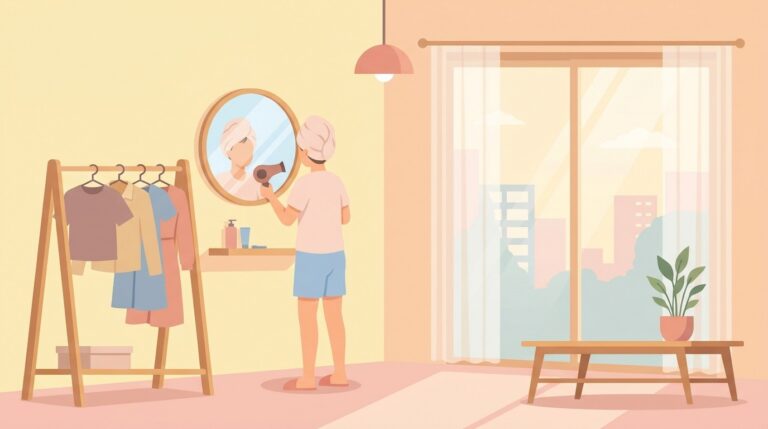
Master Korean Morning Routine: How to Say Drying Hair and Dressing Up Like a Local
Phase 1: 공감 (Story-Immersive Opening)
안녕하세요! 매일한글 에디터입니다. (Hello! I’m your Daily Hangul editor.) Have you ever watched a slice-of-life K-drama or an idol’s morning vlog and noticed the relatable chaos before leaving the house? The alarm blares, someone rushes out of the bathroom with a towel around their shoulders, frantically searching for a hairdryer while yelling to their housemate, “Where is my white shirt?”
Getting ready in the morning is a universal human experience, but when you are learning Korean, talking about your routine can suddenly feel intimidating. Many of our absolute beginner students tell us: “Teacher, I know how to say ‘hello’ and ‘thank you’, but how do I tell my Korean host family or roommate that I am simply blow-drying my hair and getting dressed?”
If you have ever stood frozen in front of a mirror wondering whether you wear clothes the same way you wear shoes in Korean, this lesson is for you. Based on real classroom hurdles from hundreds of beginner students, this guide breaks down essential, everyday morning actions into bite-sized, natural steps. By the end of this 5-minute guide, you will be able to describe your morning grooming routine with pure confidence—just like a Seoul local heading out for an exciting day!
Phase 2: 핵심 표현 3선 심층 분석 (Top 3 Core Expressions)
1. 머리를 말려요 (Meorireul mallyeoyo)
- Pronunciation: [Meo-ri-reul mal-lyeo-yo] (Sound analogy: Say “Maw-ree” like ‘morning’, then “mal-lyuh-yo” rhyming with ‘call you yo’)
- Meaning: Literal: “I dry my hair” | Real Nuance: Blow-drying or towel-drying your hair after washing it.
- K-Culture Moment: You’ll see this in almost every Korean morning vlog when creators film their aesthetic vanity table setup before applying toner and sunscreen.
- Editor’s Insight: In Korean, 머리 (meori) literally means “head,” but in daily context, it almost always refers to the “hair on your head”! You don’t need to say the longer word 머리카락 (meorikarak – hair strand) when talking about styling or drying.
- Situation Spectrum: Casual: ✅ | Semi-formal: ✅ | Formal: ⚠️
- 🤔 Think About It: In English, we specify “hair” versus “head”, but Korean often uses the whole body part (머리) to encompass both. What does this tell you about Korean language’s context-driven nature?
2. 옷을 입어요 (Oseul ibeoyo)
- Pronunciation: [O-seul i-beo-yo] (Sound analogy: “Oh-seul” sounds like ‘oath-l’, followed by “ee-buh-yo”)
- Meaning: Literal: “I wear clothes” | Real Nuance: “I am getting dressed” or “I put on my outfit.”
- K-Culture Moment: In K-dramas, whenever someone is about to change out of their loungewear into an outdoor outfit, they announce, “나 옷 입을게! (I’m going to get dressed!)”
- Editor’s Insight: Watch out! Korean is super specific about wearable items. 입다 (ipda) is reserved exclusively for the torso and legs (shirts, pants, dresses, jackets). For shoes, hats, and glasses, Korean uses completely different verbs!
- Situation Spectrum: Casual: ✅ | Semi-formal: ✅ | Formal: ✅
- 🤔 Think About It: English uses the versatile verb “to put on” for clothes, perfume, shoes, and hats. Why do you think Korean developed separate action verbs for different body zones?
3. 늦겠어요! (Neutgesseoyo!)
- Pronunciation: [Neut-ge-sseo-yo] (Sound analogy: “Neut” sounds like ‘nut’ said with flat lips, then “get-so-yo”)
- Meaning: Literal: “It seems it will be late” | Real Nuance: “I’m going to be late!” or “We’re running late!”
- K-Culture Moment: The iconic scene in high school dramas where students dash out the door with toast in their mouths, checking their wristwatches in a panic.
- Editor’s Insight: The -겠어요 (-gesseoyo) ending shows high probability or anticipation. It conveys that urgency when you look at the clock and realize your train arrives in 7 minutes!
- Situation Spectrum: Casual: ✅ | Semi-formal: ✅ | Formal: ✅
- 🤔 Think About It: Notice how Koreans express lateness as an unfolding state rather than just a personal failure. It expresses shared urgency!
Phase 3: 교과서 한국어 vs 진짜 한국어 (Textbook vs. Real-Life Korean)
Situation 1: Telling your roommate you are drying your hair
- 📖 교과서 한국어 (Textbook): 저는 머리를 건조합니다. (Jeoneun meorireul geonjohamnida. / “I am drying my head-hair.”)
- 🗣️ 진짜 한국어 (Real-Life): 머리 말려요. (Meori mallyeoyo. / “Drying my hair.”) or 머리 금방 말려요! (Meori geumbang mallyeoyo! / “I’ll dry my hair in a flash!”)
- 💡 왜 다를까? (Why the difference?): 건조하다 (to dehydrate/dry) sounds like a laboratory manual or an appliance instruction sheet. Real native speakers casually drop the subject pronoun “저 (I)” and use the warm, natural verb “말리다 (mallida)”.
Situation 2: Choosing what to wear in the morning
- 📖 교과서 한국어 (Textbook): 저는 의복을 착용합니다. (Jeoneun uibogeul chagyonghamnida. / “I put on garments.”)
- 🗣️ 진짜 한국어 (Real-Life): 옷 입어요. (Ot ibeoyo. / “Getting dressed.”) or 오늘 뭐 입지? (Oneul mwo ipji? / “What should I wear today?”)
- 💡 왜 다를까? (Why the difference?): Words like “의복 (clothing)” and “착용 (donning)” belong on official government signs or airline safety guides. Daily Korean conversations love short, cozy native words like “옷 (ot)” and “입다 (ipda)”.
Phase 4: K-Culture 딥다이브 & 비언어적 매너 (Culture Deep Dive & Non-Verbal Manners)
4-1. 눈치 (Nunchi) & Morning Gestures
- The Shared Bathroom Signal: If you live with Korean roommates or in a dormitory (기숙사), never leave wet hair clumps in the bathroom drain. After blow-drying, it is considered polite 센스 (sens – good etiquette) to take a sheet of toilet tissue and clean up fallen hair strands instantly.
- Checking Your Look (거울 보기): When checking your outfit in public transit window reflections, do it subtly! Quick, polite glances without blocking passenger pathways is the Korean golden rule of urban eye etiquette.
4-2. Cultural Code: The Iconic Hair Roller & ‘Kku-An-Kku’
- The Public Hair Roller (헤어롤 / 구루프): If you ride the Seoul subway at 8:00 AM, don’t be shocked to see young Koreans casually wearing a single plastic Velcro hair roller clipped to their bangs! It’s not considered sloppy; it’s a smart, normalized morning time-saver so their bangs look bouncy the second they step into class or the office.
- The ‘Kku-An-Kku’ (꾸안꾸) Aesthetic: Short for 꾸민 듯 안 꾸민 듯 (styled yet effortless), this is Korea’s gold standard for daily morning outfits—clean oversized shirts, neat sneakers, and tidy hair.
Phase 5: 실전 롤플레이 시나리오 (Real-Life Roleplay Scenario)
Setting: A cozy Seoul sharehouse at 8:15 AM. You and your Korean roommate Minji are rushing to catch the 8:30 AM subway!
- Minji: 아직 안 일어났어요? 벌써 여덟 시 십오 분이에요! (Ajik an ireonasseoyo? Beolsseo yeodeol si sibo bunieyo!)
🎭 Knocking lightly on your door
“You’re not up yet? It’s already 8:15!” - You: 헉, 진짜요? 아이고, 늦겠어요! (Heok, jinjjayo? Aigo, neutgesseoyo!)
🎭 Jumping out of bed in a hurry
“Whoa, really? Oh gosh, I’m going to be late!” - Minji: 드라이기 화장대 위에 있어요! 얼른 써요. (Deuraigi hwajangdae wie isseoyo! Eolleun sseoyo.)
🎭 Pointing toward the vanity table
“The hairdryer is on the vanity! Use it quickly.” - You: 고마워요! 얼른 머리 말리고 옷 입을게요. (Gomawoyo! Eolleun meori malligo ot ibeulgeyo.)
🎭 Grabbing a towel and heading for the dryer
“Thanks! I’ll dry my hair and get dressed right away.”
🔀 인터랙티브 분기점 (Choose Your Response)
Minji looks over at you and asks: “준비 다 끝났어요? (Are you completely finished getting ready?)” How do you respond?
- Option A: “네, 머리 말리고 옷 다 입었어요! 가요! (Ne, meori malligo ot da ibeosseoyo! Gayo!)”
- Feedback (Best): Spot on! You used the connector “-고 (-go / and)” smoothly: “I dried my hair AND put on all my clothes! Let’s go!” Natural and warm.
- Option B: “아니요, 모자 입어요. (Aniyo, moja ibeoyo.)”
- Feedback (Risk): Oops! Remember our golden rule: You do NOT 입다 (ipda) a hat. Hats take the verb 쓰다 (sseuda)! Minji will understand, but it sounds cute and slightly awkward.
- Option C: “몰라요. (Mollayo.)”
- Feedback (Bad): “I don’t know.” This sounds blunt, dismissive, and cold. Even in casual friendships, expressing your status clearly keeps morning harmony!
Phase 6: 10초 감정 섀도잉 드릴 (Emotion Shadowing Drill)
Practice reading these out loud! Slashes (/) indicate natural breath pauses:
[😱 당황하고 다급하게 - Panicked & Rushed]
벌써 여덟 시예요? / 아이고, / 늦겠어요!
(Beolsseo yeodeol si-yeyo? / Aigo, / neutgesseoyo!)
“It’s already eight o’clock? / Oh gosh, / I’m going to be late!”-
[🥱 졸리고 나른하게 - Sleepy & Drowsy]
하암… / 머리 먼저 말리고 / 옷 입을게요…
(Ha-am… / meori meonjeo malligo / ot ibeulgeyo…)
“Yaaawn… / I’ll dry my hair first / and then get dressed…” -
[✨ 산뜻하고 자신있게 - Fresh & Confident]
머리 다 말렸어요! / 오늘 옷 / 어때요?
(Meori da mallyeosseoyo! / Oneul ot / eottaeyo?)
“My hair is completely dry! / How does my outfit / look today?”
Phase 7: K-Culture 미니 사전 (Mini Dictionary)
- 드라이기 (Deuraigi) | Noun: Hairdryer
Korean borrows “dryer” from English, but universally refers specifically to the hair styling tool. If you ask for a “건조기 (geonjogi)”, locals will think you mean a heavy clothes dryer! - 구루프 (Gurupeu) / 헤어롤 (Heeorol) | Noun: Hair roller / Curler
“Gurupeu” comes from the French word groupe via loanword history, while “헤어롤” is modern Konglish. Both are instantly understood across beauty salons and dorms. - 꾸안꾸 (Kku-An-Kku) | Slang: Effortless chic style
An abbreviation of “꾸민 듯 안 꾸민 듯” (styled as if not styled). Used to praise someone who looks effortlessly fashionable in everyday morning outfits. - 지각 (Jigak) | Noun: Tardiness / Being late
Used in schools and companies. If you are running late, you tell your boss or teacher: “지각할 것 같아요 (I think I will be late).”
Phase 8: 여행자를 위한 생존 키트 (Traveler’s Survival Kit)
TOP 3 Survival Phrases
- 드라이기 있어요? (Deuraigi isseoyo?)
Pronunciation: [Deu-ra-i-gi i-sseo-yo?]
Pro Tip: Essential when staying at guesthouses, hanok stays, or boutique hotels where the dryer might be stored inside a vanity drawer. - 거울 어디 있어요? (Geoul eodi isseoyo?)
Pronunciation: [Geo-ul eo-di i-sseo-yo?]
Pro Tip: Use this to locate full-body mirrors when trying on clothes or finishing your outfit. - 오늘 날씨 어때요? (Oneul nalssi eottaeyo?)
Pronunciation: [O-neul nal-ssi eo-ttae-yo?]
Pro Tip: Perfect question to ask the front desk staff or your host before deciding what layer of clothes to wear.
🧳 Editor’s Travel Note
- Voltage Alert: South Korea uses 220V round two-prong plugs (Type C and F). High-wattage American or Japanese 110V blow dryers will overheat or short-circuit! Use the hotel dryer provided or buy an inexpensive Korean travel dryer at Daiso.
- Transit Preparation: Morning subway rush hours (지하철 출근길, 7:30 AM – 9:00 AM) are intense. Before you step out, verify train intervals using the 네이버 지도 앱 다운로드 to calculate your exact walking and transfer time down to the minute!
Phase 9: “한 발 더 깊이” (Cultural Reflection Essay)
Korea is internationally famous for its 빨리빨리 (ppalli-ppalli / quick-quick) fast-paced rhythm, especially during the weekday morning rush. Yet, despite rushing through showers and commutes, you will rarely see anyone step outside with disheveled clothes or uncombed wet hair. In Korean society, presenting a neat, well-groomed personal appearance (단정한 모습) is considered a fundamental sign of respect toward colleagues, classmates, and the community you share public space with. Taking care of your clothes and hair isn’t vanity—it is quiet social consideration.
💬 Your Turn: How does your home culture treat morning routines and public appearance? Do you prefer a relaxed morning, or are you a 15-minute speed demon? Share your routine in the comments below!
Phase 10: FAQ & 오해 방지 (FAQ & Common Mistakes)
Q: Can I use “입다 (ipda)” when putting on my shoes and socks?
A: No! In Korean, 입다 (ipda) is strictly for body clothes (shirts, pants, skirts, coats). For socks and shoes, you must use 신다 (sinda). For hats, use 쓰다 (sseuda).
Q: What is the difference between “머리를 말려요” and “머리를 감아요”?
A: 머리를 감아요 (meorireul gamayo) means “I wash/shampoo my hair.” After washing, you do 머리를 말려요 (meorireul mallyeoyo), which means “I dry my hair.”
Q: How do I tell someone to “hurry up and get ready” politely?
A: You can say, “얼른 준비해요! (Eolleun junbihaeyo!)” or in friendly polite terms, “서둘러요! (Seodulleoyo! – Let’s hurry!)”
🚨 Common Mistakes Warning Board
- Mistake: Saying “신발을 입어요 (Sinbareul ibeoyo)” for wearing shoes.
👉 Correct Action: Always say “신발을 신어요 (Sinbareul sineoyo)”. - Mistake: Saying “머리를 닦아요 (Meorireul dakk-ayo)” when blow-drying.
👉 Correct Action: “닦다” means to wipe or scrub surfaces. Use “머리를 말려요 (Meorireul mallyeoyo)” for drying hair. - Mistake: Overusing pronoun “저 (I)” every single sentence (저는 머리 말려요, 저는 옷 입어요).
👉 Correct Action: Drop “저는”! In Korean, context already reveals that you are doing the action.
Phase 11: 액션 미션 & 참여 유도 (Action Missions)
- 🥉 Bronze Mission (Solo Mirror Drill): Tomorrow morning, stand in front of your mirror while drying your hair and say out loud: “머리를 말려요!” Then, pick up your shirt and say: “옷을 입어요!”
- 🥈 Silver Mission (Voice Memo): Record a 5-second voice note using the shadowing line: “머리 말리고 옷 입어요! (Meori malligo ot ibeoyo!)” and play it back to check your rhythm.
- 🥇 Gold Mission (Real-Life Chat): Use “오늘 날씨 어때요? (Oneul nalssi eottaeyo?)” with a Korean study partner or write it as a comment on our Daily Hangul community post!
- 🎮 K-Culture Mission: Watch the first 10 minutes of any college K-drama (like Weightlifting Fairy Kim Bok-joo or Cheese in the Trap) and see if you spot characters using hair rollers or shouting “늦겠어요!”
Phase 12: Interactive Quiz Challenge
Test your A1 Korean morning routine vocabulary before opening the answers below!
- Situational Judgment: Your roommate is running late and still in pajamas. What is the most natural friendly Korean way to say “Get dressed quickly!”?
- A) 빨리 옷을 착용하세요! (Ppalli oseul chagyonghaseyo!)
- B) 빨리 옷 입어요! (Ppalli ot ibeoyo!)
- C) 빨리 머리 감아요! (Ppalli meori gamayo!)
- Fill-in-the-Blank: Choose the correct verb for putting on clothes (“Dress warmly!”):
바람이 많이 불어요. 따뜻하게 ( )!- A) 신어요 (sineoyo)
- B) 써요 (sseoyo)
- C) 입어요 (ibeoyo)
- True or False (Cultural Quiz): In everyday Korean, people usually say “머리카락을 말려요” rather than “머리를 말려요” when blow-drying their hair. (True / False)
Click to Reveal Quiz Answers & Detailed Explanations
- Answer: B (빨리 옷 입어요!).
- Explanation: 옷 입어요 is natural, warm, and everyday. Option A (착용하세요) sounds like an airplane safety announcement, and Option C means “Wash your hair quickly!”
- Answer: C (입어요 / ibeoyo).
- Explanation: 입어요 is used for shirts, coats, and pants. Remember: 신어요 is for shoes/socks, and 써요 is for hats/glasses!
- Answer: False.
- Explanation: Native speakers almost always shorten it to 머리 말려요 (meori mallyeoyo) in daily conversation!
🎬 Watch Our Daily Videos! (Daily Hangul Official Instagram)
Review the expressions you learned in this article with our fun daily short videos! Check out native pronunciation and real-life nuances in action.
- Instagram @dailyhangul_en







