

Phase 1: 공감 (Story-Driven Opening)
안녕하세요! 매일한글 에디터입니다.
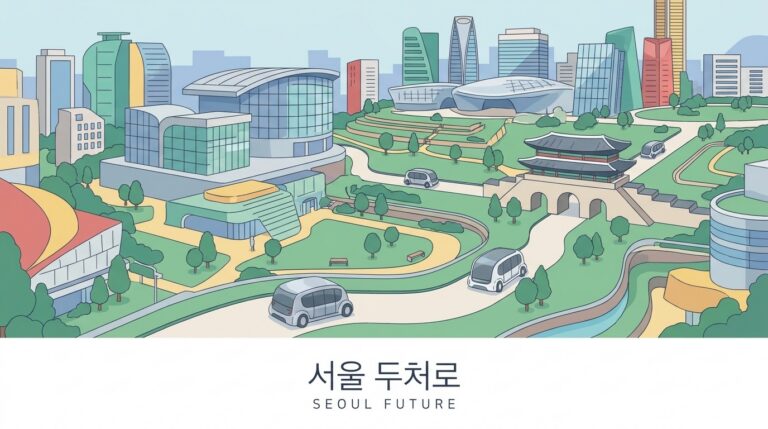
Imagine stepping out into the neon-drenched dusk of Sangam Digital Media City or the gleaming boulevards of Pangyo Techno Valley. The whisper-quiet hum of an autonomous electric shuttle glides past the curb—no driver behind the wheel, its roof-mounted LiDAR spinning silently against a backdrop of modern glass towers and bustling street-food stalls. While beginner Korean learners practice hailing a standard orange taxi with a polite hand wave, you are standing at the frontier of a massive societal shift.
When we discuss autonomous driving—specifically End-to-End AI and Software-Defined Vehicles (SDVs)—we aren’t just talking about cool gadgets. In South Korea, this conversation directly intersects with hyper-dense urban planning, the reclamation of precious commercial parking lots into lush public parks, the seismic disruption of Coupang-style overnight logistics supply chains, and complex legal debates over product liability. Advanced foreign professionals and researchers often share their frustration with me: “I know high-level English tech jargon, but the moment I step into a Korean policy summit or an SDV engineering round-table, I lack the precise idiomatic elegance to debate liability frameworks without sounding robotic or blunt.”
Drawing from years of coaching corporate executives, mobility analysts, and legal consultants navigating Korea’s regulatory sandboxes, this guide gives you the nuanced, debate-ready C2 vocabulary needed to articulate these systemic transformations naturally. Let’s step beyond textbook grammar and command the future of mobility in Korean.
Phase 2: 핵심 표현 3선 심층 분석 (3 Core Expressions Deep Dive)
1. 패러다임의 대전환을 맞이하다 (Paeleodaim-ui daejeonhwan-eul maj-ihada)
- Pronunciation: [Pae-reo-da-im-ui dae-jeon-hwan-eul ma-ji-ha-da] (Think: “Paradigm” + “Day-john-hwan” + “Ma-jee-ha-da”)
- Meaning: Literally “to welcome a grand turn of paradigm”; practically nuance: “To stand on the threshold of an epochal paradigm shift.”
- K-Culture Moment: Commonly heard in high-stakes Korean tech documentaries (like KBS Insight) or keynote addresses at the Seoul Mobility Show when tech titans unveil autonomous trucking platforms.
- Editor’s Insight: 맞이하다 (to welcome/receive) humanizes abstract structural changes. It conveys that society is not merely suffering an impact passively, but actively greeting a transformative historical juncture.
- Situation Spectrum: Casual 🚫 | Semi-formal ⚠️ | Formal ✅
- 🤔 Think About It: In English, we often say “disrupting the industry.” Why do Koreans gravitate toward philosophical phrasing like “welcoming a paradigm shift” in formal public forums?
2. 공간의 생태적 환원 (Gonggan-ui saengtaejeok hwan-won)
- Pronunciation: [Gong-gan-ui saeng-tae-jeok hwan-won] (Phonetic flow: sounds like “Gong-gahn-ee sang-teh-juck hwan-won”)
- Meaning: Literally “ecological return/restitution of space”; practically nuance: “Reclaiming grey urban concrete (parking lots, multi-lane roads) back into public green biosphere.”
- K-Culture Moment: Used by urban reform panels in Korean architectural programs and local government press conferences discussing the master plan for smart cities like Sejong or Songdo.
- Editor’s Insight: The term 환원 (hwan-won) implies returning something to its original, rightful state. Using this phrase frames autonomous fleets not just as tech efficiency, but as an ethical restoration of public living space from car dominance.
- Situation Spectrum: Casual 🚫 | Semi-formal ⚠️ | Formal ✅
- 🤔 Think About It: How does framing urban planning around 환원 (restoring what was lost) reflect Korea’s rapid industrialization and contemporary desire for healing (힐링)?
3. 책임 소재를 명확히 규명하다 (Chaeg-im sojae-reul myeonghwakhi gyumyeonghada)
- Pronunciation: [Chek-im so-jae-reul myeong-hwa-ki gyu-myeong-ha-da] (Pronounce the ‘h’ sound aspirated with ‘k’: myeong-hwa-khi)
- Meaning: Literally “to investigate and identify the location of responsibility”; practically nuance: “To legally and technically demarcate liability among stakeholders.”
- K-Culture Moment: Often delivered with razor-sharp gravity in legal K-dramas (such as Hyena or Stranger) when dissecting systemic fault versus human error.
- Editor’s Insight: 책임 소재 (where the liability resides) is the absolute gold standard in Korean administrative and tort law. It separates amateur opinions from expert regulatory analysis.
- Situation Spectrum: Casual 🚫 | Semi-formal ⚠️ | Formal ✅
- 🤔 Think About It: When an End-to-End AI model causes an accident, who answers for it? Notice how Korean legal terminology focuses on 소재 (the seat/place of residence) of responsibility.
Phase 3: 교과서 한국어 vs 진짜 한국어 (Textbook vs. Real-World C2 Korean)
Context 1: Discussing logistics cost reduction through self-driving freight
- 📖 교과서 한국어: 자율주행 화물 트럭을 도입하면 물류 운송 비용을 많이 절감할 수 있습니다. (Jayuljuhaeng hwamul teuleog-eul do-ibhyeon mullyu unseong biyong-eul man-i jeolgamhal su issseumnida. / If autonomous freight trucks are introduced, we can reduce logistics transport costs a lot.)
- 🗣️ 진짜 한국어: 24시간 무인 간선 수송이 안착되면, 물류 공급망의 한계 비용은 기하급수적으로 수렴하게 마련이죠. (Isipsigan muin ganseon susong-i anchakdoemyeon, mullyu gong-geubmang-ui hangye biyong-eun gihageubsujeog-eulo sulyeomhage maryeon-ijyo. / Once 24-hour driverless trunk-line transport stabilizes, the marginal cost of the supply chain inevitably collapses toward zero.)
- 💡 왜 다를까?: Native Korean executives and researchers avoid elementary intensifiers like 많이 (a lot). Instead, they deploy domain-specific terms like 간선 수송 (trunk-line hauling) and philosophical-economic verbs like 수렴하다 (converge/collapse into).
Context 2: Debating legal liability in SDV software malfunctions
- 📖 교과서 한국어: 사고가 나면 소프트웨어 회사나 자동차 회사 중에서 누가 잘못했는지 따져야 합니다. (Sagoga namyeon sopeuteuwe-eo hoesana jadongcha hoesa jung-eseo nuga jalmothaessneunji ttajyeoya hamnida. / If an accident occurs, we must figure out who did wrong between the software company and the car company.)
- 🗣️ 진짜 한국어: E2E 딥러닝의 블랙박스 특성상, 알고리즘 결함과 제조물 배상 책임 간의 인과관계를 입증하기란 결코 녹록지 않아요. (E2E dibleoning-ui beullaekbagseu teukseongsang, algo-lijeum gyeolhamgwa jejomul baesang chaeg-im gan-ui ingwagwan-gye-leul ibjeunghagilan gyeolko noklokji anh-ayo. / Given the black-box nature of End-to-End deep learning, establishing a causal nexus between algorithmic defects and product liability is by no means an easy task.)
- 💡 왜 다를까?: C2 discourse relies on idiomatic legal phrases (인과관계를 입증하다 – prove causality) combined with refined cultural idioms like 결코 녹록지 않다 (by no means a walk in the park).
Phase 4: K-Culture 딥다이브 & 비언어적 매너 (Non-Verbal Nuance & Cultural Code)
4-1. 눈치 (Nunchi) & Tech-Discourse Gestures
In Korean corporate-legal boardrooms (especially around Gangnam or Pangyo), debating technological liability requires careful emotional calibration. Challenging an engineering team’s algorithm or an OEM’s safety track record directly can cause severe loss of face (체면 손상).
* The Softening Tilt: When raising legal vulnerability or liability pitfalls, keep your posture slightly tilted forward, resting your palms flat or softly interlinked on the table.
* The Gaze: Avoid persistent, combative eye contact when pointing out systemic flaws. Instead, look down thoughtfully at the briefing dossier, then look up with a subtle nod, starting your critique with: “물론 기술적 완성도는 경이롭습니다만…” (While the technical prowess is undoubtedly astonishing…).
4-2. The Cultural Code: “빨리빨리” (Speed) meets “안전제일” (Safety First)
South Korea has the world’s most hyper-competitive e-commerce logistics infrastructure—symbolized by Dawn Delivery (새벽배송). Autonomous freight trucks represent the ultimate evolution of this speed-centric culture. However, after high-profile battery and software safety debates in apartment underground parking structures across Seoul, public psychology has swung violently toward hyper-precaution. When discussing autonomous vehicles in Korea, you must acknowledge this cultural duality: Koreans desire the frictionless efficiency of robotaxis, yet demand absolute zero-tolerance when it comes to algorithmic liability.
Phase 5: 실전 롤플레이 시나리오 (Real-World Roleplay Scenario)
Setting: The VIP lounge of the Pangyo Autonomous Mobility Center. Glass partitions overlook the testing ground where camera-and-sensor laden robotaxis maneuver silently.
Characters:
* Elena: Visiting Mobility Policy Fellow drafting an urban redevelopment thesis.
* Min-jae (민재): Lead SDV Architect and Legal Counsel for a Korean autonomous driving consortium.
Turn 1
Elena: 민재 님, 도심 내 로보택시 거점이 확충되면 기존 유휴 주차 부지는 어떻게 재편될 것으로 보시나요? (Min-jae nim, dosim nae lobotaegsi geojeom-i hwagchungdoemyeon gijon yuhyu juchabujineun eotteohge jaepyeondoel geos-eulo bosinayo?)
🎭 Leaning forward with curious interest, pen poised over her tablet.
“Min-jae, if downtown robotaxi hubs expand, how do you foresee existing idle parking lots being reorganized?”
Turn 2
Min-jae: 차량 소유율이 급감하면서 지상 주차면의 70% 이상을 도심 숲이나 녹지 보행로로 환원하는 지자체 조례가 급물살을 탈 겁니다. (Chalyang soyuyul-i geubgamhamyeonseo jisang juchamyeon-ui chilsib peosenteu isang-eul dosim sup-ina nokji bohaenglo-lo hwan-wonhaneun jijache jolye-ga geubmulsal-eul tal geomnida.)
🎭 Gesturing toward the smart-city blueprints displayed on the wall monitor.
“With private vehicle ownership plummeting, municipal ordinances aimed at returning over 70% of above-ground parking lots into urban forests and green pedestrian walkways will rapidly gain momentum.”
Turn 3
Elena: 물류 공급망 측면에서도 자율주행 간선 트럭이 야간 물동량을 전담하게 되면 혁신적인 원가 절감이 가능하겠군요. (Mullyu gong-geubmang cheukmyeon-eseodo jayuljuhaeng ganseon teuleog-i yagan muldonglyang-eul jeondamhage doemyeon hyeoksinjeog-in won-ga jeolgam-i ganeunghagessgunyo.)
🎭 Nodding analytically, taking strategic notes.
“In terms of the supply chain as well, if autonomous trunk trucks take full charge of nighttime freight volume, revolutionary cost reductions will be attainable.”
Turn 4
Min-jae: 맞습니다. 다만 차고지 증명제 완화와 맞물려 화물 운송 노동계와의 사회적 대타협이라는 중대한 선결 과제가 남아있죠. (Masseumnida. Daman chagoji jeungmyeongje wanhwawa majmullyeo hwamul unseong nodong-gyewaui sahoejeok daetahyeob-ilaneun jungdaehan seongyeol gwajega nam-aissjyo.)
🎭 Sighs quietly, interlocking his fingers with pragmatic gravitas.
“Precisely. However, coupled with the easing of proof-of-garage requirements, a grand social compromise with the freight transport labor unions remains an indispensable prerequisite.”
Turn 5
Elena: 기술 발전의 속도에 비해 배상 책임에 관한 법적 거버넌스는 다소 후행하는 느낌을 지울 수 없네요. (Gisul baljeon-ui sokdo-e bihae baesang chaeg-im-e gwanhan beobjeok geobeoneonseuneun daso huhaenghaneun neukkim-eul jiul su eobsneyo.)
🎭 Touching her chin thoughtfully with a mild analytical frown.
“Compared to the velocity of technological advancement, one cannot shake the impression that legal governance regarding tort liability is lagging behind somewhat.”
Turn 6
Min-jae: 정곡을 찌르셨어요. 완전 자율주행 단계에서 오작동이 발생했을 때, OTA 소프트웨어 배포사와 완성차 OEM 간의 과실 상계 기준이 여전히 모호합니다. (Jeonggog-eul jjileusyeoss-eoyo. Wanjeon jayuljuhaeng dangye-eseo ojakdong-i balsaenghaess-eul ttae, OTA sopeutu-we-eo baeposa-wa wanseongcha OEM gan-ui gwasil sang-gye gijun-i yeojeonhi mohohamnida.)
🎭 Tapping a finger decisively on the legal statute printout.
“You hit the nail on the head. When a malfunction occurs in full autonomous driving mode, the standard for comparative negligence between the OTA software distributor and the vehicle OEM remains ambiguous.”
Turn 7
Elena: 결국 징벌적 손해배상이나 결함 입증 책임의 전환 같은 법리적 보완책이 선제적으로 마련되어야겠군요. (Gyeolguk jingbeoljeok sonhaebaesang-ina gyeolham ibjeung chaeg-im-ui jeonhwan gateun beobliljeok bo-wanchaeg-i seonjejeog-eulo malyeondoeeoyagessgunyo.)
🎭 Maintaining an inquiring, earnest posture.
“Ultimately, legal safeguards such as punitive damages or shifting the burden of proof for defects must be instituted preemptively.”
Turn 8
Min-jae: 바로 그겁니다. 기술의 효용을 만끽하기 위해선 사회적 신뢰를 담보할 제도적 안전망 구축이 필수적이니까요. (Balo geugeobnida. Gisul-ui hyoyong-eul mankkighagi wihaeseon sahoejeok sinloeleul dambohal jedojeok anjeonmang guchuk-i pilsujeog-inikkayo.)
🎭 Offering a warm, approving smile and extending a hand.
“That is spot on. To truly relish the utility of technology, building an institutional safety net that guarantees societal trust is paramount.”
🔀 인터랙티브 분기점 (Interactive Choice)
You want to challenge Min-jae on the timeline of deploying driverless freight on the Gyeongbu Expressway. How do you respond?
- Option A: “어차피 기술이 다 해결해 주는데 정부 규제 철폐가 우선 아닌가요?” (Since tech solves everything anyway, isn’t deregulation top priority?)
- Option B: “공공 인프라 실증 사업과 병행하여 단계적 면책 기준을 조례화하는 접근은 어떻게 평가하십니까?” (How do you evaluate an approach that legislates phased immunity criteria in tandem with public infrastructure demonstration pilots?)
- Option C: “기사님들 반발 때문에 한국에서는 자율주행 트럭 상용화가 10년은 불가능할 것 같은데요.” (Due to truck driver pushback, autonomous freight commercialization seems impossible in Korea for 10 years.)
Feedback Guide:
* Option A (Risk): Sounds overly Silicon Valley techno-chauvinistic. In Korea, disregarding labor equity and regulatory consensus makes you sound oblivious to public policy harmony.
* Option B (Best): Perfect C2 level! Uses institutional terms (실증 사업, 면책 기준, 조례화) and seeks balanced policy evaluation.
* Option C (Bad): Far too fatalistic and dismissive (10년은 불가능). It kills constructive dialogue with an industry professional.
Phase 6: 10초 감정 섀도잉 드릴 (Emotional Shadowing Drill)
Practice these 3 critical cadence patterns out loud! Focus on the pauses marked with / and internalize the emotional signposts.
- [🧐 Analytical & Measured Insight]
“단순한 이동 수단의 혁신을 넘어, / 도시 공간의 생태적 환원이라는 / 거대한 철학적 전환을 / 내포하고 있습니다.”
(Dan-sun-han i-dong su-dan-ui hyeok-sin-eul neo-meo, / do-si gong-gan-ui saeng-tae-jeok hwan-won-i-ra-neun / geo-dae-han cheol-hak-jeok jeon-hwan-eul / nae-po-ha-go it-seum-ni-da.)
“Transcending mere innovation in transit, / it encapsulates a monumental philosophical transformation: / the ecological restitution of urban space.” -
[⚖️ Firm Legal Discernment]
“인공지능의 자율적 판단 영역에 대해 / 제조물 배상 책임을 어디까지 물을 것인가는 / 사회적 합의가 시급합니다.”
(In-gong-ji-neung-ui ja-yul-jeok pan-dan yeong-yeok-e dae-hae / je-jo-mul bae-sang chaek-im-eul eo-di-kka-ji mu-reul geot-in-ga-neun / sa-hoe-jeok hap-ui-ga si-geup-ham-ni-da.)
“Determining the extent to which product liability applies / to the realm of autonomous AI judgment / demands an urgent societal consensus.” -
[🤝 Diplomatic Persuasion]
“기존 물류 종사자들과의 상생 없는 혁신은 / 결국 극심한 사회적 매몰 비용을 / 초래할 수밖에 없어요.”
(Gi-jon mul-lyu jong-sa-ja-deul-gwa-ui sang-saeng eom-neun hyeok-sin-eun / gyeol-guk geuk-sim-han sa-hoe-jeok mae-mol bi-yong-eul / cho-rae-hal su-bak-e eop-seo-yo.)
“Innovation devoid of co-prosperity with incumbent logistics workers / will inevitably incur / devastating social sunk costs.”
Phase 7: K-Culture 미니 사전 (Core Tech-Society Dictionary)
-
소프트웨어 정의 차량 (SDV – Sopheutu-we-eo Jeong-ui Chalyang)
- Meaning: Software-Defined Vehicle.
- Context: In Korean business columns, SDVs are described as “smartphones on wheels” (바퀴 달린 스마트폰). It implies that vehicular value lies in continuous over-the-air (OTA) updates rather than mechanical horsepower.
- 입증 책임의 전환 (Ibjeung Chaeg-im-ui Jeonhwan)
- Meaning: Reversal of the burden of proof.
- Context: Crucial in Korean legal debates. Traditionally, the victim of a car crash must prove mechanical defects. In autonomous SDVs, consumer advocates push for the legal burden to be shifted (전환) to the AI automaker.
- 녹지 보행축 (Nokji Bohaengchuk)
- Meaning: Urban green pedestrian axis.
- Context: Urban development terminology frequently cited by the Seoul Metropolitan Government. As autonomous parking consolidates off-site, above-ground streets are re-zoned into continuous park pathways connecting riverfronts and residential sectors.
- 규제 샌드박스 (Gyuje Saendeubagseu)
- Meaning: Regulatory Sandbox.
- Context: Essential phrase for anyone testing foreign tech in Korea. It designates legally shielded zones (such as Sangam DMC or Gangnam) where existing transportation rules are temporarily suspended to pilot autonomous technology.
Phase 8: 여행자를 위한 생존 키트 (Tech Explorer Survival Kit)
3 Survival Phrases for Smart Mobility Hubs in Korea
- 이 구역은 자율주행 시범 운행 지구인가요?
(I gu-yeok-eun ja-yul-ju-haeng si-beom un-haeng ji-gu-in-ga-yo?)
Pro Tip: Perfect when visiting Sangam or Cheonggyecheon to confirm if the shuttle running next to you is autonomous. -
무인 셔틀 탑승 예약은 전용 앱으로만 가능한가요?
(Mu-in syeo-teul tap-seung ye-yak-eun jeon-yong aep-eu-ro-man ga-neung-han-ga-yo?)
Pro Tip: Most public robotaxis in Seoul require digital check-ins via local municipal or mobility apps. -
비상 정지 시스템은 수동 개입이 가능한 구조인가요?
(Bi-sang jeong-ji si-seu-tem-eun su-dong gae-ip-i ga-neung-han gu-jo-in-ga-yo?)
Pro Tip: Highly sophisticated technical query when interviewing autonomous safety operators onboard.
Editor’s Field Note: Navigating Korea’s Smart Mobility Realities
If you are visiting Seoul to observe autonomous infrastructure, don’t rely on global map services—their local routing is restricted by Korean geodata laws. Instead, equip your phone with the Naver Map route planner to locate designated autonomous transit pilot stops. For booking real-world autonomous trial shuttles in Gangnam and Sangam, consult the Kakao T smart mobility platform or regional autonomous transit portals operated by the Seoul Metropolitan Government. Note: foreign credit cards work fine, but you’ll almost always need local cellular authentication (본인인증) for autonomous beta services!
Phase 9: “한 발 더 깊이” (Philosophical Synthesis)
South Korea’s relentless modernization is characterized by what sociologists term “compressed growth” (압축성장). In just three decades, the country evolved from unpaved agricultural tracks to hyper-connected megacities dominated by subterranean concrete and high-density parking garages. Now, the rise of SDVs and robotaxis represents the inversion of that history: the physical de-densification of asphalt in pursuit of communal green sanctuaries. Yet, Korean society is fundamentally relational and collectivist; liability is never purely an individual contract—it is an evaluation of social responsibility. In debating autonomous vehicle liability, Korean discourse demands not just algorithmic fault-trees, but an answer to how technology preserves the civic dignity of the common space.
💬 Your Turn: Do you believe urban parking spaces in your home country should be legally mandated to turn into green parks once robotaxis reach Level 4 autonomy? How would the legal liability fall if an autonomous vehicle malfunctioned in your city? Share your thoughts below in Korean!
Phase 10: FAQ & 오해 방지 (FAQ Schema & Pitfalls)
Q: Can I use the phrase “운전기사 없는 차” when speaking at a formal conference?
A: While grammatically correct, “운전기사 없는 차” (car without a chauffeur) sounds colloquial and childish in professional settings. At C2 level, consistently replace it with 무인 자율주행차량 (Muin jayuljuhaeng-chalyang) or 완전 자율주행 모빌리티 (Wanjeon jayuljuhaeng mobil-liti).
Q: What is the exact difference between ‘배상 책임’ and ‘보상 책임’?
A: This is a classic advanced blunder. 배상 (Baesang) applies to compensation for illegal, tortious, or defective damage (e.g., algorithmic malfunction causing injury). 보상 (Bosang) refers to indemnification for lawful losses (e.g., government eminent domain seizing land for an autonomous transit hub). Never mix them up in a legal or policy briefing!
Q: How do Koreans describe the software updates that alter vehicle behavior?
A: Use the term 무선 소프트웨어 업데이트 (OTA – Museon sopeuteu-we-eo eopde-iteu). When arguing liability, advanced speakers emphasize “OTA 업데이트 이력의 보존 의무” (the legal obligation to retain OTA update logs).
🚨 Common Mistakes Warning Board
- Mistake: Saying “자율주행차가 운전자를 대신해서 책임을 져야 합니다.”
- Correct Action: Under Korean civil and criminal law, an algorithm cannot possess legal personhood (법인격). State instead: “자율주행 시스템 개발사 및 플랫폼 운영 주체에게 책임이 귀속되어야 합니다.” (Liability must be attributed to the system developer and platform operating entity).
- Mistake: Using “주차장이 공원으로 바뀌면 좋겠어요” in a policy paper.
- Correct Action: Elevate the vocabulary: “유휴 주차 부지의 생태적 녹지 환원 사업이 수반되어야 합니다.” (The project of ecologically returning idle parking spaces into greenery must be accompanied).
- Mistake: Confusing ‘과실’ (negligence) with ‘실수’ (ordinary mistake).
- Correct Action: In any formal mobility liability dispute, always use 과실 상계 (comparative negligence) or 중과실 (gross negligence), never the casual 실수.
Phase 11: 액션 미션 & 참여 유도 (Action Missions)
- 🥉 Bronze Mission (Solo Shadowing): Record yourself reciting the 3 emotional shadowing sentences in Phase 6. Listen closely: Did you pronounce 책임 소재를 with crisp, aspirated cadence?
- 🥈 Silver Mission (Social Media Post): Write a 2-sentence perspective on Twitter/LinkedIn using the terms SDV and 공간의 생태적 환원. Tag
@DailyHangulfor a native critique! - 🥇 Gold Mission (Real Debate Challenge): Find an article on Naver News regarding “로보택시 시범 운행” (Robotaxi pilot operations). Post a respectful comment in Korean analyzing whether the current liability regime (배상 책임 법리) is ready for full commercial deployment.
- 🎮 K-Culture Mission: Watch an episode of a recent Korean urban development documentary or legal drama (like 비밀의 숲/Stranger). Catch how defense lawyers use the phrase 인과관계 (causal relationship) and 입증 책임 (burden of proof) in high-stakes arguments.
Phase 12: 인터랙티브 퀴즈 챌린지 (Interactive Quiz Challenge)
Test your C2 mastery of Korean autonomous mobility discourse!
1. Scenario Judgment
You are presenting to the Ministry of Land, Infrastructure and Transport (국토교통부). You want to argue that parking lots should become pedestrian zones due to robotaxis. Which sentence displays true C2 bureaucratic sophistication?
* (A) 로보택시가 많아지면 차 댈 곳이 필요 없으니 잔디밭을 많이 만듭시다.
* (B) 자율주행 모빌리티의 확산에 발맞추어, 유휴화된 주차 인프라를 도심형 녹지 보행축으로 전환하는 국토계획적 패러다임이 요구됩니다.
* (C) 주차장을 없애고 공원을 지으면 시민들이 좋아할 수밖에 없는 노릇입니다.
2. Fill-in-the-Blank
완전 자율주행 차량에 의한 사고 발생 시, 운전자의 개입이 배제된 상태였다면 민사상 제조물 (__________)의 원칙에 따라 결함 유무를 가려야 한다.
* (Hint: Refers to legal product liability).
3. True / False Cultural Check
In South Korea, “배상 (Baesang)” and “보상 (Bosang)” can be used interchangeably in an insurance policy contract without any legal discrepancy. (True / False)
👉 Click to reveal answers & deep explanations
- Answer: (B)
- Explanation: Sentence (B) uses executive-level terminology (발맞추어, 유휴화된 주차 인프라, 녹지 보행축, 국토계획적 패러다임). Option (A) is kindergarten level, and Option (C) relies on an overly casual idiom (~노릇이다) that sounds unprofessional in government presentations.
- Answer: 배상 책임 (Baesang Chaeg-im)
- Explanation: The full legal phrase is 제조물 배상 책임 (Product Liability). This assigns strict legal fault to the manufacturer or software creator when an autonomous entity causes damage.
- Answer: False
- Explanation: In Korean law, confusing 배상 (remedying an unlawful wrong) and 보상 (compensating for lawful actions) can invalidate legal motions or lead to severe contract interpretation errors!
- Explanation: In Korean law, confusing 배상 (remedying an unlawful wrong) and 보상 (compensating for lawful actions) can invalidate legal motions or lead to severe contract interpretation errors!
🎬 Watch Our Daily Videos! (Daily Hangul Official Instagram)
Review the expressions you learned in this article with our fun daily short videos! Check out native pronunciation and real-life nuances in action.
- Instagram @dailyhangul_en







