

Ending Your Day the Korean Way: From Clocking Out to Stepping Home
Phase 1: Empathy & Storytelling Opening
안녕하세요! (Annyeonghaseyo!) I’m your Daily Hangul editor.
Picture this: It’s 6:02 PM in downtown Seoul. You’ve spent eight grueling hours staring at spreadsheets, nodding in meetings, and sipping iced Americanos to stay alive. Your desk neighbor quietly clicks their mouse, glances at the team lead, packs their canvas bag, and stands up. You want to leave too, but your throat tightens. Do you just say “Goodbye”? Do you wave? What if you say the wrong thing and accidentally sound disrespectful or overly casual? You end up staying at your desk for another awkward twenty minutes, pretending to read emails just because you don’t know the right exit phrase.
Many of our beginner students tell us this exact moment brings intense social anxiety. Leaving work and returning home in Korea is not just a physical transition; it’s an emotional ritual steeped in mutual care and respect. Once you master these simple evening phrases, you’ll glide out of the office with genuine confidence and step into your home feeling completely unburdened. Let’s make your evening transition smooth, respectful, and authentic!
Phase 2: Core 3 Expressions Deep Dive
1. 먼저 들어가 보겠습니다 (Meonjeo deureogabogesseumnida)
- Pronunciation: [Meon-jeo deu-reo-ga-bo-get-seum-ni-da] (Think: Mun-juh doo-ruh-gah-bo-get-soom-nee-dah)
- Meaning: Literally “I will go in first” / Real nuance: “I am heading out for the day (see you tomorrow)!”
- K-Culture Moment: In office dramas like Misaeng, junior employees bow neatly toward their team leader as they say this phrase right before slipping out the door.
- Editor’s Insight: In Korean culture, entering your home is phrased as “going in” (들어가다). Saying 먼저 (first) acknowledges that you are leaving while your colleagues may still be working.
- Situation Spectrum: Casual 🚫 | Semi-formal ⚠️ | Formal ✅
- 🤔 Think About It: Why do Koreans acknowledge leaving “first” instead of simply stating they are finishing work? What does this say about workplace solidarity?
2. 수고하셨습니다 (Sugohasyeosseumnida)
- Pronunciation: [Su-go-ha-syeot-seum-ni-da] (Think: Soo-go-hah-shyut-soom-nee-dah)
- Meaning: Literally “You went through hardships” / Real nuance: “Great job today! / Thank you for your hard work!”
- K-Culture Moment: At the end of every variety show shoot or variety stage on YouTube, every K-pop idol bows 90 degrees shouting “수고하셨습니다!”
- Editor’s Insight: This is the ultimate Korean sign-off. Never say this to your boss or CEO as a direct evaluation of their work if you are a junior, but as a mutual evening departure chant among teammates, it is universally loved.
- Situation Spectrum: Casual ⚠️ (Use ‘수고했어’ only with close peers) | Semi-formal ✅ | Formal ✅
- 🤔 Think About It: In English, we say “Have a good night.” Why does Korean honor the effort and hard work someone put into the day instead?
3. 다녀왔습니다 (Danyeowasseumnida)
- Pronunciation: [Da-nyeo-wat-seum-ni-da] (Think: Dah-nyuh-waht-soom-nee-dah)
- Meaning: Literally “I have gone and returned” / Real nuance: “I’m home!”
- K-Culture Moment: In slice-of-life dramas like Reply 1988, characters kick off their sneakers in the entryway while yelling this out to their family in the living room.
- Editor’s Insight: Even if you live alone, many Koreans say this out loud when unlocking the door to mark a psychological return to their sanctuary.
- Situation Spectrum: Casual ✅ (as ‘다녀왔어’) | Semi-formal ✅ (as ‘다녀왔어요’) | Formal ✅
- 🤔 Think About It: Notice the compound verb: 다니다 (to attend/go back and forth) + 오다 (to come). How does your language announce your return home?
Phase 3: Textbook Korean vs. Real Korean
Situation 1: Leaving the office at the end of the shift
- 📖 Textbook Korean: 안녕히 계세요. (Annyeonghi gyeseyo. / Stay peacefully.)
- 🗣️ Real Korean: 먼저 들어가 보겠습니다. 내일 봬요! (Meonjeo deureogabogesseumnida. Naeil bwaeyo! / I’ll head out first. See you tomorrow!)
- 💡 Why different?: While 안녕히 계세요 is grammatically fine, in an office it sounds like a student saying goodbye to a teacher. Native workers soften the departure by mentioning they will see each other tomorrow.
Situation 2: Stepping through the front door after work
- 📖 Textbook Korean: 저는 집에 도착했습니다. (Jeoneun jibe dochakhaesseumnida. / I arrived at home.)
- 🗣️ Real Korean: 집이다! (Jib-ida! / Home sweet home!) or 다녀왔습니다! (Danyeowasseumnida! / I’m home!)
- 💡 Why different?: Nobody announces “I have arrived at my residence” in real conversation. 집이다! expresses raw relief, while 다녀왔습니다 is the warm cultural greeting.
Phase 4: K-Culture Deep Dive & Non-Verbal Manners
4-1. 눈치 (Nunchi) & Entryway Etiquette
- The 15-Degree Clock-Out Bow: When you announce your departure from the office, stand up, make brief, respectful eye contact, and bend your waist forward about 15 to 30 degrees. Never just shout over your shoulder while sliding out the door.
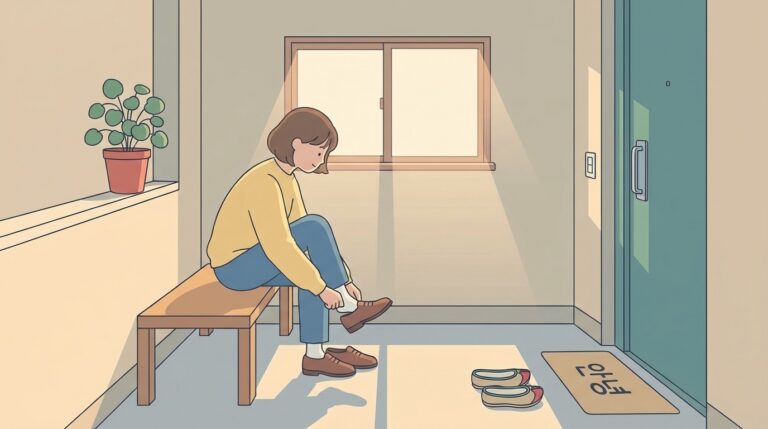
- The 현관 (Hyeon-gwan) Boundary: When returning home, take off your shoes immediately in the sunken tiled entrance area (현관). Never let your socks touch the entrance tile, and never put dirty outdoor shoes on the raised wooden floor. Align your shoes facing outward toward the door for good manners and easy departure the next day.
4-2. Culture Code: The “퇴근길” (Toegun-gil) Phenomenon
In Korean culture, the physical journey home from work (퇴근길) is sacred decompression time. You will see commuters on the Seoul subway plugging in noise-canceling headphones, watching webtoons, or ordering dinner on delivery apps. Stopping by a local convenience store to pick up a cold drink or a quick snack is a cultural staple of unwinding before officially closing out the day.
Phase 5: Real-Life Roleplay Scenario
Setting: 6:10 PM. You are packing up your desk at an office in Yeouido. Your kind senior coworker, Minho (대리님), looks up from his computer.
- You: 저, 민호 대리님. (Jeo, Minho daerinim.) [🎭 Bowing slightly and holding your bag strap] “Excuse me, Assistant Manager Minho.”
- Minho: 네, 지우 씨! 오늘 일 다 끝났어요? (Ne, Jiwoo ssi! Oneul il da kkeutnasseoyo?) [🎭 Smiling warmly and leaning back] “Yes, Jiwoo! Are you all done with work today?”
- You: 네! 오늘 분량 다 마쳤습니다. (Ne! Oneul bunryang da machyeosseumnida.) [🎭 Nodding confidently] “Yes! I have finished today’s workload.”
- You: 먼저 들어가 보겠습니다! (Meonjeo deureogabogesseumnida!) [🎭 Giving a polite 30-degree bow] “I will head out first!”
- Minho: 그래요, 지우 씨. 오늘 정말 수고하셨어요! (Geuraeyo, Jiwoo ssi. Oneul jeongmal sugohasyeosseoyo!) [🎭 Waving his hand lightly] “Alright, Jiwoo. You worked really hard today!”
- You: 대리님도 수고 많으셨습니다. 내일 봬요! (Daerinimdo sugo maneusyeosseumnida. Naeil bwaeyo!) [🎭 Smiling politely with hands clasped in front] “You worked very hard too. See you tomorrow!”
- Minho: 조심히 들어가요! (Josimhi deureogayo!) [🎭 Turning back to screen with a pleasant smile] “Get home safely!”
- You: 감사합니다! 내일 뵙겠습니다! (Gamsahamnida! Naeil boepgetseumnida!) [🎭 Taking a soft step toward the elevator] “Thank you! I will see you tomorrow!”
🔀 Interactive Branch Point:
You run into the Department Head (부장님) at the elevator. What do you say?
* Option A: “부장님, 수고했어!” (Bujangnim, sugohaesseo!)
* Option B: “부장님, 먼저 들어가 보겠습니다. 내일 뵙겠습니다!” (Bujangnim, meonjeo deureogabogesseumnida. Naeil boepgetseumnida!)
* Option C: “안녕!” (Annyeong!)
Feedback:
* Option A [Risk]: 수고했어 is informal banmal. Saying this to a boss will cause sheer panic in the office!
* Option B [Best]: Perfect honorifics, modest attitude, and mentions seeing them tomorrow. 100/100 points!
* Option C [Bad]: Never use casual greeting with a department head unless you plan to quit tomorrow!
Phase 6: 10-Second Emotional Shadowing Drill
Practice these with natural rhythm and feelings!
[😊 Polite & Relieved]
먼저 / 들어가 / 보겠습니다! / 내일 봬요!
(Meonjeo / deureoga / bogesseumnida! / Naeil bwaeyo!)-
[🤝 Sincere & Appreciative]
오늘 하루도 / 정말 / 수고하셨습니다!
(Oneul harudo / jeongmal / sugohasyeosseumnida!) -
[🛋️ Cozy & Exhaling Weariness]
아, / 집이다! / 다녀왔습니다~
(Ah, / jib-ida! / Danyeowasseumnida~)
Phase 7: K-Culture Mini Dictionary
- 퇴근 (Toegeun): Clocking out or leaving work for the day. (Antonym: 출근 / Chulgeun – going to work).
- 칼퇴 (Kaltwae): Literally “knife clock-out.” Leaving work precisely on the second your shift ends without lingering.
- 현관 (Hyeongwan): The small entryway inside a Korean residence where street footwear is removed.
- 힐링 (Hilling): The Korean loanword for rest, self-care, and recovering peace of mind after a busy day.
Phase 8: Traveler’s Survival Kit
Survival Expressions TOP 3:
- 퇴근 시간이에요? (Toegeun siganieyo?)
- Meaning: “Is it rush hour now?”
- Pro Tip: Useful when asking hotel staff or taxi drivers about evening street traffic.
- 다녀왔습니다! (Danyeowasseumnida!)
- Meaning: “I’m back!”
- Pro Tip: Say this cheerfully when returning to your guesthouse or homestay.
- 포장해 주세요. (Pojanghae juseyo.)
- Meaning: “Please wrap this for take-out.”
- Pro Tip: Use this at food stalls to take warm evening street snacks back to your room.
Editor’s Travel Note:
Rush hour in Seoul runs from 6:00 PM to 7:30 PM. Download the Naver Map app navigation guide to check real-time subway congestion. To avoid getting swept away by the evening crowd, always stand behind the yellow safety lines on subway platforms!
Phase 9: “One Step Deeper” (Reflective Question)
In Western cultures, finishing work is often framed as an individual victory: “My shift is finally over!” In Korea, departure is deeply relational. Phrases like 먼저 들어가 보겠습니다 (I am stepping out first) show conscious consideration for those still working, validating everyone’s shared endurance. The Korean evening routine reminds us that even when parting ways, we belong to a community.
💬 Your Turn: In your home country, what is the exact phrase people say before clocking out? Does it focus on the individual or the team? Share your cultural perspective in the comments!
Phase 10: FAQ & Common Mistakes
Q: Can I say “수고하셨습니다” to my CEO when leaving the office?
A: It is safer to say “먼저 들어가 보겠습니다. 내일 뵙겠습니다” (I will head out first; see you tomorrow). Direct subordinates using 수고 toward superiors can sound like you are evaluating their performance, though peers use it freely with one another.
Q: Do I say “다녀왔습니다” if nobody is at home?
A: Yes! Many Koreans say it out of habit or as a calming self-affirmation when unlocking the door to switch off “work mode.”
Q: What is the difference between 퇴근 (Toegeun) and 하교 (Hagyo)?
A: 퇴근 is leaving a job/workplace, while 하교 is specifically leaving school at the end of classes.
🚨 Common Mistakes Alert:
- Mistake: Waving your hand and saying “잘 가!” (Jal ga!) to coworkers.
- Correct Action: Keep hands together and say “먼저 들어가 보겠습니다!”
- Mistake: Entering an apartment with shoes still on.
- Correct Action: Kick shoes off in the 현관 and never step back down onto the tile in socks.
- Mistake: Saying “수고하세요” when someone is leaving before you.
- Correct Action: Use past tense: “수고하셨습니다!”
Phase 11: Action Missions
- 🥉 Bronze Mission: Stand in front of your mirror, bow 15 degrees, and repeat “먼저 들어가 보겠습니다!” five times smoothly.
- 🥈 Silver Mission: Post a picture of your evening relaxation spot on Instagram or Threads with the caption: “오늘 하루도 수고하셨습니다!”
- 🥇 Gold Mission: If you study Korean with a tutor or native friend, end your next session by saying: “선생님, 오늘 수고 많으셨습니다!”
- 🎮 K-Culture Mission: Watch any office scene in a K-drama (like Business Proposal or Misaeng) and spot the exact second an employee utters “먼저 들어가 보겠습니다”!
Phase 12: Interactive Quiz Challenge
1. [Situational] You finished your shift at your part-time job in a Korean convenience store. What should you say to your manager?
* A) 바이바이! (Bai-bai!)
* B) 수고하셨습니다, 내일 봬요! (Sugohasyeosseumnida, naeil bwaeyo!)
* C) 잘 있어! (Jal isseo!)
2. [Fill-in-the-Blank] When returning to your homestay, you announce your arrival at the door:
* “________!” (Da-nyeo-wat-seum-ni-da)
3. [True or False] It is completely fine to keep your street shoes on inside a modern Korean officetel as long as the floor looks clean.
* True / False
👉 Click to reveal answers & explanations!
- Answer: B (수고하셨습니다, 내일 봬요!) – Expresses gratitude for teamwork and gives a polite sign-off for tomorrow.
- Answer: 다녀왔습니다 (Danyeowasseumnida) – The standard, polite phrase for “I’m home!”
- Answer: False – Wearing outdoor shoes past the entryway (현관) is a major cultural taboo in Korea regardless of floor cleanliness!
🎬 Watch Our Daily Videos! (Daily Hangul Official Instagram)
Review the expressions you learned in this article with our fun daily short videos! Check out native pronunciation and real-life nuances in action.
- Instagram @dailyhangul_en







