

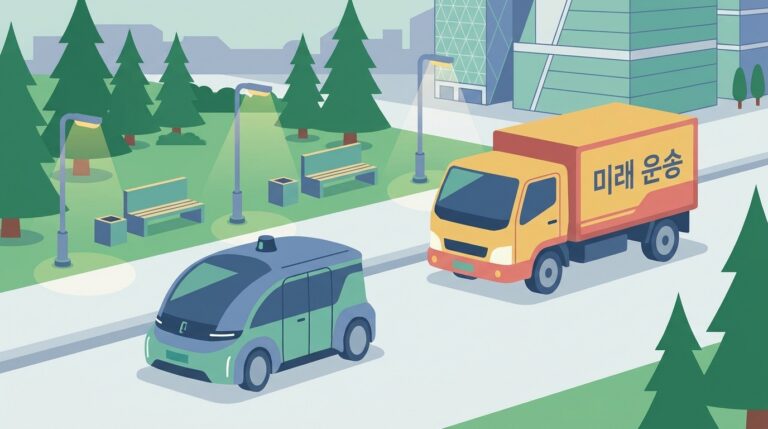
Reimagining the Urban Landscape: How Robotaxis and Autonomous Freight are Reshaping Korean Cities and Supply Chains
Phase 1: Empathy & Storytelling Opening
안녕하세요! 매일한글 에디터입니다. (Annyeonghaseyo! Maeil Hangul editeo-imnida. – Hello! This is your Daily Hangul editor.)
Picture this: You are sipping an iced Americano on the terrace of a sleek café along Teheran-ro in Gangnam. It is rush hour, yet the usual deafening roar of bumper-to-bumper traffic and screeching delivery scooters is strangely subdued. Instead, an autonomous, radar-crowned robotaxi glides quietly to the curb, while subterranean or dedicated arterial lanes usher driverless freight trucks towards logistics hubs on the city outskirts. More strikingly, the concrete multi-story parking structures that once crowded the street corner have been demolished, replaced by an open, verdant community park lined with native Korean pine and wild zelkova trees.
For advanced learners navigating C2-level professional circles, modern Korean policy forums, or boardroom deliberations in Pangyo Techno Valley, discussing these transformations requires far more than basic tech vocabulary. It demands the linguistic precision to bridge macroeconomic theory, urban development discourse, and intricate legal liability frameworks. In our masterclasses, even seasoned expatriate executives often admit: “I know the technical concepts in English, but when negotiating urban spatial restructuring or supply chain disruption in Korean, my speech sounds either excessively academic or awkwardly translated from Western frameworks.”
This guide is crafted directly from field feedback in Korean tech and urban governance workshops. By the time you finish this guide, you will articulate nuanced arguments about End-to-End AI mobility ecosystems, shifts in urban land valuation, and supply chain paradigms with native-grade elegance, confidence, and socio-cultural depth.
Phase 2: Core Expressions In-Depth Analysis
1. 패러다임의 대전환을 맞이하다 (Paereodaim-ui daejeonhwan-eul majihada)
- Pronunciation: [Pae-reo-da-im-ui dae-jeon-hwan-eul ma-ji-ha-da] (Think of ‘paradigm’ with a soft Korean lilt, followed by ‘day-jun-hwan’, flowing naturally like greeting an esteemed guest).
- Meaning: Literally “to greet a great shift in paradigm”; culturally signifies that an entire socio-technological foundation is undergoing an inevitable, systemic renaissance.
- K-Culture Moment: Heard on late-night SBS or KBS investigative economy features when visionary urban planners debate how Software-Defined Vehicles (SDVs) render private car ownership obsolete.
- Editor’s Insight: The verb 맞이하다 (majihada) implies welcoming or facing an epochal tide. Rather than viewing autonomous disruption as a passive threat, Korean corporate rhetoric frames structural technological transitions as an epochal threshold to be proactively embraced.
- Situation Spectrum: Casual 🚫 | Semi-formal ⚠️ | Formal ✅
- 🤔 Think About It: Does your native tongue frame disruptive innovation as a challenge to be conquered, or as an epochal era to be formally “greeted” (맞이하다)?
2. 공간의 생태적 재구성 (Gonggan-ui saengtaejeok jaeguseong)
- Pronunciation: [Gong-gan-ui saeng-tae-jeok jae-gu-seong] (Sound analogy: ‘Gong-gahn’ like a temple bell reverberation, ‘sang-teh-juck’ crisp and sharp).
- Meaning: “Ecological reconfiguration of urban space.” It refers specifically to converting obsolete grey infrastructure—such as curbside asphalt parking—into green corridors and public biophilic zones.
- K-Culture Moment: In architectural documentaries covering Seoul’s “Cheonggyecheon revival 2.0” or high-level roundtables on the future of Songdo International Business District.
- Editor’s Insight: C2 mastery involves using 재구성 (jaeguseong – reconfiguration) instead of simple 변화 (byeonhwa – change). It carries executive intent—deliberate, architectural, and systemic remodeling of public land.
- Situation Spectrum: Casual 🚫 | Semi-formal ⚠️ | Formal ✅
- 🤔 Think About It: How does your home country conceptualize the hierarchy between private vehicle storage (parking) and public ecological spaces?
3. 물류 공급망의 판도를 바꾸다 (Mullyu gonggeupmang-ui pando-reul bakkuda)
- Pronunciation: [Mul-lyu gong-geup-mang-ui pan-do-reul bak-ku-da] (Pronounce ‘Mul-lyu’ smoothly through liquid assimilation, then punch the double consonant in ‘bakkuda’).
- Meaning: “To fundamentally upend the competitive landscape of logistics supply chains.”
- K-Culture Moment: Corporate strategy discussions inside major logistics conglomerates like CJ Logistics or Coupang when unveiling autonomous long-haul middle-mile transport.
- Editor’s Insight: 판도 (pando) historically refers to a dynamic territory or balance of power on a board game or battlefield. Combining it with 바꾸다 (bakkuda) suggests an irreversible, tectonic shift in industry power dynamics.
- Situation Spectrum: Casual ⚠️ | Semi-formal ✅ | Formal ✅
- 🤔 Think About It: Why does Korean corporate vocabulary rely so heavily on spatial and territorial metaphors like 판 (pan) to describe industrial disruption?
Phase 3: Textbook Korean vs. Real Korean
Situation 1: Discussing Logistics Cost Reductions
- 📖 Textbook Korean: 자율주행 화물 트럭은 운송 비용을 많이 절감시킬 것입니다. (Jayuljuhaeng hwamul teureok-eun unsong biyong-eul mani jeolgamsikil geosimnida.) – “Autonomous freight trucks will reduce transportation costs significantly.”
- 🗣️ Real Korean: 완전 무인 트럭이 상용화되는 순간, 물류 단가 구조 자체가 밑바닥부터 송두리째 재편될 겁니다. (Wanjeon muin teureok-i sang-yonghwadoeneun sungan, mullyu danga gujo jachega mitbadakbuteo songdurijjae jaepyendoel geomnida.) – “The moment fully driverless trucks hit commercialization, the unit-cost economics of logistics will be overhauled from the ground up.”
- 💡 Why it differs: Textbook phrasing sounds passive and schoolbookish. Native industry leaders employ visceral idioms like 밑바닥부터 송두리째 (from the root up) and technical concepts like 단가 구조 (unit-cost structure) to convey deep market impact.
Situation 2: Repurposing Obsolete Inner-City Parking Lots
- 📖 Textbook Korean: 로보택시 때문에 도시의 주차 공간이 공원으로 바뀔 것입니다. (Robotaksi ttaemune dosi-ui jucha gonggan-i gong-won-euro bakkwil geosimnida.) – “Because of robotaxis, parking spaces in cities will turn into parks.”
- 🗣️ Real Korean: 자가용 소유가 급감하고 로보택시가 안착하면, 노상 주차 부지를 환원해 도심 녹지 축을 복원하는 게 필연적인 수순이죠. (Jagayong soyuga geupgamhago robotaksiga anchakhamyeon, nosang jucha buji-reul hwan-wonhae dosim nokji chuk-eul bogwonhaneun ge pir-yeonjeogin susun-ijyo.) – “Once private car ownership plummets and robotaxis settle in, returning on-street parking plots to reconstruct the urban green axis is an inevitable corollary.”
- 💡 Why it differs: Real-world governance discussions avoid childish cause-and-effect connectors like ~때문에 and utilize sophisticated urban planning terminology such as 부지 환원 (land restitution/repurposing), 녹지 축 (green axis), and 필연적인 수순 (inevitable sequence of events).
Phase 4: K-Culture Deep Dive & Non-Verbal Manners
4-1. Nunchi & Executive Non-Verbal Decorum
When debating emerging technologies, liability allocation, and public urban real estate in Korea, raw confrontational rhetoric is seen as a sign of intellectual immaturity. High-level executives employ 경청의 끄덕임 (Gyeongcheong-ui kkeudeog-im – attentive nodding)—a subtle, measured downward nod that acknowledges the counterparty’s premises before introducing disruptive regulatory pivots.
Keep your hands clasped lightly above the table or rest your forearms gently on the edge. When introducing a challenging critique of current urban policy, begin with a slight softening of eye contact, followed by the introductory phrase, “물론 현행 규범 체계의 고충도 충분히 이해합니다만…” (Mulron hyeonhaeng gyubeom chegye-ui gochung-do chungbunhi ihaehamnidaman… – “I certainly understand the constraints of our current normative framework, yet…”). This non-verbal deference maintains interpersonal harmony while delivering unyielding analytical precision.
4-2. The Cultural Nexus: Smart Cities and “Pali-Pali” Urban Ecology
Koreans hold a uniquely symbiotic view of ultra-modern technology and communal green retreats. Observe how futuristic high-tech districts like Pangyo or Sangam DMC intentionally integrate expansive parks alongside corporate R&D towers. Unlike Western urban sprawl, Korean urban centers prioritize high-density efficiency matched with pristine civic spaces. As End-to-End AI and robotaxis eradicate the demand for vast parking concrete, Korean society does not view this merely as a cost-saving transport tweak; it is celebrated as the historical reclaiming of human-centric communal living (사람 중심의 도시 환원).
Phase 5: Real-Life Roleplay Scenario
Setting: A high-level urban mobility forum hosted in an open-air boardroom overlooking Pangyo Techno Valley.
Character: Min-jun Park (박민준 실장), Chief Strategic Advisor at a leading Korean Smart Mobility & Infrastructure Consortium.
- 박민준: 자율주행 화물 운송과 도심형 로보택시의 도입 속도가 예상보다 훨씬 빠릅니다. 이에 따른 도심 공간 계획을 어떻게 보십니까?
(Jayuljuhaeng hwamul unsong-gwa dosimhyeong robotaksi-ui doip sokdoga yesangboda hwolssin ppareumnida. I-e ttareun dosim gonggan gyehoek-eul eotteoke bosimnikka?)
“The roll-out speed of autonomous freight transport and urban robotaxis is far outpacing initial projections. How do you assess the consequential urban spatial planning?”
🎭 Leans forward with a focused gaze, resting hands deliberately on the tablet display. -
You: 단순한 교통수단의 전환을 넘어, 도심의 토지 이용 효율을 극대화할 절호의 기회로 판단됩니다.
(Dansunhan gyotongsudan-ui jeonhwan-eul neomeo, dosim-ui toji iyong hyoyul-eul geukdaehwahal jeolho-ui gihoero pandandoemnida.)
“Beyond a mere shift in transit modalities, I deem this an unprecedented window to maximize urban land-use efficiency.”
🎭 Maintaining composed posture, speaking with steady, deliberate cadence. -
박민준: 구체적으로 어떤 유휴 부지의 활용에 주목하고 계신지요?
(Guchejeog-euro eotteon yuhu buji-ui hwalyong-e jumokhago gyesinjiyo?)
“Specifically, which dormant or underutilized real estate footprints are you focusing on?”
🎭 Tilts head slightly, testing the depth of your practical urban development insights. -
You: 노상 및 도심 주차 공간의 생태적 공원화와 물류 터미널의 외곽 거점화가 핵심입니다.
(Nosang mit dosim jucha gonggan-ui saengtaejeok gong-wonhwawa mullyu teomineol-ui oegwak geojeomhwaga haeksim-imnida.)
“The core lies in ecologically parkifying on-street parking lots and decentralizing freight hubs to outer nodes.”
🎭 Gestures subtly outward to delineate inner-city areas from peripheral freight arteries. -
박민준: 일리 있는 지적입니다. 하지만 기존 운수 사업자들과의 사회적 갈등 및 배상 책임 소지가 남아있지 않습니까?
(Illi inneun jijeog-imnida. Hajiman gijon unsu saeopjadeulgwawi sahoejeok galdeung mit baesang chaegim sojiga nama-itji anseumnikka?)
“A well-grounded critique. However, do we not still face intense social frictions with incumbent operators alongside unresolved liability exposure?”
🎭 Furrows brow slightly, introducing the inevitable socio-political bottleneck. -
You: 제조사와 소프트웨어 공급자 간의 제조물 책임 법리를 명확히 규정하고, 절감된 물류 마진을 상생 기금으로 흡수해야 합니다.
(Jejosawa sopeutu-we-eo gonggeupja gan-ui jejomul chaegim beopri-reul myeonghwakhi gyujeonghago, jeolgamdoen mullyu majin-eul sangsaeng gigeum-euro heupsuhaeya hamnida.)
“We must codify product liability doctrines between hardware OEMs and software providers while channeling logistics margin gains into shared-growth funds.”
🎭 Nods firmly, providing a balanced synthesis of legal doctrine and social justice. -
박민준: 바로 그 지점입니다. 법리적 명확성이 선행되어야 공급망의 비용 구조 재편도 탄력을 받겠군요.
(Baro geu jijeom-imnida. Beoprijeok myeonghwakseong-i seonhaengdoeeoya gonggeupmang-ui biyong gujo jaepyeondo tannyeok-eul batgetgunyo.)
“Precisely. Legal certainty must precede any durable momentum in overhauling supply chain economics.”
🎭 Smiles approvingly, taking notes on his slate. -
You: 그렇습니다. 기술 혁신과 사회적 합의가 병행될 때 진정한 모빌리티 생태계가 완성될 것입니다.
(Geureoseumnida. Gisul hyeoksin-gwa sahoejeok hab-uiga byeonghaengdoel ttae jinjeonghan mobiliti saengtaegyega wanseongdoel geosimnida.)
“Indeed. Only when technological disruption and civic consensus advance in tandem will a true mobility ecosystem culminate.”
🎭 Concludes with a respectful, confident head inclination.
🔀 Interactive Branching Moment
In response to Min-jun’s question about social frictions, what would you say?
- Option A: 화물 노조 반발은 그냥 무시하고 완전 자율주행 트럭을 강행 도입해야 산업 경쟁력이 삽니다. (Best? Bad? Risk?)
- Option B: 상생 기금 조성과 더불어 제조물 책임 및 보험 체계를 입법화하여 연착륙을 유도해야 합니다. (Best? Bad? Risk?)
- Option C: 법률적인 문제는 변호사들이 알아서 할 일이니, 우리는 기술 개발에만 집중하면 됩니다. (Best? Bad? Risk?)
Detailed Feedback:
* Option A [Risk]: High business risk. Dismissing institutional stakeholders like 화물연대 (Cargo Truckers Solidarity) alienates Korean public governance frameworks, signaling a lack of nuanced political acumen.
* Option B [Best]: Exemplary C2 response. Balances legislative reform (제조물 책임 입법화) with socio-economic cushioning (상생 기금 조성), reflecting the strategic maturity expected in executive Korean dialogues.
* Option C [Bad]: Demonstrates organizational silo mentality. At the executive SDV level, technical development is inextricably bound to regulatory jurisprudence.
Phase 6: 10-Second Emotion Shadowing Drill
Master the natural rhythm, breath pauses (/), and emotional registers of executive-level Korean:
[🧐 차분하고 분석적으로 - Calm and Analytical]
무인 로보택시의 확산은 / 단순한 교통 체증 완화를 넘어 / 도시의 주차 면적을 / 시민을 위한 녹지 공간으로 / 탈바꿈시킬 잠재력을 지니고 있습니다.
(Muin robotaksi-ui hwaksan-eun / dansunhan gyotong chejeung wanhwa-reul neomeo / dosi-ui jucha myeonjeok-eul / simin-eul wihan nokji gonggan-euro / talbakkumsikil jamjaeryeok-eul jinigo itseumnida.)-
[⚖️ 단호하고 명확하게 - Firm and Authoritative]
End-to-End AI 기반 차량의 사고 발생 시 / 배상 책임의 주체를 누구로 볼 것인가는 / 공급망 물류 기업들이 직면한 / 가장 첨예한 법적 쟁점입니다.
(End-to-End AI giban charyang-ui sago balsaeng si / baesang chaegim-ui juche-reul nugu-ro bol geosin-ganga-neun / gonggeupmang mullyu gieopdeur-i jingmyeonhan / gajang cheom-yehan beopjeok jaengjeom-imnida.) -
[🌱 희망차고 미래지향적으로 - Visionary and Inspiring]
물류 비용의 획기적 절감이 / 궁극적으로 친환경 도심 회복과 맞물릴 때 / 우리는 비로소 / 지속 가능한 미래 모빌리티의 결실을 / 맺게 될 것입니다.
(Mullyu biyong-ui hoekgijeok jeolgam-i / gunggeukjeog-euro chinhwangyeong dosim hoebok-gwa matmulril ttae / uri-neun biroso / jisok ganeunghan mirae mobiliti-ui gyeolsil-eul / maetge doel geosimnida.)
Phase 7: K-Culture Mini Dictionary
- 모빌리티 생태계 (Mobiliti Saengtaegye)
- Meaning: Mobility Ecosystem.
- Usage: Beyond manufacturing automobiles, it encompasses Software-Defined Vehicle (SDV) architectures, cloud fleet management, and regulatory frameworks. Ubiquitous in Hyundai Motor Group and Naver Labs investor briefings.
- 도심 녹지 축 (Dosim Nokji Chuk)
- Meaning: Urban Green Axis.
- Usage: An architectural and environmental planning term used by the Seoul Metropolitan Government to describe unbroken ecological corridors connecting city centers to surrounding mountains and rivers.
- 상생 기금 (Sangsaeng Gigeum)
- Meaning: Shared-Growth / Mutual Prosperity Fund.
- Usage: A socio-political mechanism unique to Korea where corporate disruptors allocate a percentage of profits to support and retrain traditional incumbents displaced by automation.
- 무과실 책임주의 (Mugwasil Chaegimjuui)
- Meaning: Strict / No-Fault Liability Doctrine.
- Usage: Essential legal terminology in Korean tort and product liability law when assigning automated vehicle malfunction responsibility to developers regardless of human negligence.
Phase 8: Expat & Traveler Survival Kit
Top 3 On-the-Ground Mobility Phrases
- 이 구역은 자율주행 시범운행지구인가요? (I guyeok-eun jayuljuhaeng sibeom-unhaengjigu-in-gayo? – Is this zone an autonomous driving pilot zone?)
- Pro Tip: Use this when exploring districts like Sangam DMC or Gangnam where pilot autonomous shuttles operate.
- 카카오 T 앱에서 로보택시 호출이 연동되나요? (Kakao T aep-eseo robotaksi hochul-i yeondongdoenayo? – Is the robotaxi hailed via Kakao T app integration?)
- Pro Tip: Essential for utilizing smart public transport trials without having to download separate proprietary apps.
- 주차장 부지가 공원으로 탈바꿈했네요. (Juchajang bujiga gong-won-euro talbakkumhaenneyo. – The former parking lot has transformed into a park!)
- Pro Tip: An elegant conversational icebreaker when taking a stroll through newly restored urban plazas in Seoul.
Editor’s Urban Mobility Note
If you want to witness this transformation firsthand, take the subway to Digital Media City (DMC) Station. Download the Kakao T App and register your Korean foreign registration card or international credit card to book scheduled trips on Sangam’s autonomous pilot shuttles. Additionally, keep the Naver Map Mobility Service bookmarked to monitor real-time designated low-emission green zones and pedestrianized urban axes throughout Seoul.
Phase 9: One Step Deeper
In traditional Korean agrarian communities, the village common—the 마당 (madang)—was the heartbeat of public life, a place where labor, celebrations, and governance blended organically. The industrialization of the late 20th century sacrificed this communal space to asphalt, turning historic centers into parking lots and high-speed corridors. The contemporary push for autonomous robotaxis and freight corridors is more than a triumph of silicon and End-to-End AI neural networks; to Koreans, it represents the collective reclamation of the contemporary madang. When driverless transport eliminates parked vehicle footprint, the city is ecologically restored to the people.
💬 Your Turn: How would your home city change if 60% of all parking lots were converted into community forests? Would you prioritize autonomous freight efficiency, or civic green spaces? Share your thoughts below using today’s C2 vocabulary!
Phase 10: FAQ & Mistake Prevention
Q: Can I use “운전자가 없다” (There is no driver) interchangeably with “무인” (Unmanned/Driverless) in high-level discussions?
A: While “운전자가 없다” (unjeonjaga eopda) is grammatically correct, using it in executive policy or legal dialogues sounds overly colloquial. At the C2 level, always opt for refined Sino-Korean constructs: 무인화 (mu-inhwa – driverless automation), 완전 자율주행 (wanjeon jayuljuhaeng – fully autonomous driving), or 자율 운항 (jayul unhang).
Q: What is the legal difference between 제조물 책임 (Product Liability) and 운행자 책임 (Operator Liability) in Korea?
A: Under the Korean Automobile Compensation Guarantee Act, 운행자 책임 (unhaengja chaegim) traditionally falls upon the person who profits from and controls the driving operation (often the owner). However, in End-to-End AI Level 4/5 scenarios, this shifts towards 제조물 책임 (jejomul chaegim), placing strict tort liability on software/hardware manufacturers. Knowing this distinction is crucial during boardroom legal strategy discussions.
Q: How do I express “supply chain bottleneck” naturally in Korean?
A: While learners often translate this literally as 공급망 병목 (gonggeupmang byeongmok), native strategists frequently say 물류 대란 (mullyu daeran – logistics crisis/havoc) or 공급망 지체 현상 (gonggeupmang jiche hyeonsang – supply chain stagnation phenomenon) depending on the severity of the bottleneck.
🚨 Common Mistakes Alert
- ❌ Mistake: Using “녹색 땅” (green dirt) to mean urban green space.
- ✔️ Correction: Use 도심 녹지 (dosim nokji) or 생태 공원 (saengtae gong-won).
- ❌ Mistake: Saying “차량 소프트웨어 법” for autonomous liability.
- ✔️ Correction: Say 제조물 책임 법리 (jejomul chaegim beopri) or 자율주행 배상 규범 (jayuljuhaeng baesang gyubeom).
- ❌ Mistake: Translating “parking fee” as “차 세우는 돈”.
- ✔️ Correction: Use 주차 요금 (jucha yogeum) or 주차 관제 비용 (jucha gwanje biyong) in formal industrial discussions.
Phase 11: Action Missions & Participation
- 🥉 Bronze Mission (Solo Shadowing): Record yourself delivering the three Phase 6 shadowing sentences. Focus on pausing naturally at the slashes (
/) without breaking cadence. - 🥈 Silver Mission (Social Vocabulary Match): Post a short reflection on LinkedIn or Twitter: “자율주행 기술의 도입은 물류 공급망의 판도를 바꾸고, 도심 유휴 부지를 녹지로 환원할 것입니다.” Tag a peer and exchange opinions on SDV liability!
- 🥇 Gold Mission (Real-World Execution): Next time you engage with a Korean colleague or tutor, frame an argument using 공간의 생태적 재구성 and 패러다임의 대전환. Challenge them on how liability should be split between AI software vendors and fleet operators.
🎮 K-Culture Media Mission: Watch an episode of a modern Korean business-centered drama (e.g., Start-Up or Agency) or a business news panel on YouTube. Listen for how corporate officers describe industrial paradigm shifts using the word 판도 (pando) or 재편 (jaepyeon). Transcribe one sentence in your study journal!
Phase 12: Interactive Quiz Challenge
1. Context Judgment Quiz
Which of the following phrases is most suitable for an executive presentation arguing that autonomous freight will cut middle-mile transport costs?
* A) 무인 트럭 쓰면 기사 월급 아낄 수 있어서 참 좋습니다.
* B) 자율주행 화물 솔루션 도입을 통해 미들마일 물류 원가 구조의 근본적 혁신을 달성할 수 있습니다.
* C) 트럭 기사 없애면 회사가 돈을 엄청나게 많이 법니다.
👉 Click to Reveal Answer & Analysis
Correct Answer: B
Analysis: Option B utilizes sophisticated industrial nomenclature: 미들마일 물류 원가 구조 (middle-mile logistics cost-price structure) and 근본적 혁신 (fundamental innovation). Options A and C are inappropriately blunt, reductionist, and informal for C2 professional discourse.
2. Fill-in-the-Blank
Fill in the blank with the appropriate executive vocabulary:
로보택시가 도심 전역에 안착하면, 노상 주차 부지를 시민들에게 ________하여 쾌적한 도시 숲을 조성할 수 있습니다.
(Robotaksiga dosim jeon-yeog-e anchakhamyeon, nosang jucha buji-reul simindeurege ________-hayeo gwajeokhan dosi sup-eul joseonghal su itseumnida.)
👉 Click to Reveal Answer & Analysis
Correct Answer: 환원 (Hwan-won)
Analysis: 환원하다 (hwan-wonhada) means to return, revert, or restore something back to its rightful owner or original state (in this case, returning land back to the citizenry). It is the premier term in public urban planning.
3. True / False Cultural & Legal Quiz
True or False: Under current emerging South Korean policy discussions on Level 4 autonomous vehicle accidents, human passengers who have no access to steering or pedals are still expected to shoulder the primary operational liability under traditional traffic court jurisprudence.
👉 Click to Reveal Answer & Analysis
Correct Answer: False
Analysis: The core of South Korea’s autonomous driving regulatory reform involves decoupling driver liability from autonomous passengers and shifting legal accountability toward 제조물 책임 (product liability) and corporate algorithmic oversight when full Level 4/5 automated systems are engaged without human operational override.
🎬 Watch Our Daily Videos! (Daily Hangul Official Instagram)
Review the expressions you learned in this article with our fun daily short videos! Check out native pronunciation and real-life nuances in action.
- Instagram @dailyhangul_en







