

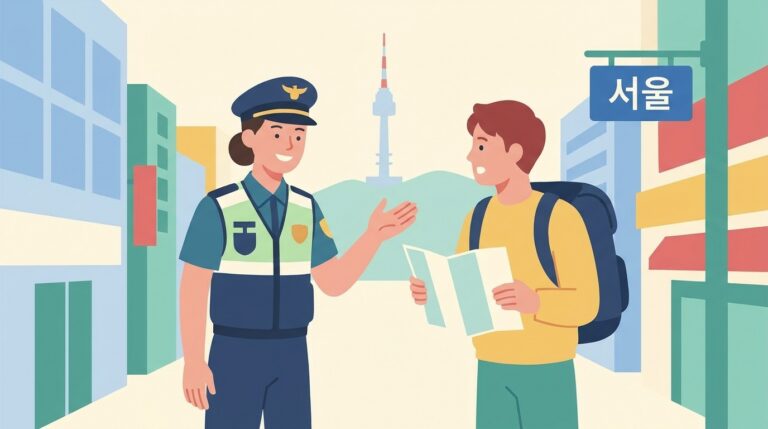
Phase 1: Empathy & Story-Driven Opening
안녕하세요! (Annyeonghaseyo!) It is your Daily Hangul editor here.
Imagine this: You are having the absolute time of your life in Seoul. You just enjoyed a hot plate of tteokbokki in Hongdae, the autumn leaves are glowing, and you are living your best K-drama life. But suddenly, your heart drops. You pat your jacket, check your tote bag, and empty your pockets. Your passport is missing. In a bustling subway station with Korean signs flashing everywhere, sheer panic kicks in.
We have all experienced that sudden spike of traveler anxiety. In fact, one of our Level 1 students, Alex, faced this exact situation outside City Hall last winter! He froze because he did not know how to say ‘embassy’ or how to ask a police officer for help without sounding rude. Today, we are turning that nightmare into an easy, empowering win. With just one core phrase, you will navigate emergencies with total confidence and earn heartfelt help from locals. Let’s master it together!
Phase 2: Top 3 Core Emergency Expressions
1. 대사관에 연락해 주세요 (Daesagwane yeollakhae juseyo)
- Pronunciation: Dae-sa-gwan-e yeol-lak-hae ju-se-yo (Think of Dae-sa-gwan as “Day-sah-gwan”, and yeollak sounds like the English name “Yell-lock”).
- Meaning: Direct: “Embassy-to contact-do please” | Actual Nuance: “Please contact my embassy for me.”
- K-Culture Moment: Seen in thrilling K-dramas whenever a character is caught in an international crisis and rushes into a Korean police station seeking urgent diplomatic protection.
- Editor’s Insight: Notice ~해 주세요 (hae juseyo)? It is your magic wand in Korean. Whenever you need an action done as a polite favor, tack this onto verb stems. It immediately sounds respectful rather than demanding.
- Situation Spectrum: Casual 🚫 | Semi-formal ✅ | Formal ✅
- 🤔 Think About It: In English, we often shout “Call my embassy!” in emergencies. Why do you think Korean retains polite suffixes (-juseyo) even in life-or-death situations?
2. 도와주세요 (Dowajuseyo)
- Pronunciation: Do-wa-ju-se-yo (Sounds like “Dough-wah juice-say-yo”).
- Meaning: Direct: “Help please” | Actual Nuance: “Please help me!”
- K-Culture Moment: The universal hero-call in Korean historical and modern dramas when someone is stranded or in need of immediate assistance.
- Editor’s Insight: If your mind goes completely blank from panic, this single word will immediately catch the attention of any passerby or subway staff.
- Situation Spectrum: Casual ⚠️ | Semi-formal ✅ | Formal ✅
- 🤔 Think About It: How does asking for ‘help’ directly in Korean show vulnerability and foster communal care (Jeong)?
3. 여권을 잃어버렸어요 (Yeogwoneul ireobeoryeosseoyo)
- Pronunciation: Yeo-gwoneul i-reo-beo-ryeo-sseo-yo (Like “Yuh-gwon-eul ee-ruh-buh-ryuh-ssuh-yo”).
- Meaning: Direct: “Passport lost-completely-have” | Actual Nuance: “I lost my passport.”
- K-Culture Moment: The classic travel disaster scene at Incheon International Airport in travel vlogs and romantic comedies.
- Editor’s Insight: The ending ~버렸어요 (-beoryeosseoyo) expresses regret or that something unfortunate happened beyond your control.
- Situation Spectrum: Casual ⚠️ | Semi-formal ✅ | Formal ✅
- 🤔 Think About It: Notice how the sentence emphasizes the completion and sadness of an accidental event rather than blaming someone.
Phase 3: Textbook Korean vs. Real Korean
Situation 1: Asking someone to dial the embassy
- 📖 Textbook Korean: 저의 대사관 전화번호로 통화해 주실 수 있으십니까? (Jeoui daesagwan jeonhwabeonhoro tonghwahae jusil su isseusinikka?)
- 🗣️ Real Korean: 대사관에 전화 좀 해 주세요. (Daesagwane jeonhwa jom hae juseyo.)
- 💡 Why is it different? Textbook versions pile on honorific layers that sound stiff and robotic during emergencies. Real native speakers use the softening particle 좀 (jom – a little/please) to create natural, urgent politeness.
Situation 2: Alerting people of an emergency
- 📖 Textbook Korean: 비상사태가 발생하였으니 지원 바랍니다. (Bisangsataega balsaenghayeosseuni jiwon baramnida.)
- 🗣️ Real Korean: 도와주세요! 큰일 났어요! (Dowajuseyo! Keunil nasseoyo!)
- 💡 Why is it different? Nobody speaks like a formal news broadcast on the street. “큰일 났어요! (Something big happened / I’m in trouble!)” communicates the stakes instantly to everyday Koreans.
Phase 4: K-Culture Deep Dive & Non-Verbal Manners
4-1. Nunchi & Emergency Body Language
When asking a Korean stranger or officer for help, body language speaks before your words do:
* Two-Hand Rule (두 손 / Du Son): Handing over your phone or ID must always be done with both hands, or with your left hand supporting your right wrist. Doing it with one hand can look dismissive, even during stress!
* Polite Bow & Eye Contact: Do not stare aggressively into their eyes while panicking. Start with a light 15-degree head bow. It signals, “I respect your space, but I truly need help.”
4-2. Culture Code: The Korean “Jigudae” & Lost Item Magic
Did you know Korea has one of the world’s highest lost-and-found return rates? If you drop a wallet in Seoul, it usually ends up sitting untouched on a cafe table or turned in at a nearby 지구대 (Jigudae – neighborhood police box). Koreans take civic security seriously. Approaching a local police box with a calm, respectful tone will instantly unlock genuine hospitality.
Phase 5: Real-Life Roleplay Scenario
- Setting: A warm afternoon outside Anguk Station near Gyeongbokgung Palace. You find a neighborhood police box (Jigudae) after misplacing your bag.
- Characters:
- You (A1 Korean Learner): Worried traveler clutching your phone.
- Officer Min (경찰관): A calm, approachable officer drinking green tea.
The Dialogue
- You: 🎭 (Pushes the glass door gently and gives a quick bow) 저기요, 도와주세요! (Jeogiyo, dowajuseyo!) – Excuse me, please help me!
- Officer Min: 🎭 (Stands up, looking concerned) 네! 무슨 일이세요? 괜찮으세요? (Ne! Museun iriseyo? Gwaenchaneuseyo?) – Yes! What is the matter? Are you okay?
- You: 🎭 (Touching your empty bag with trembling hands) 가방을 잃어버렸어요. 여권이 있어요. (Gabangeul ireobeoryeosseoyo. Yeogwoni isseoyo.) – I lost my bag. My passport is inside.
- Officer Min: 🎭 (Grabs a notepad and gestures to a chair) 아, 여권이요? 앉으세요. 어느 나라 사람이에요? (A, yeogwoniyo? Anjeuseyo. Eoneu nara saram-ieyo?) – Ah, your passport? Please sit down. Which country are you from?
- You: 🎭 (Sitting down slowly) 미국 사람이에요. 대사관에 연락해 주세요. (Miguk saram-ieyo. Daesagwane yeollakhae juseyo.) – I am American. Please contact the embassy.
- Officer Min: 🎭 (Nods reassuringly and picks up the office phone) 알겠습니다. 미국 대사관 번호 확인해 드릴게요. (Algetseumnida. Miguk daesagwan beonho hwaginhae deurilgeyo.) – Understood. I will check the US Embassy number for you.
- You: 🎭 (Holding both hands to your chest in relief) 정말 감사합니다! (Jeongmal gamsahamnida!) – Thank you so much!
- Officer Min: 🎭 (Smiles kindly) 걱정 마세요. 분실물 접수도 같이 해요. (Geokjeong maseyo. Bunsilmul jeopsudo gachi haeyo.) – Don’t worry. Let’s register a lost item report together too.
🔀 Interactive Choice Point
Officer Min asks for details on where you last had your bag. How do you respond?
* Option A: “몰라요! 빨리 전화해요! (Mollayo! Ppalli jeonhwahaeyo! – I don’t know! Call quickly!)”
* Option B: “안국역 카페에 있었어요. (Anguk-yeok kape-e isseosseoyo. – It was at an Anguk station cafe.)”
* Option C: Shouting in English loudly while tapping the counter.
- Feedback:
- Option A (Risk): Too blunt and demanding! Dropping honorifics (banmal) might make the officer feel unappreciated.
- Option B (Best!): Calm, clear, and uses simple A1 grammar to give essential location clues.
- Option C (Bad): Escalates stress and ignores basic non-verbal respect.
Phase 6: 10-Second Emotion Shadowing Drill
Practice matching these rhythms with genuine vocal emotion:
[😰 간절하고 다급하게 / Urgent & Earnest]
저기요! / 도와주세요! / 큰일 났어요!
(Jeogiyo! / Dowa-juseyo! / Keunil nasseoyo!)-
[🥺 침착하지만 절박하게 / Calm yet Pleading]
여권을 / 잃어버렸어요. / 대사관에 / 연락해 주세요.
(Yeogwoneul / ireobeoryeosseoyo. / Daesagwane / yeollakhae juseyo.) -
[🙏 깊은 안도와 감사 / Deep Relief & Gratitude]
정말 / 감사합니다. / 살았어요!
(Jeongmal / gamsahamnida. / Sarasseoyo!)
Phase 7: K-Culture Mini Dictionary
- 대사관 (Daesagwan) | Embassy
- Usage: Combine with your country name: 미국 대사관 (US Embassy), 캐나다 대사관 (Canadian Embassy), 영국 대사관 (British Embassy).
- 여권 (Yeogwon) | Passport
- Usage: Essential for tax refunds, hotel check-ins, and emergency reports.
- 경찰서 / 지구대 (Gyeongchalseo / Jigudae) | Police Station / Local Police Box
- Usage: While Gyeongchalseo refers to large central stations, Jigudae are neighborhood stations found near nightlife and transit hubs.
- 분실물 (Bunsilmul) | Lost Property
- Usage: Look for the “분실물 센터 (Lost and Found Center)” sign inside major metro transfer hubs.
Phase 8: Survival Kit for Travelers
Survival Top 3 Phrases
- 경찰을 불러 주세요 (Gyeongchareul bulleo juseyo) – Please call the police. (Pro Tip: 112 is the direct police dial in Korea.)
- 영어 할 수 있는 분 계세요? (Yeongeo hal su inneun bun gyeseyo?) – Is there someone who speaks English?
- 제 짐을 찾아 주세요 (Je jimeul chaja juseyo) – Please help find my luggage.
Editor’s Travel Note
- Essential Hotline: Dial 1330 (Korea Travel Hotline) on any local phone. They offer free 24/7 translation support connecting you, the police, and your embassy.
- Official Tracking: Bookmark the Korean National Police Lost and Found Portal (LOST112) to search registered found items across the country.
Phase 9: “One Step Deeper” (Reflective Question)
In Korean society, asking for help connects directly to the concept of 정 (Jeong)—a deep-seated sense of communal warmth and mutual responsibility. When you address a stranger with sincere courtesy using phrases like 도와주세요 (Dowajuseyo), Koreans rarely turn away; they often take personal ownership of your problem until it is resolved.
💬 Your Turn: How does asking for emergency help in your home country compare to Korea’s community-driven police culture? Share your thoughts in the comments below!
Phase 10: FAQ & Common Mistakes
Q: What if I don’t know my country’s Korean name for the embassy?
A: Simply say the English country name followed by 대사관 (Daesagwan)! For example, “France 대사관 (France Daesagwan)” or “Australia 대사관 (Australia Daesagwan)”. Locals will understand immediately.
Q: Is dialing 112 free from foreign roaming SIM cards?
A: Yes! 112 connects without credit on all mobile networks in Korea, and an English interpreter will join the line if requested.
Q: Can taxi drivers take me directly to my embassy?
A: Absolutely. Show the driver: “[Country name] 대사관으로 가 주세요 ([Country name] Daesagwaneuro ga juseyo)”. Most embassies are clustered around Gwanghwamun and Itaewon in Seoul.
🚨 Common Mistakes Warning Board
- ❌ Saying “야! 도와줘! (Ya! Dowajwo!)” -> Correct Action: Always use polite honorifics: “저기요, 도와주세요! (Jeogiyo, dowajuseyo!)”.
- ❌ Waving one hand dismissively when receiving assistance -> Correct Action: Receive business cards or contact details with both hands.
- ❌ Memorizing complicated textbook sentences -> Correct Action: Stick to short, punchy A1 phrases: 대사관 (Daesagwan) + 연락해 주세요 (Yeollakhae juseyo).
Phase 11: Action Missions
- 🥉 Bronze Mission: Stand in front of your mirror and practice saying “대사관에 연락해 주세요” three times with urgent, expressive emotion.
- 🥈 Silver Mission: Save the local phone number and address of your home country’s embassy in Seoul into your phone notes right now.
- 🥇 Gold Mission: Test yourself on your next trip or virtual Korean meetup by explaining an emergency scenario using our 3 core expressions!
- 🎮 K-Culture Mission: Watch any Korean action or procedural drama (like Signal or Crash Landing on You) and listen for the phrase 도와주세요 (Dowajuseyo)!
Phase 12: Interactive Quiz Challenge
1. Situational Judgment
You left your backpack with your passport inside on Subway Line 2. You spot a subway attendant. What is the most natural, polite phrase to say?
* A) 가방 줘! (Gabang jwo!)
* B) 저기요, 도와주세요! 여권을 잃어버렸어요. (Jeogiyo, dowajuseyo! Yeogwoneul ireobeoryeosseoyo.)
* C) 대사관에 갈 거예요. (Daesagwane gal geoyeyo.)
2. Fill in the Blank
Complete the sentence meaning “Please contact the embassy”:
대사관에 _______ 해 주세요. (Yeollak)
3. True / False Cultural Check
True or False: In Korea, it is considered polite to hand your ID or emergency documents to a police officer with just one hand if you are in a rush.
👉 Click to Reveal Answers & Explanations
- Answer: B – It politely grabs attention (Jeogiyo), asks for help (Dowajuseyo), and clearly explains the loss (Yeogwoneul ireobeoryeosseoyo).
- Answer: 연락 (Yeollak) – Together it forms 연락해 주세요 (Yeollakhae juseyo – Please contact).
- Answer: False – Even in urgent situations, using two hands (두 손) shows respect and encourages helpful cooperation!
🎬 Watch Our Daily Videos! (Daily Hangul Official Instagram)
Review the expressions you learned in this article with our fun daily short videos! Check out native pronunciation and real-life nuances in action.
- Instagram @dailyhangul_en







