

Phase 1: Empathy (Story-Driven Opening)
안녕하세요! 매일한글 에디터입니다.
Picture this: It is mid-January in Seoul. Outside, the Siberian wind is howling through the alleys, and the temperature has plummeted to a bone-chilling -12°C. You just got home from an exhausting day at work or university, dreaming of stepping into a steaming hot shower and curling up on your toasty floor. You strip down, turn the faucet to red, and step in—only to be blasted by a torrent of glacial ice water that makes your heart stop.
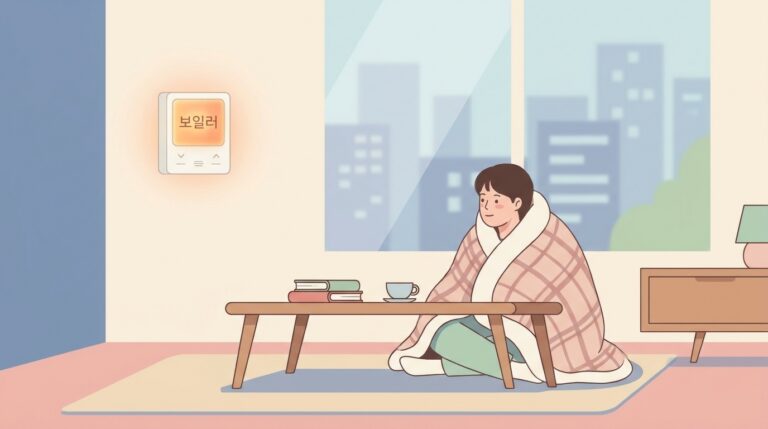
Shivering violently, you wrap yourself in your thick long padded jacket (롱패딩) and rush over to the little white controller mounted on your living room wall. Instead of the warm green light showing your target temperature, you see a menacing red light flashing rhythmically with two cryptic characters: “Er 03”. You tap the power button. Nothing happens. You switch from 난방 (heating) to 온수 (hot water). Still dead silence. Your apartment is rapidly turning into an indoor igloo, and panic sets in. How do you explain an error code to a Korean landlord who might not speak a word of English? What if they blame you? What if the pipes freeze solid overnight?
Take a deep breath! You are definitely not the first international resident to face the dreaded winter boiler crisis in Korea. In fact, over 60% of our B1 intermediate learners tell us that their first “real-life Korean test” wasn’t a TOPIK exam, but negotiating a home repair with their landlord (jipju-in). Today, we are going to equip you with the exact phrases, cultural nuances, and communication strategies you need to report boiler breakdowns, explain error codes clearly, and secure a quick visit from a repair technician—all while keeping your relationship with your landlord warm and friendly.
Phase 2: Core Expressions Deep Dive
1. 보일러에 에러 코드가 떠요. (Boilleo-e ereo kodeuga tteoyo.)
- Pronunciation: [Bohl-luh-eh eh-ruh koh-deu-gah ttuh-yoh] (Sounds like “boiler-eh error code-gah ttuh-yo”—note that “떠요” sounds like popping up or floating into sight).
- Meaning: “An error code is showing up on the boiler.”
- K-Culture Moment: Think of any slice-of-life K-drama like Because This Is My First Life where a tenant frantically photographs their blinking appliances before calling the landlord in distress.
- Editor’s Insight: In Korean, when digital screens show numbers, notifications, or warnings, native speakers use the verb 뜨다 (tteuda), which literally means “to float” or “to rise” (like the sun rising). Saying “에러 코드가 보여요” (I see an error code) sounds like a translated sentence; “에러 코드가 떠요” sounds completely native.
- Situation Spectrum: Casual: ✅ | Semi-formal: ✅ | Formal: ✅ (Add
-습니다->에러 코드가 뜹니다for formal situations). - 🤔 Think About It: Why do you think Korean uses dynamic motion verbs like “floating up” (tteuda) for digital screen alerts? How does this compare to how your native language conceptualizes screen alerts?
2. 온수랑 난방이 둘 다 전혀 안 나와요. (Onsurang nanbangi dul da jeonhyeo an nawayo.)
- Pronunciation: [Ohn-soo-rahng nahn-bahng-ee dool dah juhn-hyuh ahn nah-wah-yoh] (Flow smoothly: on-su-rang hot water and, nan-bang-i floor heating, dul da both, jeon-hyeo entirely not).
- Meaning: “Neither the hot water nor the heating is working at all.”
- K-Culture Moment: In Korean apartments, heating is primarily floor-based (ondol). If both 온수 (tap hot water) and 난방 (floor pipes) fail simultaneously, it usually means the combustion unit or water supply valve has an issue—a universal emergency in Korean winter dramas!
- Editor’s Insight: Notice the verb 나오다 (naoda) which means “to come out”. In English, you might say “the heating doesn’t work”, but Koreans say “heating/hot water doesn’t come out”. Pair 전혀 (jeonhyeo – at all) with a negative verb form to emphasize zero functionality.
- Situation Spectrum: Casual: ✅ | Semi-formal: ✅ | Formal: ✅
- 🤔 Think About It: In many Western homes, central air heating and hot water heaters are separate units. In Korea, one boiler box controls both. How does this integrated reality shape the way Koreans talk about winter comfort?
3. 기사님 좀 불러주실 수 있나요? (Gisanim jom bulleojusil su innayo?)
- Pronunciation: [Ghee-sah-neem johm bool-luh-joo-sheel soo een-nah-yoh?] (Softly soften the request with jom, which acts like a social cushion).
- Meaning: “Could you please call a repair technician for me?”
- K-Culture Moment: In Korea, repair specialists, delivery drivers, and bus drivers are respectfully addressed as 기사님 (gisanim – skilled specialist/engineer). Using this title shows high social awareness and politeness.
- Editor’s Insight: In Korean rental culture, tenants should almost never directly summon an outside repair technician without the landlord’s consent, or the landlord might refuse to cover the cost. Asking the landlord to bulleo-juda (call them for you) preserves financial liability and shows proper courtesy.
- Situation Spectrum: Casual: 🚫 | Semi-formal: ✅ | Formal: ✅
- 🤔 Think About It: Why is addressing blue-collar and technical specialists with the honorific suffix -nim (님) so deeply rooted in modern Korean society?
Phase 3: Textbook Korean vs. Real Korean
Scenario 1: Describing the error flashing on the screen
- 📖 교과서 한국어 (Textbook Korean): 보일러 액정에 오류 번호가 표시되고 난방이 작동하지 않습니다. (Boilleo aekjeong-e oryu beonhoga pyosidoego nanbangi jakdonghaji antheumnida.)
- 🗣️ 진짜 한국어 (Real Korean): 보일러에 빨간불 깜빡이면서 에러 코드가 계속 떠요! (Boilleo-e ppalganbul kkamppag-imyeonseo ereo kodeuga gyesok tteoyo!)
- 💡 왜 다를까? (Why is it different?): Textbook Korean uses clinical, mechanical jargon like oryu beonho (error number) and jakdonghaji antheumnida (does not operate). Real Koreans describe the visible sensory cues immediately—like the blinking red light (ppalganbul kkamppag-imyeonseo)—which helps the landlord visualize the urgency instantly.
Scenario 2: Asking the landlord to intervene quickly
- 📖 교과서 한국어 (Textbook Korean): 가능한 한 조속히 수리공을 파견해 주시기를 요청합니다. (Ganeunghan han josokhi surigong-eul pagyeonhae jusigireul yocheonghamnida.)
- 🗣️ 진짜 한국어 (Real Korean): 집주인님, 날이 너무 추워서 그런데 기사님 좀 빨리 봐주실 수 있을까요? (Jipju-innim, nari neomu chuwoseo geureonde gisanim jom ppalli bwajusil su isseulkkayo?)
- 💡 왜 다를까? (Why is it different?): The textbook phrasing sounds like an official legal summons or corporate requisition! Real Koreans use the soft cushion phrase -아서/어서 그런데 (-case because of X, so…) to state the human context (“it’s freezing cold”) before making the request, creating an empathetic bond rather than an aggressive demand.
Phase 4: K-Culture Deep Dive & Non-Verbal Manners
4-1. 눈치 (Nunchi) & Communication Etiquette
When dealing with home maintenance issues in Korea, verbal language is only half the battle. Your 눈치 (nunchi – contextual awareness and social tact) dictates your success:
1. The Proof Photo is Mandatory: Never just text “My boiler is broken.” Always snap a clean, well-lit photo or a 5-second video of the wall control panel showing the blinking numbers, plus a photo of the boiler brand logo (e.g., Rinnai, KyungDong Navien, Kiturami). Send this via KakaoTalk along with your message.
2. The Softening Tone: Start your message with an apology for disturbing them: “주말에/늦은 시간에 죄송합니다” (I am sorry to contact you on the weekend / late at night). Even if the boiler failure is entirely not your fault, starting with this polite formula makes the landlord jump into helpful mode instead of feeling defensive.
4-2. Cultural Code: The Sacred “Ondol” and Tenant Law
In Korea, floor heating (ondol) is not a luxury; it is a life-support system. Korean winters produce sharp cold snaps that cause 동파 (dongpa – burst pipes from freezing).
Under standard Korean residential lease agreements (주택임대차보호법), major structural appliances installed in the apartment—especially heating, gas, and major plumbing—are the legal maintenance responsibility of the landlord (임대인), provided the tenant did not cause malicious damage. However, if a tenant leaves the heating completely turned off during a sub-zero cold wave and the pipes freeze and burst, the tenant can be held legally liable! That is why landlords are terrified of frozen pipes and appreciate prompt reports when errors first appear.
Phase 5: Real-Life Roleplay Scenario
Setting: A chilly 9:00 PM in a studio apartment in Mapo-gu, Seoul. Alex’s boiler has shut down with a blinking “03” code. Alex messages Landlord Mrs. Kim on KakaoTalk and then receives a phone call.
Characters:
* Alex (알렉스): B1 Korean learner, polite and urgent.
* Landlord Mrs. Kim (김 아주머니): Practical, slightly worried about frozen pipes, responsive.
- Turn 1 (Alex):
집주인님, 늦은 시간에 연락드려 죄송합니다. 보일러에 에러 코드가 떠서요.
(Jipju-innim, neujeun sigane yeollakdeuryeo joesonghamnida. Boilleo-e ereo kodeuga tteoseoyo.)
“Landlord, I apologize for contacting you so late. An error code popped up on the boiler.”
🎭 Hands slightly trembling from cold, looking at the blinking thermostat. -
Turn 2 (Mrs. Kim):
어머, 그래요? 화면에 숫자가 뭐라고 적혀 있어요?
(Eomeo, geuraeyo? Hwamyeone sutjaga mworago jeokhyeo isseoyo?)
“Oh dear, really? What number is written on the screen?”
🎭 Sounding alert and checking her maintenance contact list. -
Turn 3 (Alex):
빨간 불이 깜빡이면서 03이라고 떠요. 온수랑 난방이 둘 다 전혀 안 나와요.
(Ppalgan buri kkamppag-imyeonseo gongsamirago tteoyo. Onsurang nanbangi dul da jeonhyeo an nawayo.)
“A red light is blinking and it shows ’03’. Neither hot water nor heating is working at all.”
🎭 Speaking clearly and pointing the phone camera at the screen. -
Turn 4 (Mrs. Kim):
03번이면 점화 불량 아니면 가스 밸브 문제 같은데… 전원 껐다가 켜봤어요?
(Gongsam-beon-imyeon jeomhwa bullyang animyeon gaseu baelbeu munje gateunde… Jeonwon kkeottaga kyeobwasseoyo?)
“If it’s number 03, it sounds like an ignition failure or a gas valve issue… Did you try turning the power off and on?”
🎭 Giving initial troubleshooting advice. -
Turn 5 (Alex):
네, 두 번 껐다 켰는데 똑같이 계속 에러가 떠요. 방이 너무 추워지고 있어요.
(Ne, du beon kkeotta kyeonneunde ttokgachi gyesok ereoga tteoyo. Bang-i neomu chuwojigo isseoyo.)
“Yes, I turned it off and on twice, but the error keeps showing up the same. The room is getting very cold.”
🎭 Hugging their fleece blanket with an earnest tone. -
Turn 6 (Mrs. Kim):
아이고, 오늘 밤 영하 10도까지 내려간다는데 큰일이네. 사진 찍어서 카톡으로 보내줄래요?
(Aigo, oneul bam yeongha sipdokkaji naeryeogandaneunde keun-irine. Sajin jjigeoseo katogeuro bonaejullaeyo?)
“Oh my, it’s dropping to minus 10 tonight, that’s a big deal. Can you take a photo and send it to me on KakaoTalk?”
🎭 Expressing genuine concern about freezing conditions. -
Turn 7 (Alex):
네, 방금 사진 보냈습니다! 날이 너무 추운데 내일 아침 일찍 기사님 좀 불러주실 수 있나요?
(Ne, banggeum sajin bonaesseumnida! Nari neomu chuwonde naeil achim iljjik gisanim jom bulleojusil su innayo?)
“Yes, I just sent the photo! Since it’s so cold, could you please call a repair technician early tomorrow morning?”
🎭 Respectfully making a direct, urgent request. -
Turn 8 (Mrs. Kim):
네, 사진 확인했어요. 내가 내일 아침 8시에 귀뚜라미 서비스 센터에 바로 기사님 예약할게요. 오늘은 전기장판 꼭 켜고 자요!
(Ne, sajin hwaginhaesseoyo. Naega naeil achim yeodeolsie gwitturami seobiseu senteoe baro gisanim yeyakhalgeyo. Oneureun jeon-gijangpan kkok kyeogo jayo!)
“Yes, I checked the photo. I will book a technician with the Kiturami service center first thing at 8 AM tomorrow. Make sure to sleep with your electric heating pad on tonight!”
🎭 Relieved that evidence was provided, offering warm grandmotherly care.
🔀 Interactive Decision Point
Suppose the landlord does not answer your evening text after 15 minutes, and your room temperature has dropped to 14°C. What do you do?
- Option A: Call a random private 24-hour plumbing company found on Google and tell them to bill the landlord tomorrow.
- Option B: Leave a short, polite voice message and a KakaoTalk photo detailing the exact code, set the faucet to drip warm water slightly to prevent freezing, and sleep with extra blankets until morning.
- Option C: Turn the boiler off completely at the main circuit breaker and move to a 5-star hotel, expecting the landlord to reimburse your hotel invoice.
Feedback:
* Option A (Risk): High financial risk! In Korean tenancy custom, if you hire an unauthorized private technician without landlord pre-approval, the landlord has the legal right to dispute or refuse the bill.
* Option B (Best): Perfect cultural awareness! Documenting the issue, taking anti-freeze measures (dongpa prevention), and communicating calmly establishes you as a responsible tenant.
* Option C (Bad): Disastrous choice! Korean rental contracts virtually never reimburse outside hotel costs without prior mutual written consent, and shutting off the breaker in sub-zero weather could cause the entire building’s pipes to freeze.
🎬 Watch Our Daily Videos! (Daily Hangul Official Instagram)
Review the expressions you learned in this article with our fun daily short videos! Check out native pronunciation and real-life nuances in action.
- Instagram @dailyhangul_en
Frequently Asked Questions (FAQ)
Q: What does "보일러에 에러 코드가 떠요. (Boilleo-e ereo kodeuga tteoyo.)" mean in Korean and how do you pronounce it?
A: In Korean, "보일러에 에러 코드가 떠요. (Boilleo-e ereo kodeuga tteoyo.)" is pronounced [Bohl-luh-eh eh-ruh koh-deu-gah ttuh-yoh] and means: "An error code is showing up on the boiler."
Q: What does "온수랑 난방이 둘 다 전혀 안 나와요. (Onsurang nanbangi dul da jeonhyeo an nawayo.)" mean in Korean and how do you pronounce it?
A: In Korean, "온수랑 난방이 둘 다 전혀 안 나와요. (Onsurang nanbangi dul da jeonhyeo an nawayo.)" is pronounced [Ohn-soo-rahng nahn-bahng-ee dool dah juhn-hyuh ahn nah-wah-yoh] and means: "Neither the hot water nor the heating is working at all."
Q: What does "기사님 좀 불러주실 수 있나요? (Gisanim jom bulleojusil su innayo?)" mean in Korean and how do you pronounce it?
A: In Korean, "기사님 좀 불러주실 수 있나요? (Gisanim jom bulleojusil su innayo?)" is pronounced [Ghee-sah-neem johm bool-luh-joo-sheel soo een-nah-yoh?] and means: "Could you please call a repair technician for me?"







