

Surviving Korean Tech Syncs: How Designers and Developers Perfect Design Systems Together
Phase 1: Empathy (Opening Story)
안녕하세요! 매일한글 에디터입니다. (Hello! I’m your Daily Hangul editor.)
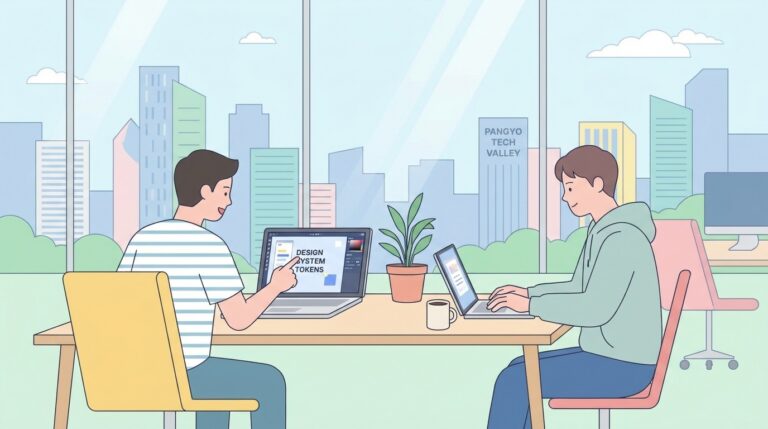
Picture this: You are sitting in a sunlit glass meeting room in Pangyo Techno Valley—South Korea’s premier Silicon Valley—just like a scene straight out of the K-Drama Start-Up. On your screen is Figma; on your colleague’s screen is VS Code. You notice a button component whose border-radius and padding deviate noticeably from the core atomic design rules. In your home country, you might simply ping Slack, adjust the CSS variable directly, or create a quick pull request. But here in a Korean cross-functional tech team, taking unilateral action without mutual consensus can create subtle friction.
You want to suggest reviewing this in the weekly sync, but how do you express this diplomatically in professional Korean? Saying things too bluntly can sound dismissive of your colleague’s hard work, while staying silent creates massive technical debt. Many intermediate Korean learners struggle right at this boundary: moving from polite textbook Korean to dynamic, collaborative IT workspace Korean. Based on hands-on feedback from foreign developers and product designers working at top Korean startups in Teheran-ro and Pangyo, this guide gives you the exact phrases, cultural nuances, and collaboration etiquette needed to master design system handoffs seamlessly.
Phase 2: Core Expressions Deep Dive
1. 이번 스프린트에 거버넌스 회의 안건으로 올려볼게요 (Ibeon seupeurinteue geobeoneonseu hoeui angeoneuro ollyeobolgeyo)
- Pronunciation: Ee-beon seu-peu-rin-teu-eh guh-buh-neon-seu hweh-ui an-geon-eu-ro ol-lyeo-bol-ge-yo (Think of “governance” spoken with Korean syllable rhythms: guh-buh-neon-seu).
- Meaning: “I’ll raise this as an agenda item in our governance sync this sprint.” (Literal) / “Let’s resolve this systematically as a team rather than fixing it haphazardly right now.” (Nuance)
- K-Culture Moment: A tech lead in an office drama like Search: WWW smoothly redirecting an escalating debate over website UI changes toward structured protocol.
- Editor’s Insight: The ending
~ㄹ게요 (~lgeyo)indicates a gentle personal promise of action that reassures the other person without imposing pressure. - Situation Spectrum: Casual: ⚠️ | Semi-formal: ✅ | Formal: ✅
- 🤔 Think About It: In many Western teams, individual ownership encourages quick self-service edits. Why does Korean workspace communication prioritize formalizing topics into shared agendas?
2. 디자인 토큰 규격을 먼저 맞추는 게 우선일 것 같아요 (Dijain tokeun gyugyeogeul meonjeo matchuneun ge useonil geot gat-ayo)
- Pronunciation: Dee-ja-in toh-keun gyoo-gyeok-eul meon-jeo mat-choo-neun geh oo-seon-il geot gat-ah-yo (The word matchuda rhymes with “catch” + “oo-da”).
- Meaning: “I think aligning the design token specifications should come first.” (Literal) / “Let’s tackle the root cause rather than patching individual component styles.” (Nuance)
- K-Culture Moment: A junior developer carefully negotiating with a senior UX designer over component inheritance without sounding confrontational.
- Editor’s Insight: Ending with
~인 것 같아요 (~in geot gat-ayo)softens an assertion into a thoughtful suggestion, demonstrating classic Korean workplace humbleness and consideration. - Situation Spectrum: Casual: ⚠️ | Semi-formal: ✅ | Formal: ✅
- 🤔 Think About It: Notice how expressing certainty directly can sometimes be perceived as overly aggressive in Korean professional dialogue. How does your native language cushion technical critiques?
3. 임의로 수정하기보다는 정기 싱크에서 같이 맞춰봐요 (Im-uiro sujeonghagibodaneun jeonggi singkeueseo gat-i matchwobwayo)
- Pronunciation: Eem-ui-ro soo-jeong-ha-gi-boh-da-neun jeong-gi seeng-keu-eh-seo gat-ee mat-chwo-bwa-yo (Focus on the crisp glide in im-ui).
- Meaning: “Rather than modifying it arbitrarily, let’s align on it together in our regular sync.” (Literal) / “Let’s avoid side-effects and respect our established process.” (Nuance)
- K-Culture Moment: Two engineers in a modern Seongsu-dong incubator balancing agility with strict team standards.
- Editor’s Insight:
~기보다는 (~gibodaneun)politely sets aside a sub-optimal choice while immediately pivoting to같이 (~gat-i, together), reinforcing unity over blame. - Situation Spectrum: Casual: ✅ | Semi-formal: ✅ | Formal: ⚠️
- 🤔 Think About It: How does collective framing (
우리,같이) shift the mood of a software development handoff from scrutiny to partnership?
Phase 3: Textbook Korean vs. Real Tech Korean
Situation 1: Proposing a review of an inconsistent UI component
- 📖 Textbook Korean: 이 버튼 컴포넌트의 크기를 즉시 변경하십시오. (I beoteun keomponeonteuui keugireul jeuksi byeongyeonghasipsio. – “Change the size of this button component immediately.”)
- 🗣️ Real Tech Korean: 이 버튼 컴포넌트 스펙, 이번 싱크 때 같이 한번 맞춰볼까요? (I beoteun keomponeonteu seupek, ibeon singkeu ttae gat-i hanbeon matchwobolkkayo? – “Shall we sync up on this button component’s specs together during this week’s sync?”)
- 💡 Why it differs: Real Korean IT teams rarely use imperative commands (
~하십시오). Instead, they frame tasks as collaborative questions (~볼까요?) to respect cross-functional peers.
Situation 2: Deciding not to build a redundant one-off component
- 📖 Textbook Korean: 우리는 새로운 컴포넌트를 만들지 않겠습니다. (Urineun saeroun keomponeonteureul mandeulji ankketseumnida. – “We will not make a new component.”)
- 🗣️ Real Tech Korean: 이건 기존 컴포넌트로 재사용하고, 필요하면 거버넌스 안건으로 올려요. (Igeon gijon keomponeonteuro jaesayonghago, piryohamyeon geobeoneonseu angeoneuro ollyeoyo. – “Let’s reuse existing components for this, and escalate it as a governance item if needed.”)
- 💡 Why it differs: Korean tech professionals prefer positive reuse language (
재사용하고) over rigid negative declarations.
Phase 4: K-Culture Deep Dive & Non-Verbal Manners
4-1. Nunchi & Screen-Sharing Etiquette
In Korean product organizations, handoff syncs are an exercise in situational awareness (Nunchi). When screen-sharing in tools like Figma or Miro, Korean designers and developers avoid abrupt zooming or clicking wildly near someone else’s avatar cursor.
When pointing out a design token discrepancy:
* Maintain attentive eye contact via webcam or gentle nods (gogaetjit).
* Preface technical pushback with brief positive affirmations like “아, 네 맞아요! (Ah, yes, that’s right!)” before introducing edge cases.
* Never say “틀렸어요 (It’s wrong).” Always use “규격 싱크가 살짝 다른 것 같아요 (The spec sync seems slightly misaligned).”
4-2. The Korean IT Culture Code: “Sync” & “Align”
Korean tech culture combines Silicon Valley agile frameworks with deep-rooted communal harmony (우리 문화). Buzzwords like “싱크 맞추다 (singkeu matchuda – to sync/align)” and “얼라인하다 (eollainhada – to align)” have become everyday verbs. Decision-making at governance syncs isn’t merely about approving a component; it’s about making sure nobody feels excluded from system stewardship.
Phase 5: Real-Life Roleplay Scenario
Setting: FastFive Seongsu Co-working Lounge. Minji (Lead Product Designer) and Alex (Frontend Engineer) are reviewing mobile modal components.
- 민지 (Minji): 알렉스 님, 이번 모달 컴포넌트 여백이 피그마 시안이랑 코드상에서 조금 달라 보여요. (Alex-nim, ibeon modal keomponeonteu yeobaegi pigeuma sian-irang kodeusang-eseo jogeum dalla boyeoyo.)
- 🎭 Politely pointing at the screen with an open palm instead of a single finger.
- “Alex, the margin on this modal component looks slightly different between Figma and the code.”
- 알렉스 (Alex): 아, 확인해 보니까 모바일 뷰포트에서 텍스트가 줄바꿈되면서 패딩이 깨지더라고요. (Ah, hwaginhae bonikka mobail byupoteueseo tekseuteuga julbakkumdoemyeonseo paeding-i kkaejideoragoyo.)
- 🎭 Nodding thoughtfully while showing the responsive dev-tools inspect window.
- “Ah, when I checked, as text wraps in mobile viewports, the padding collapses.”
- 민지 (Minji): 그렇군요! 그럼 기존 규격을 바로 수정할까요, 아니면 싱크 회의에 올릴까요? (Geureokunyo! Geureom gijon gyugyeogeul baro sujeonghalkkayo, animyeon singkeu hoeuie ollilkkayo?)
- 🎭 Tilting head slightly, offering options respectfully.
- “I see! Should we modify the existing specification right away, or bring it to the sync meeting?”
- 알렉스 (Alex): 임의로 수정하기보다는 목요일 거버넌스 회의에서 다 같이 결정해요. (Im-uiro sujeonghagibodaneun mogyoil geobeoneonseu hoeuieseo da gat-i gyeoljeonghaeyo.)
- 🎭 Smiling with calm reassurance.
- “Rather than modifying it arbitrarily, let’s decide together with everyone at Thursday’s governance meeting.”
- 민지 (Minji): 좋아요. 제가 피그마에 안건 카드 만들어 둘게요. (Joh-ayo. Jega pigeumae angeon kadeu mandeureo dulgeyo.)
- 🎭 Typing quickly in Figma to drop a comment marker.
- “Great. I’ll create an agenda card in Figma for it.”
- 알렉스 (Alex): 감사합니다! 토큰 네이밍도 같이 한번 체크해 보면 좋겠어요. (Gamsahamnida! Tokeun neimingdo gat-i hanbeon chekeuhae bomyeon jokesseoyo.)
- 🎭 Lightly bowing head while acknowledging the proposal.
- “Thank you! It would be great if we could check token naming conventions together too.”
- 민지 (Minji): 네, 개발 쪽 의견도 미리 코멘트로 남겨주시면 큰 도움 될 거예요! (Ne, gaebal jjok uigyeondo miri komenteuro namgyeojusimyeon keun doum doel geoyeyo!)
- 🎭 Giving an enthusiastic nod of appreciation.
- “Yes, having dev notes written in comments beforehand will be a huge help!”
- 알렉스 (Alex): 네, 오늘 퇴근 전까지 정리해서 공유해 드릴게요! (Ne, oneul toegeun jeonkkaji jeongnihaeseo gong-yuhae deurilgeyo!)
- 🎭 Closing the laptop screen with mutual satisfaction.
- “Sure thing, I’ll compile and share them before wrapping up today!”
🔀 Interactive Branching Moment
If the designer asks: “이 버튼 색상 토큰, 지금 바로 프론트엔드 코드에서 바꿔주실 수 있나요? (Can you change this button color token directly in frontend code right now?)”
- Option A: “규격 변경은 영향도가 커서 다음 거버넌스 회의에서 논의하는 게 안전할 것 같아요.” (Gyu-gyeok byeon-gyeong-eun yeong-hyang-do-ga keo-seo da-eum geo-beo-neon-seu hoe-ui-e-seo non-ui-ha-neun ge an-jeon-hal geot gat-a-yo.)
- 👉 Feedback (Best): Perfect! It explains the system blast radius politely while leaning on team governance.
- Option B: “안 돼요. 디자이너 마음대로 바꾸면 코드가 망가집니다.” (An dwae-yo. Di-ja-i-neo ma-eum-dae-ro ba-kku-myeon ko-deu-ga mang-ga-jim-ni-da.)
- 👉 Feedback (Bad): Extremely harsh. Accusing a team member of being careless damages cross-functional trust instantly.
- Option C: “네, 그냥 제가 지금 제 로컬에서 바로 고칠게요.” (Ne, geu-nyang je-ga ji-geum je ro-keol-e-seo ba-ro go-chil-ge-yo.)
- 👉 Feedback (Risk): Creates dangerous design token drift across the entire production codebase without peer documentation.
Phase 6: 10-Second Emotion Shadowing Drill
[🤝 협력적이고 부드럽게 / Collaborative & Warm]
“이 컴포넌트 규격, / 이번 싱크에서 / 같이 맞춰볼까요?”
(I keomponeonteu gyugyeok, / ibeon singkeueseo / gat-i matchwobolkkayo?)-
[🧐 신중하고 논리적으로 / Thoughtful & Objective]
“임의로 수정하기보다는 / 거버넌스 회의 안건으로 / 올리는 게 좋겠어요.”
(Im-uiro sujeonghagibodaneun / geobeoneonseu hoeui angeoneuro / ollineun ge jokesseoyo.) -
[🚀 활기차고 든든하게 / Energetic & Reliable]
“제가 피그마에 / 논의할 컴포넌트 목록 / 미리 등록해 둘게요!”
(Jega pigeumae / non-uihal keomponeonteu mongnok / miri deungnokhae dulgeyo!)
Phase 7: K-Culture Mini Dictionary
- 핸드오프 (Haendeu-opeu): Handoff. The formal phase where design files in Figma/Sketch are passed to frontend developers with comprehensive specs.
- 거버넌스 회의 (Geobeoneonseu Hoeui): Governance meeting. A structured weekly or biweekly cross-functional sync to decide additions, deprecations, or modifications of core design system components.
- 싱크 맞추다 (Singkeu Matchuda): To sync or align. Used ubiquitously in Korean offices whenever two people or teams need mutual understanding on project timelines or specs.
- 스펙 아웃 (Seupek-aut): Spec-out. Deciding to cut or defer a specific feature/component variation from the current sprint to protect shipping velocity.
Phase 8: Traveler & Remote Worker Survival Kit
If you are working remotely from Korean coworking hubs like FastFive, Sparkplus, or WeWork in Seoul:
- Top 3 Survival Expressions:
- 혹시 회의실 예약 화면은 어디서 확인하나요? (Hoksi hoeuisil yeyak hwamyeoneun eodiseo hwaginhanayo? – “Excuse me, where can I check the meeting room reservation screen?”)
- Pro Tip: Coworking spaces in Korea run on automated app bookings.
- 와이파이 비밀번호랑 모니터 케이블 좀 쓸 수 있을까요? (Wa-i-pa-i bimilbeonhorang moniteo keibeul jom sseul su isseulkkayo? – “Could I use the Wi-Fi password and a monitor cable?”)
- Pro Tip: Most desks provide HDMI/Type-C dongles at reception.
- 커피 머신 원두 리필 부탁드려도 될까요? (Keopi meosin wondu ripil butakdeuryeodo doelkkayo? – “Could I request a refill on the coffee machine beans?”)
- Pro Tip: Free premium drip coffee is an essential staple in every Korean IT coworking spot!
- Editor’s Travel Note: When traveling between IT hubs (such as Pangyo Techno Valley Station and Gangnam Station), navigate public transit efficiently using the 네이버 지도 앱 다운로드 (Naver Map app download). Foreign credit cards can sometimes trigger errors at local subway kiosk top-up machines; always carry a backup physical transit card (T-Money) purchased with cash at convenience stores.
Phase 9: Stepping Deeper (Cultural Reflection)
In modern Korean tech workplaces, the widespread use of collaborative words like 우리 (our/we) and 같이 (together) reflects deeper social foundations. Design systems in Western companies frequently emphasize individual component autonomy, whereas Korean teams emphasize system equilibrium and psychological safety. Resolving design modifications within a weekly governance sync preserves relational harmony, ensuring no team member feels their individual contribution was dismantled behind their back.
💬 Your Turn: In your workplace, how are design component disputes usually resolved? Have you experienced team governance meetings similar to Korea’s collaborative syncs? Share your thoughts below!
Phase 10: FAQ & Common Pitfalls
Q: Can I use 반말 (casual speech) during a design governance meeting if we are close teammates?
A: Even if you speak casually with a colleague during lunch or coffee chats, switch to 존댓말 (polite speech) during governance syncs. Because these meetings directly affect shared company-wide standards, polite language maintains professional objectivity.
Q: What is the most natural way to say “This design is broken in CSS”?
A: Avoid saying “디자인이 깨졌어요 (The design is broken)” aggressively. Instead, say “모바일 해상도에서 스타일이 살짝 다르게 렌더링되는 것 같아요 (It seems the style renders slightly differently on mobile resolution).”
Q: How do Korean teams refer to Figma components?
A: They use the English loanwords directly with Korean particles, such as “컴포넌트 (keomponeonteu)”, “배리언트 (baerieonteu – variant)”, and “프로퍼티 (peuropeoti – property)”.
🚨 Common Mistakes Alert
- Calling a teammate without honorifics: Avoid saying just “민지! (Minji!)”. Always attach the honorific: “민지 님 (Minji-nim)”.
- Using “틀렸어요” (It is wrong): Technical differences are almost never moral errors. Replace it with “스펙 싱크가 조금 다른 것 같아요 (The spec sync seems slightly different)”.
- Silently refactoring shared component styles: Always give a heads-up: “거버넌스 미팅 전 슬랙 스레드로 먼저 공유드릴게요 (I will share this in a Slack thread prior to the governance meeting).”
Phase 11: Action Missions
- Bronze Mission (Solo Practice): Practice speaking this sentence aloud 5 times until fluid: “이번 안건은 다음 거버넌스 회의에서 같이 맞춰봐요!”
- Silver Mission (Social Connection): Write a brief comment on a LinkedIn or Slack design system post using the phrase “싱크 맞춰봐요 (Let’s sync up)”.
- Gold Mission (Real-life Execution): In your next real team sprint or simulated roleplay, suggest deferring an edge-case component modification to your team’s sync using polite Korean softening expressions.
- 🎮 K-Culture Mission: Watch Episode 5 of the K-drama Start-Up and note how developer Nam Do-san and CEO Seo Dal-mi negotiate technical decisions during their sprints!
Phase 12: Interactive Quiz Challenge
- Scenario Judgment: You discovered an undocumented padding token in a Figma button. What is the most professional response?
- A) “누가 이렇게 만들었는지 지금 슬랙에 올려서 따져요.” (Let’s question who made this on Slack.)
- B) “이 패딩 규격, 다음 거버넌스 회의 안건으로 올려서 같이 논의해 봐요.” (Let’s raise this padding spec in the next governance sync and discuss it together.)
- C) “말하지 말고 그냥 개발자 임의로 적당히 바꿔서 배포해요.” (Change it arbitrarily in dev and deploy without telling anyone.)
- Fill in the Blank:
“임의로 수정하기보다는 정기 회의에서 다 같이 _______ 맞춰봐요.” (Rather than modifying arbitrarily, let’s sync up together at the regular meeting.)- Hint: The tech buzzword for alignment.
- True or False: In Korean tech handoffs, using
~인 것 같아요shows lack of professional confidence and should be avoided.
👉 Click to Reveal Quiz Answers & Explanations
- Answer: B – Polite, systematic, and collaborative.
- Answer: 싱크 (singkeu) – Combined as “싱크 맞춰봐요 (Let’s align/sync).”
- Answer: False –
~인 것 같아요is an essential Korean workplace politeness tool used even by senior principal engineers to deliver critiques constructively without confrontation.
🎬 Watch Our Daily Videos! (Daily Hangul Official Instagram)
Review the expressions you learned in this article with our fun daily short videos! Check out native pronunciation and real-life nuances in action.
- Instagram @dailyhangul_en







