

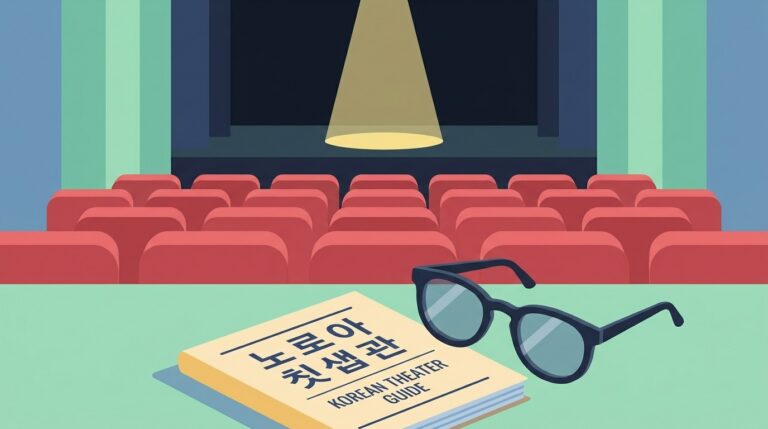
Master Korean Theater Culture: Prime Seats (중블) & Opera Glasses (오글)
안녕하세요! 매일한글 에디터입니다. Have you ever experienced the adrenaline rush of trying to buy a ticket for a major Korean musical in Seoul? You sit in front of your screen, waiting for the clock to hit 8:00 PM, only to watch thousands of seats vanish in three seconds flat. Before you know it, your only option is a seat way up on the second or third tier. As you step into the majestic theater hall, a wave of panic sets in: How am I going to see my favorite actor’s emotions from all the way up here?
Don’t worry—local Korean theater fans have mastered this dilemma with ingenious strategies and vocabulary! From targeting the legendary 중블 (center block) to renting 오페라글라스 (opera glasses), local theatergoers know exactly how to transform any seat into an unforgettable front-row experience. Based on years of navigating Daehangno plays and grand musical theaters across Seoul, I have put together this insider guide so you can book, speak, and enjoy the show like a true Korean theater connoisseur.
Phase 2: Core 3 Expressions In-Depth
1. 명당 (Myeongdang) / 중블 (Jungbeul)
- Pronunciation: Myeong-dang (Sounds like “myung-dahng”) / Jung-beul (“joong” as in jungle + “bull”)
- Meaning:
- 명당: Historically, an ideal geographical plot chosen via feng shui. Modern nuance: A “prime spot” or the best seat in the house with an immaculate sightline.
- 중블: Short for 중앙 블록 (Jung-ang beul-lok; Center block).
- K-Culture Moment: On ticket opening day, you will see fans flocking to social media writing: “드디어 중블 3열 잡았어요! (I finally snagged row 3 in the center block!)”
- Editor’s Insight: Most Korean musical venues divide ground-floor orchestra seating into three sections: 좌블 (jwa-beul; left block), 중블 (jung-beul; center block), and 우블 (u-beul; right block). Because directors stage pivotal emotional moments right in the center, 중블 is the undisputed 명당.
- Situation Spectrum:
- Casual: ✅
- Semi-formal: ✅
- Formal: ⚠️ (Use ‘중앙 구역 좌석’ in official writing)
- 🤔 Think About It: In English, we simply say “prime seats” or “orchestra center.” Why do you think Korean fans adopted an ancient Joseon geomancy term like 명당 to celebrate a great theater seat?
2. 오페라글라스 빌리다 (Opera geullaseu billida) / 오글 대여 (Ogeul daeyeo)
- Pronunciation: O-pe-ra-geul-la-seu bil-li-da / O-geul dae-yeo (“Oh-geul day-yeo”)
- Meaning:
- Literal: To rent opera glasses.
- Real Nuance: Renting venue-certified compact theater binoculars at the lobby counter to observe nuanced facial acting from distance.
- K-Culture Moment: Arriving at venues like Charlotte Theater or Blue Square at least 50 minutes early specifically to run to the counter before the limited binocular stock is depleted.
- Editor’s Insight: Theatergoers almost exclusively abbreviate this word to 오글 (O-geul). A fun slang warning: in everyday teenage slang, 오글거리다 means “to feel cringey,” but inside any theater lobby, 오글 100% refers to theater glasses!
- Situation Spectrum:
- Casual: ✅
- Semi-formal: ✅
- Formal: 🚫 (At official counters, say ‘오페라글라스 대여’)
- 🤔 Think About It: While many international theater traditions focus on absorbing the stage set as a panoramic whole, Korean fans place immense weight on close-up micro-expressions. What does this reveal about Korean performance storytelling?
3. 시야 방해 (Siya banghae) / 시야 제한석 (Siya jehanseok)
- Pronunciation: Si-ya bang-hae (“See-yah bahng-heh”) / Si-ya je-han-seok
- Meaning:
- Literal: Visual obstruction / Restricted view seat.
- Real Nuance: When a safety handrail, lighting equipment, or the person sitting ahead blocks a portion of the stage.
- K-Culture Moment: Before booking, fans review seat forums to ensure the venue handrails do not create 시야 방해 for their height.
- Editor’s Insight: Venues often release leftover 시야제한석 at a 20% to 50% discount. If you bring your 오글, these discounted seats can turn into incredible budget bargains!
- Situation Spectrum:
- Casual: ✅
- Semi-formal: ✅
- Formal: ✅
- 🤔 Think About It: How does transparently labeling and discounting “obstructed seats” influence trust between Korean entertainment venues and audiences?
Phase 3: Textbook Korean vs. Real Korean
Situation 1: Recommending the best seat to a friend
- 📖 교과서 한국어 (Textbook): 가운데 자리가 가장 잘 보입니다. (Ga-un-de ja-ri-ga ga-jang jal bo-im-ni-da. / The center seat is seen the best.)
- 🗣️ 진짜 한국어 (Real-life): 역시 중블 앞열이 찐 명당이에요. (Yeok-si jung-beul ap-yeo-ri jjin myeong-dang-i-e-yo. / As expected, the front rows of the center block are the real prime spots!)
- 💡 왜 다를까? (Why the difference?): Standard textbooks stick to formal adjectives, while real fans use colloquial portmanteaus like 중블 and emphatic modern slang like 찐 (authentic/real).
Situation 2: Asking if binoculars are still available at the booth
- 📖 교과서 한국어 (Textbook): 망원경을 빌리고 싶습니다. (Mang-won-gyeong-eul bil-li-go sip-seum-ni-da. / I would like to rent a telescope.)
- 🗣️ 진짜 한국어 (Real-life): 혹시 오페라글라스 현장 대여 남았나요? (Hok-si o-pe-ra-geul-la-seu hyeon-jang dae-yeo na-mang-na-yo? / By any chance, are there still on-site opera glass rentals left?)
- 💡 왜 다를까? (Why the difference?): The word 망원경 sounds like a pirate telescope or astronomical equipment! In performing arts venues, 오페라글라스 (or simply 오글) is the natural, accurate term.
Phase 4: K-Culture Deep Dive & Non-Verbal Manners
4-1. 눈치 (Nunchi) & Etiquette: “수그리 금지” (No Leaning Forward)
The golden rule of Korean theater decorum is: 등받이에 등을 붙이세요 (Keep your back flat against your seat back).
In Korean fan communities, leaning forward is called 수그리 (Suguri). If you lean forward to see the stage better, your head directly blocks the line of sight of the person behind you, causing immediate 시야 방해. Always keep your posture straight and your elbows pulled tightly toward your chest when holding your opera glasses. Never swing your arms wide or hold binoculars above eye level.
4-2. Culture Code: The “Hoejeonmun” (Revolving Door) Phenomenon
Korean musical enthusiasts frequently speak of 회전문 관객 (Hoejeonmun gwangae-k; revolving door audience). This refers to dedicated fans who re-watch the exact same musical 5 to 20 times to evaluate different casting pairings on the 캐스팅 보드 (Casting Board). Because they already know every lyric and plot twist, their entire focus shifts to the subtle micro-tremors of an actor’s voice and tears—which makes renting an 오글 an absolute must.
Phase 5: Real-Life Roleplay Scenario
- Setting: The service desk inside Blue Square Hall, Hannam-dong, Seoul.
- Characters: You (Learner) and Min-ji (House Usher / Theater Attendant).
Turn 1
You: 저기요, 오늘 오페라글라스 현장 대여 아직 되나요?
(Jeogiyo, oneul opera geullaseu hyeonjang daeyeo ajik doenayo? / Excuse me, is on-site opera glass rental still available today?)
🎭 Approaching the rental booth with a polite smile.
Turn 2
Min-ji: 네, 고객님! 신분증 있으시면 대여 도와드릴게요. 대여료는 4,000원입니다.
(Ne, gogaeknim! Sinbunjeung issisimyeon daeyeo dowadeurilgeyo. Daeyeoryoneun sacheon-won-imnida. / Yes, customer! If you have your physical ID, I can assist you. The rental fee is 4,000 KRW.)
🎭 Smiling and pointing to the registration tablet.
Turn 3
You: 여기 여권이랑 카드요. 제 자리가 2층 뒤쪽인데 잘 보일까요?
(Yeogi yeogwon-irang kadeuyo. Je jariga icheung dwijjoginde jal boilkkayo? / Here is my passport and credit card. My seat is at the back of the 2nd floor, will it be visible?)
🎭 Handing over your passport and payment.
Turn 4
Min-ji: 2층 뒷열은 무대 전체는 잘 보이지만, 배우님 표정은 오글을 쓰셔야 또렷하게 보여요. 초점 맞추는 법 아시나요?
(Icheung dwin-yeoreun mudae jeoncheneun jal boijiman, baeunim pyojeongeun ogeureul sseusyeoya ttoryeothage boyeoyo. Chojeom matchuneun beop asinayo? / The 2nd floor back row gives a nice overview of the full stage, but for facial expressions, you need the glasses to see clearly. Do you know how to focus them?)
🎭 Gently passing the binocular pouch across the counter.
Turn 5
You: 가운데 휠을 돌려서 맞추면 되는 거 맞죠?
(Gaunde hwireul dollyeoseo matchumyeon doeneun geo matjyo? / I adjust it by turning the central wheel, right?)
🎭 Inspecting the lens and testing the focus mechanism.
Turn 6
Min-ji: 맞습니다! 관람 중에는 팔을 너무 벌리지 마시고 가슴 쪽에 붙여서 관람해 주세요.
(Matseumnida! Gwallam jung-eneun pareul neomu beol-li-ji masigo gaseum jjoge buchyeoseo gwallamhae juseyo. / Exactly! During the performance, please keep your elbows close to your chest rather than spreading them out.)
🎭 Demonstrating the tucked-elbow posture kindly.
Turn 7
You: 네, 조심할게요! 반납은 공연 끝나고 여기로 오면 되나요?
(Ne, josimhalgeyo! Bannabeun gong-yeon kkeutnago yeogiro omyeon doenayo? / Yes, I will be careful! Do I return it here after the curtain call?)
🎭 Nodding in gratitude.
Turn 8
Min-ji: 네, 공연 종료 후 15분 내로 가져오시면 신분증 돌려드립니다. 즐거운 관람 되세요!
(Ne, gong-yeon jongnyo hu sib-o-bun naero gajyeoosimyeon sinbunjeung dollyeodeurimnida. Jeulgeoun gwallam doeseyo! / Yes, bring it back within 15 minutes after the show ends, and we will return your ID. Enjoy the show!)
🎭 Handing you the rental receipt with a bow.
🔀 Interactive Decision Point
Suppose you notice another guest asking about seat upgrades at the desk. How do you inquire about canceling your back seat for an empty center seat?
- Option A: “혹시 지금 중블 취소표 남은 것 있으면 현장 변경 가능한가요?” (Could I change my seat on-site if there are canceled tickets in the center block?)
- Feedback (Best): Extremely polite and natural. Uses theater terms accurately while respecting venue procedures.
- Option B: “배우 얼굴 안 보이니까 그냥 맨 앞줄 빈자리로 가서 앉을게요.” (I can’t see the actor, so I’ll just sit in an empty front-row seat.)
- Feedback (Bad): Major etiquette breach! Moving to an unassigned seat during a performance is strictly prohibited in Korea.
- Option C: “신분증 없는데 친구 학생증 사진으로 오글 빌려주세요.” (I don’t have my ID, please rent me glasses using my friend’s student ID photo.)
- Feedback (Risk): Venues almost universally require a physical ID card or passport under your name. Digital photos are rarely accepted.
Phase 6: 10-Second Emotion Shadowing Drill
Practice these lines with rhythm, pauses (/), and natural emotion!
[👀 다급하고 간절하게 - Urgent and earnest]
혹시 / 오늘 / 오글 대여 / 마감됐나요?
(Hok-si / oneul / o-geul dae-yeo / ma-gam-dwaen-na-yo?)
“By any chance… is opera glass rental already closed today?”-
[😍 감탄하며 신나게 - Delighted and thrilled]
우와, / 3열 중블이라니 / 완전 명당 잡았네!
(U-wa, / sam-yeol jung-beul-i-ra-ni / wan-jeon myeong-dang ja-bang-ne!)
“Wow, row three center block? You scored a total jackpot seat!” -
[🤫 조심스럽고 정중하게 - Soft and considerate]
공연 중에 / 앞사람 머리 때문에 / 시야가 조금 가려요.
(Gong-yeon jung-e / ap-sa-ram meo-ri ttae-mu-ne / si-ya-ga jo-geum ga-ryeo-yo.)
“During the show, my view is slightly blocked by the person ahead.”
Phase 7: K-Culture Mini Dictionary
-
중블 (Jung-beul)
Translation: Center Block Seating.
Usage: The most sought-after seating section in Korean theaters, offering zero neck strain and balanced acoustics. -
오글 (O-geul)
Translation: Opera Glasses / Theater Binoculars.
Usage: Daily shorthand used by theater fans when reserving or packing optics for second/third-tier seating. -
피켓팅 (Pi-ket-ting)
Translation: Bloodbath Ticketing (피 [Blood] + 티켓팅 [Ticketing]).
Usage: The fierce, lightning-fast battle to secure musical tickets online when server reservation opens. -
시체관극 (Si-che-gwan-geuk)
Translation: Corpse-like Viewing (Viewing like a quiet statue).
Usage: The ultra-quiet Korean theater culture where audiences sit motionless without whispering, rustling programs, or fidgeting.
Phase 8: Survival Kit for Travelers
Top 3 Survival Lines
- 오페라글라스 대여 어디서 하나요?
(O-pe-ra-geul-la-seu dae-yeo eo-di-seo ha-na-yo?)
Pro Tip: Ask this the second you enter the main theater foyer to locate the dedicated booth. - 신분증 여기 있습니다.
(Sin-bun-jeung yeo-gi it-seum-ni-da.)
Pro Tip: Have your physical passport or Alien Registration Card ready in hand to speed up the queue. - 시야 방해 없는 자리인가요?
(Si-ya bang-hae eop-neun ja-ri-in-ga-yo?)
Pro Tip: Use this at box office ticket pick-up desks when checking side-seat sightlines.
Editor’s Travel Note
- Digital Preparation: Most major Korean musicals open ticket sales via Interpark Global Ticket reservation. Bookmark your musical’s page in advance.
- Binocular Collateral: Korean venues will retain your physical ID (passport) until you return the binoculars immediately after the curtain call. Keep your rental slip safe!
- Arrival Timing: Aim to arrive 60 minutes before curtain-up. Popular venues like Charlotte Theater (Jamsil) or Blue Square (Itaewon) often run out of rental glasses within 20 minutes of opening the rental counter.
Phase 9: “One Step Deeper” (Cultural Reflection)
Korean musical fandom is defined by a deep culture of mutual consideration called 배려 (Bae-ryeo). Because tickets are notoriously difficult to obtain and relatively expensive, audiences treat every performance as a sacred, once-in-a-lifetime experience. This mindset created 시체관극—the unwritten agreement that everyone remains completely silent and still so that no one’s immersion is ruined. While some visitors initially find this atmosphere intense compared to the cheers and laughter of Broadway or West End theaters, it allows everyone, even in the very last row with their 오글, to feel intimately connected to the stage.
💬 Your Turn: Have you ever attended a theater show outside your home country? How does the silence and focus of Korean theater etiquette compare to your local theater culture? Share your thoughts below!
Phase 10: FAQ & Mistake Prevention
Q: Can I reserve opera glasses online in advance?
A: Some venues like the National Theater of Korea or Charlotte Theater allow online pre-reservations via their official website, but many theaters still operate on a strictly first-come, first-served basis on-site. Always check the venue notice!
Q: Can I use my own concert binoculars instead of renting?
A: Yes! Many regular fans bring their own 8×21 or 10×25 compact binoculars. Just make sure they do not have any electronic LED indicator lights that could disturb others in the dark.
Q: Is taking photos during the curtain call allowed?
A: Usually, photos and videos are strictly prohibited throughout the entire show, including the curtain call. However, venues often schedule specific “Curtain Call Day” (커튼콜 데이) events where filming is permitted. Look for the sign 커튼콜 촬영 가능 at the ticket booth!
🚨 Common Mistakes Warning Board
- ❌ Mistake 1: Leaving your physical passport at your hotel and showing a smartphone photo to rent glasses.
👉 Correct Action: Korean venues require physical photo identification as collateral. Always carry your real passport. - ❌ Mistake 2: Leaning your head forward to catch a dramatic scene.
👉 Correct Action: Keep your head and shoulders flat against the backrest to avoid blocking the patron behind you. - ❌ Mistake 3: Packing away your opera glasses during the show and letting the velcro case rip loudly.
👉 Correct Action: Keep the binoculars on your lap on top of your coat or program book to prevent any noise.
Phase 11: Action Missions
- 🥉 Bronze Level: Stand in front of your mirror and practice saying: “오페라글라스 현장 대여 남았나요?” three times with crisp pronunciation.
- 🥈 Silver Level: Go to social media (X or Instagram) and search the hashtag
#중블or#오글to see real seat view photos posted by Korean fans. - 🥇 Gold Level: On your next trip to Seoul, visit Daehangno or Blue Square, pick up a musical program book, and secure your own theater binoculars at the counter!
- 🎮 K-Culture Mission: Watch a behind-the-scenes rehearsal clip of a Korean musical production (like Jekyll & Hyde or Frankenstein) and spot how actors practice directing their gaze straight toward 중블!
Phase 12: Interactive Quiz Challenge
Question 1: Situation Judgment
You are sitting in row 12 of the 2nd floor, and you want to clearly observe the lead actor’s crying scene. What should you do?
* A) Stand up slightly so your view is higher.
* B) Lean forward as far as possible over the handrail.
* C) Keep your back against the seat and use your rented 오페라글라스 (오글).
Question 2: Fill in the Blank
Korean theater seating is divided into left, center, and right. The most popular prime center block is called “____블”.
Question 3: True or False
In Korean theater halls, you can freely lean forward whenever you want, as long as you do not make any talking noise. (True / False)
👉 Click to view answers and explanations!
- Question 1 Answer: C
Explanation: Leaning forward or standing up causes severe visual obstruction (시야 방해) for those behind you. Using your 오글 while seated back is the correct etiquette. - Question 2 Answer: 중 (Full word: 중블)
Explanation: Short for 중앙 블록 (Center Block). - Question 3 Answer: False
Explanation: Leaning forward (수그리) is one of the biggest etiquette violations in Korean theaters because it blocks the sightlines of everyone sitting behind you.
🎬 Watch Our Daily Videos! (Daily Hangul Official Instagram)
Review the expressions you learned in this article with our fun daily short videos! Check out native pronunciation and real-life nuances in action.
- Instagram @dailyhangul_en







