

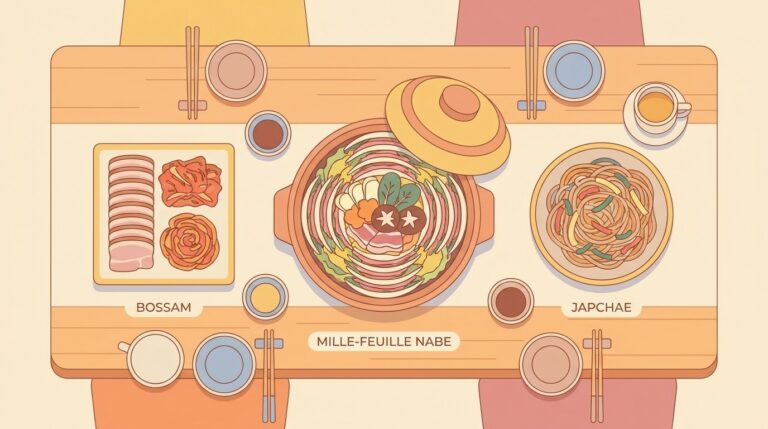
Housewarming Feast in Korea: How to Host Friends with Mille-Feuille Nabe, Bossam, and Japchae
Phase 1: Empathy (Story-Driven Opening)
안녕하세요! 매일한글 에디터입니다. (Hello! I’m your Daily Hangul editor.)
Picture this: after months of hunting for the perfect studio in Seoul, you’ve finally settled in. The fairy lights are up, your miniature plants are lined up by the window, and today is the big day—your very first jipdeuri (집들이 – Korean housewarming party)! You spent all morning meticulously layering thin slices of beef and napa cabbage into neat rosettes for a stunning 밀푀유나베 (mille-feuille nabe), simmering pork belly with ginger and doenjang for tender 보쌈 (bossam), and tossing colorful glass noodles with vegetables for classic 잡채 (japchae).
The doorbell chimes. Your Korean coworkers step in, grinning widely, clutching giant rolls of premium toilet paper and sparkling laundry detergent. Everyone takes off their shoes, gathers around your low wooden dining table, and gasps at the feast spread before them.
Suddenly, your mind freezes. You know how to say “thank you” and “hello,” but how do you introduce this entire homemade spread without sounding boastful? How do you say “I made this myself, please eat lots!” naturally at an A2 beginner level? In Korea, introducing your housewarming spread comes with a distinct touch of warm hospitality and modesty. Let’s explore how to present your home-cooked feast like a true Seoul local!
Phase 2: 3 Core Expressions for the Perfect Host
1. 직접 준비했어요 (Jikjeop junbihaesseoyo)
- Pronunciation: Jikjeop junbihaesseoyo (Sounds like: Jeek-jup joon-bee-he-so-yo)
- Meaning: Literal: “I prepared it directly.” | Actual Nuance: “I made this myself with care.”
- K-Culture Moment: You will hear this constantly on reality shows like I Live Alone (나 혼자 산다) whenever a cast member welcomes guests into their home and proudly points to the food spread.
- Editor’s Insight: The word 직접 (jikjeop – directly/personally) transforms a plain sentence into a warm expression of hospitality. It tells your guests, “I put my own time and effort into this meal for you.”
- Situation Spectrum: Casual ✅ | Semi-formal ✅ | Formal ⚠️
- 🤔 Think About It: In English, we often say “I cooked this!” In Korean, emphasizing jikjeop highlights the personal care you invested into the relationship.
2. 입맛에 맞을지 모르겠어요 (Inmase majeulji moreugesseoyo)
- Pronunciation: Inmase majeulji moreugesseoyo (Sounds like: Een-mah-seh mah-jeul-jee mo-reu-geh-so-yo)
- Meaning: Literal: “I don’t know if it will fit your taste.” | Actual Nuance: “I hope it suits your palate / I hope you enjoy it!”
- K-Culture Moment: The quintessential line uttered by every drama mother or dinner host when setting down an opulent 12-dish feast.
- Editor’s Insight: Even if your mille-feuille nabe looks like a work of art, Korean dining etiquette values humble modesty. Saying this shows humility while inviting your guests to taste without pressure.
- Situation Spectrum: Casual ⚠️ (With close friends, try “입에 맞았으면 좋겠다!”) | Semi-formal ✅ | Formal ✅
- 🤔 Think About It: Why does Korean culinary culture favor modesty before anyone takes a bite? How does that compare to your native culture’s hosting habits?
3. 많이 드세요 (Mani deuseyo)
- Pronunciation: Mani deuseyo (Sounds like: Mah-nee deu-seh-yo)
- Meaning: Literal: “Eat a lot.” | Actual Nuance: “Please help yourself / Bon appétit!”
- K-Culture Moment: The warmest phrase in Korean daily life—spoken by grandma, your favorite soup restaurant owner (imo), and proud party hosts.
- Editor’s Insight: This is the ultimate Korean equivalent of bon appétit. In Korea, caring about someone’s appetite is a foundational way of expressing affection.
- Situation Spectrum: Casual ⚠️ (많이 먹어 for same-age friends) | Semi-formal ✅ | Formal ✅
- 🤔 Think About It: Notice how “Eat a lot” is an expression of deep care in Korea, rooted in a history where wishing someone plenty of food was the highest blessing.
Phase 3: Textbook Korean vs. Real Korean
Scenario 1: Telling guests you cooked the meal
- 📖 Textbook Korean: 제가 당신들을 위해 음식을 요리했습니다. (Jega dangsindeureul wihae eumsigeul yorihan-seumnida. – I cooked food for you all.)
- 🗣️ Real Korean: 집들이 음식으로 이것저것 직접 준비했어요! (Jipdeuri eumsigeuro igeosjeogeot jikjeop junbihaesseoyo! – I prepared this and that myself for our housewarming!)
- 💡 Why the difference? Koreans almost never use “당신” (you) in everyday conversation because it feels stiff or confrontational. Instead, “이것저것” (this and that) sounds delightfully friendly and modest.
Scenario 2: Telling your guests not to hold back
- 📖 Textbook Korean: 음식을 더 많이 섭취하십시오. (Eumsigeul deo mani seopchwihasipsio. – Please ingest more food.)
- 🗣️ Real Korean: 더 있으니까 눈치 보지 말고 팍팍 드세요! (Deo isseunikka nunchi boji malgo pakpak deuseyo! – There is plenty more, so don’t be shy and dig right in!)
- 💡 Why the difference? The verb 섭취하다 sounds like a nutrition lecture. Using idioms like 눈치 보지 말다 (don’t worry about what others think) and adverbs like 팍팍 (generously/plentifully) brings instant warmth to the table.
Phase 4: K-Culture Deep Dive & Non-Verbal Manners
4-1. Nunchi (눈치) & Table Gestures
When welcoming guests to your dining table in Korea:
1. The Two-Handed Reveal: When lifting the pot lid of the mille-feuille nabe or passing a dipping sauce bowl, support your right wrist or forearm with your left hand. This subtle gesture shows politeness and care.
2. Handing Out Utensils: As the host, set down the spoons and chopsticks on napkins before guests sit down. Place the flat metal spoon on the left and the chopsticks on the right.
3. Checking Broth and Heat: Pay attention (nunchi) to the portable gas stove. Lower the flame gently when the hot pot boils so guests can eat without being splashed by broth.
4-2. Why These 3 Dishes for a Housewarming?
- 밀푀유나베 (Mille-Feuille Nabe): Originally a French-Japanese fusion, this dish has become the #1 Korean housewarming dish over the past decade. Why? It looks spectacular on Instagram with alternating layers of green cabbage and red beef, yet it is easy to prepare ahead of time.
- 보쌈 (Bossam): Boiled pork belly wrapped in crisp pickled radish and fresh greens. In traditional belief, wrapping (ssam) food symbolizes wrapping up good luck, fortune, and health for your new home.
- 잡채 (Japchae): Classic party glass noodles. Long sweet potato noodles traditionally represent a long, smooth, and prosperous life in your new space!
Phase 5: Real-World Roleplay Scenario
Setting: Sarah’s new apartment in Seoul. Min-jun, a Korean coworker, arrives for the housewarming.
- Sarah: 어서 와요, 민준 씨! 누추하지만 들어오세요. (Eoseo wayo, Minjun ssi! Nuchuhajiman deureo-oseyo.)
🎭 [Opens door with a welcoming smile, pointing to guest slippers]
“Welcome, Min-jun! It’s humble, but please come in.” -
Min-jun: 집 진짜 예쁘네요! 이거 집들이 선물 휴지랑 세제예요. (Jip jinjja yeppeuneyo! Igeo jipdeuri seonmul hyujirang seje-yeyo.)
🎭 [Hands over a large pack of toilet paper and laundry detergent]
“Your home is so pretty! Here are housewarming gifts—toilet paper and detergent.” -
Sarah: 와, 고마워요! 마침 필요했는데 센스 최고! (Wa, gomawoyo! Machim piryohaenneunde senseu choego!)
🎭 [Accepts the gifts with both hands]
“Wow, thank you! I actually needed these, you have the best taste!” -
Min-jun: 와, 식탁에 이게 다 뭐예요? 냄새 대박이다! (Wa, siktage ige da mwoyeyo? Naemsae daebak-ida!)
🎭 [Eyes widening as he spots the bubbling pot and side dishes]
“Whoa, what is all this on the dining table? The aroma is incredible!” -
Sarah: 집들이 음식으로 밀푀유나베랑 보쌈, 잡채를 직접 준비했어요. (Jipdeuri eumsigeuro milpoeyunaberang bossam, japchaereul jikjeop junbihaesseoyo.)
🎭 [Turns down the heat on the portable stove with a proud smile]
“For housewarming food, I prepared mille-feuille nabe, bossam, and japchae myself.” -
Min-jun: 이걸 다 직접 만들었어요? 식당 차려도 되겠어요! (Igeol da jikjeop mandeureosseoyo? Sikdang charyeodo doegesseoyo!)
🎭 [Clapping hands in genuine admiration]
“You made all of this yourself? You could open a restaurant!” -
Sarah: 입맛에 맞을지 모르겠어요. 식기 전에 많이 드세요! (Inmase majeulji moreugesseoyo. Sikgi jeone mani deuseyo!)
🎭 [Hands Min-jun a set of chopsticks]
“I hope it suits your taste. Eat plenty before it gets cold!” -
Min-jun: 정말 잘 먹겠습니다! 비주얼 완전 감동이에요. (Jeongmal jal meokgetseumnida! Bijueol wanjeon gamdong-ieyo.)
🎭 [Rubs hands together enthusiastically]
“I will eat well! The presentation is truly touching.”
🔀 Interactive Branching Moment
Min-jun picks up his chopsticks and looks at the steaming pot. How do you playfully reply to keep the mood fun?
- Option A: “맛없으면 배달 시켜 먹어요! 편하게 드세요.” (Maseopseumyeon baedal sikyeo meogeoyo! Pyeonhage deuseyo. – If it’s not good, we can just order takeout! Enjoy without pressure.)
- 👉 Feedback (Best!): Perfect humor! This takes off all pressure and makes guests laugh while appreciating your casual warmth.
- Option B: “제가 요리 천재라서 그래요. 다 드세요.” (Jega yori cheonjaeraseo geuraeyo. Da deuseyo. – It’s because I’m a culinary genius. Finish it all.)
- 👉 Feedback (Risk): Only works if delivered with exaggerated comical acting. Otherwise, it might sound boastful for an A2 learner.
- Option C: “음식 남기면 안 돼요. 다 먹어야 돼요.” (Eumsik namgimyeon an dwaeyo. Da meogeoya dwaeyo. – You cannot leave leftovers. You must finish everything.)
- 👉 Feedback (Bad): Sounds overly strict and stressful for guests who are trying to enjoy a casual celebration.
Phase 6: 10-Second Emotion Shadowing Drill
Read these aloud, pausing at the slashes (/), and adopting the suggested mood:
[😊 Proud & Hospitable]
집들이 음식으로 / 밀푀유나베랑 보쌈, 잡채를 / 직접 준비했어요!
(Jipdeuri eumsigeuro / milpoeyunaberang bossam, japchaereul / jikjeop junbihaesseoyo!)-
[🥺 Polite & Modest]
입맛에 / 맞을지 모르겠어요. / 따뜻할 때 드세요!
(Inmase / majeulji moreugesseoyo. / Ttatteuthal ttae deuseyo!) -
[🎉 Cheerful & Generous]
부족하면 말해요, / 더 있으니까 / 많이 드세요!
(Bujokhamyeon malhaeyo, / deo isseunikka / mani deuseyo!)
Phase 7: K-Culture Mini Dictionary
- 집들이 (Jipdeuri) | Housewarming party | The traditional and contemporary gathering where loved ones visit a new home to bring good energy and useful household items.
- 밀푀유나베 (Milpoeyu-nabe) | Mille-feuille hot pot | Layered beef, cabbage, and perilla leaves simmered in dashi broth. Renowned as the king of home party visuals in modern Korea.
- 보쌈 (Bossam) | Boiled pork belly wrap | Tender boiled pork sliced thin and wrapped with salted cabbage and kimchi. Known for feeding crowds with hearty comfort.
- 손맛 (Sonmat) | Hand taste / Culinary touch | The special home-cooked flavor that comes from a cook’s intuitive touch and genuine care rather than an exact commercial recipe.
Phase 8: Survival Kit for Expats & Travelers
Top 3 Survival Phrases
- 뭐부터 먹을까요? (Mwo-buteo meogeulkkayo?)
Meaning: “What should we eat first?”
Pro Tip: A great phrase if you are a guest looking at a lavish spread of dishes. - 국물이 진짜 시원해요! (Gungmuri jinjja siwonhaeyo!)
Meaning: “The broth is so refreshing/deep!”
Pro Tip: Saying siwonhada (cool/refreshing) while eating steaming hot soup proves your Korean cultural fluency instantly. - 배불러서 더 못 먹겠어요! (Baebulleoseo deo mot meokgetseumnida!)
Meaning: “I’m so full, I can’t eat another bite!”
Pro Tip: The ultimate compliment you can offer your host after finishing dinner.
Editor’s Travel Note
Preparing housewarming food in Korea is made effortless by modern grocery apps. Download the Coupang Rocket Fresh grocery delivery app to order fresh napa cabbage, sliced beef shabu-shabu meat, and pork belly for early morning doorstep delivery. If you are picking up ingredients in person, navigate to local traditional markets like Mangwon Market using the Naver Map navigation app.
Phase 9: “One Step Deeper” (Reflective Question)
In Korean culture, food is far more than physical sustenance—it is a physical manifestation of 정 (jeong – heartfelt affection and connection). Cooking multiple dishes with your own hands for friends stepping into your private home signals trust, belonging, and community. Even in our era of high-speed food delivery, taking the time to layer napa cabbage and boil pork for your friends remains the ultimate statement of warmth.
💬 Your Turn: If you were to host a Korean friend at your home, what signature dish from your home country would you prepare personally? Share with us in the comments below!
Phase 10: FAQ & Common Mistakes
Q: Why do guests bring toilet paper and laundry detergent to a housewarming?
A: In Korean superstition, toilet paper unrolls smoothly, symbolizing that all your future affairs will untangle with ease (술술 풀리다). Detergent produces bubbles (거품), symbolizing that your wealth will bubble up and multiply rapidly!
Q: Can I serve takeout food instead of cooking?
A: Absolutely! Many young Koreans order delivery (배달음식) like fried chicken, tteokbokki, or Chinese food for casual housewarmings. Just be honest and say cheerfully: “맛있는 배달 맛집으로 준비했어요!” (I ordered from great delivery spots!)
Q: Is it rude to start eating before the host sits down?
A: Yes, it is better to wait until the host puts on the pot and says “많이 드세요!” (Please eat plenty). Starting before the host sits down can make you appear rushed.
🚨 Common Mistakes Warning Board
- ❌ Mistake 1: Calling your guests 당신 (Dangsin).
👉 Correct Action: Use their name with 씨 (e.g., 민준 씨) or refer to them as 여러분 (everyone). - ❌ Mistake 2: Saying “제 요리를 즐기세요” (Enjoy my cooking) translated literally from English.
👉 Correct Action: Say “맛있게 드세요” (Eat deliciously) or “입맛에 맞았으면 좋겠어요”. - ❌ Mistake 3: Forgetting to offer slippers at the entryway.
👉 Correct Action: Hand your guests cozy indoor slippers (실내화) as soon as they step across the hyeon-gwan (entryway).
Phase 11: Action Mission & Engagement
- 🥉 Bronze Mission (Solo): Practice saying “집들이 음식으로 밀푀유나베를 직접 준비했어요!” three times in front of the mirror with a proud smile.
- 🥈 Silver Mission (Social): Snap a photo of your dinner tonight and post it on Instagram or your study journal with the caption: “입맛에 맞을지 모르겠어요! 많이 드세요~”
- 🥇 Gold Mission (Real Life): Invite a friend or exchange partner to your place, brew tea or prepare a snack, and say: “직접 준비했어요. 맛있게 드세요!”
🎮 K-Culture Mission: Watch an episode of a Korean lifestyle vlog or variety show (like Omniscient Interfering View or I Live Alone). Spot when the host uses 직접 (personally) when showing something in their house!
Phase 12: Interactive Quiz Challenge
1. Situational Judgment:
Your friends arrive at your apartment and praise your food layout. Which response shows proper Korean hosting modesty and warmth?
(A) 당연하죠, 제가 최고니까요.
(B) 입맛에 맞을지 모르겠어요. 많이 드세요!
(C) 손대지 마세요, 아직 안 돼요.
2. Fill in the Blank:
“이 음식들을 제가 집에서 ________ 준비했어요.” (I prepared these dishes at home myself/with my own hands.)
(A) 직접 (Jikjeop)
(B) 대충 (Daechung)
(C) 멀리 (Meolli)
3. True or False:
Bringing dishwashing liquid or laundry detergent to a housewarming party in Korea is considered impolite because it implies the host’s house is dirty.
(True / False)
👉 Click to reveal answers & explanations!
- Answer: (B) – “입맛에 맞을지 모르겠어요. 많이 드세요!” is the classic polite combination of modesty and warm hospitality.
- Answer: (A) – 직접 (Jikjeop) means “personally / with one’s own hands.” (대충 means carelessly, 멀리 means far away.)
- Answer: False – Detergent is one of the most auspicious housewarming gifts in Korea, wishing the homeowner bubbling prosperity!
🎬 Watch Our Daily Videos! (Daily Hangul Official Instagram)
Review the expressions you learned in this article with our fun daily short videos! Check out native pronunciation and real-life nuances in action.
- Instagram @dailyhangul_en






