

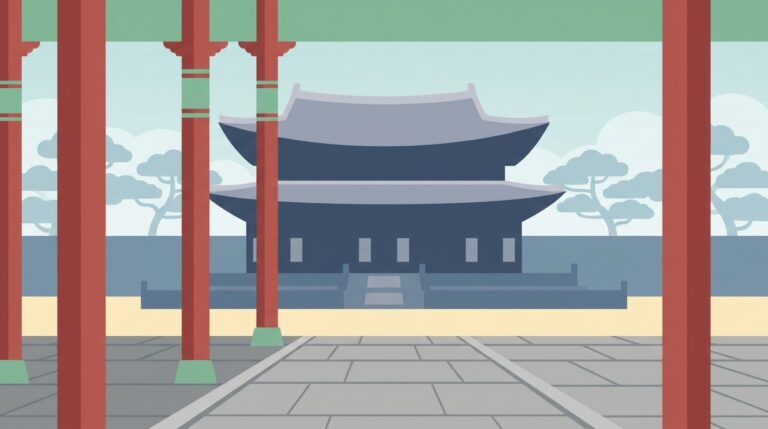
Master the Royal Court: Decoding Iconic Sageuk Honorifics in K-Dramas
Phase 1: Empathy (Story-Driven Opening)
안녕하세요! 매일한글 에디터입니다. (Hello! This is your Daily Hangul editor.)
Picture this: It is midnight on a quiet Friday. The lights are turned down, your favorite K-drama streaming app is running, and you are completely glued to a tense historical drama (사극, Sageuk). The camera pans across a rain-swept palace courtyard. Dozens of high-ranking court officials in red and blue silk robes drop to their knees simultaneously, pressing their heads against the wet stone tiles. In a desperate, thundering chorus, they cry out:
“전하, 통촉하여 주시옵소서!” (Jeonha, tongchokhayeo jusiopsoseo! / Your Majesty, please grant your profound wisdom!)
The English subtitles read something simple like “Have mercy, Your Majesty!” or “Please reconsider!” But deep down, you know those translations barely scratch the surface. Why didn’t they just say “죄송합니다” (Joesonghamnida) or “생각해 주세요” (Saenggakhyeo juseyo)? Why does court language sound so rhythmic, majestic, and intimidating?
If you have ever felt left out of the emotional gravity of Korean historical dramas because the archaic royal honorifics sound like a completely different language, you are not alone. Many of our intermediate (B2) learners tell us that modern Korean drama conversations feel approachable, yet the moment a crown prince or queen speaks, they feel completely lost.
Today, we are taking you behind the palace gates. Drawing from years of tutoring foreign drama enthusiasts, this guide breaks down the core formula of Joseon royal honorifics. By the end of this article, you will not only understand the raw dramatic tension in these iconic lines, but you will also learn the witty, humorous ways modern native Koreans use royal court speech in everyday workplace and social situations. Let us step inside the palace halls together!
Phase 2: Deep Dive into 3 Iconic Royal Expressions
┌─────────────────────────────────────────────────────────────┐
│                     ROYAL CADENCE 101                       │
│  Standard Polite (-요/-습니다)  ▶  Extreme Royal (-옵소서)    │
└─────────────────────────────────────────────────────────────┘
1. 전하, 통촉하여 주시옵소서 (Jeonha, tongchokhayeo jusiopsoseo)
- Pronunciation: Jeon-ha, tong-chok-ha-yeo joo-see-op-so-seo (Imagine the sharp “chok” of cutting wood, followed by a soft, descending “joo-see-op-so-seo”).
- Meaning:
- Literal: “Your Majesty, please penetrate with your insight and grant us your consideration.”
- Real Nuance: An urgent, desperate appeal from court ministers pleading with the monarch to revoke an unreasonable decree or reconsider a life-or-death verdict.
- K-Culture Moment: Seen in almost every palace factional dispute (붕당정치). Whenever the king announces a sudden purge, marriage alliance, or war campaign, opposing officials immediately fall to their knees and chant this line until their voices crack.
- Editor’s Insight: 통촉 (Tongchok) combines 통 (penetrate/through) and 촉 (illuminate/see clearly). You are literally asking the king to see through the fog of deception with heavenly insight. The archaic ending -옵소서 (-opsoseo) represents 극존칭 (hyper-honorific imperative), used only when addressing deities or absolute royalty.
- Situation Spectrum:
- Casual: 🚫 (Never in real life, unless joking)
- Semi-formal: 🚫
- Formal / Dramatic: ✅ (Sageuk court setting)
- 🤔 Think About It: How does pleading with an absolute monarch differ from petitioning an elected leader in your native culture? Notice how the linguistic hierarchy places all cognitive clarity solely in the king’s hands.
2. 성은이 망극하옵니다 (Seongeuni manggeukhapnida)
- Pronunciation: Seong-eun-i mang-geuk-hap-ni-da (Fluid and humble; keep your tone solemn and lowered).
- Meaning:
- Literal: “The King’s royal grace is boundless and infinite.”
- Real Nuance: “Your benevolence is so vast that a humble subject like me cannot possibly fathom or repay it.”
- K-Culture Moment: Spoken by an underdog protagonist who has just been promoted from a slave or kitchen maid to a royal physician, or by a wrongfully imprisoned general whose title has been restored by the king.
- Editor’s Insight: 성은 (Seongeun) specifically denotes grace bestowed by royalty. 망극 (Manggeuk) means having no boundaries (망 = not / 극 = extreme limit). Fun fact: Modern Koreans frequently use this playfully! If your generous friend or manager buys an expensive round of Korean beef BBQ, dramatic friends often bow theatrically and say, “성은이 망극하옵니다!”
- Situation Spectrum:
- Casual (Humorous/Playful): ⚠️ (Great for comedic banter with close friends)
- Semi-formal / Business: 🚫
- Historical Drama: ✅
- 🤔 Think About It: In Korean culture, receiving favor often creates a feeling of moral debt (부채감). Why do you think acknowledging someone’s favor as “unpayable” is considered the highest form of humility?
3. 어명 (Eomyeong)
- Pronunciation: Eo-myeong (Deliver this with a sharp, heavy initial Eo and an echoing, resonant nasal myeong).
- Meaning:
- Literal: “Royal decree / The King’s direct order.”
- Real Nuance: An irrevocable command that holds the absolute authority of life, death, and national fate.
- K-Culture Moment: The royal messenger storms into a remote province, unrolls a golden silk scroll, and booms: “어명을 받으라!” (Eomyeongeul badeura! / Receive the royal command!) Everyone, regardless of status, drops to their knees immediately.
- Editor’s Insight: The prefix 어- (Eo-) is an honorific tag attached specifically to royal objects and actions (e.g., 어의 = royal doctor, 어진 = royal portrait). In modern Korean corporate culture, a sudden, non-negotiable directive from the company chairman is often sarcastically nicknamed 어명 behind closed office doors.
- Situation Spectrum:
- Casual (Metaphorical satire): ⚠️
- Semi-formal: 🚫
- Historical Drama: ✅
- 🤔 Think About It: How do words originally reserved for absolute monarchs survive and adapt inside modern high-stress corporate environments?
Phase 3: Textbook Korean vs. Real Korean
| Situation | 📖 Textbook Korean | 🗣️ Real / Sageuk-Infused Korean |
|---|---|---|
| Situation 1: Begging a superior to reconsider a harsh decision | 다시 한번 재고해 주시겠습니까? (Dasi hanbeon jaegohae jusigesseumnikka?) | 전하, 통촉하여 주시옵소서! (Jeonha, tongchokhayeo jusiopsoseo!) / In real life: 팀장님, 제발 한 번만 봐주세요! (Timjangnim, jebal han beonman bwajuseyo!) |
| Situation 2: Expressing overwhelming gratitude when treated | 베풀어 주신 호의에 대단히 감사드립니다. (Beepureo jusin houie daedanhi gamsadeurimnida.) | 아이고, 부장님! 성은이 망극하옵니다! (Aigo, bujangnim! Seongeuni manggeukhapnida!) |
💡 Why is it different?
- Textbook Korean strips away emotional theater and social intimacy, favoring bland corporate neutrality.
- Real Korean draws deeply from historical archetypes. In casual settings, jumping into Sageuk tone adds theatrical wit (익살), breaking social stiffness and elevating a simple “thank you” into memorable, laugh-out-loud camaraderie.
Phase 4: K-Culture Deep Dive & Non-Verbal Manners
4-1. Nunchi & Body Etiquette in the Royal Court
In a historical context, verbal honorifics are only half the sentence; the rest is delivered through deliberate physical submission:
- The Concealed Hands (읍, Eup): When speaking to superiors, never let your fingers dangle loose. Clasp both hands together at chest or abdomen level, covered by your sleeves.
- Eye Contact Boundaries: Looking straight into the eyes of the King (용안, Yongan – the dragon countenance) was historically interpreted as insolence bordering on treason. When delivering lines like “통촉하여 주시옵소서”, keep your gaze fixed on the royal shoes or the stone floor.
- Prostration (복지부복, Bok-ji-bu-bok): Pleading with majesty requires your entire upper body to fold until your forehead is inches away from the ground.
  [Eyes Cast Down]          [Hands Clasped (읍)]         [Full Bow (복지부복)]
       ( •_•)                     ( •_•)                      _ _
       <)   )╯                   <)   (>                     (o o  )
       /    \                     /    \                    =====\_
4-2. Cultural Code: Why Sageuk Acting is the Ultimate Test
In Korea, an actor is not considered a true “master of the craft” until they have conquered a major Sageuk role. Contemporary K-dramas rely on modern speech rhythm (구어체), natural pauses, and breathy tones. In contrast, historical dialogue requires 단전호흡 (deep abdominal breath support) and theatrical vocal resonance. The archaic cadence must feel ancient yet emotionally raw, striking fear or tears into the audience through strict rhythmic pacing.
Phase 5: Interactive Roleplay Scenario
Setting: The dimly lit royal council chamber at midnight. Rain hammers outside.
Characters:
* You: Inspector Kim (김 사헌), an outspoken, incorruptible court official.
* NPC: Chief State Councillor Min (영의정 민 대감), your corrupt political rival.
* NPC: King Yi Gon (전하), young, decisive, and furious.
[Scene Start]
1. Chief Councillor Min: 전하, 역적 무리를 즉시 참형에 처하셔야 하옵니다! (Jeonha, yeokjeok murireul jeuksi chamhyeong-e cheohasiyeo haomnida! / Your Majesty, you must execute the treasonous faction immediately!)
🎭 [Kneeling, forehead furrowed with faux loyalty]
2. King Yi Gon: 과인의 판단이 아직 서지 않았소. 어찌 이리도 재촉하는 것이오? (Gwain-ui pandani ajik seoji anatso. Eojji irido jaechokhaneun gosio? / My judgment is not yet settled. Why do you rush me so aggressively?)
🎭 [Slamming his hand onto the royal desk]
3. You (Inspector Kim): 전하, 부디 억울한 자가 없도록 통촉하여 주시옵소서! (Jeonha, budi eogulhan jaga eopdorok tongchokhayeo jusiopsoseo! / Your Majesty, please look deeply so that no innocent soul is framed!)
🎭 [Lowering yourself to your knees with an impassioned plea]
4. Chief Councillor Min: 감히 어전에서 역적을 비호하려 들다니, 무엄하도다! (Gami eojeon-eseo yeokjeogeul bihoharyeo deuldani, mueomhadoda! / How dare you shield traitors before the throne! What insolence!)
🎭 [Glaring at you with blazing eyes]
5. You (Inspector Kim): 비호가 아니옵니다! 사건의 진상이 밝혀지지 않았을 뿐이옵니다! (Bihoga aniopnida! Sageon-ui jinsang-i balkhyeojiji anasseul ppuniopnida! / It is not shielding! It is only that the ultimate truth has yet to come to light!)
🎭 [Looking steadfastly at the floor before the throne]
6. King Yi Gon: 멈추시오! 의금부는 진상을 다시 조사하라. 이것은 과인의 어명이오! (Meomchusio! Uigeumbuneun jinsang-eul dasi josahara. Igeoseun gwain-ui eomyeong-io! / Silence! Let the royal investigative bureau reopen the case. This is my royal decree!)
🎭 [Standing up and spreading his royal robes]
7. You (Inspector Kim): …성은이 망극하옵니다, 전하! (…Seongeuni manggeukhapnida, jeonha! / …Your royal grace is boundless, Your Majesty!)
🎭 [Bowing deeply, feeling a surge of relief]
8. Chief Councillor Min: …명을 받들겠나이다. (…Myeongeul batdeulgennaida. / …I shall obey your command.)
🎭 [Clenching his teeth and bowing his head bitterly]
[Scene End]
🔀 Interactive Decision Point
The King suddenly turns his gaze upon you and asks: “Inspector Kim, will you stake your own life on the innocence of these prisoners?”
- Option A: “전하, 제 목숨을 걸고 결백을 밝혀내겠사옵니다!” (Jeonha, je moksumeul geolgo gyeolbaegeul balkhyeonaegessaomnida! / Your Majesty, I shall stake my very life to prove their innocence!)
- Option B: “어… 전하, 그건 좀 부담스러운데요?” (Eo… Jeonha, geugeon jom budamseureoundeyo? / Uh… Your Majesty, that feels a bit too burdensome?)
- Option C: “영의정 대감의 목숨을 거는 것은 어떠하옵니까?” (Yeong-uijeong daegam-ui moksumeul geoneun geoseun eotteohaopnikka? / How about we stake Chief Councillor Min’s life instead?)
Decision Feedback:
- Selecting Option A [BEST]: Perfect court resolve! You honor the gravity of the royal chamber while standing firm. The King is impressed by your fearless devotion, and your loyalty rating skyrockets.
- Selecting Option B [BAD]: Instant decapitation or exile! Using modern casual hesitancy (부담스럽다) in front of a Joseon monarch breaks royal protocol entirely.
- Selecting Option C [RISK]: Hilarious, but extremely dangerous! Provoking the Chief State Councillor in open court will likely incite his assassination squad to visit your home tonight.
Phase 6: 10-Second Emotional Shadowing Drill
Read aloud, paying strict attention to breath pauses marked by / and the emotion brackets:
- Drill 1 [🥺 Desperately pleading with tears welling up]:
- 전하! / 부디 소신의 충정을 / 헤아려 주시어, / 통촉하여 주시옵소서!
(Jeonha! / Budi sosin-ui chungjeong-eul / he-aryeo jusieo, / tongchokhayeo jusiopsoseo!)
“Your Majesty! / Please consider your humble subject’s loyalty / and grant your deep wisdom!”
- 전하! / 부디 소신의 충정을 / 헤아려 주시어, / 통촉하여 주시옵소서!
- Drill 2 [🙇 Overwhelmed with tearful relief and gratitude]:
- 황공하옵니다, / 전하! / 성은이 / 망극하옵니다!
(Hwanggonghaomnida, / jeonha! / Seongeun-i / manggeukhapnida!)
“I am humbled to tears, / Your Majesty! / Your royal grace / is truly boundless!”
- 황공하옵니다, / 전하! / 성은이 / 망극하옵니다!
- Drill 3 [👑 Chilling, absolute authority that brooks no defiance]:
- 입을 다물라! / 이것이 / 과인의 / 어명이니라!
(Ibeul damulla! / Igeosi / gwain-ui / eomyeong-inira!)
“Shut your mouths! / This / is my / royal decree!”
- 입을 다물라! / 이것이 / 과인의 / 어명이니라!
Phase 7: K-Culture Mini Dictionary
┌─────────────────────────────────────────────────────────────┐
│                     SAGEUK COURT LEXICON                    │
└─────────────────────────────────────────────────────────────┘
- 과인 (Gwain)
- Translation: “This imperfect person” (The King’s humble first-person pronoun).
- Real Usage: Kings in Sageuk never refer to themselves as “나” (Na) or “저” (Jeo). They use 과인, reflecting the Confucian belief that a monarch must constantly reflect on his own moral shortcomings.
- 소신 (Sosin)
- Translation: “Your humble servant / This small subject.”
- Real Usage: Used by court officials instead of “제가” (Jega) when addressing royalty. It conveys that the speaker’s personal conviction is entirely subservient to the state.
- 종묘사직 (Jongmyosajik)
- Translation: “The Royal Ancestral Shrine and the Altars of Earth and Grain.”
- Real Usage: A symbolic metonym for “the very foundation of the nation.” When ministers say “종묘사직을 보존하소서!”, they mean “Protect the survival of our country!”
- 하교 (Hagyo)
- Translation: “A royal directive / Royal instructions handed down.”
- Real Usage: In historical contexts, an edict from above. In witty modern office banter, a sudden announcement sent via Slack from high-level executives is sometimes cheekily called a 하교.
Phase 8: Traveler’s Survival Kit
If you visit South Korea, exploring grand heritage sites like Gyeongbokgung or Changdeokgung is a must. Here is how you bring these drama lines into real-world palace visits!
🧳 Palace Experience Survival Expressions
- 전하, 사진 한 장만 같이 찍어 주시옵소서!
(Jeonha, sajin han jangman gachi jjigeo jusiopsoseo!)
Pro Tip: Use this playfully when asking royal guard actors or friends dressed in king’s dragon robes at Gyeongbokgung for a photo! It instantly sparks laughter. - 한복을 입으니 정말 왕족 같으시옵니다.
(Hanbogeul ibeuni jeongmal wangjok gateusiopnida.)
Pro Tip: A flattering, humorous compliment to pay your travel partner once they step out of the rental boutique in full regal attire. - 궁궐 해설 투어는 어디서 시작하나요?
(Gung-gwol haeseol tueoneun eodiseo sijakhannayo?)
Pro Tip: Use this clear, modern sentence at the visitor center to locate English/Korean guided historical tours.
🗺️ Editor’s Travel Note
- Free Palace Entry with Hanbok: Did you know that wearing traditional Hanbok grants you free admission to all five major palaces in Seoul? Make sure to reserve your preferred outfit style ahead of time through verified local booking channels.
- Smart Navigation: Google Maps struggles with detailed walking routes inside palace grounds. Always use a reliable local map by initiating your Naver Map app installation before touching down at Incheon Airport.
Phase 9: “One Step Deeper” (Reflective Cultural Essay)
Archaic honorifics like 통촉하여 주시옵소서 and 성은이 망극하옵니다 might initially seem like relics of an oppressive, feudal caste system (신분제). However, a closer look reveals that court language was also a sophisticated linguistic safeguard. By framing intense disagreements within hyper-polite formulas, officials could challenge the monarch’s moral judgment without committing overt treason. Honorifics acted as emotional armor; they allowed radical debate to exist under the umbrella of absolute respect.
Even in contemporary Korean society, where egalitarian values prevail, the linguistic instinct to wrap difficult feedback in layered politeness remains strong. Language continues to balance power, harmony, and confrontation.
💬 Your Turn: Have you ever noticed historical drama lines popping up as jokes in modern K-dramas or reality TV shows like Running Man? Which royal phrase is your absolute favorite? Let us know in the comments below!
Phase 10: FAQ & Common Mistakes
Q: Can I use “통촉하여 주시옵소서” with my Korean boss or university professor?
A: Absolutely not in a serious context! Using -옵소서 in real business or academic scenarios sounds either like you are mocking them or that you have lost touch with reality. However, if your boss jokingly buys everyone iced coffee during a brutal overtime shift, saying “팀장님, 성은이 망극하옵니다!” with a dramatic bow is a well-received, lighthearted joke.
Q: What is the difference between “폐하” (Pyeha) and “전하” (Jeonha)?
A: 폐하 (Pyeha) translates to Your Imperial Majesty (used for Emperors, such as during the Korean Empire or in Chinese/Goryeo historical dramas). 전하 (Jeonha) translates to Your Royal Highness / Your Majesty, standard for the kings of the Joseon Dynasty, which maintained a tributary diplomatic relationship with the Ming/Qing empires.
Q: Why do royal drama characters end their sentences in “-하오” or “-느니라”?
A: Kings speak in specialized speech levels known as 하오체 (semi-formal archaic style) or 해라체 (authoritative plain style). Because the king is above everyone, he never uses honorific suffixes like -요 or -습니다 to his subjects.
🚨 COMMON MISTAKES WARNING BOARD
──────────────────────────────────────────────────────────────
❌ MISTAKE 1: Calling your taxi driver or shop owner "전하 (Jeonha)".
   ✔ CORRECT: Use standard respectful titles like "기사님" (Gisanim) or "사장님" (Sajangnim).

❌ MISTAKE 2: Pronouncing "망극" as [Man-geuk].
   ✔ CORRECT: Keep the velar nasal crisp: [Mang-geuk].

❌ MISTAKE 3: Using "어명 (Eomyeong)" when referring to your parents' rules seriously.
   ✔ CORRECT: Use "부모님 말씀" (Bumonim malsseum) for everyday family respect.
──────────────────────────────────────────────────────────────
Phase 11: Action Missions
- 🥉 Bronze Mission (Solo Practice): Stand in front of your mirror, raise both hands in the 읍 (Eup) posture, and practice delivering “전하, 통촉하여 주시옵소서!” 3 times using deep abdominal breath support.
- 🥈 Silver Mission (Social Share): Pick your favorite historical K-drama scene on social media, tag a drama-watching friend, and caption it with “성은이 망극하옵니다!”
- 🥇 Gold Mission (Real Application): Next time a close Korean friend or language exchange partner does a small generous favor for you (like sharing a snack), bow your head playfully and proclaim: “성은이 망극하옵니다!” Watch their surprised smile.
- 🎮 K-Culture Mission: Watch one episode of a renowned historical drama (such as The Red Sleeve, Under the Queen’s Umbrella, or The King’s Affection). Keep a tally of how many times 전하, 어명, and 통촉 appear!
Phase 12: Interactive Quiz Challenge
Test your royal fluency before you step before the throne!
1. Situational Judgment:
You are watching a historical drama. The King has wrongly accused a faithful prime minister of treason based on forged letters. What line will the prime minister most likely cry out while kneeling on the courtyard stone?
(A) 형님, 진짜 왜 이러세요? (Hyeongnim, jinjja wae ireoseyo?)
(B) 전하, 부디 통촉하여 주시옵소서! (Jeonha, budi tongchokhayeo jusiopsoseo!)
(C) 성은이 망극하옵니다! (Seongeuni manggeukhapnida!)
(D) 어명을 취소해 줄래? (Eomyeongeul chwisohae jullae?)
2. Fill-in-the-Blank:
When the King issues a non-negotiable decree that carries national authority, this order is referred to as ( ).
Hint: It begins with the royal honorific prefix 어-.
3. True or False:
“성은이 망극하옵니다” can be used humorously in modern everyday Korean when someone treats you to a meal.
[ True / False ]
👉 Click here to reveal the answers and explanations!
1. Answer: (B)
Explanation: When begging the King to reconsider a mistaken or unjust verdict, “전하, 부디 통촉하여 주시옵소서!” is the definitive historical formula. (A) is modern slang, (C) is an expression of gratitude, and (D) is overly casual speech that would lead to immediate imprisonment!
2. Answer: 어명 (Eomyeong)
Explanation: 어명 specifically denotes the monarch’s divine and inviolable decree.
3. Answer: True
Explanation: While you should never use it in serious formal situations, native Koreans frequently use it among close peers or accommodating seniors as a humorous hyperbole for extreme gratitude.
🎬 Watch Our Daily Videos! (Daily Hangul Official Instagram)
Review the expressions you learned in this article with our fun daily short videos! Check out native pronunciation and real-life nuances in action.
- Instagram @dailyhangul_en







