

안녕하세요! 매일한글 에디터입니다.
Have you ever scrolled through Danggeun (Karrot Market, Korea’s favorite neighborhood secondhand app) and spotted that dream item—maybe a vintage film camera or a sold-out K-pop lightstick—only to freeze when you open the chat? You want to message the seller, but your fingers hover anxiously over the keyboard. “What if I sound rude? What if they ask me to meet at an exit with ten different staircases, and I get totally lost?”
One of our lovely A2 learners, Sarah, told me about her first trade attempt: “I used a translator app to ask if we could meet at Gangnam Station. The seller replied with a long string of polite Korean abbreviations, and I panicked and closed the app!” Don’t let conversational anxiety keep you from scoring amazing secondhand treasures. Meeting a local seller for a direct deal is one of the most exciting, authentic cultural milestones you can experience in Korea. With just a few clear, friendly phrases, you’ll be arranging meetups like an absolute Seoul insider. Let’s dive in together!
Phase 2: Core 3 Expressions Deep Dive
1. 오늘 저녁 8시에 시간 되세요? (Oneul jeonyeok yeodeolsie sigan doeseyo?)
- Pronunciation: [Oh-neul jeon-yeok yeo-deol-shi-eh shi-gan doe-seh-yo?] (Rhymes smoothly like “does say yo” at the end)
- Meaning:
- Literal: Tonight 8 o’clock at time becomes?
- Real Nuance: “Are you free tonight at 8 PM?” / “Does 8 PM tonight work for you?”
- K-Culture Moment: You hear this in slice-of-life K-dramas whenever two busy neighbors try to schedule a quick coffee or grocery run after overtime.
- Editor’s Insight: Instead of asking “Do you have time?” (시간 있어요?), Korean speakers often ask if time becomes possible (시간 되세요?). It sounds far softer and more considerate.
- Situation Spectrum: Casual (⚠️ – too polite for close buddies) | Semi-formal (✅ – ideal for Karrot chat) | Formal (✅)
- 🤔 Think About It: Why does Korean prefer saying “Does time become available?” rather than directly asking “Do you have time?” Notice how shifting the focus to time itself softens the request!
2. 강남역 3번 출구 앞에서 직거래 가능하세요? (Gangnam-yeok sambeon chulgu ap-eseo jikgeorae ganeunghaseyo?)
- Pronunciation: [Gahng-nahm-yeok sahm-beon chool-goo ahp-eh-seo jeek-geo-rae gah-neung-hah-seh-yo?]
- Meaning:
- Literal: Gangnam Station Exit 3 in front direct deal possible-honorific?
- Real Nuance: “Can we meet for an in-person trade in front of Gangnam Station Exit 3?”
- K-Culture Moment: The iconic subway exit rendezvous! In Seoul, meeting right at a numbered station exit is the golden standard for quick neighborhood handoffs.
- Editor’s Insight: The word 직거래 (jikgeorae) comes from 직접 (directly/in-person) + 거래 (transaction). Adding ~가능하세요? makes your proposal ultra-respectful without sounding stiff.
- Situation Spectrum: Casual (🚫) | Semi-formal (✅ – Karrot perfection) | Formal (✅)
- 🤔 Think About It: In many Western countries, people ship items or meet at police station parking lots. Why is the bustling subway exit the go-to safe zone in Korea?
3. 도착하시면 채팅 남겨주세요! (Dochakhasimyeon chaeting namgyeojuseyo!)
- Pronunciation: [Doh-chahk-hah-she-myeon chae-ting nahm-gyeo-joo-seh-yo!]
- Meaning:
- Literal: If you arrive, please leave a chat!
- Real Nuance: “Let me know in the chat once you’re there!”
- K-Culture Moment: The final text you send right before you step outside. It eliminates the awkwardness of calling someone you have never spoken to on the phone.
- Editor’s Insight: Koreans value swift communication without privacy invasion. Instead of asking for phone numbers (전화번호), everything stays inside the app chat (채팅).
- Situation Spectrum: Casual (⚠️ – use 반말 with close pals) | Semi-formal (✅) | Formal (✅)
- 🤔 Think About It: Notice how polite Korean wraps actions with ~주세요 (“please give me the favor of…”). How does your native language handle polite reminders?
Phase 3: Textbook Korean vs. Real-Life Korean
Situation 1: Proposing an In-Person Trade
- 📖 교과서 한국어: 직접 만나서 물건을 교환합시다. (Jikjeop mannaseo mulgeon-eul gyohwanhapsida.) — “Let us meet directly and exchange goods.”
- 🗣️ 진짜 한국어: 혹시 직거래 가능하세요? (Hoksi jikgeorae ganeunghaseyo?) — “By any chance, are you open to a direct trade?”
- 💡 왜 다를까? Textbook phrases can sound like a formal commercial treaty from 1980! Adding 혹시 (hoksi – “by any chance”) shows consideration for the seller’s schedule.
Situation 2: Announcing Your Arrival at the Exit
- 📖 교과서 한국어: 제가 약속 장소에 도착했습니다. (Jega yaksok jangso-e dochakhaetsseumnida.) — “I have arrived at the appointment location.”
- 🗣️ 진짜 한국어: 저 3번 출구 앞에 도착했어요! (Jeo sambeon chulgu ap-e dochakhaesseoyo!) — “I’ve arrived in front of Exit 3!”
- 💡 왜 다를까? In real life, conversational ~했어요 feels warm and punctual, while textbook declarative endings (~했습니다) sound like a military report.
Phase 4: K-Culture Deep Dive & Non-Verbal Manners
4-1. 눈치 (Nunchi) & Gestures: Spotting Your Trading Partner
When you emerge from Gangnam Station Exit 3, you won’t be alone—there are dozens of people waiting. Here is how your body language speaks volumes:
* The Karrot Posture: Hold your phone loosely in one hand and the item (or shopping bag) visibly in the other. Look around with friendly, darting eye contact.
* The Magic Verification Phrase: When someone makes eye contact while holding a shopping bag, tilt your head slightly and whisper with a warm smile: 혹시… 당근이세요? (Hoksi… danggeun-iseyo? – “Excuse me… are you Karrot?”).
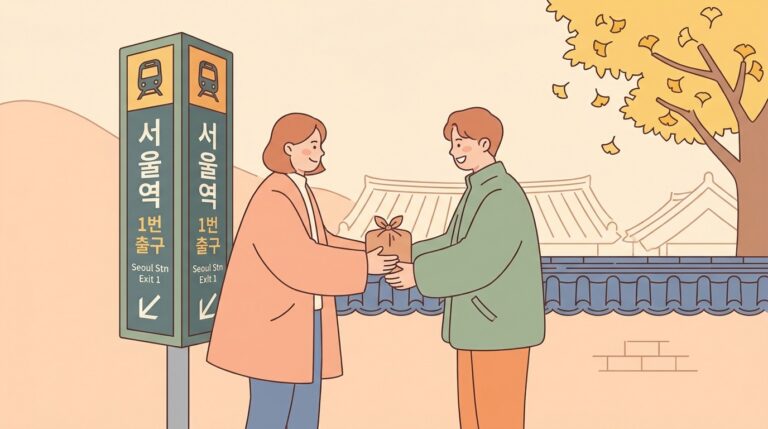
* The Two-Handed Handover: Even in a quick 30-second street trade, hand over the item or cash with both hands (or touch your left hand gently to your right forearm). It signals immediate warmth and trustworthiness.
4-2. Culture Code: The 36.5°C Manner Temperature
In Korea, Karrot Market is not just an e-commerce platform; it is a hyper-local trust network. Every user begins with a Manner Temperature (매너온도) of 36.5°C—the standard human body temperature. Polite greetings, punctual meetups, and friendly chats raise your temperature toward 40°C+, making you a beloved neighbor. Canceling last minute or being unresponsive drops your score toward freezing point!
Phase 5: Real-Life Roleplay Scenario
Setting: You are buying a mint-condition portable espresso maker from user “MannerKing Minho (매너온도 41.2°C)” via Karrot Chat.
- You: 안녕하세요! 상품 아직 있나요? (Annyeonghaseyo! Sangpum ajik innayo?)
🎭 Typing politely on your sofa- Hello! Is the item still available?
- Minho: 네, 아직 있어요! 구매 원하시나요? (Ne, ajik isseoyo! Gumae wonhasinayo?)
🎭 Replies within two minutes- Yes, it’s still available! Are you looking to purchase?
- You: 네! 오늘 저녁 8시에 강남역 3번 출구 앞에서 직거래 가능하세요? (Ne! Oneul jeonyeok yeodeolsie Gangnam-yeok sambeon chulgu ap-eseo jikgeorae ganeunghaseyo?)
🎭 Suggesting clear time and place- Yes! Can we meet for a direct trade tonight at 8 PM in front of Gangnam Station Exit 3?
- Minho: 네, 좋아요. 8시에 뵐게요! (Ne, joayo. Yeodeolsie boelgeyo!)
🎭 Sends a smiling carrot sticker- Yes, sounds good. See you at 8!
- You: 도착하시면 채팅 남겨주세요! (Dochakhasimyeon chaeting namgyeojuseyo!)
🎭 Setting up smooth rendezvous- Please leave a chat message when you arrive!
- Minho: 저 지금 3번 출구 앞에 도착했어요. 검은색 패딩 입었어요. (Jeo jigeum sambeon chulgu ap-e dochakhaesseoyo. Geomeunsaek paeding ibeosseoyo.)
🎭 Giving visual cues- I’ve arrived in front of Exit 3 now. I’m wearing a black puffer jacket.
- You: 저도 도착했어요! 흰색 가방 들고 있어요. (Jeodo dochakhaesseoyo! Huinsaek gabang deulgo isseoyo.)
🎭 Spotting him across the steps- I’ve arrived too! I’m holding a white bag.
- Minho: 찾았습니다! 바로 갈게요~ (Chajatsseumnida! Baro galgeyo~)
🎭 Waving hand lightly- Found you! Heading over right now~
🔀 Interactive Choice Point
You are running 5 minutes late due to line 2 train delays. What do you message Minho?
* Option A: 그냥 가세요. (Geunyang gaseyo. – “Just go.”)
* Feedback: BAD. This sounds like “Go away!” You will likely get blocked and your manner temperature will plummet.
* Option B: 죄송해요! 지하철이 늦어서 5분만 기다려 주실 수 있으세요? (Joesonghaeyo! Jihacheor-i neojeoseo obunman gidaryeo jusil su isseuseyo? – “I’m so sorry! The subway is delayed, could you please wait 5 minutes?”)
* Feedback: BEST. Transparent, polite, and respectful. In Korea, letting them know before the appointment time preserves your 40°C reputation!
* Option C: 늦어요. (Neojeoyo. – “I’m late.”)
* Feedback: RISK. Blunt and cold. Even if grammatically correct, Korean etiquette requires an apology and specific ETA.
Phase 6: 10-Second Emotion Shadowing Drill
Read these out loud, pausing briefly at the slashes (/):
[😊 밝고 공손하게 - Bright and polite]
오늘 저녁 8시에 / 시간 되세요? (Oneul jeonyeok yeodeolsie / sigan doeseyo?)-
[🤝 명확하고 상냥하게 - Clear and cheerful]
강남역 3번 출구 앞에서 / 직거래 가능하세요? (Gangnam-yeok sambeon chulgu ap-eseo / jikgeorae ganeunghaseyo?) -
[👀 안심시키는 어조로 - Reassuring tone]
도착하시면 / 편하게 채팅 남겨주세요! (Dochakhasimyeon / pyeonhage chaeting namgyeojuseyo!)
Phase 7: K-Culture Mini Dictionary
- 직거래 (Jikgeorae) | Direct / In-person transaction
Trading face-to-face rather than shipping via parcel. The absolute heart and soul of neighborhood apps in Korea. - 당근하다 (Danggeunhada) | To do a Karrot trade / To buy or sell secondhand
A brand name transformed into a verb, identical to how “Googling” became everyday English. - 네고 (Nego) | Price negotiation / Haggle
Short for “negotiation.” Often listed as 네고 불가 (Nego bulga – “No bargaining”) on popular electronics or collectibles. - 쿨거래 (Kulgurae) | Cool deal / Quick, hassle-free transaction
A dream transaction where both buyer and seller agree instantly, show up on time, and make no fuss.
Phase 8: Traveler’s Survival Kit
Top 3 Survival Phrases
- 계좌이체 가능하세요? (Gyejw-aiche ganeunghaseyo?)
- Can I pay via bank transfer?
- Pro Tip: Keep cash ready just in case, but almost all Korean trades happen via instant mobile bank app transfer right on the spot.
- 상태 아주 좋아요! (Sangtae aju joayo!)
- The condition is very good!
- Pro Tip: Say this while inspecting the goods to compliment the seller’s care.
- 감사합니다, 잘 쓸게요! (Gamsahamnida, jal sseulgeyo!)
- Thank you, I will make good use of it!
- Pro Tip: The quintessential Korean closing phrase after receiving an item.
Editor’s Travel Note
Gangnam Station has a staggering 12 exits, and walking between opposite ends can take 10 minutes underground! Before you set your meetup, check the Naver Map app download for subway exits to pinpoint whether Exit 3 is located near your transit line. Always specify “outside the fare gates” (개찰구 밖) or “in front of the exit stairs” to prevent roaming the huge concourse.
Phase 9: “One Step Deeper” (Reflective Prompt)
Korea boasts one of the highest safety index ratings in the world, allowing thousands of people to meet complete strangers on street corners every night without fear. But beyond physical safety lies a cultural pillar: Jeong (정) and mutual social accountability. When you trade on Karrot, you are interacting as community neighbors, not faceless consumers.
💬 Your Turn: In your home country, how do people normally buy and sell secondhand goods? Would you feel comfortable meeting a stranger at a subway exit at 8 PM? Share your thoughts below!
Phase 10: FAQ & Avoiding Misunderstandings
Q: Can foreigners sign up for Danggeun (Karrot) without a Korean phone number?
A: Unfortunately, no. Danggeun requires GPS location verification inside a Korean neighborhood and a Korean mobile number (tied to an Alien Registration Card or Korean ID). If you are traveling on a short-term SIM, ask a Korean friend to assist, or look for English-friendly expat Facebook trade groups using these exact same phrases!
Q: Is it okay to haggle on the spot when meeting in person?
A: Absolutely not! In Korean secondhand culture, haggling at the meetup spot (현장 네고) is considered very bad etiquette. All price discussions must happen inside the chat before agreeing on the meetup time.
Q: What should I do if the seller doesn’t show up after 10 minutes?
A: Send a polite check-in: 혹시 오고 계신가요? (Hoksi ogo gyesin-gayo? – “Are you on your way, by any chance?”). If they don’t reply within 15 minutes, you are culturally entitled to cancel the meetup and report a no-show.
🚨 Common Mistakes Warning Board
- Mistake 1: Asking for personal KakaoTalk IDs or phone numbers immediately.
- Correct Action: Keep all scheduling inside the app chat until both parties feel comfortable.
- Mistake 2: Using 반말 (informal talk) because you assume the seller is younger.
- Correct Action: Always maintain 존댓말 (polite speech) using ~되세요? and ~감사합니다.
- Mistake 3: Not bringing exact cash.
- Correct Action: Street sellers won’t have change. If paying cash, withdraw the exact amount beforehand!
Phase 11: Action Missions
- 🥉 Bronze Mission (Solo Shadowing): Say the sentence “오늘 저녁 8시에 강남역 3번 출구 앞에서 직거래 가능하세요?” 5 times aloud in front of a mirror until it rolls off your tongue in under 5 seconds.
- 🥈 Silver Mission (SNS Community): Post a comment below or in your language study group writing your favorite subway station exit in Korean using
[역 이름] + [숫자]번 출구(e.g., 홍대입구역 9번 출구). - 🥇 Gold Mission (Real-life Practice): Next time you arrange to meet a friend at a subway station, text them: “도착하시면 채팅 남겨주세요!”
- 🎮 K-Culture Mission: Watch an episode of a modern Korean drama (like Crash Landing on You or Hospital Playlist) and listen for when characters propose meeting times using “~시 어때요?” or “시간 돼요?”.
Phase 12: Interactive Quiz Challenge
- Situational Judgment: You want to ask the seller if they can meet in front of Hongdae Exit 9 for an in-person trade. Which sentence is most natural?
- A) 홍대 9번 출구에서 만나서 거래를 집행합시다.
- B) 홍대입구역 9번 출구 앞에서 직거래 가능하세요?
- C) 홍대입구역에 빨리 오세요.
- Fill-in-the-Blank: Complete the polite arrival phrase:
- 저 3번 출구 앞에 ________! (I have arrived!)
- True / False Cultural Check:
- It is polite to ask for a discount once you check the item with your own eyes during an in-person trade. (True / False)
Click to reveal answers & explanations!
- Answer: B. 홍대입구역 9번 출구 앞에서 직거래 가능하세요? is polite, natural, and standard. (A sounds like a formal police warrant, and C sounds bossy!)
- Answer: 도착했어요! (dochakhaesseoyo).
- Answer: False. In Korea, asking for a discount at the meetup location (현장 네고) is considered disrespectful. All price agreements should be finalized in the chat beforehand!
🎬 Watch Our Daily Videos! (Daily Hangul Official Instagram)
Review the expressions you learned in this article with our fun daily short videos! Check out native pronunciation and real-life nuances in action.
- Instagram @dailyhangul_en






