

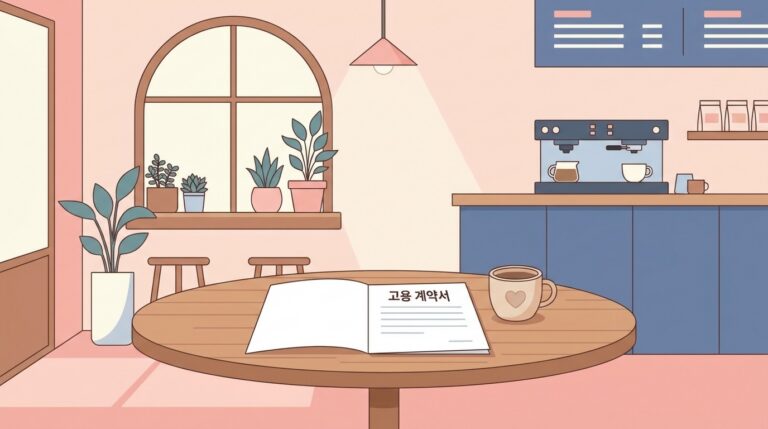
Sign with Confidence: How to Check Your Korean Work Contract, Allowances, and Insurance Without the Awkwardness
Phase 1: Empathy (Real Talk from Your Seoul Bestie)
안녕하세요! 매일한글 에디터입니다.
Picture this: You just aced your interview at a sunlit cafe in Hongdae or a trendy convenience store near Sinchon. The owner smiles warmly, hands you an apron, and says with classic Korean warmth: “우리 가족처럼 편하게 지내봐요!” (Let’s get along comfortably like family!). But the moment they slide a crisp document across the table—or worse, don’t mention paperwork at all—your stomach knots up.
You know you need to verify your 주휴수당 (weekly holiday pay), clarify your 야간수당 (night shift surcharge), and check if you are registered under the 4대 보험 (four major social insurances). But a panicked voice whispers in your head: If I start asking about money and legal regulations on day one, will Boss-nim think I’m greedy? Will I seem difficult and ruin the friendly vibe before I even start?
If you have watched K-dramas like Fight for My Way or Itaewon Class, you have seen young workers silently enduring grueling part-time shifts (알바), feeling conflicted between loyalty (정, Jeong) and fair compensation. But here is the truth gathered from over a decade of guiding international students and expats in Korea: In modern Korean society, understanding and politely verifying your labor rights does not make you look confrontational; it shows professionalism, diligence, and self-respect.
Korean business owners actually value workers who know the rules because it prevents future misunderstandings and builds long-term mutual trust. In this practical guide, we will unlock the exact Korean phrases, subtle body language, and cultural nunchi you need to navigate your employment contract seamlessly, ensuring you protect your hard-earned rights while keeping a wonderful relationship with your boss!
Phase 2: Core 3 Expressions In-Depth
1. 근로계약서 확인하고 서명해도 될까요? (Geunrogoyakseo hwaginhago seomyeonghaedo doelkkayo?)
- Pronunciation: [Geun-ro-gye-yak-seo hwa-gin-ha-go seo-myeong-hae-do doel-kka-yo?] (Think: “Goon-roh-gyeh-yahk-suh hwah-geen-hah-goh suh-myuhng-heh-doh dwel-kkah-yoh?”)
- Meaning: Literal: “May I check the labor contract and then sign it?” | Real Nuance: “May I take a few moments to carefully read through the contract terms before signing?”
- K-Culture Moment: Seen in workplace dramas like Misaeng or Start-Up, where sharp employees take a breath, read every clause attentively, and show that they treat formal commitments with seriousness.
- Editor’s Insight: The magic here lies in the ending
-해도 될까요?(May I…?). It transforms a potential demand into a polite, considerate request that acknowledges the owner’s authority while exercising your basic rights. - Situation Spectrum: Casual: 🚫 | Semi-formal: ⚠️ | Formal: ✅
- 🤔 Think About It: In many Western countries, taking time to review legal papers is standard. In traditional Korea, signing immediately was sometimes seen as demonstrating blind faith. Why does modern Korea prioritize clear written agreements over spoken promises?
2. 혹시 주휴수당도 시급에 포함되어 있나요? (Hoksi juhyusudang-do sigeube pohamdoeeo innayo?)
- Pronunciation: [Hok-si ju-hyu-su-dang-do si-geu-be po-ham-doe-eo in-na-yo?] (Think: “Hohk-shee joo-hyoo-soo-dahng-doh shee-geu-beh poh-hahm-dweh-uh een-nah-yoh?”)
- Meaning: Literal: “By any chance, is weekly holiday pay also included in the hourly rate?” | Real Nuance: “Could you clarify whether my base hourly pay already factors in the mandatory weekly holiday allowance, or if it is calculated separately?”
- K-Culture Moment: Young part-timers on popular Korean YouTube web dramas comparing their monthly pay stubs and celebrating the bonus paid rest day after working over 15 hours a week.
- Editor’s Insight: Always preface tricky questions with 혹시 (Hoksi)! It translates to “by any chance” or “perchance,” functioning as a polite shock absorber that softens any perceived assertiveness.
- Situation Spectrum: Casual: 🚫 | Semi-formal: ✅ | Formal: ✅
- 🤔 Think About It: Under Korean labor law, working 15+ hours a week guarantees one paid day off per week. How does your native country handle paid rest time for hourly workers?
3. 야간 근무 시 수당은 어떻게 계산되나요? (Yagan geunmu si sudang-eun eotteoke gyesandoenayo?)
- Pronunciation: [Ya-gan geun-mu si su-dang-eun eo-tteo-ke gye-san-doe-na-yo?] (Think: “Yah-gahn goon-moo shee soo-dahng-oon uh-ttuh-keh gyeh-sahn-dweh-nah-yoh?”)
- Meaning: Literal: “When working at night, how is the allowance calculated?” | Real Nuance: “Could you explain how the legal night-shift differential is applied for hours worked between 10 PM and 6 AM?”
- K-Culture Moment: Late-night convenience store clerks in slice-of-life K-dramas (like Backstreet Rookie) calculating night-shift earnings to finance tuition or rent.
- Editor’s Insight: Notice that we ask “어떻게 계산되나요?” (How is it calculated?) instead of “돈 더 주나요?” (Do you give more money?). Framing the question around the system and rules keeps the tone professional and neutral.
- Situation Spectrum: Casual: 🚫 | Semi-formal: ✅ | Formal: ✅
- 🤔 Think About It: Why does focusing on objective calculations rather than personal monetary gain make workplace negotiations much friendlier in Korean culture?
Phase 3: Textbook Korean vs. Real Korean
Situation 1: Asking About the 4 Major Public Insurances
- 📖 교과서 한국어 (Textbook): 4대 보험에 가입해 주십니까? (Sadae boheome gaiptae jusimnikka? / Will you enroll me in the four major insurances?)
- 🗣️ 진짜 한국어 (Real-Life): 혹시 4대 보험 적용은 어떻게 되나요? (Hoksi sadae boheom jeok-yong-eun eotteoke doenayo? / By any chance, how is the four major insurance coverage handled here?)
- 💡 왜 다를까? (Why the difference?): The textbook sentence sounds like a legal interrogation. Using
혹시and asking how it is applied (어떻게 되나요?) sounds conversational, respectful, and cooperative.
Situation 2: Inquiring About the Official Payday
- 📖 교과서 한국어 (Textbook): 월급을 언제 주실 겁니까? (Wolgeubeul eonje jusil geomnikka? / When will you give me my monthly salary?)
- 🗣️ 진짜 한국어 (Real-Life): 급여일은 매달 며칠인가요? (Geubyeo-ireun maedal myeochiringayo? / Which day of the month is regular payday?)
- 💡 왜 다를까? (Why the difference?): Asking “when will you give me money” creates awkward tension. In real workplaces, Koreans use the polished term
급여일(payday) to keep the conversation businesslike.
Phase 4: K-Culture Deep Dive & Non-Verbal Manners
4-1. 눈치 (Nunchi) & Polite Physical Etiquette
- The Two-Handed Handover (두 손 사용): When receiving the contract from your boss or handing it back with your signature, always use both hands. Hold the corners with both hands and accompany it with a slight upper-body bow (목례, mongnye).
- The Gentle Eye Contact: Avoid an unblinking, laser-focused stare, which can feel challenging. Maintain warm, steady eye contact, nodding gently as your employer explains the terms.
- The Soft Transition: When you spot something on the contract you want to ask about, don’t point aggressively with your index finger. Softly place your open hand near the clause, tilt your head slightly, and start with: “사장님, 이 부분 여쭤봐도 될까요?” (Boss, may I ask about this section?).
4-2. Cultural Code: Moving from “Jeong (정)” to “Kkalkkeumham (깔끔함)”
Historically, Korean work culture relied heavily on Jeong (deep relational affection). In that era, bringing out a formal contract was sometimes frowned upon because older bosses thought: “우리 사이에 계약서까지 써야 해?” (Do we really need a contract between us? Don’t you trust me?).
Today, Korea’s younger generation has embraced 깔끔함 (cleanliness, fairness, and transparency). Employers and employees alike recognize that clear contracts protect everyone from messy disputes at the Ministry of Employment and Labor (노동청). When you ask for clear terms politely, you show that you intend to be a reliable, long-term team member who values clarity.
Phase 5: Real-Life Roleplay Scenario
- Setting: The counter of “Cafe Haru” in Sinchon, Seoul.
- Characters:
- 사장님 (Boss Park): A hard-working, fair-minded cafe owner who values trustworthy staff.
- 알렉스 (Alex): A proactive international student who wants to make sure his rights are protected.
사장님 (Boss Park): 🎭 서류를 건네며 따뜻하게 미소 지으며 (Handing over the papers with a warm smile)
“알렉스 씨, 면접 통과 축하해요! 여기 근로계약서 초안인데 한번 보세요.”
(Aleukseu ssi, myeonjeop tonggwa chukahaeyo! Yeogi geunrogoyakseo choaninde hanbeon boseyo.)
“Congratulations on passing the interview, Alex! Here is the draft of your employment contract; take a look.”
알렉스 (Alex): 🎭 두 손으로 계약서를 공손히 받으며 (Receiving the paper politely with both hands)
“감사합니다, 사장님! 꼼꼼히 확인하고 서명해도 될까요?”
(Gamsahamnida, sajangnim! Kkomkkomhi hwaginhago seomyeonghaedo doelkkayo?)
“Thank you so much, Boss! May I review it carefully before signing?”
사장님 (Boss Park): 🎭 고개를 끄덕이며 차 한 잔을 건네며 (Nodding gently while offering a cup of tea)
“그럼요, 천천히 읽어봐요. 궁금한 부분 있으면 편하게 물어보고요.”
(Geureomyo, cheoncheonhi ilgeobwayo. Gunggeumhan bubun isseumyeon pyeonhage mureobogoyo.)
“Of course, take your time. If you have any questions, feel free to ask.”
알렉스 (Alex): 🎭 계약서의 근무시간 항목을 짚으며 조심스럽게 (Gently indicating the work hours section)
“제가 주 18시간 근무로 되어 있는데, 혹시 주휴수당도 포함된 시급인가요?”
(Jega ju sip-pal-sigan geunmuro doeeo inneunde, hoksi juhyusudang-do pohamdoen sigeub-ingayo?)
“It says here I work 18 hours a week. By any chance, does the hourly wage include weekly holiday pay?”
사장님 (Boss Park): 🎭 계약서를 함께 들여다보며 친절하게 설명하며 (Looking over the page together and explaining kindly)
“아, 기본 시급에 주휴수당을 별도로 계산해서 매달 명세서에 표기해 줄 거예요.”
(A, gibon sigeube juhyusudangeul byeoldoro gyesanhaeseo maedal myeongseseoe pyogihae jul geoyeyo.)
“Ah, we calculate the weekly holiday allowance separately from the base wage and list it on your monthly pay stub.”
알렉스 (Alex): 🎭 안도하며 밝은 표정으로 (Smiling brightly in relief)
“아, 명세서에 따로 나오는군요! 설명해 주셔서 정말 안심이 돼요.”
(A, myeongseseoe ttaro naoneungunyo! Seolmyeonghae jusyeoseo jeongmal ansim-i dwaeyo.)
“Ah, so it appears separately on the pay stub! Hearing that really puts my mind at ease.”
사장님 (Boss Park): 🎭 만족스러운 표정으로 알렉스의 어깨를 가볍게 토닥이며 (Patting Alex lightly on the shoulder in approval)
“권리를 잘 알고 꼼꼼히 확인하는 친구라 더 믿음이 가네요. 우리 오래오래 같이 일합시다.”
(Gwonrireul jal algo kkomkkomhi hwaginhaneun chingura deo mideum-i ganeyo. Uri orae-orae gachi ilhapsida.)
“Seeing that you know your rights and double-check thoroughly makes me trust you even more. Let’s work together for a long time!”
알렉스 (Alex): 🎭 정중하게 머리를 숙여 인사하며 (Bowing respectfully)
“네, 사장님! 믿어주신 만큼 성실하게 열심히 일하겠습니다!”
(Ne, sajangnim! Mideojusin mankeum seongsilhage yeolsimhi ilhagetseumnida!)
“Yes, Boss! I will work diligently to repay your trust!”
🔀 Interactive Decision Point
Suppose your boss leaves the overtime and night shift space blank on the contract. How do you respond?
- Option A: “사장님, 왜 야간수당 안 써주세요? 법 안 지키시는 건가요?” (Boss, why didn’t you write night pay? Are you not following the law?)
👉 Feedback [Bad]: Accusatory and hostile. Destroys rapport instantly before your first shift. - Option B: “사장님, 혹시 밤 10시 이후 야간수당 계산 기준도 계약서에 함께 기재해 주실 수 있나요?” (Boss, by any chance, could we also specify the night-shift calculation standard after 10 PM in the contract?)
👉 Feedback [Best]: Polite, objective, legally sound, and collaborative. Shows high nunchi! - Option C: Say nothing, sign in silence, and vent on foreign community forums later.
👉 Feedback [Risk]: High danger of future pay disputes and simmering frustration.
Phase 6: 10-Second Emotion Shadowing Drill
Read these sentences aloud! Follow the pause markers (/) and embody the emotional stage cues:
[😊 정중하고 당당하게 / Polite & Confident]
“근로계약서 / 확인하고 / 서명해도 될까요?”
(Geunrogoyakseo / hwaginhago / seomyeonghaedo doelkkayo?)-
[🤔 조심스럽지만 명확하게 / Careful yet Clear]
“혹시 주휴수당도 / 시급에 / 포함되어 있나요?”
(Hoksi juhyusudang-do / sigeube / pohamdoeeo innayo?) -
[✨ 안도하며 신뢰를 담아 / Relieved & Trusting]
“설명해 주셔서 / 정말 안심이 돼요!”
(Seolmyeonghae jusyeoseo / jeongmal ansim-i dwaeyo!)
Phase 7: K-Culture Mini Dictionary
- 주휴수당 (Juhyusudang) | Weekly Holiday Allowance
Under the Korean Labor Standards Act, if an employee works 15 hours or more per week as contracted, the employer must provide one paid holiday per week. - 4대 보험 (Sadae Boheom) | Four Major Social Insurances
The national safety net comprising National Pension (국민연금), Health Insurance (건강보험), Employment Insurance (고용보험), and Industrial Accident Compensation Insurance (산재보험). - 알바 / 아르바이트 (Alba / Areuba-iteu) | Part-Time Job
Borrowed from the German word Arbeit (work). It is the ubiquitous term across Korea for any hourly or part-time gig. - 최저시급 (Choejeo Sigeup) | Statutory Minimum Wage
The mandatory minimum hourly wage evaluated annually in Korea. Employers cannot pay less than this amount regardless of agreement.
Phase 8: Survival Kit for Working & Living in Korea
Top 3 Part-Timer Survival Phrases
- “급여 명세서 받아볼 수 있을까요?” (Geubyeo myeongseseo badabol su isseulkkayo?)
Pro Tip: Always ask for an itemized pay stub (급여명세서). Korean employers are legally required to provide this every payday. - “수습 기간 시급 규정이 어떻게 되나요?” (Suseup gigan sigeup gyujeong-i eotteoke doenayo?)
Pro Tip: Probationary wage reductions (up to 10%) are only legal if your contract is for one year or longer. - “일하다 다치면 산재보험 처리가 가능한가요?” (Ilhada dachimyeon sanjaeboheom cheoriga ganeunghangayo?)
Pro Tip: Industrial Accident Compensation Insurance covers all workers from day one, even if you work under 15 hours a week.
Editor’s Living Note
- Essential Job Hunt Apps: When searching for part-time work, browse listings on verified platforms like Albamon (알바몬) job portal or Alba Heaven (알바천국) app to benchmark standard hourly rates in your neighborhood.
- Track Your Shifts: Use commute log apps like Shiftee (시프티) attendance tracker or keep a personal digital calendar with photo proof of your punch cards to ensure your hours match your payslip.
Phase 9: “One Step Deeper” (Cultural Reflection)
In many cultures, signing an employment contract is viewed strictly as a legal transaction. In Korea, however, a contract is both a legal boundary and an emotional stepping stone. When you demonstrate that you respect the labor law, you signal that you respect your own time and the employer’s business. Far from destroying harmony (화합), clear contractual expectations eliminate hidden resentment, laying the groundwork for true workplace camaraderie.
💬 Your Turn: Have you ever felt awkward talking about money or contracts at a job abroad? How does your culture view discussing overtime pay upfront? Share your story in the comments below!
Phase 10: FAQ & Avoiding Misunderstandings
Q: Can foreign students on a D-2 or D-4 visa receive 주휴수당 (weekly holiday pay)?
A: Absolutely yes! If you have acquired legal Part-Time Work Permission (시간제취업 허가) from Korean Immigration and work 15 or more hours per week, the Korean Labor Standards Act protects you equally regardless of your nationality.
Q: What should I do if my boss asks me to start work immediately without signing a contract?
A: Under Article 17 of the Labor Standards Act, written contracts must be issued before work starts. Gently smile and say: “첫 출근 전에 근로계약서를 먼저 작성하고 시작하겠습니다!” (I would love to fill out the contract before my first shift starts!).
Q: Am I required to join all 4 Major Insurances if I work less than 15 hours a week?
A: Workers contracted for fewer than 15 hours per week (초단시간 근로자) are exempt from National Pension, Health Insurance, and Employment Insurance, but Industrial Accident Compensation Insurance (산재보험) is strictly mandatory for everyone from day one!
🚨 Common Mistakes Alert
- Mistake: Relying on verbal promises regarding bonuses or hourly rates.
Correct Action: Ensure all figures, including probation clauses, are explicitly written on the contract. - Mistake: Assuming you can skip Part-Time Work Permission from Immigration.
Correct Action: Always report your job to the Immigration Office before working; unregistered work risks visa cancellation. - Mistake: Throwing away your monthly pay stubs.
Correct Action: Save digital copies or screenshots of every monthly 급여명세서 for your financial and tax records.
Phase 11: Action Missions
- 🥉 Bronze Mission (Solo): Stand in front of the mirror and practice asking: “근로계약서 확인하고 서명해도 될까요?” three times with a confident smile and two-hand gesture.
- 🥈 Silver Mission (Social): Share this guide with a friend on a working holiday or study-abroad journey in Korea.
- 🥇 Gold Mission (Real-Life): Inspect your own work contract or draft a sample contract checklist using today’s keywords before your next job interview!
- 🎮 K-Culture Mission: Watch a workplace K-drama or web series this week and spot how part-timers interact with their managers during shift handovers.
Phase 12: Interactive Quiz Challenge
Test your real-world Korean employment knowledge below!
1. [Situational Judgment] You work 17 hours a week at a bakery. At the end of the month, your weekly holiday pay (주휴수당) is missing from your slip. What is the most polite and effective phrase?
* A) 사장님, 제 주휴수당 떼먹으신 건가요? 당장 주세요.
* B) 사장님, 혹시 이번 달 주휴수당 계산 내역을 한번 여쭤봐도 될까요?
* C) 사장님, 계약서 다시 쓰죠.
2. [Fill in the Blank] Fill in the respectful request ending:
“근로계약서 꼼꼼히 확인하고 서명______?”
(May I review the contract thoroughly and sign it?)
3. [True / False] Foreign workers on legal student visas are not entitled to weekly holiday pay in Korea. (True / False?)
👉 Click to reveal answers & explanations!
- Answer: B. Option B uses polite buffering (혹시) and asks to inquire about calculation details (여쭤봐도 될까요?), solving the issue respectfully.
- Answer: 해도 될까요? (haedo doelkkayo?) – This completes the gentle, semi-formal request structure.
- Answer: False. Korean labor law applies equally to all registered workers regardless of nationality, provided you have official work permission.
Cheering on your thriving work life in Korea! With the right words and right knowledge, you are ready to build trust and shine!
🎬 Watch Our Daily Videos! (Daily Hangul Official Instagram)
Review the expressions you learned in this article with our fun daily short videos! Check out native pronunciation and real-life nuances in action.
- Instagram @dailyhangul_en







