

Spilled Soup on Your Favorite Clothes? How to Talk to a Korean Dry Cleaner Like a Pro
Phase 1: Empathy (스토리 몰입형 오프닝)
안녕하세요! 매일한글 에디터입니다. (Hello! I’m your Daily Hangul editor.)
Picture this: You are having the meal of your life at a buzzing street food stall in Seoul, slurping spicy tteokbokki or grilling savory samgyeopsal with friends. Then, disaster strikes—a bright red drop of chili oil splashes directly onto your favorite cream-colored wool sweater! In K-dramas, this is usually the meet-cute moment where someone swoops in with a handkerchief. In real life, however, sheer panic sets in.
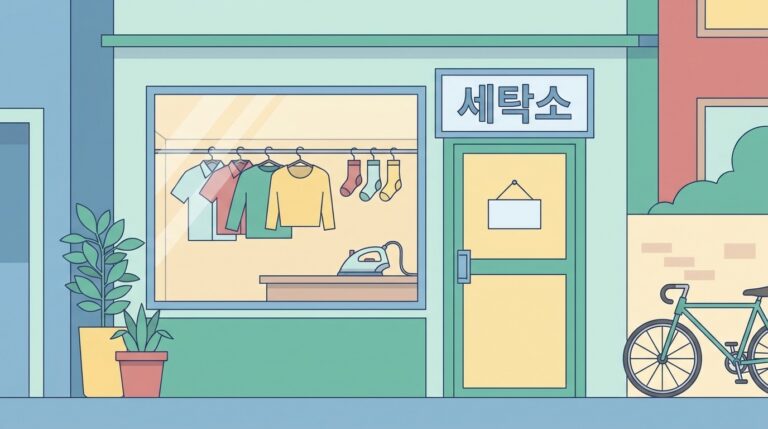
You wander through the alleys of your neighborhood looking for a local dry cleaner, known as a setakso (세탁소). You walk past the hanging vinyl covers and the warm hissing clouds of an industrial steam iron. An elderly master tailor with a yellow tape measure around their neck inspects the bright crimson spot, smiles gently, and says the most comforting words you will hear all day: “특수 얼룩 제거제를 써서 최대한 깨끗하게 세탁해 드릴게요 (Teuksu eolluk jegeoje-reul sseoseo choedaehan kkaekkeuthage setakhae deurilgeyo – We will use a special stain remover to wash it as cleanly as possible).”
Navigating local Korean service shops can feel intimidating if you only know stiff textbook phrases. But mastering these conversational laundry expressions does not just save your clothing—it opens the door to genuine warmth with neighborhood elders. Today’s guide is designed with real feedback from fellow learners who turned their laundry mishaps into unforgettable cultural wins.
Phase 2: 핵심 표현 3선 심층 분석
1. 얼룩 좀 지워 주세요 (Eolluk jom jiwo juseyo)
- Pronunciation: [Eol-luk jom ji-wo ju-se-yo] (Think of ‘Eol’ like the ‘earl’ in Earl Grey, ‘luk’ like ‘look’, and ‘jom’ like ‘chom-p’ without the ‘p’.)
- Meaning: Literal: “Please erase stain a little.” | Real Nuance: “Could you please get this stain out for me?”
- K-Culture Moment: Seen in slice-of-life dramas like Hospital Playlist or Reply 1988 when a character rushes into the neighborhood dry cleaner holding a stained school uniform or doctor’s coat.
- Editor’s Insight: The tiny word 좀 (jom) means “a little,” but functionally it is Korean’s ultimate politeness softener. Without 좀, the phrase sounds like an order. With it, you sound thoughtful and considerate.
- Situation Spectrum: Casual ⚠️ | Semi-formal ✅ | Formal ✅
- 🤔 Think About It: In English, we say “wash” or “remove” a stain, but Korean uses the verb 지우다 (jiuda)—the exact same verb used for “erasing” pencil marks on paper. How does treating a stain as an accidental mark waiting to be erased change how you view laundry?
2. 최대한 깨끗하게 해 드릴게요 (Choedaehan kkaekkeuthage hae deurilgeyo)
- Pronunciation: [Choe-dae-han kkae-kkeu-tha-ge hae deu-ril-ge-yo] (Start ‘Choe’ like ‘chew’, ‘kkae’ with a crisp popping ‘k’ sound, and ‘deurilgeyo’ smooth like ‘du-ril-geh-yo’.)
- Meaning: Literal: “I will do it as cleanly as possible for you (honorable).” | Real Nuance: “I’ll do my very best to get it completely clean!”
- K-Culture Moment: The hallmark reassurance spoken by neighborhood masters (darin) across Korea when accepting a difficult request from a valued customer.
- Editor’s Insight: The helper verb -해 드리다 (-hae deurida) is the humble honorific of -해 주다 (-hae juda). When the laundry owner uses this, they are honoring you as their client and expressing sincere craftsmanship.
- Situation Spectrum: Casual 🚫 | Semi-formal ✅ | Formal ✅
- 🤔 Think About It: Notice how Korean artisans rarely guarantee 100% perfection upfront; instead, they promise 최대한 (choedaehan – to the utmost maximum). Why do you think Korean service culture values honest commitment over empty guarantees?
3. 언제 찾으러 오면 돼요? (Eonje chajeureo omyeon dwaeyo?)
- Pronunciation: [Eon-je cha-jeu-reo o-myeon dwae-yo?] (Say ‘Eon-je’ like ‘un-jay’, ‘chajeureo’ like ‘cha-jeu-ruh’, and ‘dwaeyo’ like ‘dway-yo’.)
- Meaning: Literal: “When I come to find it, is it okay?” | Real Nuance: “When should I come pick this up?”
- K-Culture Moment: Every busy Seoul professional stopping by on their morning commute uses this exact rhythmic phrase before running off to the subway.
- Editor’s Insight: Koreans use the verb 찾다 (chatda – to find/search) to mean “pick up items” (like dry cleaning, parcels, or luggage). You are literally saying “come find my clothes.”
- Situation Spectrum: Casual ⚠️ | Semi-formal ✅ | Formal ✅
- 🤔 Think About It: In English, we say “pick up” (an action of taking possession), whereas Korean emphasizes “reclaiming what belongs to you” (찾으러 가다/오다). Notice how location perspective shifts whether you are going or coming!
Phase 3: 교과서 한국어 vs 진짜 한국어
Situation 1: Asking if a food stain can be washed out
- 📖 교과서 한국어 (Textbook): 이 얼룩을 완전히 제거하는 것이 가능합니까? (I eollugeul wanjeonhi jegeohaneun geosi ganeunghabnikka? – Is it possible to completely eradicate this stain?)
- 🗣️ 진짜 한국어 (Real Life): 사장님, 이거 얼룩 잘 빠질까요? (Sajangnim, igeo eolluk jal ppajilkkayo? – Boss, will this stain come out okay?)
- 💡 왜 다를까? (Why the difference?): Real Koreans refer to stains coming out using the dynamic verb 빠지다 (ppajida – to fall out / escape). Using formal Sino-Korean nouns like ‘제거 (removal)’ sounds like you are conducting a clinical laboratory test!
Situation 2: Asking the cleaner to take extra care with your precious coat
- 📖 교과서 한국어 (Textbook): 이 옷은 매우 소중하므로 조심스럽게 세탁해 주십시오. (I oseun maeu sojunghameuro josimseureopge setakhae jusipsio. – Because this garment is very precious, please wash it carefully.)
- 🗣️ 진짜 한국어 (Real Life): 제가 진짜 아끼는 옷인데 잘 좀 부탁드려요! (Jega jinjja akkineun osinde jal jom butakdeuryeoyo! – This is a piece I really treasure, so please take extra care of it!)
- 💡 왜 다를까? (Why the difference?): 아끼다 (akkida – to cherish/save) conveys emotional attachment. Adding 잘 부탁드려요 (jal butakdeuryeoyo) honors the master’s professional pride, instantly turning them into your clothing’s personal guardian.
Phase 4: K-Culture 딥다이브 & 비언어적 매너
4-1. 눈치 (Nunchi) & Polite Laundry Body Language
When you step into a neighborhood setakso, visual etiquette speaks before words do:
* Handing over the clothes: Always hand the clothing over with both hands or support your right elbow lightly with your left hand. Avoid tossing it onto the counter.
* Pinpointing the stain: Do not make the dry cleaner search for the spot! Fold or hold the garment open, and politely point at the stain with an open hand or gentle index finger while looking apologetic: “여기에 찌개 국물이 튀었어요 (Yeogie jjigae gungmuri twieosseoyo – Some stew soup splashed right here).”
* Receiving the receipt/pickup slip: When handed the paper slip (보관증 – bogwanjeung), accept it with two hands and a slight nod of gratitude.
4-2. The Soul of the Korean Dongne Setakso (동네 세탁소)
While automated 24-hour coin laundromats (Koin-wosibang) and app-based laundry deliveries are booming in modern Korea, the beating heart of local neighborhoods remains the 동네 세탁소 (dongne setakso).
Often operated for 30 to 40 years by married couples, these small shops are social hubs. The owner knows every resident’s seasonal wardrobe, hems pants to the exact millimeter by eye, and brews homemade barley tea behind the counter. Entrusting your prized clothes to them is an act of neighborhood community trust (jeong, 정).
Phase 5: 실전 롤플레이 시나리오
- Setting: A warm, nostalgic neighborhood dry cleaner in Mapo-gu, Seoul. A bell chimes above the sliding door as steam rises from an ironing board.
- Characters:
- Alex (알렉스): An exchange student holding a white padded jacket with a spicy stew stain.
- Mr. Park (박 사장님): A 65-year-old laundry master with spectacles resting on the tip of his nose.
Turn 1
알렉스 (Alex): 안녕하세요, 사장님! 드라이클리닝 좀 맡기려고 하는데요.
(Annyeonghaseyo, sajangnim! Deuraikeullining jom matgiryeogo haneundeyo.)
“Hello, Mr. Boss! I’d like to drop this off for dry cleaning.”
🎭 Alex enters holding the white jacket carefully with both hands.
Turn 2
박 사장님 (Mr. Park): 네, 어서 와요! 이리 줘 봐요. 어디 손볼 데가 있나?
(Ne, eoseo wayo! Iri jwo bwayo. Eodi sonbol dega inna?)
“Yes, welcome! Pass it here. Any specific spots that need work?”
🎭 Mr. Park lays the jacket flat on the wooden counter and pats it down.
Turn 3
알렉스 (Alex): 점심 먹다가 소매 쪽에 김치찌개 국물이 묻었어요. 얼룩 좀 지워 주세요.
(Jeomsim meokdaga somae jjoge kimchijjigae gungmuri mudeosseoyo. Eolluk jom jiwo juseyo.)
“While eating lunch, kimchi stew got onto the sleeve. Could you please get this stain out?”
🎭 Alex points directly to the cuff with a sheepish, apologetic smile.
Turn 4
박 사장님 (Mr. Park): 아이고, 빨간 국물이 진하게 배었네. 바로 안 닦았죠?
(Aigo, ppalgan gungmuri jinhage baeeonne. Baro an dakkatjyo?)
“Oh dear, the red soup soaked in pretty deep. You didn’t wipe it off right away, did you?”
🎭 Mr. Park squints through his glasses, rubbing the fabric gently with his thumb.
Turn 5
알렉스 (Alex): 네, 수업이 있어서요… 제가 아끼는 옷인데 지워질까요?
(Ne, sueobi isseoseoyo… Jega akkineun osinde jiwojilkkayo?)
“Yes, because I had class… It’s an outfit I really treasure, will it come out?”
🎭 Alex puts his hands together pleadingly.
Turn 6
박 사장님 (Mr. Park): 걱정 마요. 특수 얼룩 제거제를 써서 최대한 깨끗하게 세탁해 드릴게요!
(Geokjeong mayo. Teuksu eolluk jegeoje-reul sseoseo choedaehan kkaekkeuthage setakhae deurilgeyo!)
“Don’t worry. We will use a special stain remover to wash it as cleanly as possible!”
🎭 Mr. Park nods reassuringly and pats the jacket counter.
Turn 7
알렉스 (Alex): 정말 감사합니다! 언제 찾으러 오면 돼요?
(Jeongmal gamsahamnida! Eonje chajeureo omyeon dwaeyo?)
“Thank you so much! When should I come pick it up?”
🎭 Alex breathes a sigh of relief.
Turn 8
박 사장님 (Mr. Park): 모레 목요일 오후 다섯 시 이후에 찾으러 와요. 영수증 챙기고요!
(More mogyoil ohu daseot si ihue chajeureo wayo. Yeongsujeung chaenggigoyo!)
“Come pick it up the day after tomorrow, Thursday, after 5 PM. Don’t forget your receipt!”
🎭 Mr. Park scribbles on a yellow receipt ticket and hands it over.
🔀 Interactive Choice Point: How would you respond to Mr. Park after he hands you the receipt?
- Choice A: “감사합니다, 사장님! 목요일에 올게요. 수고하세요! (Gamsahamnida, sajangnim! Mogyoire olgeyo. Sugohaseyo!)”
- Choice B: “얼룩 못 지우면 환불해 주세요. (Eolluk mot jiumyeon hwanbulhae juseyo.)”
- Choice C: “그냥 내일 아침에 주시면 안 돼요? (Geunyang naeil achime jusimyeon an dwaeyo?)”
[Feedback Box]
* Selection A (Best): ⭐⭐⭐⭐⭐ Perfect! You thanked the master, confirmed the pickup day, and wished him well with "수고하세요 (Thank you for your hard work)." This builds instant neighborhood rapport!
* Selection B (Bad): ⚠️ Demanding a refund before the work even begins violates mutual trust (*jeong*) and will deeply offend the craftsperson.
* Selection C (Risk): ⚠️ Rushing a delicate stain removal process might force them to use harsh chemicals that ruin your fabric, or they may refuse the order altogether.
Phase 6: 10초 감정 섀도잉 드릴 (Shadowing Drill)
Read out loud, paying attention to the pause markers (/) and emotional tone indicators!
[🥺 간절하고 걱정스럽게 - Anxious and pleading]
“사장님, / 이거 아끼는 옷인데 / 얼룩 좀 지워 주세요.”
(Sajangnim, / igeo akkineun osinde / eolluk jom jiwo juseyo.)-
[🧑🦳 든든하고 자신감 넘치게 - Confident and reassuring]
“특수 얼룩 제거제를 써서 / 최대한 깨끗하게 / 세탁해 드릴게요!”
(Teuksu eolluk jegeoje-reul sseoseo / choedaehan kkaekkeuthage / setakhae deurilgeyo!) -
[😊 밝고 경쾌하게 - Cheerful and polite]
“감사합니다! / 세탁 다 되면 / 언제 찾으러 오면 돼요?”
(Gamsahamnida! / Setak da doemyeon / eonje chajeureo omyeon dwaeyo?)
Phase 7: K-Culture 미니 사전 (Core Keywords)
-
드라이클리닝 (Deuraikeullining) | Dry cleaning
Everyday Usage: Essential for coats, knitwear, and suits in Korea. You say: “드라이클리닝 맡길게요 (I’d like to drop this off for dry cleaning).” -
얼룩 (Eolluk) | Stain / Smudge
Everyday Usage: Covers everything from coffee and kimchi spills to makeup collars. Combined frequently as 얼룩 제거 (stain removal). -
기장 수선 (Gijang suseon) | Length alteration / Hemming
Everyday Usage: When buying trousers or long skirts in Korea, pants legs are often long. Take them to a neighborhood cleaner and say: “바지 기장 수선해 주세요 (Please hem the length of these pants).” -
보관증 (Bogwanjeung) | Claim slip / Custody receipt
Everyday Usage: The numbered slip or paper tag given by traditional dry cleaners. Keep this safe, or snap a photo on your phone to show during pickup!
Phase 8: 여행자를 위한 생존 키트 (Traveler’s Survival Kit)
TOP 3 Survival Phrases
- 이거 얼룩 지울 수 있어요? (Igeo eolluk jiul su isseoyo?)
(Ee-guh eol-luk jee-ool soo ee-ssuh-yo?)
Pro Tip: Use this first if you have a mystery stain and want to know if it’s salvageable before paying. - 바지 기장 2센티만 줄여 주세요. (Baji gijang i-senti-man juryeo juseyo.)
(Bah-jee gee-jahng ee-sen-tee-mahn joo-ryuh joo-say-yo.)
Pro Tip: Perfect for newly bought K-fashion pants! You can also fold the hem up in front of the mirror to show your desired line. - 오늘 바로 돼요? (Oneul baro dwaeyo?)
(Oh-neul bah-roh dway-yo?)
Pro Tip: If you are traveling and leaving tomorrow, ask this to check for same-day express service (usually incurs a small fee).
Editor’s Travel Note
- Finding a local cleaner: Avoid typing “laundry” on foreign search engines. Instead, do a quick search on the Naver Map app download using the keyword 세탁소 (setakso) to find nearby spots with operating hours and reviews.
- Payment Manners: Small neighborhood shops appreciate cash or domestic card payments. When paying or picking up, displaying your 보관증 (claim slip) ensures zero mix-ups even with zero conversational skills!
Phase 9: “한 발 더 깊이” (Cultural Reflection)
In many Western cultures, service interactions follow a strict contractual model: a company guarantees a specific metric, or you get your money back. In Korean neighborhood businesses, however, relationships are guided by 정성 (jeongseong – sincere devotion) and 최대한 (choedaehan – to one’s utmost ability).
When a Korean cleaner says, “최대한 깨끗하게 해 드릴게요 (I will do it as cleanly as possible),” they are not offering a cold legal disclaimer; they are invoking their professional honor as a neighborhood craftsman. They promise to apply their decades of expertise without making reckless promises that might damage delicate fibers. It is a philosophy grounded in respect and realistic care.
💬 Your Turn: Have you ever experienced a moment when an everyday service worker went above and beyond for you in another country? Share your story in the comments below!
Phase 10: FAQ & 오해 방지
Q: Can I bring clothes to a neighborhood setakso if I do not speak fluent Korean?
A: Absolutely! Most neighborhood cleaners are extraordinarily kind to foreigners. Simply point at the stain, use the key phrase “얼룩 좀 지워 주세요 (Please remove the stain),” and use hand gestures to confirm pickup dates on their wall calendar.
Q: What is the difference between 세탁소 (setakso) and 빨래방 (ppallaebang)?
A: A 세탁소 (setakso) is a full-service dry cleaner and tailoring shop run by human experts. A 빨래방 (ppallaebang) or 코인빨래방 (coin laundromat) is an unmanned, self-service laundromat with coin-operated washers and dryers meant for everyday t-shirts, towels, and sheets.
Q: Do dry cleaners in Korea also do alterations?
A: Yes! Almost all traditional setakso have a professional sewing machine and iron setup. They do 수선 (suseon – alterations), including zipper replacements, waistband adjustments, and pants hemming.
🚨 흔한 실수 (Common Mistakes) 경고판
- Saying “이거 씻어 주세요 (Igeo ssiseo juseyo)”:
The Mistake: 씻다 (ssitda) means to wash hands, vegetables, or one’s body.
Correct Action: Use 세탁해 주세요 (Setakhae juseyo) or 드라이해 주세요 (Deuraihae juseyo) for clothes. - Scrubbing the stain vigorously with wet wipes beforehand:
The Mistake: Wet wipes contain alcohol and surfactants that often spread oil-based soup deep into garment fibers.
Correct Action: Dab lightly with a dry napkin and take it directly to the cleaner without scrubbing. - Losing the paper claim slip (보관증):
The Mistake: Misplacing the yellow or pink slip makes retrieval awkward during peak rush hours.
Correct Action: Take a smartphone photo of the receipt immediately after receiving it.
Phase 11: 액션 미션 & 참여 유도
- 🥉 Bronze Mission (Solo Practice): Stand in front of your mirror with a stained or wrinkled piece of clothing and practice saying: “사장님, 얼룩 좀 지워 주세요!” three times with polite hand gestures.
- 🥈 Silver Mission (SNS & Share): Leave a comment on our blog post with a sentence stating what clothes you need to wash this week in Korean (e.g., “이번 주에 코트 세탁할 거예요!”).
- 🥇 Gold Mission (Real Life Action): Visit a local Korean cleaner or practice speaking with a language exchange partner, using the phrase “언제 찾으러 오면 돼요?”
🎮 K-Culture Mission: Watch an episode of a neighborhood K-drama (like Reply 1988 or When the Camellia Blooms) and spot the dry cleaner or tailor shop in the background alleys!
Phase 12: 인터랙티브 퀴즈 챌린지
Q1. [상황 판단] You spilled red spicy tteokbokki sauce on your silk blouse. What is the most polite and natural phrase to say to the laundry owner?
(a) 야! 이거 빨아 줘. (Ya! Igeo ppala jwo.)
(b) 사장님, 소매에 얼룩 좀 지워 주세요. (Sajangnim, somae-e eolluk jom jiwo juseyo.)
(c) 이 얼룩을 당장 완전히 없애시오. (I eollugeul dangjang wanjeonhi eopsaesio.)
Q2. [빈칸 채우기] Fill in the blank with the appropriate word for “to the utmost / as much as possible”:
“특수 얼룩 제거제를 써서 [최____] 깨끗하게 세탁해 드릴게요.”
Q3. [True / False 문화 퀴즈]
In Korea, an unmanned self-service coin laundromat is called a setakso (세탁소). (True / False)
👉 Click here to reveal the answers and explanations!
Answers & Explanations:
1. Answer: (b)
Explanation: Calling the owner 사장님 (sajangnim) and using the softener 좀 (jom) with 지워 주세요 is the gold standard of polite conversational Korean. (a) is rude banmal (slang/informal), and (c) sounds like an ancient king’s command!
2. Answer: 최대한 (Choedaehan)
Explanation: 최대한 means “to the maximum” or “as much as humanly possible.”
3. Answer: False
Explanation: A full-service cleaner with staff is a 세탁소 (setakso). An unmanned coin laundromat is called a 빨래방 (ppallaebang) or 코인빨래방 (coin ppallaebang).
🎬 Watch Our Daily Videos! (Daily Hangul Official Instagram)
Review the expressions you learned in this article with our fun daily short videos! Check out native pronunciation and real-life nuances in action.
- Instagram @dailyhangul_en







