

Phase 1: Empathy & Immersive Opening
안녕하세요! 매일한글 에디터입니다. (Hello! This is your Daily Hangul editor.)
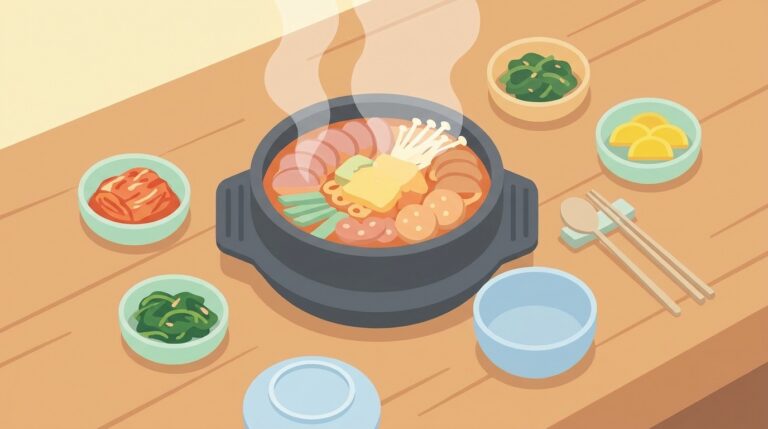
Picture this: You are sitting in a bustling, fragrant neighborhood diner in Seoul on a crisp autumn evening. In the center of your table sits an iron pot of bubbling budae jjigae (army stew) or dakbokkeumtang (spicy braised chicken). You and your friend have been happily slurping up spoonfuls of the deeply savory soup. But suddenly, you notice a small crisis: the pot is boiling down rapidly, your noodles are beginning to scorch against the bottom, and the broth has vanished! Half your toppings are still left, but the soup is gone.
You desperately want more broth, but you freeze up. Can I just ask for soup? Will they charge me extra? What if they think I am greedy? How do I even say ‘broth’ in Korean? In the end, many beginner travelers simply chew on dry noodles or awkwardly pour drinking water straight from their tumbler into the boiling pot.
Please don’t do that! In Korean food culture, broth refills are practically a universal birthright, and asking for a top-up is not only accepted—it is warmly welcomed. Over the past decade coaching foreign food lovers in Korea, I have seen this single interaction turn nervous first-timers into cherished restaurant regulars. Today, you will master the exact phrase to get that rich soup flowing again like a confident local.
Phase 2: Core Expressions Deep Dive
1. 국물 좀 더 주실 수 있어요? (Gungmul jom deo jusil su isseoyo?)
- Pronunciation: [Gung-mool jom duh joo-sheel soo ee-ssuh-yo?] (Think of ‘cool’ with an m-sound: goom-mool, followed by a soft jom, and juice-hill sue ee-saw-yo)
- Meaning: Literal: “Could you give a little more soup?” vs. Real Nuance: “Could I please get a little more broth?”
- K-Culture Moment: The heartwarming winter K-drama scene where friends sit at a late-night street stall (pojangmacha) and the kind owner ladles piping-hot fishcake broth into their paper cups.
- Editor’s Insight: The secret charm of this sentence is the tiny word 좀 (jom), meaning ‘a little’. Even if you secretly want three massive ladles of soup, saying jom magically softens your request, making you sound polite, modest, and naturally fluent.
- Situation Spectrum: Casual: ⚠️ | Semi-formal: ✅ | Formal: ✅
- 🤔 Think About It: In many Western restaurants, asking for extra sauce or broth brings an extra charge on the receipt. Why do you think Korean dining treats broth as something meant to be shared freely?
2. 여기 육수 추가해 주세요 (Yeogi yuksu chugahae juseyo)
- Pronunciation: [Yeo-gi yook-soo choo-gah-hae joo-seh-yo] (Yaw-gee + yook-sue + choo-gah-hae + joo-seh-yo)
- Meaning: Literal: “Here, please add stock.” vs. Real Nuance: “Excuse me, could we please have a broth refill here?”
- K-Culture Moment: In modern cooking shows like Baek Jong-won’s Alley Restaurant, diners call this out crisp and clear when boiling down shabu-shabu or spicy hot pots.
- Editor’s Insight: While 국물 (gungmul) is a general word for any soup or liquid, 육수 (yuksu) specifically refers to carefully simmered stock (anchovy, beef, or kelp broth). Using yuksu shows that you really understand Korean cooking!
- Situation Spectrum: Casual: ⚠️ | Semi-formal: ✅ | Formal: ✅
- 🤔 Think About It: Starting a request with “여기 (yeogi – here)” directs attention to your table without needing to know the server’s personal name. How does your native language get a server’s attention politely?
3. 반찬 더 드릴까요? (Banchan deo deurilkkayo?)
- Pronunciation: [Bahn-chahn duh deu-reel-kkah-yo?] (Bahn-chahn + duh + dew-reel-kkah-yo)
- Meaning: Literal: “Shall I give you more side dishes?” vs. Real Nuance: “Would you like some more side dishes?”
- K-Culture Moment: The affectionate neighborhood restaurant owner (Imo) notices your empty kimchi plate from across the room and rushes over with a smiling refill before you even ask.
- Editor’s Insight: This is a phrase you will hear rather than speak. It uses the humble honorific verb 드리다 (deurida) instead of 주다 (juda). When you hear this melodic question, all you need to do is smile and reply: 네, 감사합니다! (Ne, gamsahamnida! – Yes, thank you!).
- Situation Spectrum: Casual: 🚫 | Semi-formal: ✅ | Formal: ✅
- 🤔 Think About It: Notice how the server uses a higher honorific verb (deurida) to elevate the dining guest. How does hospitality language in your country express respect?
Phase 3: Textbook Korean vs. Real Korean
Situation 1: Asking for more broth at your table
- 📖 교과서 한국어: 국물을 리필해 주시겠습니까? (Gungmureul ripilhae jusigesseumnikka?)
- 🗣️ 진짜 한국어: 이모님, 국물 좀 더 주세요~ (Imo-nim, gungmul jom deo juseyo~)
- 💡 왜 다를까?: The textbook phrase “주시겠습니까” sounds like you are filing a formal legal petition! Native speakers prefer calling out the warm title 이모님 (Imo-nim – auntie) followed by the gentle imperative ~좀 더 주세요 (~jom deo juseyo – please give a little more).
Situation 2: Asking if the broth refill is complimentary
- 📖 교과서 한국어: 이것은 무료로 다시 채워집니까? (Igeoseun muryoro dasi chaewojimnikka?)
- 🗣️ 진짜 한국어: 이거 리필 돼요? (Igeo ripil dwaeyo?)
- 💡 왜 다를까?: Translating ‘free of charge’ (muryoro) sounds overly stiff and robotic. Everyday Koreans use the natural Konglish word 리필 (ripil – refill) combined with 돼요? (dwaeyo? – is it possible/allowed?).
Phase 4: K-Culture Deep Dive & Non-Verbal Manners
4-1. 눈치 (Nunchi) & Table Gestures
When calling for a refill in Korea, waving your hand high in the air or snapping your fingers is considered bad manners. Instead, exercise a little Nunchi (situational awareness):
1. Catch the server’s eye across the room.
2. Raise your hand slightly to chest or shoulder level with your fingers together.
3. If your table has a small round button in the corner (the famous ding-dong call bell), do not yell at all—simply press it once gently.
4. When the server arrives with the stainless steel kettle to pour broth, hold the rim of your bowl or pot slightly with both hands (or place one hand under your pouring arm) as a universal gesture of gratitude and respect.
4-2. The Cultural Code of Jeong (정) and Soup
In Korean culinary history, soup (guk or tang) is the ultimate symbol of communal comfort. During colder eras, adding water and vegetables to stretch a pot of soup was how large families shared warmth and survived together. That legacy lives on in the concept of 정 (Jeong)—an unspoken, unconditional bond of affection and generosity. Charging a paying diner for plain soup broth feels emotionally stingy in traditional Korean hospitality. That boiling kettle of broth is a gift of hospitality meant to keep your meal warm until the very last bite.
Phase 5: Real-World Roleplay Scenario
Setting: Sinchon Ttukbaegi, a lively stew restaurant on a freezing Friday night in Seoul.
Characters:
* Alex: A beginner Korean learner enjoying army stew with noodles.
* Imo (이모): The energetic, gold-jewelry-wearing restaurant auntie carrying a broth kettle.
Alex: 저기요, 이모님! (Jeogiyo, Imonim!)
🎭 Gently raises hand at shoulder height with a bright, friendly smile
“Excuse me, Auntie!”
Imo: 네~ 총각, 뭐 더 줄까? (Ne~ chonggak, mwo deo julkka?)
🎭 Strides over with a warm grin, holding a heavy broth kettle
“Yes~ young man, what more can I get you?”
Alex: 찌개 국물 좀 더 주실 수 있어요? (Jjigae gungmul jom deo jusil su isseoyo?)
🎭 Politely points with two hands toward the simmering, dry stew pot
“Could you give me some more stew broth?”
Imo: 아이고, 국물이 다 졸았네! 바로 부어 줄게요. (Aigo, gungmuri da joranne! Baro bueo julgeyo.)
🎭 Tilts the kettle over the pot, pouring a generous stream of steaming stock
“Oh dear, the broth boiled down completely! I will pour it in right away.”
Alex: 감사합니다! 혹시 육수 리필은 공짜예요? (Gamsahamnida! Hoksi yuksu ripireun gongjjayeyo?)
🎭 Tilts head with a modest smile, curious about the bill
“Thank you! By the way, is the broth refill free?”
Imo: 아이구, 당연하지! 국물은 얼마든지 더 먹어요. (Aigu, dangyeonhaji! Gungmureun eolmadeunji deo meogeoyo.)
🎭 Chuckles affectionately and pats the table corner
“Oh goodness, of course! Have as much broth as you want.”
Alex: 와, 대박! 밥 한 공기 더 시켜야겠어요. (Wa, daebak! Bap han gonggi deo sikyeoyagesseoyo.)
🎭 Eyes widen in genuine joy, rubbing hands together in excitement
“Wow, amazing! I will have to order one more bowl of rice.”
Imo: 하하, 잘 먹으니 보기 좋네! 김치도 더 줄게. (Haha, jal meogeuni bogi jonne! Kimchido deo julge.)
🎭 Gives a thumbs-up and heads straight to the side dish counter
“Haha, I love seeing you eat so well! I’ll bring you more kimchi too.”
🔀 Interactive Decision Point
When Imo finishes pouring the broth into your pot, what is your best response?
- Choice A: “감사합니다, 이모님! 맛있게 먹을게요!” (Gamsahamnida, Imonim! Masitge meogeulgeyo! – Thank you, Auntie! I will eat delicious!)
👉 Feedback (Best!): Outstanding! Calling her Imonim and announcing that you will eat well warms the owner’s heart. You might find a complimentary soda or extra rice cakes placed on your table! - Choice B: “이거 영수증에 얼마 찍혀요?” (Igeo yeongsujeunge eolma jjikhyeoyo? – How much will this show on the receipt?)
👉 Feedback (Risk): Awkward! Even though you mean well, asking this repeatedly implies you don’t trust her word that it is complimentary. - Choice C: “국물 맛없으면 다시 바꿔 줘요.” (Gungmul mateopseumyeon dasi bakkwo jwoyo. – If the broth is bad, exchange it again.)
👉 Feedback (Bad!): Disaster! This is deeply disrespectful and attacks the cook’s pride. You may receive cold silence for the rest of the night!
Phase 6: 10-Second Emotional Shadowing Drill
Read these sentences aloud with feeling, pausing momentarily at each slash mark (/):
[🙋 친절하고 공손하게 / Friendly and polite]
“저기요~ / 국물 좀 / 더 주실 수 있어요? / (Jeogiyo~ / gungmul jom / deo jusil su isseoyo?)”-
[😋 기대감 가득하고 신나게 / Eager and excited]
“우와, / 육수 더 부으니까 / 다시 새것 같아요! / (Uwa, / yuksu deo bueeunikka / dasi saegeot gatayo!)” -
[🙏 따뜻하게 감동받으며 / Warm and genuinely grateful]
“이모님, / 친절하게 챙겨 주셔서 / 정말 감사합니다! / (Imonim, / chinjeolhage chaenggyeo jusyeoseo / jeongmal gamsahamnida!)”
Phase 7: K-Culture Mini Dictionary
- 국물 (Gungmul) | Broth / Soup base | In Korea, drinking warm broth is believed to soothe tired bodies and heal hangovers. A famous slang idiom is “국물도 없다 (gungmuldo eopda)”, meaning “You won’t get a single drop / Not a chance!”
- 리필 (Ripil) | Refill | Konglish term widely used in modern eateries for side dishes, soups, and beverages.
- 인심 (Insim) | Warm-hearted generosity | The cultural virtue of treating guests and neighbors with abundance, best demonstrated by free side-dish top-ups.
- 셀프 바 (Selpeu-ba) | Self-service side dish bar | A buffet-style station in casual barbecue or soup restaurants where diners scoop their own kimchi, garlic, and sauces.
Phase 8: Traveler’s Survival Kit
Survival Expressions TOP 3
- 물 좀 더 주세요. (Mul jom deo juseyo.)
Pronunciation: [Mool jom duh joo-seh-yo.]
Pro Tip: Before asking, look around the dining room! If you spot a water dispenser with metal cups, look for a sign that says “물은 셀프” (Water is self-service). That means you should fetch it yourself. - 반찬 좀 더 주실 수 있어요? (Banchan jom deo jusil su isseoyo?)
Pronunciation: [Bahn-chahn jom duh joo-sheel soo ee-ssuh-yo?]
Pro Tip: Standard side dishes (banchan) in Korea are virtually always 100% free to refill. Hand your empty dish gently to the staff when requesting! - 육수 좀 더 부어 주세요. (Yuksu jom deo bueo juseyo.)
Pronunciation: [Yook-soo jom duh boo-uh joo-seh-yo.]
Pro Tip: Use this when your hot pot or noodles are still on an active portable gas burner at your table.
Editor’s Travel Note
When hunting for authentic neighborhood soup spots, skip global maps which often miss local alleyways. Make sure you complete your [Naver Map app download] beforehand to view real-time Korean menus, photos, and opening hours. Also, remember payment etiquette: do not leave money or your card on the dining table! When you finish your meal, pick up your table bill slip and take it to the cash counter (kaunteo) near the front exit to settle your payment.
Phase 9: “One Step Deeper” (Cultural Reflection)
In many individualistic dining cultures, a meal is a collection of private plates separated by invisible boundaries. In Korea, however, a meal is an act of shared community. The communal stew pot sits at the exact geometric and emotional center of the table, bubbling for everyone at once. Broth is the lifeblood that ties all the ingredients together. When a restaurant owner gladly pours fresh, boiling stock into your pot without charging an extra cent, they are extending an ancient gesture: You are a guest under my roof; eat comfortably until your heart is full.
💬 Your Turn: What is one food item in your home country that restaurants would never give you for free, but you wish they did? Tell us your stories in the comments below!
Phase 10: FAQ & Common Mistakes
Q: Are broth and side dish refills really 100% free everywhere in Korea?
A: In 95% of traditional Korean stew, hot pot, and soup eateries, basic broth and vegetable side dishes (banchan) are completely complimentary. However, adding extra solid ingredients like fresh meat, dumplings, cheese, or ramen noodles (sari) comes with an extra menu charge (usually 1,000 to 3,000 KRW).
Q: What should I call the server if I need more soup?
A: If the server is a middle-aged woman, calling her 이모님 (Imo-nim – Auntie) or 사장님 (Sajangnim – Boss/Owner) is exceptionally friendly and respectful. For male staff or younger workers, stick to a polite 저기요~ (Jeogiyo~ – Excuse me).
Q: What does the sign ‘반찬은 셀프입니다’ mean?
A: It means “Side dishes are self-service!” Instead of calling the server, take your empty plate to the self-serve counter (selpeu-ba), take only what you can finish, and bring it back to your table.
🚨 Common Mistakes (흔한 실수 TOP 3)
- ❌ Mistake 1: Shouting “웨이터! (Waiter!)” or snapping your fingers across the dining room.
✅ Correct Action: Press the table bell once, or make eye contact and say softly: “저기요~ (Jeogiyo~)”. - ❌ Mistake 2: Leaving a 15% cash tip on the table after receiving free broth.
✅ Correct Action: Tipping does not exist in Korea and can cause genuine confusion. Express your gratitude with a slight bow and a heartfelt “감사합니다! (Gamsahamnida!)”. - ❌ Mistake 3: Pouring cold drinking water from your table pitcher into the stew pot to recreate soup.
✅ Correct Action: Don’t dilute the delicious seasonings! Ask confidently: “국물 좀 더 주실 수 있어요? (Gungmul jom deo jusil su isseoyo?)”.
Phase 11: Action Missions
- 🥉 Bronze Mission (Solo Practice): Stand in front of your mirror, hold up an imaginary ladle, and repeat “국물 좀 더 주실 수 있어요?” three times with a friendly, relaxed expression.
- 🥈 Silver Mission (Social Sharing): Snap a photo of a soup or stew you eat this week, upload it to your Instagram Story or X, and tag #DailyHangul with the caption: “국물 좀 더 주세요! 🍲”.
- 🥇 Gold Mission (Real-World Challenge): Visit a Korean restaurant in your city (or in Korea!). When your broth runs low, decline to switch to English and order a broth refill in 100% pure Korean!
- 🎮 K-Culture Mission: In the next K-drama episode you watch involving a meal, watch carefully: do the characters call out “사장님”, press a table bell, or receive extra side dishes without asking?
Phase 12: Interactive Quiz Challenge
Test your real-world Korean dining skills with three quick questions:
1. Situation Judgment: Your pot of budae jjigae is boiling dry on the burner. What is the most natural and polite sentence to say to the restaurant owner?
* A) 야! 물 가져와! (Ya! Mul gajyeowa!)
* B) 국물 좀 더 주실 수 있어요? (Gungmul jom deo jusil su isseoyo?)
* C) 국물 리필은 얼마예요? (Gungmul ripireun eolmayeyo?)
2. Fill-in-the-Blank: Choose the magical one-syllable word that softens requests to sound polite and humble:
* “이모님, 육수 [ ? ] 더 주세요!”
3. True or False: In Korea, you must leave extra cash on the table when asking for multiple broth refills. (True / False)
👉 Click to reveal answers & explanations!
- Answer: B (국물 좀 더 주실 수 있어요?)
Explanation: Option A is rude slang meaning “Hey! Bring water!”, and Option C awkwardly assumes you will be charged for broth. Option B is the gold standard of polite dining Korean! -
Answer: 좀 (jom)
Explanation: Inserting 좀 (jom – a little) softens any imperative, turning an abrupt order into a charming, natural request. -
Answer: False
Explanation: Tipping is not part of Korean dining culture. Broth refills in traditional stew restaurants are complimentary, and a warm verbal thank-you is the best payment!
🎬 Watch Our Daily Videos! (Daily Hangul Official Instagram)
Review the expressions you learned in this article with our fun daily short videos! Check out native pronunciation and real-life nuances in action.
- Instagram @dailyhangul_en







