

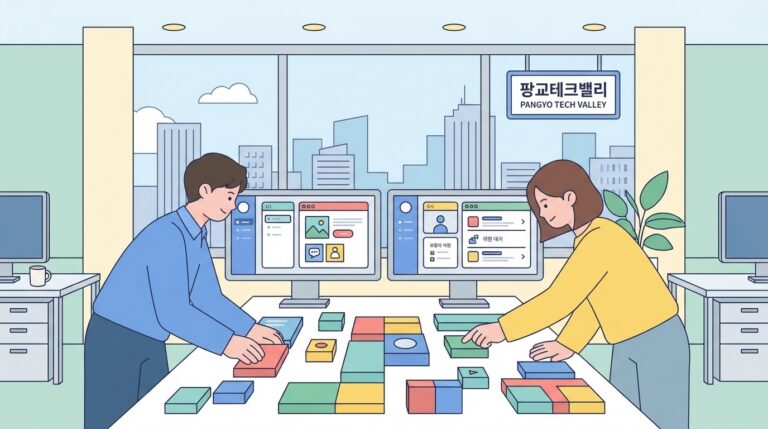
Speak Like a Pangyo Tech Insider: Level Up Your Korean Design System & Handoff
Phase 1: Empathy (Story-Immersive Opening)
안녕하세요! 매일한글 에디터입니다. (Hello! This is your Daily Hangul editor.)
Picture this: You are sitting in an open-plan tech studio overlooking the bustling streets of Pangyo Techno Valley—Korea’s Silicon Valley, just like the trendy office in the hit K-drama Start-Up. You’re a foreign product designer, and your frontend developer teammate turns to you, looking completely burnt out after redrawing every button variant manually. “Do we really need 14 shades of blue?” they sigh, sipping their third iced Americano.
You want to suggest adopting a unified design system where components snap together seamlessly, but how do you pitch standardizing UI components in natural Korean without sounding stiff or overly academic? In dynamic Korean startups, communication moves at lightning speed. When designers stop reinventing primary buttons and developers assemble interfaces 3x faster, collaboration feels like magic. In this guide, backed by insights from real foreign designers working in Seoul’s top IT teams, you’ll learn the exact intermediate (B2) phrases to align specs, build component libraries, and run seamless design-to-code handoffs.
Phase 2: Deep Dive into 3 Key Expressions
1. 레고 블록 조립하듯이 (Lego beullok joriphadeusi)
- Pronunciation: [Le-go beul-lok jo-rip-ha-deu-si] (Sounds like reh-go bull-lock jo-rip-ha-doo-shee)
- Meaning: “Just like assembling Lego blocks” vs. Building scalable, modular components that snap together effortlessly without bespoke coding.
- K-Culture Moment: In modern Korean tech culture, this analogy is ubiquitous when describing atomic design systems or microservice architectures. Team leads use it in sprint demos to celebrate modular design.
- Editor’s Insight: Combining the noun 레고 블록 (Lego block) with the comparative particle -하듯이 (as if / just like) turns technical architecture into an instantly relatable, delightful visual.
- Situation Spectrum:
- Casual: ✅ (Used in coffee chats and retros)
- Semi-formal: ✅ (Perfect for sprint planning and sprint reviews)
- Formal: ⚠️ (In an executive investor pitch, prefer 표준화된 모듈 구조로 – pyojunhwadoen modyul gujoro)
- 🤔 Think About It: Why do Korean teams adore physical toy metaphors like “Lego blocks” to describe digital workflows? It reflects a cultural craving for tangible, visible team efficiency!
2. 싱크를 맞추다 (Singkeureul matchuda)
- Pronunciation: [Sing-keu-reul mat-chu-da] (Sounds like sing-koo-rule maht-choo-dah)
- Meaning: “To adjust the sync” vs. Aligning design tokens, specs, and implementation details between designers and developers.
- K-Culture Moment: Often heard in tech hubs from Seongsu to Gangnam when developers and designers open Figma and VS Code together right before a release.
- Editor’s Insight: 싱크 (sync) from English combines with the native Korean verb 맞추다 (to calibrate, fit, match). It carries active mutual collaboration, rather than one-sided command.
- Situation Spectrum:
- Casual: ✅
- Semi-formal: ✅
- Formal: ✅
- 🤔 Think About It: In English, we simply say “let’s sync.” In Korean, using the active verb 맞추다 (to harmonize) highlights that team consensus is a deliberate, shared effort.
3. 손발이 척척 맞다 (Sonbari cheokcheok matda)
- Pronunciation: [Son-ba-ri cheok-cheok mat-da] (Sounds like sohn-bah-ree chuck-chuck maht-dah)
- Meaning: “Hands and feet match rhythmically” vs. Working together in flawless harmony with instinctive teamwork.
- K-Culture Moment: Often uttered when a designer hands over clean Figma autolayout specs and the engineer pushes the production build without a single discrepancy question.
- Editor’s Insight: 손발 (hands and feet) represents motor coordination, while 척척 is an onomatopoeia describing smooth, uninterrupted movement. It is the ultimate compliment for collaborative chemistry.
- Situation Spectrum:
- Casual: ✅
- Semi-formal: ✅
- Formal: ⚠️ (Use 긴밀하게 협력하다 – ginmilhage hyeopryeokhada in legal or formal reports)
- 🤔 Think About It: Notice how Korean idioms ground abstract team efficiency in physical body parts moving in sync. How does your native language describe team chemistry?
Phase 3: Textbook Korean vs. Real Korean
Scenario 1: Proposing reusable standardized components
- 📖 교과서 한국어: 컴포넌트를 표준화하면 효율성이 증대됩니다. (Keomponeonteureul pyojunhwahamyeon hyoyulseong-i jeungdaedoemnida.)
- Translation: “If we standardize components, efficiency will increase.”
- 🗣️ 진짜 한국어: 공통 컴포넌트 맞춰두면 매번 새로 그릴 필요 없잖아요! (Gongtong keomponeonteu matchwodumyeon maebeon saero geuril piryo eopjanayo!)
- Translation: “Once we lock down common components, we don’t have to redraw them every single time!”
- 💡 왜 다를까? Textbook Korean relies heavily on Sino-Korean nouns (효율성 증대), whereas real startup pros speak in outcome-based conversational softeners (-잖아요 – “as you know / isn’t it true”).
Scenario 2: Highlighting rapid feature delivery to teammates
- 📖 교과서 한국어: 화면 개발 속도가 이전보다 3배 빨라졌습니다. (Hwamyeon gaebal sokdoga ijeonboda sebae ppallajyeosseumnida.)
- Translation: “Screen development speed has become three times faster than before.”
- 🗣️ 진짜 한국어: 레고 블록 맞추듯이 조립하니까 화면 치는 속도가 3배는 빨라졌어요. (Lego beullok matchudeusi joriphanikka hwamyeon chineun sokdoga sebaeneun ppallajyeosseoyo.)
- Translation: “Since we assemble screens like snapping Lego blocks together, cranking out UI is three times faster.”
- 💡 왜 다를까? Real tech developers frequently use the vivid slang verb 화면을 치다 (to punch/knock out screens rapidly) instead of the dry 화면을 개발하다.
Phase 4: K-Culture Deep Dive & Non-Verbal Manners
4-1. Nunchi & Gestures During Handoffs
In Korean collaborative spaces, sharing a screen during design handoffs requires specific non-verbal etiquette (눈치, nunchi):
* The Two-Finger Screen Indicator: When pointing out spacing tokens or hex codes on a monitor, never point an aggressive single index finger close to the engineer’s face. Instead, open your palm upward or point gently with two fingers gathered together.
* The Softened Agreement Nod: When an engineer points out that an autolayout constraint breaks on Android screens, tilt your head slightly with a soft “아, 그럴 수 있겠네요” (Ah, that could happen) before adjusting specs. Direct, blunt disagreement (“아닌데요?”) creates immediate friction.
4-2. Cultural Code: The Pangyo Tech Lexicon
Korea’s tech ecosystem blends global English tech terms with localized nuances. Koreans affectionately refer to the fast-paced agile cycle as 스프린트 지옥 (sprint hell) or celebrate smooth handoffs as 티키타카가 잘 된다 (having great back-and-forth tiki-taka). Showing that you understand both design system architecture and Korean tech culture turns you from an “outsider contractor” into an indispensable core team member.
Phase 5: Real Roleplay Scenario
Setting: Min-jun (Frontend Tech Lead) and Sarah (Senior Product Designer) are reviewing Figma component libraries in a Seongsu startup lounge.
- Turn 1 (Sarah): 민준 님, 이번에 버튼이랑 텍스트 필드 공통 컴포넌트로 다 정리해 뒀어요. (Minjun-nim, ibeone beoteun-irang tekseuteu pildeu gongtong keomponeonteuro da jeongnihae dwosseoyo.)
- 🎭 Smiling warmly while sharing her Figma link via Slack.
- Translation: “Minjun, I’ve organized all the buttons and text fields into shared common components this time.”
- Turn 2 (Min-jun): 와, 진짜요? 매번 마진이랑 폰트 크기 확인하느라 고생했는데 대박이네요! (Wa, jinjjayo? Maebeon majin-irang ponteu keugi hwaginhaneura gosaenghaenneunde daebagineyo!)
- 🎭 Eyes widening with relief as he inspects the neatly grouped variants.
- Translation: “Wow, really? It was such a pain checking margins and font sizes every single time—this is awesome!”
- Turn 3 (Sarah): 이제 개발하실 때 레고 블록 조립하듯이 뚝딱 만드실 수 있을 거예요. (Ije gaebalhasil ttae lego beullok joriphadeusi ttukttak mandeusil su isseul geoyeyo.)
- 🎭 Playfully mimicking snapping Lego blocks together with both hands.
- Translation: “Now when you build, you’ll be able to assemble them in a snap just like Lego blocks.”
- Turn 4 (Min-jun): 이러면 화면 개발 속도 진짜 3배는 빨라지겠어요. 야근 끝났다! (Ireomyeon hwamyeon gaebal sokdo jinjja sebaeneun ppallajigesseoyo. Yageun kkeutnatda!)
- 🎭 Laughing cheerfully, pumping a small fist into the air.
- Translation: “At this rate, screen dev speed will literally be three times faster. No more overtime!”
- Turn 5 (Sarah): 토큰 네이밍도 개발 쪽 코드랑 똑같이 싱크 맞춰놨거든요. (Tokeun neimingdo gaebal jjok kodeorang ttokgachi singkeu matchwonwatgeodeunyo.)
- 🎭 Tapping on the design token inspection panel with subtle pride.
- Translation: “I also synced all the token naming exactly to match your codebase conventions.”
- Turn 6 (Min-jun): 대박… 우리 오늘 손발이 척척 맞네요. 핸드오프가 이렇게 편할 수가 없어요. (Daebak… Uri oneul sonbari cheokcheok manneyo. Haendeuopeuga ireoke pyeonhal suga eopseoyo.)
- 🎭 Nodding repeatedly with evident appreciation.
- Translation: “Incredible… Our teamwork is in total harmony today. Handoff couldn’t be smoother.”
- Turn 7 (Sarah): 배포 전에 인터랙션 세부 상태만 한 번 더 같이 봐요! (Baepo jeone inteoraeksyeon sebu sangtaeman han beon deogachi bwayo!)
- 🎭 Tilting screen toward Min-jun with an inviting smile.
- Translation: “Let’s review the detailed interaction states together one more time before deployment!”
- Turn 8 (Min-jun): 좋습니다! 커피 한 잔 마시면서 바로 체크해 보시죠. (Joeusseumnida! Keopi han jan masimyeonseo baro chekeuhae bosijyo.)
- 🎭 Standing up to grab an iced Americano for Sarah.
- Translation: “Sounds great! Let’s grab a coffee and check it right away.”
🔀 Interactive Branching Decision
If Min-jun says the interaction states look slightly tricky to build, how do you respond?
* Option A: “기획서대로 이미 결정된 거니까 그냥 이대로 개발해 주세요.” (“It’s already decided in the spec, so please just code it as is.”)
* ❌ Bad: Shuts down dialogue immediately and damages designer-developer trust.
* Option B: “개발하기 까다로운 부분이 있으면 같이 컴포넌트 스펙 조정해 볼까요?” (“If any part is tricky to develop, shall we calibrate the component specs together?”)
* 🌟 Best: Shows empathy, collaborative agility, and professional problem-solving.
* Option C: “그럼 이번 기능은 아예 빼고 디자인 다시 할게요.” (“Then let’s just scrap this feature entirely and I’ll redesign it.”)
* ⚠️ Risk: Overreacts unnecessarily and disrupts product launch deadlines.
Phase 6: 10-Second Emotion Shadowing Drill
[✨ 자신감 넘치고 설레는 톤]
공통 컴포넌트가 생겨서 / 이제 레고 블록 조립하듯이 / 화면 칠 수 있어요!
(Gongtong keomponeonteuga saenggyeoseo / ije lego beullok joriphadeusi / hwamyeon chil su isseoyo!)
“With common components ready / now like building Lego blocks / we can knock out screens!”-
[🤝 배려 깊고 다정하게]
디자인 토큰 명칭을 / 개발 코드랑 싱크 맞추면 / 훨씬 편하시겠죠?
(Dijain tokeun myeongching-eul / gaebal kodeorang singkeu matchumyeon / hwolssin pyeonhasigetjyo?)
“If we sync design token names / with the dev codebase / wouldn’t it be much more convenient for you?” -
[😄 감탄하며 뿌듯하게]
우리 오늘 / 손발이 척척 맞아서 / 배포 일정 당길 수 있겠어요!
(Uri oneul / sonbari cheokcheok majaseo / baepo iljeong danggil su itgesseoyo!)
“Because our teamwork / is clicking so seamlessly today / we can even pull the release date forward!”
Phase 7: K-Culture Mini Dictionary
- 공통 컴포넌트 (Gongtong keomponeonteu)
- Translation: Shared/Reusable Common Components.
- Usage: The bread and butter of Korean design systems. Used when defining standard UI elements like inputs, modals, and buttons.
- 핸드오프 (Haendeuopeu)
- Translation: Design-to-Development Handoff.
- Usage: Widely used in Korean tech companies to describe exporting assets, syncing tokens, and delivering UI specs to developers.
- 야근각 (Yageun-gak)
- Translation: High probability of working overtime (-각 implies an imminent angle or prospect).
- Usage: Humorous office slang used when requirements change abruptly without a design system: “오늘도 야근각이네요…” (Looks like overtime again today…).
- 티키타카 (Tikitaka)
- Translation: Seamless rapid banter / back-and-forth collaboration.
- Usage: Borrowed from football to describe snappy communication where designer and developer understand each other instantly.
Phase 8: Survival Kit for Tech Professionals & Expats
TOP 3 Tech Survival Expressions
- 피그마 링크 슬랙으로 전달드렸어요! (Pigeuma ringkeu seullaeg-euro jeondaldeuryeosseoyo!)
- Pro Tip: Always include the exact frame link in Slack, not just the general project file, to save your engineer’s precious clicks.
- 스펙 싱크 한 번만 맞춰볼 수 있을까요? (Seupek singkeu han beonman matchwobol su isseulkkayo?)
- Pro Tip: The magic polite opener when you spot a slight layout mismatch in staging.
- 이 컴포넌트 재사용 가능하게 만들어뒀어요. (I keomponeonteu jaesayong ganeunghage mandeureodwosseoyo.)
- Pro Tip: Use this phrase to instantly win praise during design reviews.
Editor’s Travel & Tech Hub Note
If you visit South Korea’s vibrant tech corridors—like Pangyo Station’s tech valley or Seongsu’s creative startup belt—you’ll notice high-speed Wi-Fi, ultra-quiet laptop cafes, and tech professionals working over iced Americanos. To navigate to meetings smoothly, make sure you download the official Korean navigation tool: 네이버 지도 앱 다운로드. Remember that Apple Maps or Google Maps won’t show real-time transit transfers accurately in Korea due to national map data regulations!
Phase 9: “한 발 더 깊이” (Cultural Reflection)
In Western individualism, digital design systems are often framed primarily around scalability, metrics, and automation. However, in Korean tech culture, a design system is celebrated equally as an act of 배려 (baeryeo – thoughtful consideration for coworkers) and 조화 (johwa – collective harmony). When a designer builds clean components, it shows deep empathy for the engineer’s workload, eliminating unnecessary overtime (야근). The system becomes a shared social contract that respects everyone’s time and wellbeing.
💬 Your Turn: In your work environment, how do you express consideration for your teammates across different disciplines? Leave a comment below sharing your thoughts!
Phase 10: FAQ & Common Mistakes
Q: Can I use “레고 블록 조립하듯이” in an official client presentation?
A: It is widely accepted in product demos and sprint presentations because of its intuitive clarity. However, in binding contractual deliverables or formal procurement bids, opt for higher-register terminology such as “모듈형 디자인 시스템 구축을 통한 생산성 향상” (Enhancement of productivity through modular design system implementation).
Q: What is the difference between “싱크를 맞추다” and “일치시키다”?
A: 일치시키다 is a formal, objective verb meaning “to make identical.” 싱크를 맞추다 is an interactive, conversational industry term that emphasizes the ongoing communicative process of staying aligned.
Q: How do Korean engineers refer to design tokens?
A: Korean engineers commonly use either 디자인 토큰 (Design Token) or 공통 스타일 변수 (Common Style Variable). Sticking to 디자인 토큰 is universally understood across modern tech teams.
🚨 Common Mistakes Top 3
- Using overly blunt commands: Saying “이대로 개발하세요” (Develop it like this) sounds abrasive. Always say “이 컴포넌트 기준으로 작업해 주시면 감사하겠습니다” (I’d appreciate it if you could work based on this component).
- Confusing “맞추다” with “맞히다”: 맞추다 means to calibrate/match together. 맞히다 means to guess the right answer to a riddle. Never write “싱크를 맞히다”!
- Overusing dry textbook grammar: Avoid writing “본 컴포넌트의 가용성을 고찰해 주십시오.” In modern tech teams, say “이 컴포넌트 재사용 가능한지 검토 부탁드려요!”
Phase 11: Action Missions
- 🥉 Bronze Mission (Solo Practice): Read the 3 sentences in Phase 6 out loud three times, matching the emotional cues and slash
/rhythm markers. - 🥈 Silver Mission (Social Sharing): Post a screenshot of a component library you admire on LinkedIn or Instagram with the Korean caption: “레고 블록 조립하듯이 컴포넌트 정리 완료! 🧱✨”
- 🥇 Gold Mission (Real-World Use): In your next standup, pull request, or Slack exchange with a Korean teammate or Korean language partner, suggest alignment using the phrase: “스펙 싱크 한 번 맞춰봐요!”
- 🎮 K-Culture Mission: Watch an episode of K-drama Start-Up (or a YouTube tech vlog of a Korean startup) and spot moments where team members navigate collaborative disagreement using non-verbal nunchi.
Phase 12: Interactive Quiz Challenge
1. Situational Judgment
You notice a developer used a non-standard button corner radius on the staging app. How should you ask them in friendly, natural B2-level Korean?
* A) 왜 스펙을 안 지키셨어요? 다시 만드세요. (Why didn’t you follow specs? Remake it.)
* B) 민준 님, 이 버튼 공통 컴포넌트랑 싱크 한 번만 맞춰주실 수 있을까요? (Minjun, could you sync this button with the common component once?)
* C) 그냥 놔두세요. 나중에 고치면 돼요. (Leave it alone. We can fix it later.)
2. Fill-in-the-Blank
표준 컴포넌트가 생겨서 이제 화면을 레고 블록 [________] 뚝딱 조립할 수 있어요.
* A) 부수듯이
* B) 조립하듯이
* C) 감추듯이
3. Cultural True or False
In Korean startup teams, using vivid analogies like “손발이 척척 맞다” or “레고 블록 조립하듯이” is considered impolite and should never be used in engineering meetings. (True / False)
👉 Click to reveal answers & explanations!
- Answer: B | Explanation: Option B uses polite collaborative phrasing (싱크 한 번만 맞춰주실 수 있을까요?) without assigning blame, whereas Option A is hostile.
- Answer: B (조립하듯이) | Explanation: 조립하다 means to assemble. Combined with -듯이, it forms “as if assembling Lego blocks.”
- Answer: False | Explanation: Korean tech culture actively embraces vivid, human-centric idioms and analogies to foster warm team chemistry during sprints!
🎬 Watch Our Daily Videos! (Daily Hangul Official Instagram)
Review the expressions you learned in this article with our fun daily short videos! Check out native pronunciation and real-life nuances in action.
- Instagram @dailyhangul_en







