

Phase 1: Empathy (Story Opening)
안녕하세요! 매일한글 에디터입니다.
Imagine this classic K-drama scene from Misaeng (Incomplete Life): It’s your second week at a fast-paced Seoul office. Your hands tremble as you realize you just sent the client invoice with a missing zero. A cold sweat runs down your neck. Your inner instinct screams: Can I quickly sneak into the file and rewrite it before anyone notices?
Stop right there! In Korean business culture, trying to secretly fix an error without telling your team is considered the ultimate workplace taboo. What separates an overwhelmed rookie from a respected teammate isn’t perfection—it is how transparently you address errors. Based on our coaching sessions with hundreds of expats working in Korean conglomerates and startups, mentors do not expect new hires to know everything. What they genuinely value is immediate reporting, a teachable attitude, and a ready notepad. Mastering how to report a slip-up, ask for guidance, and document the solution will transform your onboarding journey from stressful to empowering.
Phase 2: Core Expressions Deep Dive
1. 제가 실수를 한 것 같습니다 (Je-ga sil-su-reul han geot gat-seum-ni-da)
- Pronunciation: [Je-ga sil-su-reul han geot gat-seum-ni-da] (Think: Je-gah seal-soo-reul hahn got gaht-seum-nee-dah)
- Meaning: Literal: “It seems that I made a mistake.” / Real Nuance: “I believe I made an error (taking ownership gently without panic).”
- K-Culture Moment: Commonly heard when rookie employees in Korean workplace dramas step up to their team lead’s desk with an apologetic yet composed posture.
- Editor’s Insight: Koreans rarely say “I messed up!” bluntly. Using the soft hedge
~ 것 같습니다(~it seems like) shows politeness and composure under pressure while clearly owning up to the event.- Situation Spectrum: Casual 🚫 | Semi-formal ⚠️ | Formal ✅
- 🤔 Think About It: Why do you think Korean business culture softens direct statements with “it seems like” even when the speaker is sure of the fact?
2. 어떻게 수정하면 좋을까요? (Eo-tteoh-ge su-jeong-ha-myeon jo-eul-kka-yo?)
- Pronunciation: [Eo-tteoh-ge su-jeong-ha-myeon jo-eul-kka-yo] (Think: Uh-ttuh-keh soo-jung-hah-myun joh-eul-kkah-yoh)
- Meaning: Literal: “How would it be good if I modify it?” / Real Nuance: “How should I best correct this issue?”
- K-Culture Moment: The signature phrase of an eager junior waiting with pen and paper while their senior (sasu) points out the fix on screen.
- Editor’s Insight: Notice the verb
수정하다(su-jeong-ha-da / to modify, revise). Asking for solutions immediately shows you are proactive and solution-oriented rather than wallowing in guilt.- Situation Spectrum: Casual 🚫 | Semi-formal ✅ | Formal ✅
- 🤔 Think About It: In your home culture, is it preferred to ask your boss how to fix something, or should you come up with a solution entirely on your own first?
3. 메모해 두고 다음에는 주의하겠습니다 (Me-mo-hae du-go da-eum-e-neun ju-ui-ha-get-seum-ni-da)
- Pronunciation: [Me-mo-hae du-go da-eum-e-neun ju-ui-ha-get-seum-ni-da] (Think: Meh-moh-heh doo-goh dah-eum-eh-noon joo-eui-hah-get-seum-nee-dah)
- Meaning: Literal: “I will note it down and pay attention next time.” / Real Nuance: “I’ve taken notes and will make sure this does not happen again.”
- K-Culture Moment: The magic closing phrase that melts away a senior manager’s frustration, reassuring them that their mentorship was well received.
- Editor’s Insight: In Korea, taking physical or digital notes is proof of respect and sincerity. Saying this sentence closes the feedback loop with professional maturity.
- Situation Spectrum: Casual 🚫 | Semi-formal ⚠️ | Formal ✅
- 🤔 Think About It: Why is physical note-taking still regarded as an essential sign of diligence across Asian business cultures?
Phase 3: Textbook Korean vs. Real Korean
Situation 1: Reporting an Error Immediately
- 📖 교과서 한국어: 제가 잘못했습니다. 죄송합니다. (Je-ga jal-mot-haet-seum-ni-da. Joe-song-ham-ni-da. / I did wrong. I am sorry.)
- 🗣️ 진짜 한국어: 선배님, 죄송한데 확인 좀 부탁드려도 될까요? 제가 잘못 처리한 것 같습니다. (Seon-bae-nim, joe-song-han-de hwa-gin jom bu-tak-deu-ryeo-do doel-kka-yo? Je-ga jal-mot cheo-ri-han geot gat-seum-ni-da. / Senior, excuse me, could you take a quick look? I think I processed this incorrectly.)
- 💡 왜 다를까?: Blindly apologizing sounds dramatic and unhelpful. Real Korean professionals identify the area needing review (
확인 부탁드려도 될까요?) and ask for input quickly.
Situation 2: Accepting Correction and Showing Action
- 📖 교과서 한국어: 잘 알겠습니다. 가르쳐 주십시오. (Jal al-get-seum-ni-da. Ga-reu-chyeo ju-sip-si-o. / I understand well. Please teach me.)
- 🗣️ 진짜 한국어: 알려주신 내용 바로 메모해 두고 다시 검토하겠습니다! (Al-lyeo-ju-sin nae-yong ba-ro me-mo-hae du-go da-si geom-to-ha-get-seum-ni-da! / I will note down what you just explained and review it again right away!)
- 💡 왜 다를까?: Modern Korean workplaces prefer energetic, action-driven confirmations over stiff, passive declarations.
Phase 4: K-Culture Deep Dive & Non-verbal Manners
4-1. 눈치 (Nunchi) & Non-verbal Gestures
When walking up to your mentor (sasu) to confess an error:
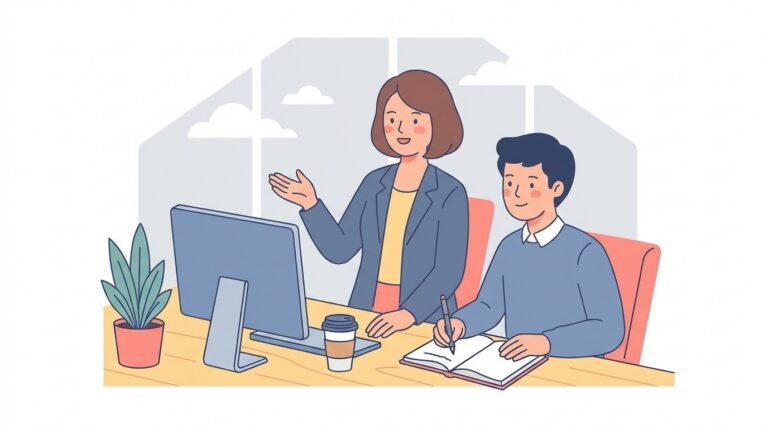
1. The Notebook Shield: Never approach empty-handed. Always carry a notepad and a pen. It signals readiness to learn rather than an attitude of making excuses.
2. Hand Posture: Hold your notebook with both hands resting lightly in front of your lower torso. Avoid crossing your arms, putting your hands into your pockets, or leaning casually against office partition dividers.
3. Eye Contact & Slight Bow: Make respectful eye contact when greeting them, followed by a slight 15-degree head nod. When receiving correction, nod slowly and look down at your notes while jotting down their feedback.
4-2. Cultural Code: The 사수 (Sasu) & 부수 (Busu) Bond
In Korean corporate life, your direct senior mentor is called your 사수 (Sa-su), and you are their 부수 (Bu-su). In dramas like Misaeng or Search: WWW, mentors take full responsibility for mistakes committed by their rookies during onboarding. This is why hiding an error (은폐) is seen as a betrayal: if the mistake snowballs, your sasu gets reprimanded by the department director. On the flip side, running to them early allows them to protect you and guide you.
Phase 5: Real-Life Roleplay Scenario
Setting: The busy marketing floor of a tech firm in Pangyo.
Characters:
* Park Dae-ri (박 대리): Your meticulous yet supportive sasu (mentor).
* Alex (알렉스): You, a passionate international hire in your second week.
- Alex: 대리님, 바쁘신 중에 죄송한데 잠깐 확인 좀 부탁드려도 될까요? (Dae-ri-nim, ba-ppeu-sin jung-e joe-song-han-de jam-kkan hwa-gin jom bu-tak-deu-ryeo-do doel-kka-yo? / Assistant Manager Park, sorry to bother you while you are busy, but could you please check something for a second?)
🎭 [Holding a notebook with both hands, speaking softly] - Park Dae-ri: 네, 알렉스 씨. 무슨 일이에요? (Ne, Al-lek-seu ssi. Mu-seun il-i-e-yo? / Yes, Alex. What is going on?)
🎭 [Turning around from the monitor with a curious glance] - Alex: 오늘 보낸 견적서 수량을 제가 잘못 입력한 것 같습니다. (O-neul bo-naen gyeon-jeok-seo su-ryang-eul je-ga jal-mot im-ryeok-han geot gat-seum-ni-da. / I think I typed the wrong quantity on the quotation sent out today.)
🎭 [Pointing calmly at the highlighted line on the printed draft] - Park Dae-ri: 아, 거래처에 이미 메일 발송했나요? (A, geo-rae-cheo-e i-mi me-il bal-song-haet-na-yo? / Ah, did you already email the client?)
🎭 [Eyes widening slightly, adjusting glasses] - Alex: 네, 발송 직후에 확인했습니다. 어떻게 수정하면 좋을까요? (Ne, bal-song jik-hu-e hwa-gin-haet-seum-ni-da. Eo-tteoh-ge su-jeong-ha-myeon jo-eul-kka-yo? / Yes, I noticed right after sending it. How should we proceed with correcting it?)
🎭 [Pen ready on paper, maintaining an open, attentive expression] - Park Dae-ri: 바로 정정 메일 보내면 괜찮아요. 제가 템플릿 보여줄 테니 보고 수정본 보내세요. (Ba-ro jeong-jeong me-il bo-nae-myeon gwaen-chan-a-yo. Je-ga tem-pleu-lit bo-yeo-jul te-ni bo-go su-jeong-bon bo-nae-se-yo. / It’s okay if we send a correction email right away. I’ll show you the template, so draft the revision based on that.)
🎭 [Relieved nod, pulling up a sample draft on the screen] - Alex: 네, 알려주신 내용 바로 메모해 두고 다음에는 두 번 확인하겠습니다! (Ne, al-lyeo-ju-sin nae-yong ba-ro me-mo-hae du-go da-eum-e-neun du beon hwa-gin-ha-get-seum-ni-da! / Yes, I will note this down immediately and double-check twice next time!)
🎭 [Bowing head politely while writing notes] - Park Dae-ri: 실수는 누구나 해요. 바로 말해줘서 고마워요. (Sil-su-neun nu-gu-na hae-yo. Ba-ro mal-hae-jwo-seo go-ma-wo-yo. / Everyone makes mistakes. Thank you for reporting it right away.)
🎭 [Patting your shoulder with a reassuring smile]
🔀 Interactive Choice Point
What would you do if your mentor was on a 15-minute phone call when you caught your mistake?
- Option A: Silently recall the email and replace the file on your own without telling anyone.
Feedback: [Bad ❌] — Never modify external client documents without team knowledge. If the client already downloaded it, you risk creating a critical dispute. - Option B: Leave a concise Slack/Teams message summarizing the error with the document link, waiting at your desk with your notepad ready.
Feedback: [Best ⭐] — Flawless! This creates a clear written trail immediately without interrupting their call, proving promptness and consideration. - Option C: Wait quietly until the next morning’s team meeting to bring it up in front of the entire division.
Feedback: [Risk ⚠️] — Time-sensitive errors decay rapidly. In Korean business, minor issues reported late become major managerial failures.
Phase 6: 10-Second Emotion Shadowing Drill
Read these sentences aloud, pausing precisely at the slashes / while embodying the given emotion cues!
[🥺 차분하지만 진솔하게 / Calm yet sincere]
선배님, / 바쁘신 중에 죄송한데 / 확인 좀 부탁드려도 될까요?
(Seon-bae-nim, / ba-ppeu-sin jung-e joe-song-han-de / hwa-gin jom bu-tak-deu-ryeo-do doel-kka-yo? / Senior, / sorry while you’re busy, / but could you please check this?)-
[📝 집중하며 책임감 있게 / Focused and accountable]
제가 실수를 한 것 같습니다. / 어떻게 수정하면 좋을까요?
(Je-ga sil-su-reul han geot gat-seum-ni-da. / Eo-tteoh-ge su-jeong-ha-myeon jo-eul-kka-yo? / I think I made a mistake. / How should I correct it?) -
[🫡 씩씩하고 신뢰감 넘치게 / Confident and trustworthy]
알려주신 내용 / 바로 메모해 두고 / 다음에는 꼭 주의하겠습니다!
(Al-lyeo-ju-sin nae-yong / ba-ro me-mo-hae du-go / da-eum-e-neun kkok ju-ui-ha-get-seum-ni-da! / What you taught me / I will note down right away / and will definitely be careful next time!)
Phase 7: K-Culture Mini Dictionary
- 사수 (Sa-su): Senior workplace mentor / The experienced team member assigned directly to mentor and train a new hire.
- 보고 (Bo-go): Official report or notification / The foundational act of updating your superior on task statuses, problems, or completions.
- 업무 노트 (Eop-mu no-teu): Work journal or notebook / A dedicated notebook kept by junior staff to document procedures, institutional rules, and mentor tips.
- 수습 (Su-seup): Resolving or cleaning up an issue / Also refers to a probationary period; in this context, handling the immediate aftermath of a workplace blunder smoothly.
Phase 8: Traveler and Expat Survival Kit
Top 3 Survival Phrases for Navigating Workplace Confusion
- 이 부분 다시 설명해 주실 수 있나요? (I bu-bun da-si seol-myeong-hae ju-sil su it-na-yo?)
Could you explain this part one more time?
Pro Tip: Never pretend to understand. Asking for clarification early is praised as diligence in Korean companies. - 메모하면서 들어도 될까요? (Me-mo-ha-myeon-seo deu-reo-do doel-kka-yo?)
May I take notes while listening to you?
Pro Tip: Asking this shows supreme courtesy and immediately flatters any mentor’s dedication. - 수정 완료했습니다. 확인 부탁드립니다! (Su-jeong wan-ryo-haet-seum-ni-da. Hwa-gin bu-tak-deu-rim-ni-da!)
I have completed the revisions. Please check!
Pro Tip: Always close your tasks by inviting your mentor to take the final look.
Editor’s Office Note
Keep an organized workflow using the Notion 한국어 템플릿 다운로드 to build your own personal onboarding glossary. If commuting between offices or client meetings in Seoul, ensure you have the 네이버 지도 앱 다운로드 installed, as Google Maps does not provide detailed indoor pedestrian navigation inside Korean corporate complexes.
Phase 9: “One Step Deeper” (Reflective Essay)
In Korean corporate philosophy, there is an endearing unspoken truth: 신입사원의 특권 (The rookie’s privilege). During your onboarding period, making mistakes is not only expected—it is considered a natural bridge to competence. However, Korean companies operate on collective responsibility (연대책임). If you try to mask a mistake out of pride, the eventual fallout splashes onto your mentor and team. When you report early and bring your notebook, you signal to your colleagues: “I respect this team enough to be vulnerable, and I am committed to growing.” Humility coupled with active note-taking turns workplace errors into the foundation of genuine camaraderie.
💬 Your Turn: How are errors handled at workplaces or schools in your home country? Is asking for direct help encouraged, or is self-reliance expected first? Share your experiences in the comments below!
Phase 10: FAQ & Common Mistakes
Q: When is the right time to approach my mentor if they look stressed?
A: If an error directly impacts an external client, finance, or executive deadlines, report it immediately regardless of how busy they appear. Preface with: “대리님, 급한 건으로 확인 부탁드릴 게 있습니다” (Assistant Manager, I have an urgent matter requiring your review). For minor internal typos, you can leave a polite instant message.
Q: Is it considered rude to ask the same question twice in Korea?
A: Yes, asking the exact same mechanical question twice can signal inattentiveness. This is precisely why carrying an 업무 노트 (work notebook) is critical. If you must ask again, show your notes first: “이 부분까지 적어두었는데, 다음 단계가 헷갈립니다” (I wrote down up to this part, but I am confused about the next step).
Q: Should I buy coffee for my mentor after they help fix my mistake?
A: While not mandatory, sliding a small coffee or beverage onto their desk with a bright “알려주셔서 감사합니다!” (Thank you for teaching me!) is a heartwarming Korean office tradition that solidifies your relationship.
🚨 Common Mistakes Warning Board
- Mistake: Trying to fix external files secretly without notifying anyone.
Correct Action: Always confess promptly using:제가 실수를 한 것 같습니다. - Mistake: Nodding repeatedly without taking written notes.
Correct Action: Always keep a pen and notepad in hand whenever receiving feedback. - Mistake: Excessively apologizing with bowed head for hours without proposing a fix.
Correct Action: Shift the focus to action quickly by asking:어떻게 수정하면 좋을까요?
Phase 11: Action Mission & Engagement
- Bronze Level: Practice reciting the 3 core phrases aloud 5 times while standing in front of a mirror with a notebook.
- Silver Level: Write a comment below answering the “Your Turn” question using the phrase
메모해 두고 다음에는 주의하겠습니다! - Gold Level: In your real Korean office, study group, or language exchange, use
어떻게 수정하면 좋을까요?the next time you receive feedback on an assignment. - 🎮 K-Culture Mission: Watch Episode 1 or 2 of the workplace drama Misaeng. Spot the moment a rookie holds a notebook while receiving advice, and notice how their body language changes!
Phase 12: Interactive Quiz Challenge
1. Situational Judgment: You discover an error in a presentation deck scheduled for tomorrow morning. Your mentor is typing away. What is the best step?
* (A) Wait until tomorrow morning before the meeting starts.
* (B) Bring your notebook, politely ask for a quick review, and explain the error using 제가 실수를 한 것 같습니다.
* (C) Silently delete the slide.
2. Fill in the Blank: Complete the sentence showing professional resolution:
“알려주신 내용 바로 __________ 두고 다음에는 주의하겠습니다!”
* (A) 버려 (beo-ryeo)
* (B) 숨겨 (sum-gyeo)
* (C) 메모해 (me-mo-hae)
3. True or False: In Korean office etiquette, taking physical notes while receiving correction from a senior mentor is seen as rude and distrustful.
* (A) True
* (B) False
🔍 Click to reveal answers & explanations!
- Answer: (B). Immediate, transparent reporting with your notebook ready is the gold standard of Korean onboarding etiquette.
- Answer: (C).
메모해(from 메모하다, to take notes). The full phrase means: “I will note down what you taught me and be careful next time!” - Answer: (B) False. Writing things down is viewed as the ultimate sign of respect, dedication, and professionalism!
🎬 Watch Our Daily Videos! (Daily Hangul Official Instagram)
Review the expressions you learned in this article with our fun daily short videos! Check out native pronunciation and real-life nuances in action.
- Instagram @dailyhangul_en







