

Phase 1: 공감 (스토리 몰입형 오프닝)
안녕하세요! 매일한글 에디터입니다.
Imagine this: You are enjoying the ultimate spring afternoon in Seoul. Cherry blossom petals are fluttering like pink snow around Seokchon Lake, your favorite K-drama acoustic soundtrack is playing in your earbuds, and your aesthetic street photo looks immaculate. But thirty minutes in, a sudden itch strikes your eyelids. You rub them gently, then furiously. Before you know it, you are tearing up like the lead character in a tragic melodrama finale! Your eyes turn fiery red, swollen, and impossibly gritty.
Springtime in Korea brings breathtaking flowers, but it also ushers in tree pollen and fine yellow dust. Walking into a local medical building with bloodshot eyes and zero clue how to explain allergic conjunctivitis in Korean can feel truly overwhelming. You do not need to suffer in silence or rely purely on awkward pantomime! Based on real clinic feedback from our international students, this step-by-step guide will arm you with straightforward, natural phrases to get quick relief at an eye clinic (안과) or ENT (이비인후과).
Phase 2: 핵심 표현 3선 심층 분석
1. 눈이 너무 가려워요. (Nooni neomu garyeowoyo.)
- Pronunciation: [Noon-ee neo-moo gah-ryeo-wo-yo] (Sounds like the English word “noon” followed by “neo-moo”)
- Meaning: Literal: “Eyes are too itchy.” | Nuance: “My eyes are terribly itchy.”
- K-Culture Moment: Think of a variety show star in Running Man frantically blinking and whining to the camera during an outdoor spring mud challenge.
- Editor’s Insight: In Korean, “너무 (neomu)” technically means “excessively,” but native speakers use it constantly as an emphatic “so” or “really.” Use it to show the doctor your level of discomfort.
- Situation Spectrum: Casual: ✅ | Semi-formal: ✅ | Formal: ✅
- 🤔 Think About It: In English, you might say “I have an itch in my eye,” making yourself the subject. In Korean, the body part (“눈이”) is often the subject causing the sensation. How does shifting the focus to the body part change how symptoms feel?
2. 눈이 빨갛게 충혈됐어요. (Nooni bbalgake chunghyeoldwaesseoyo.)
- Pronunciation: [Noon-ee bpal-gah-keh choong-hyeol-dwae-sseo-yo] (“Chung” rhymes with “rung”, “hyeol” sounds like “hyul”)
- Meaning: Literal: “My eyes became red and congested with blood.” | Nuance: “My eyes are bloodshot red.”
- K-Culture Moment: That iconic scene where a stressed-out startup CEO in an office K-drama looks in the mirror after an all-nighter.
- Editor’s Insight: “충혈 (chunghyeol)” is a Sino-Korean medical term (充血: filling with blood) that everyday Koreans use casually. Saying this immediately tells the doctor you are dealing with irritation or burst capillaries.
- Situation Spectrum: Casual: ⚠️ (sounds a bit clinical with close friends unless describing symptoms) | Semi-formal: ✅ | Formal: ✅
- 🤔 Think About It: Korean vocabulary combines everyday native words like “빨갛게” (redly) with Sino-Korean terms like “충혈” (congestion). Blending descriptive colors with precise physical conditions creates vivid clarity.
3. 알레르기 안약 좀 처방해 주세요. (Allereugi anyak jom cheobanghae juseyo.)
- Pronunciation: [Al-leh-reu-gee ahn-yak jom cheo-bang-hae joo-seh-yo] (“Al-le-reu-gi” matches the German pronunciation of allergy)
- Meaning: Literal: “Please prescribe some allergy eye drops a little.” | Nuance: “Could you please prescribe me some allergy eye drops?”
- K-Culture Moment: A quick clinic scene where a practical character cuts straight to the point to get medicine before running back to work.
- Editor’s Insight: The little word “좀 (jom)” literally means “a little,” but functionally acts as a magical softener. It turns a direct demand into a polite, warm request.
- Situation Spectrum: Casual: 🚫 | Semi-formal: ✅ | Formal: ✅
- 🤔 Think About It: Why do Koreans soften imperative requests with words indicating smallness (“좀”)? It shows humility and avoids burdening the listener.
Phase 3: 교과서 한국어 vs 진짜 한국어
Situation 1: Explaining what caused your eye irritation
- 📖 교과서 한국어: 꽃가루가 눈에 들어가서 염증이 생겼습니다. (Kkotgaruga nune deureogaseo yeomjeungi saenggyeotseumnida. / Pollen entered my eyes and inflammation occurred.)
- 🗣️ 진짜 한국어: 봄철 꽃가루 때문인지 눈이 따갑고 가려워요. (Bomcheol kkotgaru ttaemun-inji nooni ttagapgo garyeowoyo. / Maybe because of spring pollen, my eyes sting and itch.)
- 💡 왜 다를까? Textbook Korean leans heavily on passive Sino-Korean nouns like “염증 (inflammation).” Real natives use vivid sensory verbs like “따갑다 (stinging)” and hedge their guess using “-때문인지 (maybe because of…)” since they are not doctors themselves.
Situation 2: Checking in at the reception desk
- 📖 교과서 한국어: 저는 안과 진료를 받고 싶어서 방문했습니다. (Jeoneun angwa jinryoreul batgo sipeoseo bangmunhaetseumnida. / I visited because I wish to receive ophthalmological medical care.)
- 🗣️ 진짜 한국어: 눈이 너무 충혈돼서 진료받으러 왔어요. (Nooni neomu chunghyeoldwaeseo jinryobadeureo wasseoyo. / My eyes are super bloodshot, so I came in to see a doctor.)
- 💡 왜 다를까? Stating your key symptom right at the front desk (“눈이 충혈돼서”) is much faster and clearer for triage than stating formal administrative goals.
Phase 4: K-Culture 딥다이브 & 비언어적 매너
4-1. 눈치 (Nunchi) & Clinic Gestures
When visiting an eye clinic in Korea, hygiene and body language speak volumes:
* Do not rub your eyes in front of the doctor: Instead of rubbing with your knuckles (which doctors will scold you for), lightly point your index finger toward the outer corner of your eye while keeping your hands clean.
* Two-handed etiquette: Always hand your alien registration card (ARC) or passport, as well as your payment card, with both hands to the clinic receptionist.
* Removing glasses and masks: When seated in the examination chair in front of the slit-lamp microscope, place your chin on the rest and gently lower your mask below your nose only if requested. Doctors appreciate quick compliance.
4-2. Cultural Code: The Double-Edged Sword of Korean Spring
In Korea, spring is celebrated with nationwide anthems like Busker Busker’s Cherry Blossom Ending (벚꽃 엔딩). However, locals also prepare for “봄의 불청객 (uninvited spring guests)”: fine yellow dust (황사) blown across from mainland deserts combined with heavy pine and birch pollen (꽃가루).
Because Korean healthcare emphasizes high accessibility and speed, local neighborhood clinics (동네 의원) are everywhere. Koreans do not wait weeks for specialist appointments; the moment their eyes sting, they walk into a nearby “안과 (Eye Clinic)” or “이비인후과 (ENT Clinic)” on their lunch break. Knowing how to explain symptoms lets you leverage this world-class medical convenience like a true local.
Phase 5: 실전 롤플레이 시나리오
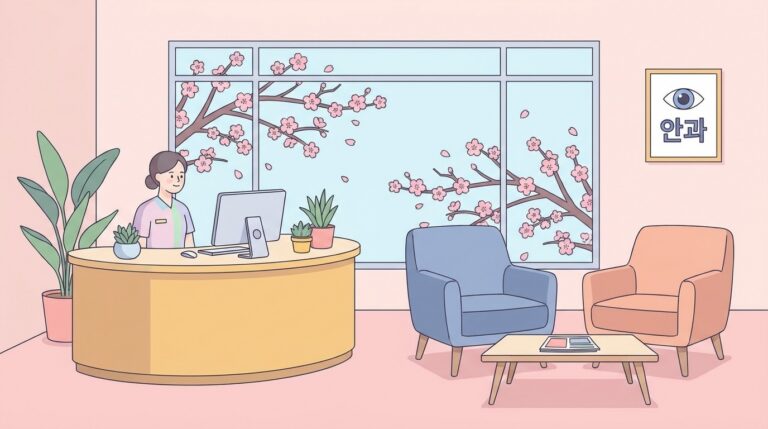
Setting: A clean, brightly lit eye clinic near Hongik University Station. Nurse Min sits at reception, and Dr. Lee is examining patients.
- Nurse Min: 🎭 Smiling behind the desk with clipboard in hand
어떻게 오셨어요?
(Eotteoke osyeosseoyo? / What brings you in today?) -
You: 🎭 Pointing gently near your reddened eyes
눈이 너무 가렵고 빨갛게 충혈돼서 왔어요.
(Nooni neomu garyeopgo bpalgake chunghyeoldwaeseo wasseoyo. / I came because my eyes are super itchy and bloodshot.) -
Nurse Min: 🎭 Typing quickly into the computer
혹시 렌즈 끼셨어요? 알레르기 있으세요?
(Hoksi renjeu kkisyeosseoyo? Allereugi isseuseyo? / Are you wearing contact lenses? Do you have any allergies?) -
You: 🎭 Shaking head gently
렌즈는 안 꼈고, 꽃가루 알레르기가 있는 것 같아요.
(Renjeuneun an kkyeotgo, kkotgaru allereugiga inneun geot gatayo. / I am not wearing contacts, and I think I might have pollen allergies.) -
Dr. Lee: 🎭 Peering through the eye examination microscope in the consultation room
눈 안쪽이 많이 부었네요. 비염 증상도 같이 있으세요?
(Noon anjjogi mani bueotneyo. Biyeom jeungsangdo gachi isseuseyo? / The inside of your eyes is quite swollen. Do you have rhinitis symptoms too?) -
You: 🎭 Sniffling slightly
네, 재채기도 나고 콧물도 조금 나와요.
(Ne, jaechaegido nago konmuldo jogeum nawayo. / Yes, I am sneezing and have a slight runny nose too.) -
Dr. Lee: 🎭 Writing prescription on digital screen
알레르기 결막염입니다. 안약 넣으시고 비비지 마세요.
(Allereugi gyeolmagyeom-imnida. Anyak neoeusigo bibiji maseyo. / It is allergic conjunctivitis. Use the eye drops and do not rub your eyes.) -
You: 🎭 Bowing slightly with gratitude
네, 감사합니다! 처방전은 밖에서 받나요?
(Ne, gamsahamnida! Cheobangjeoneun bakkeseo bannayo? / Understood, thank you! Do I receive the prescription outside?)
🔀 인터랙티브 분기점 (What would you say next?)
If the doctor asks: “혹시 복용 중인 다른 약이 있으세요? (Are you currently taking any other medication?)”
- Option A: “아니요, 없어요. 처방약만 주세요.” (No, I don’t. Just give me the prescription medication.)
- Feedback (Best): Clear, polite, and direct! It allows the doctor to prescribe antihistamines without drug-interaction worries.
- Option B: “왜요? 상관없잖아요.” (Why? That has nothing to do with this.)
- Feedback (Bad): Very rude! In Korean medical culture, doctors ask about medications to prevent harmful interactions. Tone matters.
- Option C: “비밀이에요.” (It is a secret.)
- Feedback (Risk): Confusing and unsafe. Medical staff take history seriously, and joke responses can cause delay or incorrect prescribing.
Phase 6: 10초 감정 섀도잉 드릴
Follow the rhythm markers (/) and embody the emotion tag!
[🥺 눈이 따갑고 불편해서 하소연하듯]
선생님, / 봄철 꽃가루 때문인지 / 눈이 너무 가려워요.
(Seonsaengnim, / bomcheol kkotgaru ttaemun-inji / nooni neomu garyeowoyo. / Doctor, maybe because of spring pollen, my eyes are so itchy.)-
[😣 거울을 보고 깜짝 놀란 감정으로]
자고 일어났는데 / 눈이 빨갛게 / 충혈됐어요.
(Jago ireonanneunde / nooni bbalgake / chunghyeoldwaesseoyo. / I woke up and my eyes were completely bloodshot.) -
[🙏 간절하고 공손하게]
눈이 너무 따가우니까 / 안약 좀 / 처방해 주세요.
(Nooni neomu ttagaucconikka / anyak jom / cheobanghae juseyo. / Since my eyes sting so badly, please prescribe me some eye drops.)
Phase 7: K-Culture 미니 사전 (핵심 키워드 4개)
- 안과 (An-gwa) | Ophthalmology / Eye Clinic
- Essential word for locating neighborhood eye doctors on street signs or maps.
- 충혈 (Chung-hyeol) | Bloodshot eyes / Hyperemia
- Key medical symptom word used when your eyes turn bright red from fatigue, allergies, or irritation.
- 꽃가루 알레르기 (Kkot-ga-ru al-le-reu-gi) | Pollen allergy
- A composite term: “꽃가루” (flower dust = pollen) + “알레르기” (allergy). Your ultimate spring defense word.
- 처방전 (Cheo-bang-jeon) | Medical prescription paper
- Korean clinics do not dispense eye drops directly. Take your 처방전 to any “약국 (Pharmacy)” located on the ground floor of the clinic building.
Phase 8: 여행자를 위한 생존 키트
서바이벌 표현 TOP 3
- 눈 비비면 안 돼요? (Noon bibimyeon an dwaeyo?)
- Pronunciation: [Noon bee-bee-myeon ahn dwae-yo?]
- Pro Tip: Ask this to confirm if touching or rubbing will worsen the infection.
- 렌즈는 며칠 동안 못 껴요? (Renjeuneun myeochil dong-an mot kyeoyo?)
- Pronunciation: [Ren-jeu-neun myeo-chil dong-ahn mot kyeo-yo?]
- Pro Tip: Essential if you wear contacts. Eye drops often stain or react with soft lenses.
- 약국이 어디에 있어요? (Yakgugi eodie isseoyo?)
- Pronunciation: [Yak-gook-ee eo-dee-eh ee-sseo-yo?]
- Pro Tip: Almost 99% of clinics have a dedicated pharmacy on the 1st floor of the exact same building.
Editor’s Travel Note
- Finding Clinics Instantly: Do not use Google Maps in Korea—it lacks up-to-date local clinic details. Instead, use 네이버 지도 앱 다운로드 and search “안과” (eye clinic) or “이비인후과” (ENT). Look for ones marked “진료 중” (Currently Open).
- Insurance & Walk-in System: Most neighborhood clinics take walk-ins without an appointment. If you don’t have Korean National Health Insurance (NHIS), you can pay out-of-pocket (usually 25,000–40,000 KRW for a consultation plus prescription) with any credit card. Ask reception for a “진료비 영수증 (Medical bill receipt)” for overseas travel insurance reimbursement.
Phase 9: “한 발 더 깊이” (생각 질문)
In many Western countries, seeing a specialist eye doctor requires a referral from a primary care physician and weeks of waiting. In Korea, anyone can walk directly into a specialist’s office on the 4th floor of a subway station commercial building and see a board-certified ophthalmologist in twenty minutes. This hyper-efficient medical culture values prompt problem-solving and immediate relief. However, because consultations move at breakneck speed, communicating your core symptoms clearly within the first sixty seconds is critical.
💬 Your Turn: Have you ever experienced pollen allergies while traveling abroad? How does medical access in your home country compare to Korea’s quick walk-in specialist culture? Share your thoughts below!
Phase 10: FAQ & 오해 방지 (FAQ Schema)
Q: Can I visit an ENT (이비인후과) if my main problem is itchy eyes?
A: Yes! In Korea, spring pollen often triggers both allergic conjunctivitis (eyes) and allergic rhinitis (sneezing/nose). An ENT doctor can examine both your nose and prescribe anti-allergy eye drops simultaneously.
Q: Do I need an appointment before going to an eye clinic in Seoul?
A: Generally, no. Most local neighborhood clinics operate on a first-come, first-served walk-in basis. Just walk in, show your identification (passport or alien registration card) at the counter, and wait for your name to be called.
Q: Can I buy allergy eye drops over the counter at a Korean pharmacy without seeing a doctor?
A: Yes, basic lubricating eye drops (인공눈물) and mild antihistamine drops are sold over the counter at pharmacies (약국). However, prescription drops from an eye doctor are significantly more potent and tailored to severe inflammation.
🚨 흔한 실수 (Common Mistakes) 경고판
- Mistake 1: Saying “눈이 아파요” only.
- Why: “아프다” just means “painful/hurts.” It doesn’t tell the doctor if it’s itching, burning, dry, or infected.
- Correct Action: Specify: “가려워요 (itchy)” or “따가워요 (stinging).”
- Mistake 2: Asking the doctor for medicine in the consultation room.
- Why: Doctors in Korea do not sell or hand you medicines. They issue a paper prescription (처방전).
- Correct Action: Take the prescription slip from the front reception desk after paying, then hand it to a nearby pharmacy (약국).
- Mistake 3: Putting in medicated eye drops while wearing colored contact lenses.
- Why: Preservatives in prescription drops can bind to contact lenses and damage your cornea.
- Correct Action: Switch to glasses until the doctor confirms your allergy has cleared up.
Phase 11: 액션 미션 & 참여 유도
- 🥉 Bronze Mission (Solo Practice): Stand in front of your mirror and practice saying: “선생님, 눈이 너무 가려워요!” (Doctor, my eyes are so itchy!) three times with feeling.
- 🥈 Silver Mission (SNS & Community): Post a photo of your springtime Korea view or your daily outfit on Instagram, tagging your caption with the sentence: “봄철 꽃가루 조심하세요! (Watch out for spring pollen!).”
- 🥇 Gold Mission (Real Life Execution): Next time you pass a Korean pharmacy (약국), walk in and ask: “알레르기 안약 있어요? (Do you have allergy eye drops?)” and acquire artificial tears.
- 🎮 K-Culture Mission: Watch any spring episode of a medical drama like Hospital Playlist (슬기로운 의사생활) and spot how patients explain their symptoms at registration.
Phase 12: 인터랙티브 퀴즈 챌린지
Q1. [Situational Judgment] You wake up in Seoul with red, irritated eyes from flower pollen. What is the most natural sentence to tell the clinic receptionist?
* A) 눈에 벌레가 살고 있어요. (Insects are living in my eyes.)
* B) 꽃가루 때문에 눈이 너무 가렵고 충혈됐어요. (Because of pollen, my eyes are super itchy and bloodshot.)
* C) 눈을 수술하고 싶습니다. (I would like to have eye surgery.)
Q2. [Fill in the Blank] Complete the request for eye drops:
알레르기 안약 좀 ______해 주세요. (Please prescribe some allergy eye drops.)
Q3. [True / False] In Korea, you must always schedule an appointment weeks in advance to visit a local eye clinic.
* True / False
👉 Click to reveal answers & explanations!
- Q1 Answer: B) 꽃가루 때문에 눈이 너무 가렵고 충혈됐어요. Perfectly describes both the suspected cause (꽃가루) and symptoms (가렵다 + 충혈되다).
- Q2 Answer: 처방 (Cheo-bang) -> 처방해 주세요 means “Please prescribe.”
- Q3 Answer: False! Most neighborhood clinics (안과/이비인후과) in Korea gladly accept walk-in patients during standard clinic hours.
🎬 Watch Our Daily Videos! (Daily Hangul Official Instagram)
Review the expressions you learned in this article with our fun daily short videos! Check out native pronunciation and real-life nuances in action.
- Instagram @dailyhangul_en







