

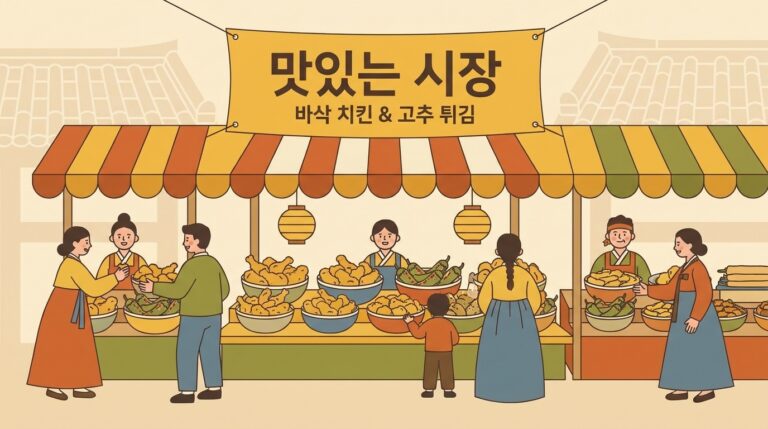
Conquering Mangwon Market: Crispy Chicken & Stuffed Peppers Like a Local
Phase 1: Empathy & Story Opening
안녕하세요! I am your editor and trusted cultural navigator from Daily Hangul. Picture this: you are walking through the buzzing covered alleyways of Mangwon Market (망원시장). The irresistible aroma of sizzling fried food fills the cool Seoul breeze. Suddenly, you find yourself in front of a bustling food stall with a mountain of giant, golden-brown stuffed peppers (고추튀김) and tubs of glossy sweet-and-sour chicken (닭강정). The market auntie looks up with her metal tongs and asks, “뭐 드릴까요? (What can I get you?)” Your mind goes completely blank. Do you ask for a box or a cup? Can you get half spicy and half sweet? Over the past ten years of coaching Korean learners, I have watched so many eager travelers freeze up at street stalls and settle for whatever points easiest. But don’t worry! Today’s guide will transform you from a hesitant tourist into a confident market foodie who orders custom flavors like a true Seoulite.
Phase 2: Top 3 Core Expressions Deep Dive
1. 고추튀김 하나 주세요 (Gochutwigim hana juseyo)
- Pronunciation: [Go-chu-twi-gim ha-na ju-se-yo] (Think Go-chew-twee-geem, rhyme twi with ‘tweet’ and gim with ‘kimono’ starter)
- Meaning: Literal: “Chili pepper fry one give please.” | Real Nuance: “Could I get one stuffed fried chili pepper, please?”
- K-Culture Moment: Seen on weekend food shows like Amazing Saturday where idols gasp when cutting open a giant green chili packed with juicy minced pork and tofu.
- Editor’s Insight: These peppers look fiery red-hot, but they are mild, crunchy o-i-gochu (cucumber chili) stuffed with savory filling. When ordering, use counter words like 하나 (hana – one) or 두 개 (du gae – two items).
- Situation Spectrum: Casual: ⚠️ (too blunt to elders) | Semi-formal: ✅ (perfect for stall aunties) | Formal: 🚫 (too stiff for street markets)
- 🤔 Think About It: In English, you specify the verb first (“Give me”), but Korean places the delicious food right upfront. Why do you think Korean spotlights the desired object before the request?
2. 닭강정 작은 상자 매운맛으로 주세요 (Dakgangjeong jageun sangja maeunmaseuro juseyo)
- Pronunciation: [Dak-gang-jeong ja-geun sang-ja mae-un-ma-seu-ro ju-se-yo] (Dak rhymes with ‘rock’; sangja sounds like ‘song-jah’)
- Meaning: Literal: “Sweet crispy chicken small box spicy flavor with please.” | Real Nuance: “I’d like a small box of the spicy sweet crispy chicken, please.”
- K-Culture Moment: The iconic snack bought in paper cups or pink takeaway boxes by college students strolling toward the nearby Han River park.
- Editor’s Insight: At Mangwon Market, stalls usually offer three sizes: 컵 (keop – cup), 작은 상자 (jageun sangja – small box), and 큰 상자 (keun sangja – large box). The particle 으로 (-euro) simply marks your flavor selection!
- Situation Spectrum: Casual: ⚠️ | Semi-formal: ✅ | Formal: 🚫
- 🤔 Think About It: Korean separates fried chicken (chikin) from dakgangjeong. Why does Korean food culture create distinct names based on the sauce coating technique?
3. 반반 섞어서 포장해 주세요 (Banban seokkeoseo pojanghae juseyo)
- Pronunciation: [Ban-ban seok-keo-seo po-jang-hae ju-se-yo] (Ban sounds like ‘barn’ without the ‘r’; pojang sounds like ‘poh-jong’)
- Meaning: Literal: “Half-half mix and wrap give please.” | Real Nuance: “Please mix two flavors half-and-half, to go!”
- K-Culture Moment: The holy grail phrase in Korean food delivery culture, immortalized by the eternal dilemma: sweet garlic or cheese snow?
- Editor’s Insight: Banban (half-and-half) is an indispensable magic word. Even if a menu doesn’t advertise combo flavors, polite market vendors will happily split a medium or large box between two glazes if you ask with a warm smile.
- Situation Spectrum: Casual: ⚠️ | Semi-formal: ✅ | Formal: 🚫
- 🤔 Think About It: How does the linguistic convenience of banban reflect modern Korea’s value on speed, efficiency, and resolving culinary indecision?
Phase 3: Textbook Korean vs. Real Korean
Situation 1: Asking if the food is very spicy
- 📖 Textbook Korean: 이것은 대단히 매운 음식입니까? (Igeoseun daedanhi maeun eumsigimnikka? – “Is this an exceptionally spicy food item?”)
- 🗣️ Real Korean: 이거 많이 매워요? (Igeo mani maewoyo? – “Is this one really spicy?”)
- 💡 Why is it different? Real market conversations drop heavy honorific suffixes like -imnikka and overly literary adverbs like daedanhi. Simple conversational endings sound far more friendly and approachable.
Situation 2: Stating that you want to take it out
- 📖 Textbook Korean: 그것을 테이크아웃용으로 포장해 주시겠습니까? (Geugeoseul teikeu-a-un-yong-euro pojanghae jusigesseumnikka? – “Would you be kind enough to package that for takeout use?”)
- 🗣️ Real Korean: 들고 가면서 먹을게요! / 포장해 갈게요! (Deulgo gamyeonseo meogeulgeyo! / Pojanghae galgeyo! – “I’ll eat it while walking! / I’ll take it to go!”)
- 💡 Why is it different? Koreans announce their immediate eating intentions directly. Telling the auntie whether you are eating right away changes whether she hands you long wooden skewers or tape-seals the bag.
Phase 4: K-Culture Deep Dive & Non-Verbal Manners
4-1. Nunchi & Street Gestures
Traditional markets are lively, energetic, and crowded. Showing nunchi (quick social situational awareness) means:
* Number Fingers: When saying 하나 (hana – one), don’t hold up your index finger sideways; show your thumb or upright index clearly above the glass sneeze guard so the vendor can see through the steam.
* Two-Handed Card Handoff: Even at casual outdoor stalls, always hand over your credit card or cash with both hands (or your right hand supported by your left wrist). It demonstrates respect to older shop owners.
* The Skewer Step-Aside: Once handed your cup, step two paces to the side immediately. This lets the next customer step up while you dip your chicken into extra sauce.
4-2. Cultural Code: Mangwon’s MZ Market Revolution
While traditional markets in many global cities struggle, Mangwon Market became Seoul’s trendiest weekend destination for young people in their 20s and 30s. Nestled right next to Mangnidan-gil’s boutique cafes, this market retained its authentic communal spirit while pioneering innovative fusion street foods—like marshmallow ice cream, fiery stuffed chili peppers, and sweet fruit-glazed dakgangjeong. It embodies the concept of Gaseongbi (가성비 – high price-to-quality ratio) loved by Korean youth.
Phase 5: Real-Life Roleplay Scenario
Setting: A vibrant red stall at Mangwon Market named Mangwon Wonjo Dakgangjeong. Trays of golden fried chicken are tossed in glistening sweet-spicy chili glaze.
Characters:
* You: A hungry traveler craving hot street bites.
* Imo (이모): A cheery market auntie sporting a floral visor and stainless steel tongs.
- Imo: 학생, 뭐 줄까? 닭강정 맛있어! (Haksaeng, mwo julkka? Dakgangjeong masisseo!)
[🎭 Calling you ‘student’ with a welcoming grin, waving her tongs toward the warm trays]
“What can I get you, student? The crispy chicken is delicious!” -
You: 안녕하세요! 고추튀김도 여기서 팔아요? (Annyeonghaseyo! Gochutwigimdo yeogiseo parayo?)
[🎭 Smiling politely, pointing toward the large fried peppers in the glass case]
“Hello! Do you sell stuffed fried peppers here too?” -
Imo: 그럼! 방금 튀겨서 아주 바삭해. (Geureom! Banggeum twigyeoseo aju basakhae.)
[🎭 Nodding enthusiastically as steam rises from a fresh batch]
“Of course! We just fried them, so they are super crispy.” -
You: 고추튀김 하나랑 닭강정 작은 상자 주세요. (Gochutwigim hanarang dakgangjeong jageun sangja juseyo.)
[🎭 Holding up one finger, looking at the colorful flavor board]
“One fried chili pepper and a small box of sweet crispy chicken, please.” -
Imo: 닭강정은 무슨 맛으로 해 줄까? 달콤한 맛? 매운맛? (Dakgangjeongeun museun maseuro hae julkka? Dalkomhan mat? Maeunmat?)
[🎭 Ready with an open paper box and ladle in hand]
“Which flavor for the chicken? Sweet flavor? Or spicy flavor?” -
You: 반반 섞어서 포장해 주세요. (Banban seokkeoseo pojanghae juseyo.)
[🎭 Speaking clearly with polite eye contact]
“Please mix them half-and-half to go.” -
Imo: 그래, 반반! 소스 듬뿍 넣어줄게. 오천 원이야. (Geurae, banban! Soseu deumpuk neoeojulge. Ocheon woniya.)
[🎭 Drizzling rich glaze generously and packing skewers into the bag]
“Alright, half-and-half! I’ll put plenty of sauce. That’s 5,000 won.” -
You: 감사합니다, 사장님! 맛있게 먹을게요. (Gamsahamnida, sajangnim! Masitge meogeulgeyo.)
[🎭 Handing the card with both hands and bowing your head slightly]
“Thank you, boss! I will enjoy eating it.”
🔀 Interactive Decision Point
The auntie hands you the steaming box and asks: “바로 먹을 거야? (Are you eating it right now?)”
* Choice A: “네, 꼬치 두 개 주세요!” (Ne, kkochi du gae juseyo! – “Yes, please give me two skewers!”)
* Outcome (Best): Perfect! She hands you two long wooden skewers and leaves the bag unsealed so the steam won’t make your food soggy.
* Choice B: “아니요, 먹지 마세요.” (Aniyo, meokji maseyo. – “No, please do not eat it.”)
* Outcome (Bad): Awkward! You accidentally ordered her not to eat your food! Say “아니요, 나중에 먹을게요” (No, I will eat it later).
* Choice C: “그냥 포장만 해 주세요.” (Geunyang pojangman hae juseyo. – “Just pack it up.”)
* Outcome (Risk): Understandable, but sounds slightly cold and abrupt for a warm market atmosphere. Add a soft ~yo smile!
Phase 6: 10-Second Emotion Shadowing Drill
Practice speaking with natural Korean rhythm! Pause briefly at each slash /.
[🤤 Craving & curious]
고추튀김 하나랑 / 닭강정 작은 상자 / 주세요!
(Gochutwigim hanarang / dakgangjeong jageun sangja / juseyo!)-
[😊 Excited & upbeat]
달콤한 맛이랑 매운맛 / 반반 섞어 주세요!
(Dalkomhan masirang maeunmat / banban seokkeo juseyo!) -
[🙏 Polite & grateful]
정말 맛있어 보여요! / 많이 파세요, 사장님!
(Jeongmal masisseo boyeoyo! / Mani paseyo, sajangnim!)
Phase 7: K-Culture Mini Dictionary
- 닭강정 (Dakgangjeong): Deep-fried bite-sized chicken glazed in a sticky, sweet syrup-based sauce. Unlike regular fried chicken, it stays crunchy even after cooling down.
- 고추튀김 (Gochutwigim): Large mild green chili peppers stuffed generously with minced pork, glass noodles (dangmyeon), and tofu, dipped in batter and deep-fried twice.
- 반반 (Banban): Meaning “half-and-half.” Originating from pizza and chicken orders, this word can be used at street stalls, cafe drinks, or noodle dishes (jjamjjamyon).
- 사장님 (Sajangnim): Literally “company president/boss.” In daily life, it is the most polite, respectful, and flattering title to address any shopkeeper or restaurant owner.
Phase 8: Traveler’s Survival Kit
Survival Phrases TOP 3
- 덜 맵게 해 주세요 (Deol maepge hae juseyo): “Please make it less spicy.” (Pro Tip: Crucial for sensitive tastebuds when ordering red glaze!)
- 현금 영수증 필요 없어요 (Hyeongeum yeongsujeung piryo eopseoyo): “I don’t need a cash receipt.” (Pro Tip: Speeds up quick cash transactions at market stalls).
- 꼬치 하나 더 주실 수 있나요? (Kkochi hana deo jusil su innayo?): “Could I have one more wooden skewer?” (Pro Tip: Handy when sharing a single cup with a travel buddy).
Editor’s Travel Note
- Navigation: Google Maps often lags with Korean pedestrian paths. Be sure to check the Naver Map app download for route navigation before navigating through Mangwon’s alleys.
- Payments: Almost all Mangwon stalls now accept overseas Visa and Mastercard credit cards, but carrying 10,000 KRW in crisp cash is courteous for single skewers under 2,000 KRW.
- Waste Etiquette: Do not toss wooden skewers into general trash bins with chicken grease dripping. Return empty paper cups and skewers directly to the stall bin where you purchased them.
Phase 9: “One Step Deeper” (Reflective Essay)
In Korean traditional markets, transactions are rarely just financial exchanges; they are anchored in Jeong (정)—a deep sense of communal warmth and unspoken bonding. When an elderly market vendor calls you haksaeng (student) or ttal (daughter) and drops an extra fried dumpling into your paper bag as Service (서비스 – free treat), they are sharing affection. In a fast-paced digital world of automated kiosk screens, buying food at Mangwon Market invites you into an authentic, human-to-human cultural exchange where language becomes the bridge.
💬 Your Turn: Which street food flavor combination do you crave most: sweet honey garlic or fiery chili pepper? Share your dream market snack combo in the comments below!
Phase 10: FAQ & Common Mistakes
Q: Can I sit down and eat street food right at Mangwon Market?
A: Most smaller stalls are grab-and-go only, but Mangwon Market features designated rest areas like the Mangwon Cafe in the center basement where visitors can enjoy outside market foods as long as they purchase a beverage!
Q: Are the stuffed peppers (고추튀김) extremely hot and spicy?
A: No! They are prepared using large Korean green chili peppers called o-i gochu (cucumber peppers) or mild put-gochu. They prioritize crunchy texture and juicy savory meat filling over tongue-burning heat.
Q: How do I address the stall owner politely?
A: Call male or female owners Sajangnim (사장님 – boss). If the vendor is an affectionate middle-aged woman, calling her Imo (이모 – auntie) creates an instant friendly connection.
🚨 Common Mistakes Alert
- Mistake: Using “저기요! (Jeogiyo!)” aggressively at close distance.
Correct Action: Since you are standing just two feet across the counter, a soft “사장님~ (Sajangnim~)” with a slight head nod is far more natural. - Mistake: Assuming all chicken sizes come in a cup.
Correct Action: Cups (컵) are usually only for single snackers. If sharing with a friend, ask for “작은 상자” (small box). - Mistake: Saying “가지고 갈게요” mechanically like an automated translation.
Correct Action: Use “포장해 주세요” (Please pack it up) or “들고 갈게요” (I’ll take it with me).
Phase 11: Action Mission & Engagement
- 🥉 Bronze Mission: Stand in front of your mirror and practice saying: “반반 섞어서 포장해 주세요” three times smoothly without pausing.
- 🥈 Silver Mission: Save a photo of Mangwon Market food on Instagram or TikTok and leave a Korean comment practicing: “고추튀김 정말 먹고 싶어요!” (I really want to eat stuffed peppers!).
- 🥇 Gold Mission: Visit a local Korean supermarket, deli, or K-town snack vendor, order an item, and address the owner warmly as Sajangnim.
- 🎮 K-Culture Mission: Watch the classic Mangwon Market tour episode of variety show I Live Alone (나 혼자 산다) and spot how many times people use the word “바삭바삭” (crunchy-crispy)!
Phase 12: Interactive Quiz Challenge
1. Situation Challenge:
You want to order one small box containing both sweet sauce and spicy sauce chicken to eat at your hotel. What should you say?
* A) 닭강정 매운맛 하나 주세요. (Dakgangjeong maeunmat hana juseyo.)
* B) 닭강정 작은 상자 달콤한 맛, 매운맛 반반 포장해 주세요. (Dakgangjeong jageun sangja dalkomhan mat, maeunmat banban pojanghae juseyo.)
* C) 닭강정 큰 상자 여기서 먹고 갈게요. (Dakgangjeong keun sangja yeogiseo meokgo galgeyo.)
2. Fill-in-the-Blank:
고추 속에 고기를 채운 튀김은 “______튀김”이라고 불러요.
(The deep-fried snack made of chili pepper stuffed with meat is called “______-twigim.”)
3. True or False:
In Korea, calling a market vendor “사장님 (Sajangnim)” is considered rude because they do not run a Fortune 500 company. (True / False)
👉 Click here to reveal the answers and explanations!
- Answer: B
Explanation: Option B specifies the size (작은 상자), the two flavors (달콤한 맛, 매운맛), the half-and-half request (반반), and the to-go instruction (포장). - Answer: 고추 (Gochu)
Explanation: Gochu means chili pepper. Combined with twigim (fried food), it becomes Gochutwigim. - Answer: False
Explanation: Sajangnim is the highest respect term for independent business owners in Korea. Stalls owners love hearing it!
🎬 Watch Our Daily Videos! (Daily Hangul Official Instagram)
Review the expressions you learned in this article with our fun daily short videos! Check out native pronunciation and real-life nuances in action.
- Instagram @dailyhangul_en







