

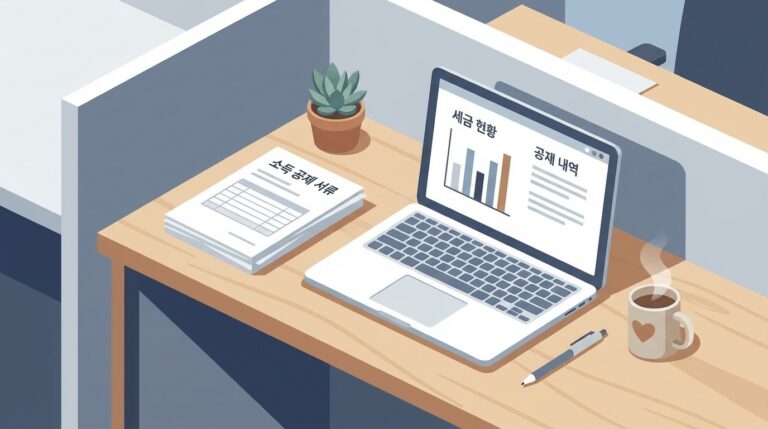
Phase 1: 공감 (Story-Driven Opening)
안녕하세요! 매일한글 에디터입니다. Have you ever stepped into a Korean office during late January or early February? If you have, you might have noticed a strangely intense atmosphere around the pantry. Half of your colleagues are cheering about getting a “13th-month salary” (13월의 월급), while the other half are clutching the backs of their necks in utter disbelief, groaning that they have to “vomit up money” (돈을 토해 내야 돼).
If you are living and working in South Korea, navigating the National Tax Service (국세청) Hometax year-end settlement (연말정산) is an inevitable rite of passage. Many expats anticipate a sweet bonus refund, only to open their tax report and discover an unpleasant surprise: because of low registered deductions, they owe a hefty extra payment! In this guide, built directly on real questions from expat learners and local corporate survival tips, you will learn the exact phrases Koreans use to talk about tax settlements, how to express financial shock naturally, and how to avoid cultural blunders when discussing paychecks with coworkers.
Phase 2: 핵심 표현 3선 심층 분석
1. 세금을 토해 내다 (Se-geum-eul to-hae nae-da)
- Pronunciation: [Se-geum-eul to-hae nae-da] (Sounds like “say-geum-eul toh-heh neh-dah”, where ‘to’ is short like ‘toll’ without the ll)
- Meaning: Literal: “To vomit/throw up taxes” ➔ Nuance: To have to pay back taxes or pay an unexpected additional tax bill instead of getting a refund.
- K-Culture Moment: Seen frequently in office comedy K-Dramas like Good Manager (Chief Kim) or Misaeng. An exhausted employee checks their banking app after year-end settlement and screams at their computer screen: “내가 왜 세금을 토해 내야 해?!” (Why do I have to cough up extra taxes?!).
- Editor’s Insight: The verb
토해 내다is visceral. Just like vomiting is involuntary and painful, paying money back to the tax bureau feels like forcibly giving up what you thought was rightfully yours. Use it to share dramatic financial despair with close peers. - Situation Spectrum:
- Casual (with friends/coworkers over coffee): ✅
- Semi-formal (in team banter): ⚠️
- Formal (official HR meetings/presentations): 🚫 (Use
추가 납부하다instead)
- 🤔 Think About It: In English, we might say “I got hit with an unexpected tax bill” or “I had to cough up money.” Why do you think Korean uses such a bodily, visceral verb like “vomiting” for financial loss?
2. 공제 항목 (Gong-je hang-mok)
- Pronunciation: [Gong-je hang-mok] (Sounds like “gong-jeh hahng-mohk”)
- Meaning: Literal: “Deduction items” ➔ Nuance: Tax deduction categories such as credit card usage, medical expenses, rent, or pension payments.
- K-Culture Moment: Every January, Korean lifestyle YouTubers post videos titled: “놓치면 후회하는 연말정산 공제 항목 총정리!” (Summary of year-end tax deduction items you’ll regret missing!).
- Editor’s Insight:
공제means subtraction or deduction. If your공제 항목are few, your taxable income remains high. When speaking with HR or tax accountants, this is the exact professional phrase you need. - Situation Spectrum:
- Casual: ✅
- Semi-formal: ✅
- Formal: ✅
- 🤔 Think About It: How does your home country categorize deductible expenses compared to Korea, where daily transit and debit card purchases are tracked for deductions?
3. 추가 납부 (Chu-ga nap-bu)
- Pronunciation: [Chu-ga nap-bu] (Sounds like “choo-gah nahp-boo”)
- Meaning: Literal: “Additional payment” ➔ Nuance: The official, formal term for having an outstanding tax balance to pay.
- K-Culture Moment: The dreaded corporate email sent by the finance department in mid-February with the subject line: “[안내] 연말정산 결과에 따른 추가 납부액 공제 안내” (Notice of additional tax deductions from February payroll).
- Editor’s Insight: While
토해 내다is colorful and slangy,추가 납부is the neutral phrase you will see printed on your Hometax receipt and hear from HR representatives. - Situation Spectrum:
- Casual: ⚠️ (Sounds too textbook-ish)
- Semi-formal: ✅
- Formal: ✅
- 🤔 Think About It: Notice the Sino-Korean root
납(納), which relates to paying or offering dues to authorities (e.g., 세금 납부, 납기일).
Phase 3: 교과서 한국어 vs 진짜 한국어
Situation 1: Explaining you owe extra taxes this month
- 📖 교과서 한국어: “저는 이번에 공제가 적어서 세금을 추가로 납부해야 합니다.” (Jeo-neun i-beon-e gong-je-ga jeok-eo-seo se-geum-eul chu-ga-ro nap-bu-hae-ya ham-ni-da. / “Because my deductions are small, I must make an additional tax payment.”)
- 🗣️ 진짜 한국어: “저 이번에 공제받은 게 별로 없어서 완전 토해 내게 생겼어요.” (Jeo i-beon-e gong-je-ba-deun ge byeol-lo eop-seo-seo wan-jeon to-hae nae-ge saeng-gyeot-eo-yo. / “I barely got any deductions this time, so I’m about to totally vomit cash.”)
- 💡 왜 다를까? In actual Korean workplaces, coworkers rarely speak like automated tax manuals. Using expressions like
완전 ~게 생겼어요(I’m totally on the verge of…) adds natural emotion and vulnerability.
Situation 2: Asking a coworker if they are getting a refund or owing money
- 📖 교과서 한국어: “연말정산 결과가 환급입니까, 아니면 징수입니까?” (Yeon-mal-jeong-san gyeol-gwa-ga hwan-geub-im-ni-kka, a-ni-myeon jing-su-im-ni-kka? / “Is your settlement result a refund or a collection?”)
- 🗣️ 진짜 한국어: “이번에 환급받으세요, 아니면 뱉어내세요?” (I-beon-e hwan-geub-ba-deu-se-yo, a-ni-myeon baet-eo-nae-se-yo? / “Are you getting a refund this time, or spitting money back out?”)
- 💡 왜 다를까?
뱉어내다(to spit out) is another vivid peer slang alongside토해내다. It conveys the exact same mutual solidarity around tax season dread.
Phase 4: K-Culture 딥다이브 & 비언어적 매너
4-1. 눈치 (Nunchi) & Office Body Language
In Korean corporate settings, discussing exact monetary figures is taboo, but discussing whether you “gained” or “lost” during 연말정산 is standard small talk. However, high-level Nunchi (social sensing) is mandatory:
* The “Back of the Neck Clutch” (뒷목 잡기): If a coworker walks out of the HR office sighing while placing a hand behind their neck or leaning heavily against the counter, do not boast about your 1,000,000 KRW refund!
* The Shared Sigh (공감의 한숨): If you discover you have to pay additional tax, letting out a soft sigh and saying, “아… 또 토해 내네요…” (Ah, coughing it up again…) invites immediate comfort and shared snacks from colleagues.
4-2. 문화 코드 분석: 13월의 월급 vs 13월의 세금 폭탄
Koreans affectionately call the tax refund “13월의 월급” (The 13th month’s salary). When Hometax opens on January 15th, server queues surge into the tens of thousands. However, if your spending was primarily via unregistered foreign credit cards, cash without phone receipts (현금영수증), or if you lack dependents, the system recalculates your base tax upwards. This reverse phenomenon is dramatically dubbed “13월의 세금 폭탄” (The 13th month tax bomb). Korean office workers bond through shared misfortune; acknowledging this shared financial pain is one of the fastest ways to turn polite coworkers into genuine friends.
Phase 5: 실전 롤플레이 시나리오
Setting: The 7th-floor office breakroom of a tech startup in Pangyo. It is late January, right after lunch. Minho is stirring a stick of Maxim mocha coffee, and Alex looks distressed staring at his mobile phone screen.
- Turn 1 (Minho):
알렉스 씨, 왜 그래요? 어디 아파요? 얼굴이 하얗게 질렸어요.
(Alex-ssi, wae geu-rae-yo? Eo-di a-pa-yo? Eol-gul-i ha-yah-ge jil-lyeot-eo-yo.)
“Alex, what’s wrong? Are you sick? Your face is completely pale.”
🎭 [☕️ 마일드하게 커피를 저으며 걱정스러운 표정으로 바라본다] -
Turn 2 (Alex):
민호 씨… 저 방금 홈택스 연말정산 결과 확인했거든요…
(Min-ho-ssi… jeo bang-geum hom-taek-seu yeon-mal-jeong-san gyeol-gwa hwak-in-haet-geo-deun-yo…)
“Minho… I just checked my Hometax year-end settlement results…”
🎭 [📱 스마트폰을 멍하니 든 채 깊은 한숨을 푹 내쉰다] -
Turn 3 (Minho):
설마… 환급이 아니라 추가 납부 나왔어요?
(Seol-ma… hwan-geub-i a-ni-ra chu-ga nap-bu na-wat-eo-yo?)
“Don’t tell me… did you get an additional tax bill instead of a refund?”
🎭 [👀 눈을 크게 뜨며 목소리를 살짝 낮춘다] -
Turn 4 (Alex):
네, 맞아요. 공제 항목이 너무 적어서 세금을 50만 원이나 토해 내야 한대요!
(Ne, mat-a-yo. Gong-je hang-mok-i neo-mu jeok-eo-seo se-geum-eul o-ship-man won-i-na to-hae nae-ya han-dae-yo!)
“Yeah, exactly. They say my deductions are so low that I have to cough up 500,000 won!”
🎭 [🤦♂️ 손바닥으로 이마를 짚으며 억울한 목소리로 하소연한다] -
Turn 5 (Minho):
아이구, 50만 원이나요? 현금영수증 등록이나 체크카드 사용 안 하셨어요?
(A-i-gu, o-ship-man won-i-na-yo? Hyeon-geum-yeong-su-jeung deung-rok-i-na che-keu-ka-deu sa-yong an ha-syeot-eo-yo?)
“Oh no, 500,000 won? Didn’t you register for cash receipts or use a debit card?”
🎭 [🍵 커피를 테이블에 내려놓고 진심으로 안타까워한다] -
Turn 6 (Alex):
외국 신용카드만 주로 썼더니 공제받을 수 있는 내역이 거의 없더라고요.
(Oe-guk sin-yong-ka-deu-man ju-ro sseot-deo-ni gong-je-ba-deul su it-neun nae-yeok-i geo-ui eop-deo-ra-go-yo.)
“I mostly used my foreign credit cards, so there was barely anything eligible for deduction.”
🎭 [📉 어깨를 축 늘어뜨리며 씁쓸하게 웃는다] -
Turn 7 (Minho):
아이고, 저도 첫해에 세금 폭탄 맞고 울 뻔했어요. 오늘 퇴근하고 삼겹살에 소주 한잔해요. 제가 살게요!
(A-i-go, jeo-do cheot-hae-e se-geum pok-tan mat-go ul ppeon-haet-eo-yo. O-neul toe-geun-ha-go sam-gyeop-sal-e so-ju han-jan-hae-yo. Je-ga sal-ge-yo!)
“Gosh, my first year I also got hit with a tax bomb and almost cried. Let’s get pork belly and soju after work. My treat!”
🎭 [🤝 알렉스의 어깨를 툭툭 치며 따뜻하게 위로한다] -
Turn 8 (Alex):
감사해요, 민호 씨… 내년엔 홈택스 미리 공부해서 꼭 환급받을 거예요.
(Gam-sa-hae-yo, Min-ho-ssi… nae-nyeon-en hom-taek-seu mi-ri gong-bu-hae-seo kkok hwan-geub-ba-deul geo-ye-yo.)
“Thank you, Minho… Next year I’ll study Hometax in advance and definitely get a refund.”
🎭 [🥹 감동받은 표정으로 고개를 끄덕인다]
🔀 인터랙티브 분기점: How should Alex reply in Turn 4 if he wants to handle it gracefully?
- Choice A: “50만 원 토해 내야 해요. 진짜 짜증 나니까 말 걸지 마세요!” (I have to vomit 500k won. I’m really annoyed, so don’t talk to me!)
- 🚫 Feedback (Bad): Too aggressive! Even if you are upset, directing sharp anger at an empathetic coworker damages workplace rapport.
- Choice B: “공제 항목을 제대로 못 챙겨서 세금을 좀 뱉어내게 생겼어요.” (I missed my deduction items, so it looks like I have to spit out some tax.)
- ✅ Feedback (Best!): Perfect natural tone! It acknowledges your own mistake with humorous native phrasing that invites sympathy.
- Choice C: “세무서 직원을 당장 고소해서 돈을 되찾겠습니다.” (I will immediately sue the tax office employee to get my money back.)
- ⚠️ Feedback (Risk): Culturally bizarre! Tax calculations are automated according to national law; suing won’t change your lack of receipts.
Phase 6: 10초 감정 섀도잉 드릴
Practicing with genuine emotion trains your tongue muscles to remember natural cadence. Pay attention to the / pause marks!
[😩 억울하고 답답하게]
공제 항목이 너무 적어서 / 세금을 토해 내야 한대요!
(Gong-je hang-mok-i neo-mu jeok-eo-seo / se-geum-eul to-hae nae-ya han-dae-yo!)
“My deductions are way too few / they say I have to cough up extra tax!”-
[💸 씁쓸하게 헛웃음 치며]
13월의 월급은커녕… / 완전 세금 폭탄 맞았어요.
(Sib-sam-wol-ui wol-geub-eun-keo-nyeong… / wan-jeon se-geum pok-tan mat-at-eo-yo.)
“Forget a 13th-month salary… / I got hit with a complete tax bomb.” -
[🥺 위로를 구하며 조심스럽게]
이번 달 월급에서 / 추가 납부액이 / 빠져나간대요.
(I-beon dal wol-geub-e-seo / chu-ga nap-bu-aek-i / ppa-jeo-na-gan-dae-yo.)
“From this month’s salary / the additional payment amount / will be deducted.”
Phase 7: K-Culture 미니 사전 (핵심 키워드 4개)
-
연말정산 (Yeon-mal-jeong-san) | Year-End Tax Settlement
The national process conducted every January where wage earners reconcile estimated taxes withheld against actual annual tax liability. -
홈택스 (Hom-taek-seu) | NTS Hometax
The official online tax portal administered by the National Tax Service (국세청). Most paperless documents are downloaded via its “Simplified Service” (간소화 서비스). -
세금 폭탄 (Se-geum pok-tan) | Tax Bomb
An idiom describing an unexpected, shockingly large tax assessment or clawback that severely dents your monthly budget. -
현금영수증 (Hyeon-geum-yeong-su-jeung) | Cash Receipt for Tax Deduction
A receipt linked to your mobile phone number or resident registration number when paying with cash, granting up to 30% tax deduction eligibility.
Phase 8: 여행자와 거주자를 위한 생존 키트
서바이벌 표현 TOP 3
-
현금영수증 해 주세요. (Hyeon-geum-yeong-su-jeung hae ju-se-yo.)
“Please issue a cash receipt.”
💡 Pro Tip: Whenever paying cash at marts, cafes, or convenience stores, recite your Korean cell phone number right after saying this sentence. -
홈택스 연말정산 간소화 서류 제출했습니다. (Hom-taek-seu yeon-mal-jeong-san gan-so-hwa seo-ryu je-chul-haet-seum-ni-da.)
“I submitted the Hometax simplified settlement documents.”
💡 Pro Tip: Tell your company’s HR/accounting team this phrase once you upload your downloaded PDF. -
이번에 세금 추가 납부해야 하나요? (I-beon-e se-geum chu-ga nap-bu-hae-ya ha-na-yo.)
“Do I have to pay additional tax this time?”
💡 Pro Tip: A polite, professional way to ask your accountant or HR manager without resorting to slang like토해내다.
Editor’s Expat Life Note
If you live in Korea, download the mobile version of Hometax by searching for the 국세청 손택스 앱 다운로드 on Google Play or Apple App Store. To access your simplified deductions, you will need a registered Korean Joint Certificate (공동인증서) or a simple authentication method like KakaoTalk/Toss. If you get confused, don’t suffer in silence: call the dedicated National Tax Service Foreigner Hotline at 1588-0560 for English guidance.
Phase 9: “한 발 더 깊이” (문화 에세이)
In Western individualist corporate settings, personal income, tax balances, and net earnings are guarded behind strict privacy walls. In Korean corporate life, however, commiserating over common hardships creates immediate group solidarity. When people say they have to “vomit taxes” (세금을 토해 내다), they aren’t just complaining about money; they are participating in an annual bonding ritual of shared adulthood. It signals: “I worked just as hard as you, and the system took its cut from me too.” It turns an otherwise sterile bureaucratic process into a human moment of shared resilience over shared soju.
💬 Your Turn: Have you ever experienced an unexpected tax bill or financial surprise in your home country? How do people colloquially describe that pain in your native language? Share your thoughts below!
Phase 10: FAQ & 흔한 실수 예방 (FAQ Schema)
Q: Why do people say ‘토해 내다’ (vomit) instead of just ‘내다’ (pay)?
A: Because 내다 sounds like a voluntary or routine payment. 토해 내다 implies that the money had already settled in your pocket or was anticipated as a bonus, but circumstances forcibly squeezed it back out of you against your will.
Q: Can foreign residents get tax refunds through Hometax just like Korean citizens?
A: Yes! Foreign registered workers under the Korean Labor Standards Act are subject to the exact same year-end tax settlement rules and deduction benefits (medical expenses, debit card usage, education expenses) as Korean nationals.
Q: What if I didn’t register my rent payments for deductions?
A: You can claim a monthly rent tax deduction (월세 세액공제) retroactively! Even if you missed it this cycle, Korean tax law allows you to file an amended return (경정청구) for up to 5 years past.
🚨 흔한 실수 (Common Mistakes) 경고판
- ❌ Mistake 1: Using foreign credit cards all year in Korea.
- 👉 Correct Action: Foreign credit card expenditures are never reported to Korea’s NTS Hometax. Open a local bank account and use a Korean debit card (체크카드) which offers up to 30% deduction rate (double a regular credit card’s 15%).
- ❌ Mistake 2: Using the slang word
토해 내다directly with the company CEO or tax auditor.- 👉 Correct Action: Always substitute with
추가 납부(chu-ga nap-bu) or추가 징수(chu-ga jing-su) in formal conversations.
- 👉 Correct Action: Always substitute with
- ❌ Mistake 3: Ignoring the cash receipt prompt at offline stores.
- 👉 Correct Action: Don’t just say “괜찮아요” (No thanks). Register your Korean phone number on the Hometax site once, and always say “현금영수증 해주세요” when paying cash.
Phase 11: 액션 미션 & 참여 유도
- 🥉 Bronze Level: Practice saying “공제 항목이 적어서 세금을 토해 내게 생겼어요” out loud 3 times in front of the mirror, matching the distressed facial expression!
- 🥈 Silver Level: Leave a comment on our Daily Hangul community forum or Instagram using the phrase
추가 납부in a realistic sentence. - 🥇 Gold Level: Check your own Korean phone receipt or convenience store payment today, ask for a
현금영수증in Korean, and confirm the receipt printed. - 🎮 K-Culture Mission: Watch an episode of a Korean office drama (like Misaeng, Agency, or Kkondae Intern) and listen for scenes where characters complain about
연말정산or their월급.
Phase 12: 인터랙티브 퀴즈 챌린지
Q1. [상황 판단] When is it socially inappropriate to use the phrase “세금을 토해 냈어요”?
(A) When talking to a close coworker over coffee at lunch.
(B) In a casual KakaoTalk group chat with your Korean friends.
(C) During an official salary negotiation meeting with the Chief Financial Officer (CFO).
Q2. [빈칸 채우기] Fill in the blank with the appropriate B1-level term:
“체크카드를 많이 쓰면 연말정산 때 ( ) 항목을 늘릴 수 있어요.”
(If you use debit cards often, you can increase your deduction items during year-end settlement.)
Q3. [True or False] True or False?
Foreign credit cards used in Korea automatically register as deductions on National Tax Service Hometax. ( O / X )
👉 정답 및 해설 확인하기 (Click to reveal answers & explanations!)
- Q1 정답: (C)
해설:토해 내다is a vivid informal slang term. In a formal meeting with executives or the finance department, you should use the formal expression추가 납부를 하게 되었습니다. - Q2 정답: 공제 (또는 공제 항목)
해설:공제refers to deductions that reduce your taxable income. - Q3 정답: X (False)
해설: Foreign credit cards are not linked to the Korean National Tax Service. Only domestic Korean cards and registered cash receipts count toward your year-end tax deduction total.
🎬 Watch Our Daily Videos! (Daily Hangul Official Instagram)
Review the expressions you learned in this article with our fun daily short videos! Check out native pronunciation and real-life nuances in action.
- Instagram @dailyhangul_en







