

Phase 1: Empathy & Story Opening
안녕하세요! 매일한글 에디터입니다. (Hello! I’m your Daily Hangul editor!)
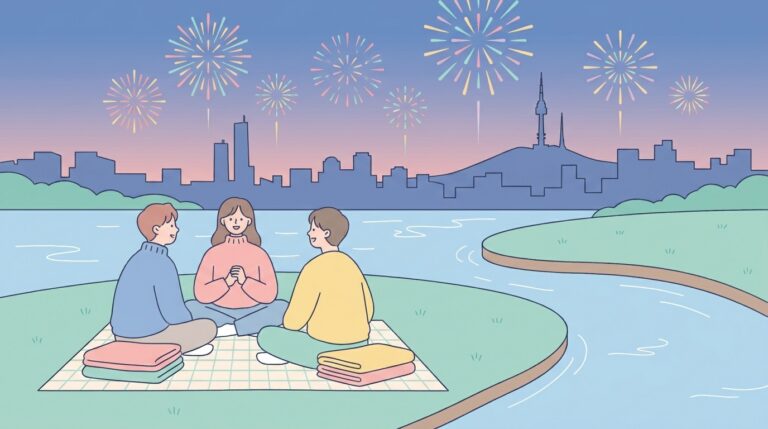
Imagine this: It is a brisk Saturday afternoon in early October. You are walking up the steps from Yeouinaru Station toward the iconic Hangang Park for the famous Seoul International Fireworks Festival (서울세계불꽃축제). You expect a relaxed weekend picnic, but the moment your shoes hit the grass, you are greeted by an endless ocean of silver foil picnic mats, warm pastel blankets, and over one million energetic people! Every single inch of prime grass facing the Han River is already being claimed. Your friend looks at you with wide eyes and asks, “Where on earth are we going to sit?”
Securing a golden viewing spot—what Koreans call a myeongdang (명당)—is practically an Olympic sport in Seoul. When you don’t know the right words to ask if a spot is open, or how to politely hold a patch of grass with your companions, you can easily end up stranded on a cold concrete pathway behind a tall tree.
Don’t worry! This guide was crafted with real feedback from beginner learners just like you who wanted to enjoy Seoul’s seasonal festivals without awkwardness. Today, we will master the essential, friendly A2-level Korean phrases to help you claim your spot, bundle up against the river breeze, and enjoy the night like a seasoned local.
Phase 2: 3 Core Expressions In-Depth
1. 자리 잡았어요! (Jari jab-asseoyo!)
- Pronunciation: [Jari jab-asseoyo] (Sounds like “jah-ree jah-bah-ssuh-yo” — imagine gently grabbing a jar of treats!)
- Meaning: Literally “I caught a seat/spot” vs. Actual nuance: “I saved/secured our spot!”
- K-Culture Moment: You’ll hear this in slice-of-life K-dramas whenever college buddies race through a busy festival lawn or crowded library, triumphantly waving their hands once they find empty territory.
- Editor’s Insight: The verb 잡다 (japda) means “to catch” or “to grab.” In Korean, good seats aren’t just “found”—they are actively captured! Use this triumphant sentence the moment your picnic mat touches the ground.
- Situation Spectrum: Casual (To friends: 자리 잡았어! ✅) | Semi-formal (자리 잡았어요! ✅) | Formal (자리를 잡았습니다! ⚠️ – a bit too robotic for a picnic).
- 🤔 Think About It: In English, we say “I saved a seat.” In Korean, you “catch” (잡다) a spot. What does this reveal about the fast-paced, dynamic nature of gathering in vibrant public spaces in Korea?
2. 여기 비어 있나요? (Yeogi bieo innayo?)
- Pronunciation: [Yeogi bieo innayo] (Sounds like “yuh-ghee bee-uh in-nah-yo”)
- Meaning: Literally “Is here empty?” vs. Actual nuance: “Is this spot taken, or is it free?”
- K-Culture Moment: Seen in romantic drama scenes where a gentle lead approaches someone sitting alone on a park bench during the spring cherry blossom or autumn fireworks festival.
- Editor’s Insight: The word 비다 (bida) means “to be vacant.” Adding ~어 있나요? asks about the current state politely. It sounds much friendlier and softer than bluntly asking “Can I sit here?”
- Situation Spectrum: Casual (여기 비었어? ✅ among peers) | Semi-formal (여기 비어 있나요? ✅ perfect for strangers) | Formal (여기가 비어 있습니까? ⚠️ too stiff).
- 🤔 Think About It: Asking whether a physical space is empty rather than asking about the person’s permission shows polite indirectness, an essential trait of Korean conversational etiquette.
3. 담요 좀 덮을래요? (Damyo jom deopeul-laeyo?)
- Pronunciation: [Damyo jom deopeul-laeyo] (Sounds like “dahm-yo johm duh-peul-lay-yo” — smooth and caring)
- Meaning: Literally “Would you like to cover with a blanket a little?” vs. Actual nuance: “Would you like to share/use this blanket?”
- K-Culture Moment: The quintessential K-drama trope: as the chilly autumn river wind blows, the thoughtful companion pulls out a fleece blanket and wraps it around their shivering date’s shoulders.
- Editor’s Insight: The little word 좀 (jom, a little) acts as a politeness cushion. Even if you’re offering something helpful, adding 좀 makes your offer feel thoughtful and pressure-free.
- Situation Spectrum: Casual (담요 덮을래? ✅) | Semi-formal (담요 좀 덮을래요? ✅) | Formal (담요를 덮으시겠습니까? 🚫 too formal for friends).
- 🤔 Think About It: Sharing blankets and food mats on the grass reflects Jeong (정)—the warm, communal affection woven into everyday Korean interactions.
Phase 3: Textbook Korean vs Real Korean
Situation 1: Checking if a grass area is available
- 📖 Textbook Korean: 여기에 앉아도 됩니까? (Yeogie anj-ado doepnikka? / May I sit here?)
- 🗣️ Real Korean: 여기 혹시 자리 있나요? (Yeogi hoksi jari innayo? / Excuse me, is this spot taken?)
- 💡 Why is it different? While the textbook phrase sounds like an exam interview, locals use 혹시 (hoksi, by any chance) + 자리 있나요 (is there a spot?) to sound natural, considerate, and breezy.
Situation 2: Spotting a breathtaking view
- 📖 Textbook Korean: 이곳의 경치가 아주 좋습니다. (Igot-ui gyeongchiga aju joseumnida. / The scenery of this place is very good.)
- 🗣️ Real Korean: 와, 여기 완전 명당이다! (Wa, yeogi wanjeon myeongdang-ida! / Wow, this is totally the prime spot!)
- 💡 Why is it different? Young Koreans constantly use 완전 (wanjeon, completely/totally) coupled with the cultural buzzword 명당 (myeongdang, prime spot) to express authentic excitement!
Phase 4: K-Culture Deep Dive & Non-Verbal Manners
4-1. Nunchi (눈치) & Picnic Mat Etiquette
At a crowded event like the Han River Fireworks Festival, space etiquette is everything. When laying down your 돗자리 (dotjari, picnic mat), make sure not to overlap the corner of your neighbor’s mat. If you need to walk past crowded mats to buy snacks, step carefully along the tiny walking gaps—never step directly onto someone else’s mat with your shoes on! A slight polite nod (목례, mongnye) while passing through tight clusters instantly wins you friendly smiles.
4-2. The Han River Chimaek Culture (치맥)
Waiting for fireworks from 2:00 PM until 7:30 PM is half the fun because of Korean food culture! Festival-goers order crispy fried chicken and beer directly to designated Han River Delivery Zones (배달존), or line up at convenience stores to boil Han River instant ramen (한강라면) in portable induction foil pans. Wrapping yourself in a cozy blanket with hot ramen while the sun sets over the 63 Building is an unforgettable rite of passage.
Phase 5: Real-World Roleplay Scenario
Setting: Yeouido Hangang Park, 3:30 PM. The autumn breeze is crisp, and the lawn is filling up fast. You and your Korean friend, Min-su (민수), are hunting for a spot.
- Min-su: 사람 진짜 많다! 우리 어디 앉지? (Saram jinjja manta! Uri eodi anjji?)
(🎭 Looking around anxiously at the packed lawn)
“There are so many people! Where do we sit?” - You: 저기 나무 밑에 공간 있어요! (Jeogi namu mite gonggan isseoyo!)
(🎭 Pointing enthusiastically toward an open grassy patch)
“There is space under that tree over there!” - Min-su: 오, 그러네! 가서 자리 있는지 물어보자. (O, geureone! Gaseo jari inneunji mureoboja.)
(🎭 Walking briskly toward the patch)
“Oh, you’re right! Let’s go ask if the spot is free.” - You (to a neighbor): 저기요, 혹시 여기 비어 있나요? (Jeogiyo, hoksi yeogi bieo innayo?)
(🎭 Giving a gentle, polite head tilt)
“Excuse me, by any chance, is this spot taken?” - Neighbor: 네, 거기 돗자리 펴셔도 돼요! (Ne, geogi dotjari pyeosyeodo dwaeyo!)
(🎭 Smiling and moving their bag slightly aside)
“Yes, you can lay your picnic mat there!” - You: 감사합니다! 민수야, 우리 자리 잡았어! (Gamsahamnida! Minsu-ya, uri jari jab-asseo!)
(🎭 Spreading out your picnic mat with relief)
“Thank you! Min-su, we secured our spot!” - Min-su: 대박, 여기 불꽃놀이 진짜 잘 보이겠다. (Daebak, yeogi bulkkotnori jinjja jal boigetda.)
(🎭 Sitting down and looking toward the river)
“Awesome, we’ll see the fireworks so well from here.” - You: 강바람 부니까 쌀쌀하네요. 담요 좀 덮을래요? (Gangbaram bunikka ssalssalhaneyo. Damyo jom deopeul-laeyo?)
(🎭 Unfolding a soft fleece blanket and offering half of it)
“It’s chilly with the river wind blowing. Would you like to share this blanket?”
🔀 Interactive Decision Point
You need to step away to the restroom, but you don’t want to lose your hard-earned spot. What do you do?
- Choice A: Pack up all your belongings and hope no one sits there while you’re away.
- Choice B: Leave your picnic mat, spread a blanket across it, and casually say to the friendly neighbor: “화장실 금방 다녀올게요!” (Hwajangsil geumbang danyeoolgeyo! / I’ll be right back from the restroom!).
- Choice C: Place a rock on the grass with a written English note saying “Occupied.”
Feedback:
* Choice A (Bad): You will lose your spot within 30 seconds! Finding another spot after 4 PM is nearly impossible.
* Choice B (Best!): Korea’s public trust culture allows you to leave mats and everyday items to hold a spot. Letting your friendly neighbor know creates warm rapport!
* Choice C (Risk): While understandable, rocks blow away or look odd. Leaving your actual mat and blanket is the standard Korean festival norm.
Phase 6: 10-Second Emotion Shadowing Drill
Practice these natural festival cadence rhythms! The slashes (/) indicate brief breathing pauses.
[🤩 신나고 당당하게 / Proud & Excited]
“드디어 / 한강 명당자리 / 잡았어요!”
(Deudio / hangang myeongdangjari / jab-asseoyo!)
“Finally / we grabbed a prime spot / at the Han River!”-
[😊 조심스럽고 다정하게 / Polite & Inquiring]
“실례지만, / 여기 혹시 / 비어 있나요?”
(Sillyejiman, / yeogi hoksi / bieo innayo?)
“Pardon me, / by any chance / is this spot open?” -
[🥶 쌀쌀해서 떨며 따뜻하게 / Cozy & Caring]
“바람이 차네요. / 우리 담요 / 같이 덮을래요?”
(Barami chaneyo. / Uri damyo / gachi deopeul-laeyo?)
“The wind is chilly. / Shall we share / this blanket together?”
Phase 7: K-Culture Mini Dictionary
- 명당 (Myeongdang) | Prime spot / Golden viewpoint
Originally an ancient Feng Shui term describing land blessed with harmonious energy, today Koreans use it humorously for concert seats, train tickets, or picnic spots with uninterrupted views. - 돗자리 (Dotjari) | Picnic mat / Ground mat
The unsung hero of Korean outdoor leisure. Sold outside Han River subway exits for a few thousand won, silver insulated picnic mats are essential for park days. - 한강라면 (Hangang Ramyeon) | Han River instant ramen
Ramen cooked outdoors using paper foil bowls and automatic hot water dispensers found at Han River convenience stores. It tastes ten times better in the crisp evening air! - 불꽃축제 (Bulkkot-chukje) | Fireworks festival
Composed of 불 (fire) + 꽃 (flower) + 축제 (festival). The Seoul International Fireworks Festival at Yeouido is Korea’s largest autumn gathering.
Phase 8: Traveler’s Survival Kit
Top 3 Survival Expressions
- 돗자리 있어요? (Dotjari isseoyo?)
- Pronunciation: [Dotjari isseoyo?]
- Pro Tip: Ask this at convenience stores or to street vendors outside subway exits if you forgot to bring a mat.
- 배달존이 어디예요? (Baedaljoni eodiyeyo?)
- Pronunciation: [Baedal-joni eodiyeyo?]
- Pro Tip: Because parks are huge, food delivery drivers meet customers at designated “Delivery Zones.” Use this to locate your chicken!
- 불꽃놀이 몇 시에 시작해요? (Bulkkotnori myeot sie sijakaeyo?)
- Pronunciation: [Bulkkotnori myeot sie sijakaeyo?]
- Pro Tip: Perfect for double-checking official launch times with park staff.
Editor’s Travel Note
- Essential Navigation: Check crowd density and transit detours beforehand on the Naver Map App Download Guide. KakaoMap is also great for finding public restrooms nearby.
- Transit Survival Tip: Yeouinaru Station (Line 5) becomes overwhelmingly congested and often closes its entry gates without stopping trains immediately after the fireworks end. Plan to walk 15–20 minutes to Mapo Station (Line 5) or Saetgang Station (Line 9) for an easy ride home!
Phase 9: “One Step Deeper” (Cultural Reflection)
In many global metropolitan cities, leaving personal belongings on an open lawn to hold a spot would invite instant theft. In Korea, however, thousands of people leave picnic mats, thick blankets, umbrellas, and sometimes even jackets or water bottles to demarcate their space while grabbing snacks. This stems from a deep-seated cultural trust and collective civic consideration known as gongdongche uisik (공동체 의식, community awareness). Respecting another person’s occupied boundary is an unspoken social pact that makes massive festivals surprisingly peaceful and orderly.
💬 Your Turn: Have you ever attended a festival where people saved spots in unique ways? What would happen if you left a blanket on the lawn in your home city? Share your story in the comments below!
Phase 10: FAQ & Common Mistakes
Q: What time should I arrive at Yeouido to get a good spot for the fireworks?
A: For front-row riverside views, seasoned locals arrive between 1:00 PM and 3:00 PM. Fireworks usually start around 7:20 PM, so arriving in the early afternoon with snacks, a portable battery, and a warm blanket is the standard ritual.
Q: Can I bring chairs or tall camping tents?
A: Small, low-profile ground cushions are welcome, but tall camping chairs and high shade tents are restricted in the main viewing zones because they block the line of sight for people sitting on ground mats behind you.
Q: Is it really cold at the Han River in October?
A: Yes! October days can be sunny and warm (around 20°C / 68°F), but once the sun dips over the river, temperatures plummet rapidly to 10°C (50°F) with strong river winds. Always pack an extra fleece blanket (담요) and a windbreaker.
🚨 Common Mistakes Warning Board
- Mistake 1: Standing up directly in front of seated mats right when the fireworks begin.
- Correct Action: Keep seated on your mat unless you are in a designated rear standing zone so everyone behind you can see.
- Mistake 2: Using formal “~하십시오” commands when asking neighbors for space.
- Correct Action: Use the soft, friendly semi-formal style: “여기 혹시 자리 있나요?” (Yeogi hoksi jari innayo?).
- Mistake 3: Leaving trash on your picnic spot when departing.
- Correct Action: Hangang parks provide large temporary waste disposal bags at festival exits. Pack your trash into a bag and dispose of it on your way out.
Phase 11: Action Missions
- 🥉 Bronze Mission (Solo Practice): Stand in front of your mirror and practice offering a blanket with warm emotion: “바람이 부네요. 담요 좀 덮을래요?” three times smoothly.
- 🥈 Silver Mission (Social Share): Snap a photo of your cozy picnic blanket or autumn park view and post it with the Korean caption: “오늘 명당자리 잡았어요! ✨”.
- 🥇 Gold Mission (Real Life Execution): Next time you visit a Korean park or cafe, approach an empty table/mat area and naturally ask a neighbor: “저기요, 여기 비어 있나요?”.
🎮 K-Culture Mission: Watch an episode of a Han River scene in a K-drama (like Weightlifting Fairy Kim Bok-joo or Business Proposal) and spot how Koreans sit together on picnic mats sharing street snacks!
Phase 12: Interactive Quiz Challenge
Test your festival savvy! Can you ace all three?
- Situational Judgment: You arrive at the park and spot an empty patch of grass next to a family. What is the most polite and natural phrase to confirm if you can sit there?
- a) 여기 비어 있나요? (Yeogi bieo innayo?)
- b) 비키세요! (Bikiseyo!)
- c) 앉아라! (Anj-ara!)
- Fill-in-the-Blank: You want to tell your buddy you successfully claimed the prime viewing spot. Fill in the missing verb:
“드디어 명당자리 _______!” (Hint: Past tense of “to catch/grab”) -
True or False: In Korea, it is considered rude to share half of your picnic blanket with a friend or companion sitting next to you.
👉 Click to reveal answers & explanations!
- Answer: a) 여기 비어 있나요? (Yeogi bieo innayo?)
Explanation: This politely asks “Is this spot vacant?”. Choice b means “Get out of the way!” (rude!), and choice c is a blunt low-form command. -
Answer: 잡았어요 (jab-asseoyo) / 잡았어 (jab-asseo)
Explanation: The idiom for securing territory or seats is ‘자리를 잡다’. In the past tense, it becomes 잡았어요 (polite) or 잡았어 (casual). -
Answer: False
Explanation: Quite the opposite! Offering to share a blanket (담요 좀 덮을래요?) is seen as very warm, considerate, and affectionate (Jeong).
🎬 Watch Our Daily Videos! (Daily Hangul Official Instagram)
Review the expressions you learned in this article with our fun daily short videos! Check out native pronunciation and real-life nuances in action.
- Instagram @dailyhangul_en







