

안녕하세요! 매일한글 에디터입니다.
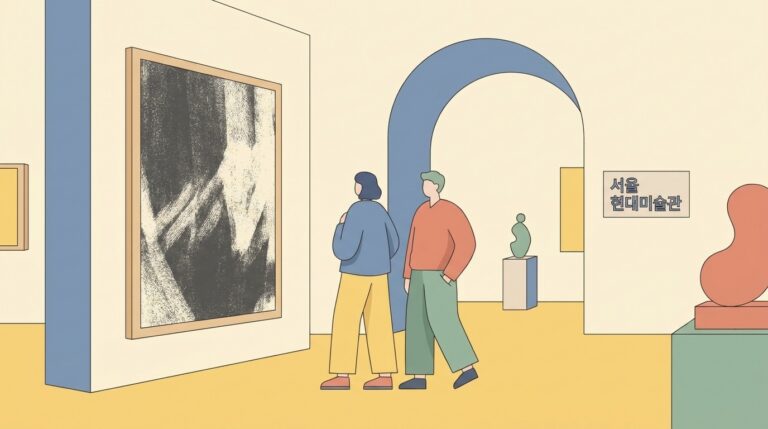
Imagine walking into the cavernous, gleaming halls of COEX during early September. The buzz is electric: art collectors from London, curators from New York, and chic Seoulites clad in oversized blazers are bustling around the intersecting booths of Kiaf and Frieze Seoul. You stop dead in your tracks in front of a massive canvas. It is covered entirely in repetitive, rhythmic strokes of charcoal and white plaster. Beside it, an intricate installation of industrial blinds hangs suspended in mid-air.
Your first instinct might be an internal shrug: “Wait… what am I even looking at? Is this art, or did someone just scratch paint for twenty hours?”
Modern and contemporary art—especially abstract paintings and avant-garde installations—can feel deeply cryptic when you encounter them in total vacuum. But then, a soft voice nearby breaks through the gallery murmur. A docent steps forward, gathers a small circle, and begins untangling the artist’s turbulent life during post-war Korea, their painstaking meditative search for endurance, and the silent grief behind every textured ridge. Suddenly, the canvas shifts. The random marks dissolve into a breathing rhythm. It no longer feels alien; it feels as though the canvas is whispering its history directly to your soul.
Engaging with contemporary Korean art fair culture is not just about appreciating visual aesthetics—it is about sharing a sophisticated intellectual frequency. B2 learners often tell us: “I know how to order food or ask for directions, but standing in a gallery, I feel tongue-tied when trying to discuss modern art without sounding like a toddler.” Today’s guide is designed precisely to bridge that gap. Let’s equip you with the exact phrases, cultural nuances, and conversational finesse needed to navigate docent tours at Frieze and Kiaf like a true art insider.
Phase 2: Core Expressions Deep Dive
1. 작품이 나에게 말을 걸어오는 듯해요 (Jakpumi na-ege mareul georeo-oneun deuthaeyo)
- Pronunciation: [Jak-pu-mi na-eh-geh ma-reul geo-reo-o-neun deu-thae-yo] (Think of ‘Jakpum’ sounding like ‘chalk-poom’, and ‘deuthaeyo’ rolling smoothly like ‘dut-heh-yo’.)
- Meaning: Literally “It feels like the artwork is striking up a conversation with me.” In natural English: “The artwork feels like it is speaking directly to me / It really resonates with me.”
- K-Culture Moment: You will often hear this phrase on artsy vlog channels or read it in contemplative Instagram captions posted by culture-loving idols like RM of BTS when he visits solo exhibitions in Samcheong-dong.
- Editor’s Insight: Koreans rarely say “I understand this art piece rationally” (이 작품을 논리적으로 이해했어요). Instead, appreciating art is framed as an emotional and relational encounter. Using 말을 걸어오다 (to strike up a conversation / talk to someone) personifies the artwork, showing that you perceive an energetic dialogue between creator and viewer.
- Situation Spectrum:
- Casual (Friends): ⚠️ 이거 왠지 나한테 말 거는 느낌이야! (Igeo waenji nahante mal geoneun neukkimiya!)
- Semi-formal (Docent / Acquaintances): ✅ 작품이 저에게 말을 걸어오는 듯해요. (Jakpumi jeoege mareul georeo-oneun deuthaeyo.)
- Formal (Interview / Art Critique): ✅ 작품이 관객에게 말을 건네는 듯한 인상을 줍니다. (Jakpumi gwangaegege mareul geonneneun deutan insangeul jumnida.)
- 🤔 Think About It: In English, we often say “This piece speaks to me.” Notice how Korean uses the progressive directional form 걸어오다 (coming toward me to speak). Why do you think Korean art contemplation emphasizes the artwork approaching the viewer rather than the viewer dissecting the art?
2. 작가의 의도를 알고 나니 새롭게 보여요 (Jakgaui uidoreul algo nani saeropge boyeoyo)
- Pronunciation: [Jak-ga-ui ui-do-reul al-go na-ni sae-rop-ge bo-yeo-yo] (Pronounce ‘ui’ softly like a quick ‘ee’ or ‘eui’, sliding naturally into ‘do’.)
- Meaning: Literally “Having learned the artist’s intent, it shows newly.” In natural English: “Now that I understand the artist’s creative intent, I see it in a whole new light.”
- K-Culture Moment: Seen frequently in variety shows like You Quiz on the Block whenever host Yoo Jae-suk interviews an artisan, sculptor, or director and experiences an aesthetic epiphany.
- Editor’s Insight: The grammar pattern -고 나니 indicates that the prior action (learning the context) became the catalyst for a fresh state of perception. It reflects intellectual humility—admitting your initial impression was incomplete, while celebrating your new appreciation.
- Situation Spectrum:
- Casual: ✅ 의도 듣고 나니까 완전 다르게 보인다! (Uido deutgo nanikka wanjeon dareuge boinda!)
- Semi-formal: ✅ 작가의 의도를 알고 나니 새롭게 보여요. (Jakgaui uidoreul algo nani saeropge boyeoyo.)
- Formal: ✅ 창작 배경을 이해하고 나니 작품의 진가가 새롭게 다가옵니다. (Changjak baegyeongeul ihaehago nani jakpumui jingaga saeropge dagaomnida.)
- 🤔 Think About It: Does learning an artist’s personal trauma enhance or diminish your personal interpretation of their work? How does expressing “seeing newly” acknowledge both the artist and your evolving self?
3. 처음엔 난해했는데 깊은 울림이 있네요 (Cheo-eumen nanhaehaenneunde gipeun ullimi inneyo)
- Pronunciation: [Cheo-eu-men nan-hae-haen-neun-de gi-peun ul-li-mi in-ne-yo] (Make sure the ‘h’ in ‘nanhae’ breathes out softly, and the double-l in ‘ullim’ resonates like the ringing of a bell.)
- Meaning: Literally “It was cryptic at first, but there is a deep resonance/echo.” In natural English: “I found it impenetrable at first glance, but it carries a profound resonance.”
- K-Culture Moment: Frequently spoken by gallery visitors interviewed at major biennales (such as Gwangju Biennale) or sophisticated cable channel documentaries when reflecting on avant-garde performance art.
- Editor’s Insight: 난해하다 (nanhaehada) is a sophisticated Hanja-based adjective meaning esoteric, cryptic, or abstruse. Pair it with 울림 (ullim)—which literally translates to acoustic reverberation or echo—and you immediately elevate your conversational level from a simple “It was cool” to a perceptive critique.
- Situation Spectrum:
- Casual: ⚠️ 처음엔 멘붕이었는데 볼수록 소름 돋아. (Cheo-eumen menbung-ieonneunde bolsurok soreum doda.)
- Semi-formal: ✅ 처음엔 좀 난해했는데, 듣고 나니 깊은 울림이 있네요. (Cheo-eumen jom nanhaehaenneunde, deutgo nani gipeun ullimi inneyo.)
- Formal: ✅ 난해한 조형 언어 이면에 시대적 울림이 내재되어 있습니다. (Nanhaehan johyeong eoneo imyeone sidaejeok ullimi naejaedoe-eo itseumnida.)
- 🤔 Think About It: Why does Korean culture prize 울림 (ullim – resonance) over mere beauty or technique when evaluating mastery in art and literature?
Phase 3: Textbook Korean vs. Real Korean
Situation 1: Inquiring About the True Theme of an Abstract Canvas
- 📖 Textbook Korean: 이 그림은 무엇을 의미합니까? (I geurimeun mueoseul uimihamnikka? – “What does this painting mean?”)
- 🗣️ Real Korean: 이 작품에는 어떤 시대적 배경이나 메시지가 담겨 있나요? (I jakpumeneun eotteon sidaejeok baegyeong-ina mesijiga damgyeo innayo? – “What kind of historical background or message does this piece hold?”)
- 💡 Why it differs: Asking “What does this mean?” sounds blunt and treats the artwork like a multiple-choice riddle with a single right answer. Real art lovers inquire about what is 담겨 있다 (contained/infused within), acknowledging multiple layers of meaning.
Situation 2: Expressing That the Docent’s Explanation Struck a Chord
- 📖 Textbook Korean: 도슨트님의 설명을 이해했습니다. (Doseunteunimui seolmyeongeul ihaehaetseumnida. – “I have understood the docent’s explanation.”)
- 🗣️ Real Korean: 설명을 듣고 나니까 작품의 의미가 확 와닿네요! (Seolmyeongeul deutgo nanikka jakpumui uimiga hwak wadatneyo! – “Hearing your explanation makes the meaning of the work strike right home!”)
- 💡 Why it differs: Saying you “understood” sounds like you just passed a comprehension test. Native speakers use the vibrant sensory verb 와닿다 (to touch/hit home) with the adverb 확 (suddenly, distinctly) to convey emotional connection.
Phase 4: K-Culture Deep Dive & Non-Verbal Manners
4-1. Nunchi & Gallery Etiquette: The Art of the “Silent Dialogue”
- The Docent Angle & Spatial Awareness: In mega-fairs like Frieze Seoul or Kiaf, exhibition halls get packed. Showing good 눈치 (nunchi) means positioning yourself so you don’t block the sightlines of someone taking notes or photographing the gallery placard. Stand slightly at a 45-degree angle to the art, leaving a clear channel behind you.
- Sotto Voce (속삭임) & Eye Gestures: When whispering feedback to a friend or asking a docent a question during pauses, lower your vocal pitch rather than just lowering volume. Keep hands clasped loosely in front or behind your back—never point with a stiff index finger near the canvas. Gesture toward a detail with an open palm held at chest level.
- The Contemplative Nod (끄덕임): When the docent explains a delicate historical point (such as how Korea’s monochrome Dansaekhwa masters survived military dictatorships), don’t interrupt with loud affirmations. Maintain quiet eye contact and give slow, deliberate nods to show deep comprehension.
4-2. Cultural Code Analysis: The Dansaekhwa Boom & MZ Generation Art Fans
In contemporary Korea, art collecting is no longer reserved for chaebol board members. Led by passionate cultural patrons like RM and prominent younger actors, visiting art fairs has transformed into a lifestyle movement called 아트 테크 (Art-Tech) and 취향 소비 (consumption based on personal taste).
At the center of Korean contemporary pride is 단색화 (Dansaekhwa – Korean Monochrome Painting), pioneered by figures like Kim Whanki, Park Seo-bo, and Chung Sang-hwa. These artists did not simply paint minimalist squares; they layered hanji paper, scratched wet oil with wooden sticks, and submerged canvases in pigments thousands of times. The docent’s role is crucial here: without knowing that this repetitive toil was an antidote to personal grief and national trauma, the canvas looks like blank gray cloth. Once you grasp that repetition is endurance, the silence of the room transforms into an overwhelming emotional experience.
Phase 5: Live Roleplay Scenario
Setting: Hall C at COEX, during Frieze Seoul. Alex is standing in front of an expansive, textured Dansaekhwa piece by master Park Seo-bo. A gallery docent, Min-ji, notices his curious expression.
- Turn 1 (Min-ji):
- 한글: 안녕하세요! 이 작품 앞에서 꽤 오래 머무시네요. 어떤 느낌이 드세요?
- Pronunciation: Annyeonghaseyo! I jakpum ap-eseo kkwae orae meomusineyo. Eotteon neukkimi deuseyo?
- English: Hello! You’ve been lingering in front of this work for quite some time. What does it make you feel?
- 🎭 Action: Smiles warmly, stepping beside Alex while keeping respectful distance from the artwork.
- Turn 2 (Alex):
- 한글: 솔직히 처음 봤을 땐 단순한 선의 반복이라 조금 난해하다고 생각했어요.
- Pronunciation: Soljiki cheo-eum bwasseul ttaen dansunhan seonui banbogira jogeum nanhaehadago saenggakhaesseoyo.
- English: To be honest, when I first saw it, I thought it was somewhat cryptic because it’s just repeating lines.
- 🎭 Action: Scratches his cheek with a sheepish, sincere grin.
- Turn 3 (Min-ji):
- 한글: 많은 분들이 그렇게 느끼세요. 하지만 작가는 한국 전쟁 이후의 혼란 속에서 마음을 비우는 수행의 과정으로 이 선들을 그어 내려갔답니다.
- Pronunciation: Maneun bundeuri geureoke neukkiseyo. Hajiman jakganeun hanguk jeonjaeng ihu-ui hollan sogeseo maeumeul biuneun suhaeng-ui gwajeong-euro i seondeureul geoeo naeryeogatdamnida.
- English: Many people feel that way. However, the artist drew these continuous lines as an act of meditative practice to clear his mind amidst post-war turmoil.
- 🎭 Action: Softly indicates the textured grooves with an open palm.
- Turn 4 (Alex):
- 한글: 아… 작가의 제작 의도와 시대 배경을 알고 나니 작품이 완전히 새롭게 보여요.
- Pronunciation: A… jakgaui jejak uidowa sidaebae-gyeong-eul algo nani jakpumi wanjeonhi saeropge boyeoyo.
- English: Ah… now that I understand the artist’s creative intent and historical context, I see the piece in an entirely new light.
- 🎭 Action: Widens eyes slightly in genuine surprise and leans in closer to inspect the relief.
- Turn 5 (Min-ji):
- 한글: 그렇죠? 단순한 캔버스가 아니라 작가의 삶과 호흡이 고스란히 굳어져 있는 공간이에요.
- Pronunciation: Geureochyo? Dansunhan kaenbeoseuga anira jakgaui samgwa hoheubi goseuranhi gudeojyeo inneun gong-gan-ieyo.
- English: Right? It isn’t merely a canvas, but a space where the artist’s life and breath have crystallized intact.
- 🎭 Action: Nods gently, appreciating Alex’s receptive attitude.
- Turn 6 (Alex):
- 한글: 맞아요. 배경을 듣고 가만히 바라보니까, 작품이 나에게 말을 걸어오는 듯한 묵직한 울림이 있네요.
- Pronunciation: Majayo. Baegyeong-eul deutgo gamanhi barabonikka, jakpumi na-ege mareul georeo-oneun deutan mukjikan ullimi inneyo.
- English: Exactly. Gazing quietly at it after hearing the background, it feels as if the piece is speaking to me with a heavy resonance.
- 🎭 Action: Places a hand over his chest with an inspired, appreciative expression.
- Turn 7 (Min-ji):
- 한글: 정곡을 찌르셨네요! 이 옆 설치 미술도 그 시대의 트라우마를 치유하는 과정을 다루고 있는데, 같이 보시겠어요?
- Pronunciation: Jeonggog-eul jjireusyeotneyo! I yeop seolchi misuldo geu sidae-ui teuraumareul chiyuhaneun gwajeong-eul darugo inneunde, gachi bosigesseoyo?
- English: You hit the nail right on the head! The installation next to this also explores the healing of that era’s trauma—shall we take a look together?
- 🎭 Action: Brightens enthusiastically and gestures smoothly toward the adjacent booth.
- Turn 8 (Alex):
- 한글: 네, 너무 좋습니다! 도슨트님 설명 덕분에 현대 미술의 매력에 푹 빠질 것 같아요.
- Pronunciation: Ne, neomu joseumnida! Doseunteunim seolmyeong deokbune hyeondae misurui maeryeoge puk ppajil geot gatayo.
- English: Yes, I would love that! Thanks to your explanation, I think I’m completely falling for contemporary art.
- 🎭 Action: Bows head with sincere gratitude and follows her lead.
🔀 Interactive Decision Point
Suppose Min-ji asked you Turn 1 (“How does this work feel to you?”). How would you respond?
- Option A: “그냥 하얀 페인트만 칠해 놓은 것 같은데 솔직히 이게 왜 비싼지 모르겠어요.” (It just looks like white paint smeared on a canvas; honestly, I don’t get why this is expensive.)
- Outcome (Bad): Brutally honest, but it cuts off cultural dialogue and makes you sound dismissive of the fair and docent.
- Option B: “추상화라 처음엔 난해하게 느껴졌는데, 어떤 의도로 작업하신 건지 궁금해요.” (Since it’s abstract, it felt cryptic at first, but I’m curious about the intent behind the work.)
- Outcome (Best): Demonstrates emotional honesty, cultural modesty, and proactive curiosity. The docent will be thrilled to unpack the artwork for you.
- Option C: “이 그림 완벽하게 다 이해했어요. 별로 설명 안 해주셔도 괜찮습니다.” (I understand this painting completely. You don’t really need to explain.)
- Outcome (Risk): Comes across as arrogant and socially aloof (눈치 없는 태도), shutting down an educational cultural exchange.
Phase 6: 10-Second Emotion Shadowing Drill
Read these out loud, observing the emotional cue and natural breath pauses marked with /.
- [😮 Awestruck Realization]
아… / 작가의 제작 의도를 듣고 나니 / 완전히 새롭게 보여요!
(A… / jakgaui jejak uidoreul deutgo nani / wanjeonhi saeropge boyeoyo!)
“Ah… / having heard the artist’s intent / I see it in a completely new light!” -
[😌 Quiet Contemplative Warmth]
가만히 바라보고 있으니까 / 작품이 저에게 / 말을 걸어오는 듯해요.
(Gamanhi barabogo isseunikka / jakpumi jeoege / mareul georeo-oneun deuthaeyo.)
“As I gaze at it quietly / it feels as though the artwork / is whispering directly to me.” -
[🤝 Intellectual Appreciation]
처음엔 좀 난해했는데 / 도슨트님 해설 덕분에 / 깊은 울림이 느껴지네요.
(Cheo-eumen jom nanhaehaenneunde / doseunteunim haeseol deokbune / gipeun ullimi neukkyeojineyo.)
“It felt quite cryptic at first / but thanks to your commentary / I feel such a profound resonance.”
Phase 7: K-Culture Mini Dictionary
-
도슨트 (Doseunteu) [Noun]
Translation: Docent / Exhibition Guide.
Usage: Unlike a tour guide, a Korean 도슨트 is considered an educational cultural storyteller. Addressing them respectfully as 도슨트님 (Doseunteu-nim) instantly shows polished social manners. -
단색화 (Dansaekhwa) [Noun]
Translation: Korean Monochrome Painting.
Usage: Korea’s signature post-war modernist movement focusing on tactile repetition, monochromatic palettes, and meditative spirit. Essential vocabulary when visiting Frieze Seoul. -
난해하다 (Nanhaehada) [Adjective]
Translation: Cryptic, abstruse, impenetrable.
Usage: A sophisticated way to say something is hard to decode without sounding uneducated. Perfect for abstract or experimental installation art. -
울림 (Ullim) [Noun]
Translation: Resonance, deep lingering echo.
Usage: Used when an aesthetic, musical, or human experience strikes a chord in your heart that lingers long after you leave the venue.
Phase 8: Traveler’s Survival Kit
Top 3 Art Fair Survival Phrases
- 도슨트 투어는 몇 시에 시작하나요? (Doseunteu tueoneun myeot sie sijakanayo?)
Pro Tip: Art fairs hold docent tours at specific scheduled hours, often limited to small groups. Inquire early at the fair information desk. - 이 작품에 대해 조금 더 설명해 주실 수 있나요? (I jakpume daehae jogeum deo seolmyeonghae jusil su innayo?)
Pro Tip: Use this when approaching a gallerist inside an individual booth. It signals that you are a serious, respectful art admirer. - 도록이나 리플릿이 어디에 비치되어 있나요? (Dorogina ripeullisi eodie bichidoeeo innayo?)
Pro Tip: 도록 (catalog) and 리플릿 (leaflet/pamphlet) contain artist statements and historical context that solidify your learning.
Editor’s Travel Note: Conquering Seoul Art Week
- Navigation: Frieze and Kiaf take over COEX Convention Center in Gangnam every September. The subterranean mall is notoriously a labyrinth! Keep your phone ready by utilizing the Naver Map application download page to locate COEX Hall A, B, and C without getting lost.
- Etiquette & Payments: Luggage storage is available outside the hall—large backpacks are strictly banned in the exhibition areas to safeguard fragile sculptures. Most contemporary art catalogs at booth shops accept contactless international credit cards and local mobile pay methods.
Phase 9: A Step Deeper (한 발 더 깊이)
In Western art tradition, a blank canvas often represents absence—something waiting to be filled with color, perspective, and form. In traditional and contemporary Korean aesthetics, however, empty canvas space is celebrated as 여백의 미 (Yeobaek-ui mi – The Beauty of Margin / Emptiness).
When Korean artists leave large fields unpainted or repeat monotonous strokes across burlap, they are not withholding art; they are intentionally creating room for the viewer’s breath, thoughts, and emotions to dwell. The artwork is intentionally incomplete until you, the viewer, step into its orbit and reflect your own emotional landscape onto it. That is why art in Korea is a dialogue rather than a performance.
💬 Your Turn: Have you ever looked at an abstract sculpture or painting and felt suddenly moved after hearing the back-story? Drop a comment below sharing your favorite artist or your first art fair experience in Korea!
Phase 10: FAQ & Common Mistakes
Q: Can I take photos while listening to the docent’s explanation?
A: Generally yes, but keep camera shutters muted (using silent mode apps) and avoid flash entirely. Step back so you do not block the docent or other listeners’ line of sight.
Q: What is the polite way to ask a docent a question during a tour?
A: Wait for a natural pause between artworks. Raise your hand gently to chest height and say: “도슨트님, 질문 하나 드려도 될까요?” (Doseunteunim, jilmun hana deuryeodo doelkkayo? – “Docent-nim, may I ask one question?”)
Q: How do Kiaf and Frieze Seoul differ?
A: Kiaf (Korea International Art Fair) is organized by the Galleries Association of Korea, highlighting pioneering modern and emerging domestic talent. Frieze Seoul is a globally curated fair bringing blue-chip international galleries to COEX under the same collaborative roof.
🚨 Common Mistakes Warning Board
- ❌ Mistake 1: Saying “이거 너무 이상해요” (This is too weird) when encountering bizarre installation art.
👉 Correct Action: Say “조형 언어가 굉장히 독특하고 신선하네요” (The sculptural language is very unique and fresh) or “조금 난해하지만 인상적이에요” (A bit cryptic, but impressive). - ❌ Mistake 2: Addressing the docent as “저기요 선생님” (Hey teacher) in an art gallery.
👉 Correct Action: Use the professional, respectful title “도슨트님” (Doseunteu-nim). - ❌ Mistake 3: Touching textures to test if oil paint or hanji is real.
👉 Correct Action: Keep a minimum 30cm safety perimeter; step back and appreciate the tactile relief with your eyes.
Phase 11: Action Missions
- 🥉 Bronze Mission (Solo Practice): Stand before any picture or abstract wallpaper in your room. Whisper aloud: “작가의 의도를 알고 나니 새롭게 보여요.” Focus on the smooth transition of 알고 나니.
- 🥈 Silver Mission (Social Media): Find a photo of an artwork by Kim Whanki or Park Seo-bo on Instagram. Write a one-line reflection: “작품이 나에게 말을 걸어오는 듯한 울림이 있다.”
- 🥇 Gold Mission (Real Life): Visit a local museum, gallery, or next season’s Kiaf/Frieze fair. Stay for at least one docent segment, and thank them afterward with: “설명 덕분에 작품의 울림이 확 와닿았어요. 감사합니다!”
- 🎮 K-Culture Mission: Watch RM’s gallery tour vlogs or an episode of an art-centered K-Drama (like Her Private Life). Spot whether you can hear the terms 난해하다 or 작가의 의도 used by curators!
Phase 12: Interactive Quiz Challenge
Test your gallery fluency! Try answering without peeking at the answers below.
- Situational Judgment: You are listening to a docent explain how a post-war artist survived hardship by painting. You want to express how deeply it struck your heart. Which expression is the most natural and polished?
- (A) 이 그림은 비싸 보여요.
- (B) 시대 배경을 알고 나니 깊은 울림이 느껴지네요.
- (C) 도슨트님 말이 너무 길어서 난해해요.
- Fill-in-the-Blank: Complete the phrase meaning “Now that I know the artist’s intent, it looks completely fresh.”
- 작가의 의도를 [ ] 나니 완전히 새롭게 보여요.
- True or False Culture Check: In Korean art aesthetics, leaving empty white space on a canvas is viewed as unfinished, lazy execution.
- (True / False)
🔍 Click to reveal answers & explanations!
- Answer: (B)
Explanation: (B) uses 깊은 울림이 느껴지네요 (I feel a deep resonance), which gracefully reflects empathy with the artist’s historical struggle. (A) is overly material, and (C) is rude to the speaker. -
Answer: 알고 (or 듣고)
Explanation: The grammar pattern -고 나니 (after doing / having realized) attaches to the stem 알다 (to know) or 듣다 (to hear), yielding 알고 나니 or 듣고 나니. -
Answer: False
Explanation: Emptiness is celebrated as 여백의 미 (the beauty of margin/void)—an intentional space designed for the spectator’s breath and emotional contemplation.
🎬 Watch Our Daily Videos! (Daily Hangul Official Instagram)
Review the expressions you learned in this article with our fun daily short videos! Check out native pronunciation and real-life nuances in action.
- Instagram @dailyhangul_en







