

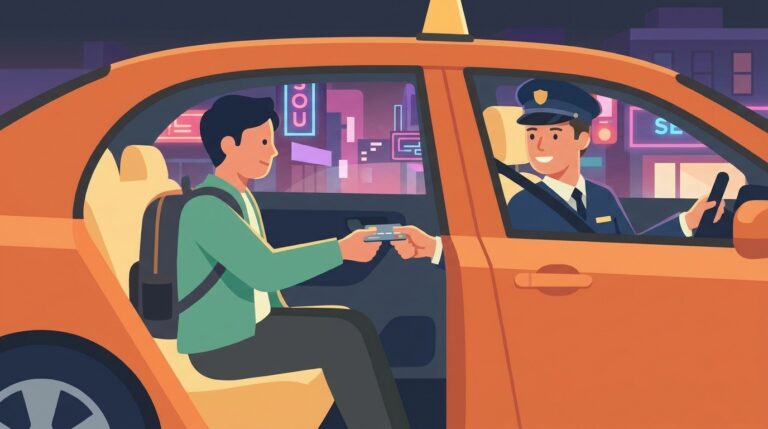
Riding a Seoul Taxi: How to Ask ‘Can I Pay with a Card?’ Like a Local
Phase 1: Empathy & Storytelling Opening
안녕하세요! 매일한글 에디터입니다. (Hello! I am your Daily Hangul editor.) Imagine this scene: It’s 11:30 PM in the neon-lit streets of Hongdae, Seoul. You just enjoyed crispy Korean fried chicken with friends, and your feet are aching. A sleek orange taxi glides up to the curb. You sink into the heated seat with pure relief as the driver whisks you toward your hotel in Myeongdong. But as the meter reaches 12,000 won, a cold sweat breaks out on your palms. You look at your wallet—no Korean banknotes, only your international credit card and a plastic T-money transit card. You panic: What if the driver gets upset? Can I even use a card in a Korean taxi?
Take a deep breath! You are not alone. In fact, over 80% of our beginner students tell us that taking a taxi and paying at the end is their single most nerve-wracking moment in Korea. But here is the wonderful secret: South Korea is virtually a cashless society. Almost every single taxi in the country is legally equipped with a card terminal. All you need is one sweet, natural question to break the ice and settle your ride smoothly. Let’s unlock this essential skill together!
Phase 2: Top 3 Core Expressions
1. 카드 돼요? (Kadeu dwaeyo?)
- Pronunciation: [Kadeu dwaeyo?] (Sounds like: “Kah-deu dway-yo?” – imagine saying “do weigh you” quickly).
- Meaning: Literal: “Is card possible?” | Nuance: “Can I pay with a card?” / “Do you take card?”
- K-Culture Moment: You will hear this everywhere in K-dramas whenever a character dashes out of a taxi to chase someone at the airport—they casually flip a plastic card forward while saying this quick line.
- Editor’s Insight: The word 돼요 (dwaeyo) comes from 되다 (to become/to work/to be okay). It is the magical Swiss Army knife of Korean. Instead of a stiff, formal sentence, this short 4-syllable question is universally understood and instantly polite.
- Situation Spectrum: Casual: ⚠️ (too polite for best friends) | Semi-formal: ✅ (Perfect for taxi drivers, cafes, food trucks) | Formal: ⚠️
- 🤔 Think About It: Notice how English speakers say “Can I…” (focusing on personal permission), while Koreans ask “Is it possible?” (focusing on the shared situation). Why do you think Korean prioritizes the situational state over the individual actor?
2. 카드로 할게요 (Kadeu-ro halgeyo)
- Pronunciation: [Kadeu-ro hal-ge-yo] (Sounds like: “Kah-deu-ro hahl-geh-yo” – rhyme hal with “hall”).
- Meaning: Literal: “I will do by card.” | Nuance: “I’ll pay by card, please.”
- K-Culture Moment: In modern romantic comedies like Business Proposal, lead characters boldly whip out a sleek black credit card at a counter and say this exact line with confident elegance.
- Editor’s Insight: The particle 로/으로 (ro/euro) indicates the “method” or “tool.” When the ride finishes and the driver pauses the meter, stating this phrase tells them to wake up the terminal right before you tap your card.
- Situation Spectrum: Casual: ⚠️ | Semi-formal: ✅ (Standard customer etiquette) | Formal: ✅
- 🤔 Think About It: In Korean, the verb 하다 (to do) often replaces specific transaction verbs like “purchase” or “calculate.” How does simplifying actions to “doing” affect your speaking speed as a beginner?
3. 영수증 주세요 (Yeongsujeung juseyo)
- Pronunciation: [Yeong-su-jeung ju-se-yo] (Sounds like: “Young-soo-jeung joo-seh-yo”).
- Meaning: Literal: “Please give receipt.” | Nuance: “May I have a receipt, please?”
- K-Culture Moment: In thriller or mystery dramas, detectives always ask taxi drivers for this slip of paper to check the taxi vehicle number, boarding time, and telephone contacts!
- Editor’s Insight: Always ask for a receipt if you accidentally leave your umbrella, phone, or shopping bag in the backseat! Korean taxi receipts display the taxi’s registration number and the company’s dispatch hotline.
- Situation Spectrum: Casual: 🚫 | Semi-formal: ✅ | Formal: ✅
- 🤔 Think About It: The word 주세요 (juseyo) literally combines “give” with an honorific request. Isn’t it neat that one single word turns any noun into a polite order?
Phase 3: Textbook Korean vs. Real Korean
Situation A: Asking if card payment is accepted
- 📖 교과서 한국어 (Textbook): 신용카드로 결제해도 됩니까? (Sin-yong-ka-deu-ro gyeol-je-hae-do doep-ni-kka? – “Is it permissible if I settle payment via credit card?”)
- 🗣️ 진짜 한국어 (Real-Life): 카드 돼요? (Kadeu dwaeyo? – “Card okay?”)
- 💡 왜 다를까? (Why the difference?): While the textbook phrase is grammatically flawless, native Koreans rarely use heavy corporate words like 결제 (payment settlement) during a casual taxi hop. Saying “카드 돼요?” sounds warm, natural, and immediately understood.
Situation B: Declining a printed receipt
- 📖 교과서 한국어 (Textbook): 저는 영수증이 필요하지 않습니다. (Jeoneun yeongsujeungi piryohaji anseumnida. – “As for me, a receipt is not needed.”)
- 🗣️ 진짜 한국어 (Real-Life): 영수증은 괜찮아요! (Yeongsujeungeun gwaenchanayo! – “The receipt is okay / No receipt needed!”)
- 💡 왜 다를까? (Why the difference?): Rejecting something directly with “I don’t need it” can sound slightly abrupt in Korean culture. Using 괜찮아요 (it is okay) softens the refusal with polite consideration.
Phase 4: K-Culture Deep Dive & Non-Verbal Manners
4-1. 눈치 (Nunchi) & Gestures in the Backseat
When the cab reaches your stop, take a moment to observe the taxi setup. The card terminal is almost always mounted in the center console between the front driver and passenger seats.
* The Two-Handed Hand-off: When passing your physical credit card forward, hold the card with both hands or support your right wrist lightly with your left hand. This subtle gesture shows immense respect to elders and service providers.
* T-Money Tap: If you are paying with a transit card (T-Money), simply say “티머니 돼요?” (T-meoni dwaeyo?) and hold it near the terminal screen. Many modern terminals allow you to tap it yourself without handing it to the driver!
* Mirror Eye Contact: Korean taxi drivers will frequently look at you through the rearview mirror instead of turning around. Don’t be startled—a polite nod while looking into the mirror conveys instant courtesy.
4-2. Cultural Code: The Cashless Marvel of Seoul Cabs
South Korea has one of the world’s highest cashless transaction rates. In major cities, taxi drivers are actually legally mandated to accept card payments for any amount—even if the ride is just the base fare (around 4,800 won). While foreign travelers sometimes worry about offending drivers with small card charges, it is the daily norm in Korea. In fact, many younger drivers actively prefer card payments because they avoid the hassle of counting change late at night!
Phase 5: Real-World Roleplay Scenario
Setting: A rainy Friday night near Hongik University Station. You slide into the back of a silver taxi driven by Mr. Kim, a gentle driver in his 50s.
- Turn 1 (Alex – Passenger): 안녕하세요! 홍대입구역 가주세요. (Annyeonghaseyo! Hongdae-ip-gu-yeok ga-juseyo.)
🎭 Leaning slightly forward with a friendly smile.
(Hello! Please take me to Hongik University Station.) - Turn 2 (Driver Kim): 네, 출발합니다. 비가 많이 오네요. (Ne, chulbalhamnida. Biga mani oneyo.)
🎭 Glancing into the rearview mirror and turning on the windshield wipers.
(Yes, heading out now. It’s raining a lot today.) - Turn 3 (Alex – Passenger): 네, 맞아요. 조금 막히네요. (Ne, majayo. Jogeum makhineyo.)
🎭 Looking out the window at the flashing red taillights.
(Yes, that’s right. The traffic is a bit heavy.) - Turn 4 (Driver Kim): 다 왔습니다! 손님, 6,800원입니다. (Da watseumnida! Sonnim, yuk-cheon-pal-baek-won-imnida.)
🎭 Shifting into park and tapping the meter to stop the fare.
(Here we are! Passenger, that will be 6,800 won.) - Turn 5 (Alex – Passenger): 저… 기사님, 카드 돼요? (Jeo… gisa-nim, kadeu dwaeyo?)
🎭 Holding up a credit card politely between the front seats.
(Excuse me… Driver, is card okay?) - Turn 6 (Driver Kim): 그럼요! 앞에 단말기에 대주시거나 주세요. (Geureomyo! Ape danmalgie daejusigeona juseyo.)
🎭 Pointing cheerfully to the card machine on the center dashboard.
(Of course! Tap it on the terminal in front or hand it here.) - Turn 7 (Alex – Passenger): 여기요! 카드로 결제해 주세요. (Yeogiyo! Kadeu-ro gyeoljehae juseyo.)
🎭 Handing the card over with both hands with a gentle bow.
(Here you go! Please charge it to the card.) - Turn 8 (Driver Kim): 결제 완료됐어요. 영수증 필요하세요? (Gyeolje wanryodwaesseoyo. Yeongsujeung piryohaseyo?)
🎭 Handing the card back smoothly.
(Payment is complete. Do you need a receipt?)
🔀 Interactive Decision Point
How will you reply to Driver Kim in Turn 8?
* Choice A: “영수증 주세요! 감사합니다.” (Yeongsujeung juseyo! Gamsahamnida.)
* Choice B: “싫어요! 안 받아요.” (Sireoyo! An badayo.)
* Choice C: “영수증은 괜찮아요! 감사합니다.” (Yeongsujeungeun gwaenchanayo! Gamsahamnida.)
- Feedback on Choice A (Best for Travelers): Perfect! Getting the receipt allows you to have the driver’s contact info just in case you drop your wallet or bag.
- Feedback on Choice B (Bad / Rude): “싫어요” means “I hate it / I don’t want to,” which sounds confrontational and childish to an older driver.
- Feedback on Choice C (Best Native Flow): Super natural! You politely tell him you don’t need the paper without sounding blunt.
Phase 6: 10-Second Emotional Shadowing Drill
Read these aloud while syncing with the emotional tone markers and pauses (/):
[😊 Polite & Inquiring]저… 기사님, / 카드 돼요? (Jeo… gisa-nim, / kadeu dwaeyo?)[💳 Crisp & Decisive]네, / 카드로 할게요! (Ne, / kadeu-ro halgeyo!)[🙏 Grateful & Sweet]영수증 주세요! / 감사합니다. (Yeongsujeung juseyo! / gamsahamnida.)[👋 Casual & Gentle]영수증은 괜찮아요, / 안녕히 계세요! (Yeongsujeungeun gwaenchanayo, / annyeonghi gyeseyo!)
Phase 7: K-Culture Mini Dictionary
- 기사님 (Gisa-nim) | Driver / Chauffeur-nim
- Meaning: A warm, respectful title for any driver (taxi, bus, private car). Never call taxi drivers Ajusshi (아저씨) directly to their face if you want great service; Gisa-nim shows true Korean manners!
- 교통카드 (Gyo-tong-ka-deu) | Transportation Card (T-money / Cashbee)
- Meaning: The rechargeable contactless card used for subways, buses, and yes—taxis! It is Korea’s ultimate travel lifesaver.
- 미터기 (Mi-teo-gi) | Taxi Fare Meter
- Meaning: The digital gauge tracking mileage and fare. If a driver ever forgets to turn it on, say: “미터기 켜주세요” (Miteogi kyeo-juseyo – Please turn on the meter).
- 영수증 (Yeong-su-jeung) | Receipt
- Meaning: The paper record of your transaction. In Korean cabs, it contains the vehicle license plate, taxi company, boarding time, and telephone number.
Phase 8: Survival Kit for Travelers
Top 3 Survival Phrases
- 여기서 내려주세요 (Yeogiseo naeryeojuseyo) – “Please let me off here.” (Pro Tip: Say this when you spot your destination 50 meters ahead to give the driver time to pull over safely).
- 티머니 돼요? (T-meoni dwaeyo?) – “Can I use T-Money?” (Pro Tip: Keep at least 20,000 won loaded on your transit card as an emergency backup for cab rides).
- 트렁크 열어주세요 (Teureongkeu yeoreo-juseyo) – “Please open the trunk.” (Pro Tip: Useful when arriving at Incheon Airport with heavy luggage).
Editor’s Travel Note
Before stepping onto Korean streets, download and install the official Kakao T taxi calling application or check routes using the Naver Map navigation application. Kakao T allows foreigners to call ordinary cabs without a Korean phone number and pay directly in cash or by physical card directly to the driver upon arrival!
Phase 9: “One Step Deeper” (Cultural Reflection)
In the Korean language, the verb 되다 (to work / to be possible) reveals a profound aspect of Korean collectivist harmony. Instead of asking someone “Do you possess the ability to accept this?”, phrasing it as “Does card work?” removes personal burden from the interaction. You are inquiring about the shared environment rather than challenging the individual. When you step into a Korean taxi and speak these modest, considerate words, you are showing respect for the driver’s space and embracing the gentle rhythm of everyday Korean society.
💬 Your Turn: Have you ever experienced language anxiety when paying for something in a foreign country? Tell us your funniest or most memorable travel payment story in the comments below!
Phase 10: FAQ & Avoiding Misunderstandings
Q: Do Korean taxi drivers accept foreign credit cards like Visa or Mastercard?
A: Yes! Almost all modern Korean taxi terminals accept international Visa, Mastercard, and American Express with an IC chip. Just make sure your card has foreign transaction permissions turned on before your trip.
Q: Can I use Apple Pay in Korean taxis?
A: Currently, Apple Pay adoption in Korean taxis is still limited because many cab terminals only support domestic contact/magnetic EMV protocols. It is always safest to carry a physical credit card or a loaded T-money transit card.
Q: Is tipping customary in Korean taxis after paying by card?
A: No, tipping is neither required nor expected in South Korea! Paying the exact meter fare shown on the screen is completely standard and appreciated.
🚨 Common Mistakes Warning Board
| Mistake | What Happens | Correct Action |
|---|---|---|
| Handing the card with one hand carelessly | Can come across as disrespectful or impatient to older drivers. | Use both hands or lightly touch your right arm with your left hand. |
| Calling the driver “Ajusshi!” (아저씨) | While not a swear word, it sounds blunt and impersonal. | Address the driver as “기사님” (Gisa-nim) for an immediate friendly smile. |
| Leaving without waiting for the card slip | International card approvals can take 2–3 seconds to ping the satellite. | Wait until you hear the beep and the driver hands the card back! |
Phase 11: Action Mission & Community
- 🥉 Bronze Mission (Solo Practice): Stand in front of your mirror with a credit card. Practice handing it forward with both hands while repeating: “기사님, 카드 돼요?” (Gisa-nim, kadeu dwaeyo?) 5 times with a warm smile.
- 🥈 Silver Mission (Social Connection): Record a 5-second audio clip of yourself saying “카드로 할게요!” and share it on Instagram or TikTok tagging
@DailyHangulto receive personalized pronunciation feedback! - 🥇 Gold Mission (Real Life Execution): Next time you step into a Korean restaurant, convenience store, or taxi, do not switch to English. Ask “카드 돼요?” and complete the entire transaction in Korean!
- 🎮 K-Culture Media Mission: Watch Episode 1 of any contemporary K-drama on Netflix. Spot the first moment a character takes a taxi or pays at a convenience store and write down what phrase they used!
Phase 12: Interactive Quiz Challenge
Question 1: Situational Judgment
You reach your Airbnb in Busan and the fare is 8,200 won. You want to pay with your plastic transit card. What is the most natural sentence to say?
* (A) 티머니 싫어요. (T-meoni sireoyo.)
* (B) 티머니 돼요? (T-meoni dwaeyo?)
* (C) 티머니 주십시오. (T-meoni jusipsio.)
Question 2: Fill-in-the-Blank
Complete the sentence to politely ask for a receipt:
“________ 주세요!” (Please give me a receipt!)
Question 3: True or False Cultural Check
True or False: In Seoul, taxi drivers will refuse card payments if the fare is under 5,000 won.
👉 Click here to reveal Answers & Explanations!
- Answer 1: (B) 티머니 돼요?
- Explanation: Asking “[Noun] 돼요?” is the gold standard for asking if any payment method is possible!
- Answer 2: 영수증 (Yeongsujeung)
- Explanation: 영수증 주세요 (Yeongsujeung juseyo) means “Please give me the receipt.”
- Answer 3: False!
- Explanation: Legally, Korean taxis cannot refuse card payments regardless of how short the ride or small the fare is. Taxis are proudly cashless-friendly!
- Explanation: Legally, Korean taxis cannot refuse card payments regardless of how short the ride or small the fare is. Taxis are proudly cashless-friendly!
🎬 Watch Our Daily Videos! (Daily Hangul Official Instagram)
Review the expressions you learned in this article with our fun daily short videos! Check out native pronunciation and real-life nuances in action.
- Instagram @dailyhangul_en







