

Phase 1: 공감 (Story Opening)
안녕하세요! 매일한글 에디터입니다.
Picture this: You are walking down a cobblestone alley in Seongsu-dong, Seoul. You push open the frosted-glass door of an aesthetic studio, greeted by the warm aroma of browned butter and vanilla. You’ve finally booked your very first Korean baking “one-day class” (원데이 클래스)! But suddenly, your palms get sweaty. What if you mishear a measurement in grams? What if you spill flour all over the immaculate wooden counter? You start asking yourself: What if I completely ruin this beautiful cake?
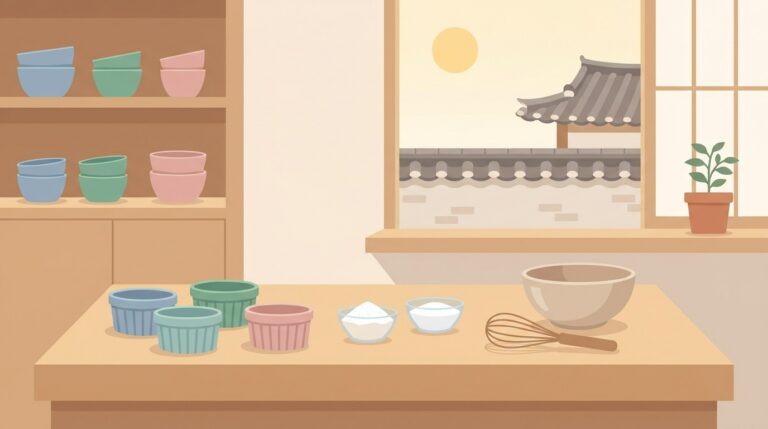
Then, you take your seat, and a huge wave of relief washes over you. In front of you sits a clean tray with pastel ceramic ramekins, each holding the exact pinch of salt, sugar, and flour you need. The warm instructor smiles and says everything is set up so you won’t make a single mistake. At that moment, you want to express your sincere gratitude and excitement in Korean—not with robotic textbook lines, but like a real local!
That is why this guide exists. Based on real questions from our Daily Hangul learners who survived (and loved!) crafting workshops across Seoul, this lesson equips you with warm, natural A2-level Korean to praise your instructor, express relief, and talk proudly about your handmade souvenirs.
Phase 2: 핵심 표현 3선 심층 분석
1. 다 준비해 주셨어요 (Da junbihae jusyeosseoyo)
- Pronunciation: [Da jun-bi-hae ju-syeo-sso-yo] (Sounds like: Da as in ‘darling’, joon-bee-hae, joo-shuh-so-yo)
- Meaning: “They prepared everything for me/us.” (Literal: “All prepared and gave [honorific].”) Real nuance: Deep appreciation for someone’s thoughtful hospitality and pre-arranged care.
- K-Culture Moment: In lifestyle variety shows like I Live Alone (나 혼자 산다), when a celebrity visits a pottery workshop and sees the clay neatly centered on the wheel, they always clasp their hands and say: “선생님이 다 준비해 주셨어요!” (Seonsaengnimi da junbihae jusyeosseoyo! / “The teacher already prepared everything for us!”)
- Editor’s Insight: Adding “-해 주셨어요” (-hae jusyeosseoyo) instead of just “준비했어요” (junbihaesseoyo) acknowledges that the teacher did this act of service for your benefit.
- Situation Spectrum: Casual (⚠️ 다 해줬어) / Semi-formal (✅ 다 준비해 주셨어요) / Formal (✅ 다 준비해 주셨습니다)
- 🤔 Think About It: In English, we often say “Everything was ready.” Why do you think Korean specifically highlights the person who performed the kind deed for you?
2. 초보자도 할 수 있어요? (Choboja-do hal su isseoyo?)
- Pronunciation: [Cho-bo-ja-do hal su i-sseo-yo?] (Rhymes roughly with Cho like ‘chore’, bo-ja, hahl soo ee-suh-yo)
- Meaning: “Can even a complete beginner do this?”
- K-Culture Moment: The classic YouTube comment under K-baking tutorials. Before viewers buy baking kits, they inevitably ask if a total “beginner” can pull off the aesthetic cafe treat.
- Editor’s Insight: “-도” (-do) means “even” or “also”. Attaching it to “초보자” (choboja – beginner) softens the question and shows gentle modesty.
- Situation Spectrum: Casual (⚠️ 초보도 돼?) / Semi-formal (✅ 초보자도 할 수 있어요?) / Formal (✅ 초보자도 가능합니까?)
- 🤔 Think About It: Is it common in your culture to admit you are a novice upfront, or do people prefer to figure it out quietly?
3. 실패 없이 따라 했어요 (Silpae eopsi ttara haesseoyo)
- Pronunciation: [Sil-pae eop-si tta-ra haes-seo-yo] (Sil-peh like ‘silk/pet’, up-she, tah-rah heh-suh-yo with a crisp double ‘t’)
- Meaning: “I followed along without failing.”
- K-Culture Moment: Frequently heard during K-drama hobby scenes where a character proudly shows off their handmade perfume or mug to their best friend: “실패 없이 잘 만들었지?” (Silpae eopsi jal mandeureotji? / “I made it well without failing, right?”)
- Editor’s Insight: “실패 없이” (silpae eopsi) literally means “without failure”. It conveys pure satisfaction that the process went smoothly thanks to clear instructions.
- Situation Spectrum: Casual (✅ 실패 없이 따라 했어) / Semi-formal (✅ 실패 없이 따라 했어요) / Formal (✅ 실패 없이 완성했습니다)
- 🤔 Think About It: Why do you think Korean hobbyists celebrate “no-fail” (실패 없는) recipes so enthusiastically in everyday culture?
Phase 3: 교과서 한국어 vs 진짜 한국어
Situation 1: Asking if the ingredients are measured
- 📖 교과서 한국어: 재료의 양을 미리 측정하셨습니까? (Jaeryoui yangeul miri cheukjeonghasyeotseumnikka? / “Did you measure the quantity of the ingredients in advance?”)
- 🗣️ 진짜 한국어: 재료 계량을 다 해두셨네요! (Jaeryo gyeryangeul da haedusyeotneyo! / “Oh, you’ve already measured out all the ingredients!”)
- 💡 왜 다를까? Textbook Korean uses clinical, scientific words like “측정” (cheukjeong – measurement/testing), whereas locals naturally say “계량” (gyeryang – culinary measurement) and add the exclamation ending “-네요” (-neyo) to show pleasant surprise.
Situation 2: Expressing that you have zero artistic talent
- 📖 교과서 한국어: 저는 손재주가 별로 없습니다. (Jeoneun sonjaejuga byeollo eopseumnida. / “I do not possess much manual dexterity.”)
- 🗣️ 진짜 한국어: 제가 완전 ‘똥손’인데 괜찮을까요? (Jega wanjeon ‘ttongson’inde gwaenchaneulkkayo? / “I am totally all thumbs, will it still be okay?”)
- 💡 왜 다를까? While textbook Korean is formal and stiff, modern Koreans use playful self-deprecating slang like “똥손” (ttongson – literally ‘poop hands’, meaning clumsy) to break the ice and ease classroom tension with a laugh.
Phase 4: K-Culture 딥다이브 & 비언어적 매너
4-1. 눈치 (Nunchi) & Studio Etiquette
- In Korean workshops, instructors give step-by-step demonstrations. Good nunchi means pausing what your hands are doing the second the teacher speaks. Rest your tools down, make eye contact, and nod gently with short audio cues like “아, 네!” (A, ne! / “Ah, yes!”).
- When the teacher hands you pre-portioned cups, receive them using both hands or with your left hand lightly touching your right forearm—a subtle sign of courtesy that instantly wins hearts in Korea!
4-2. Cultural Code: The “One-Day Class” Phenomenon
- In dynamic cities like Seoul and Busan, young Koreans love “one-day classes” (원데이 클래스). From making custom solid perfumes in Hannam-dong to baking vintage lunchbox cakes in Hongdae, these 2-hour workshops represent “힐링” (healing) and practical self-care. It is also one of the most popular date spots featured in K-dramas (think of the romantic pottery wheel scene in Ghost or modern cafe dates). Studio owners pride themselves on being meticulous hosts, which is why everything is pre-measured and set up for your absolute success.
Phase 5: 실전 롤플레이 시나리오
Setting: “Sweet Studio” in Yeonnam-dong. You are sitting at a spotless wooden workbench with Chef Minji, a warm instructor wearing a linen apron.
- Chef Minji: 어서 오세요! 오늘 마들렌 베이킹 클래스 신청하셨죠? (Eoseo oseyo! Oneul madeulleon beiking keullaeseu sincheonghasyeotjyo?)
- 🎭 행동 지문: Welcoming you warmly with a bow and pointing to your workbench.
- “Welcome! You signed up for today’s madeleine baking class, right?”
- Learner: 네, 맞아요! 그런데 제가 베이킹은 완전 처음이에요. (Ne, majayo! Geureonde jega beiking-eun wanjeon cheoeum-ieyo.)
- 🎭 행동 지문: Smiling shyly while tucking hair behind ears.
- “Yes, that’s right! But it’s completely my first time baking.”
- Chef Minji: 걱정 마세요! 초보자분들도 쉽게 만들 수 있어요. (Geokjeong maseyo! Chobojabundeuldo swipge mandeul su isseoyo.)
- 🎭 행동 지문: Handing you a clean apron with a reassuring nod.
- “Don’t worry! Even beginners can make them easily.”
- Learner: 와, 버터랑 밀가루를 다 준비해 주셨네요! (Wa, beoteorang milgarureul da junbihae jusyeotneyo!)
- 🎭 행동 지문: Looking at the cute pre-measured glass bowls with wide eyes.
- “Wow, you prepared all the butter and flour already!”
- Chef Minji: 네, 계량을 미리 다 해둬서 실패 없이 따라 하실 수 있어요. (Ne, gyeryangeul miri da haedwoseo silpae eopsi ttara hasil su isseoyo.)
- 🎭 행동 지문: Demonstrating how to whisk the mixture gently.
- “Yes, I pre-measured everything so you can follow along without any mistakes.”
- Learner: 정말 다행이에요. 순서대로만 넣으면 되나요? (Jeongmal dahaeng-ieyo. Sunseodaeroman neoeumyeon doenayo?)
- 🎭 행동 지문: Grasping the whisk with both hands attentively.
- “That’s such a relief. Do I just add them in order?”
- Chef Minji: 맞아요! 천천히 저어주세요. 잘하고 계세요! (Majayo! Cheoncheonhi jeoeojuseyo. Jalhago gyeseyo!)
- 🎭 행동 지문: Giving an encouraging thumbs-up.
- “Exactly! Whisk slowly. You’re doing great!”
- Learner: 친절하게 가르쳐 주셔서 감사해요! (Chinjeolhage gareuchyeo jusyeoseo gamsahaeyo!)
- 🎭 행동 지문: Smiling brightly as the batter turns smooth.
- “Thank you for teaching me so kindly!”
🔀 인터랙티브 분기점 (Interactive Choice)
Now, Chef Minji asks: “혹시 향이나 토핑을 더 추가해 보시겠어요?” (Would you like to add more scents or toppings?)
- Option A: “아니요, 레시피 그대로 할게요! 실패하기 싫어요.” (No, I’ll stick strictly to the recipe! I don’t want to fail.)
- Feedback [Best]: Polite, realistic, and humorous! It shows you respect the workshop recipe while keeping a lighthearted tone.
- Option B: “마음대로 다 넣을래요.” (I’ll just throw in whatever I want.)
- Feedback [Bad]: A bit too blunt and casual. In Korean workshops, straying wildly off-recipe without asking can ruin the delicate baking chemistry.
- Option C: “선생님 추천으로 부탁드려요!” (Please give me the teacher’s recommendation!)
- Feedback [Risk / Good Alternative]: Great way to build rapport, though be prepared to try unique Korean flavor profiles like mugwort (쑥) or black sesame (흑임자)!
Phase 6: 10초 감정 섀도잉 드릴
- [😊 안도하고 감격스럽게 / Relieved & Impressed]:
와! / 재료 계량을 / 다 준비해 주셨네요! (Wa! / Jaeryo gyeryangeul / da junbihae jusyeotneyo!) - [🥺 겸손하고 조심스럽게 / Humble & Inquiring]:
제가 초보인데, / 실패 없이 / 할 수 있을까요? (Jega chobo-inde, / silpae eopsi / hal su isseulkkayo?) - [✨ 뿌듯하고 감사하게 / Proud & Grateful]:
선생님 덕분에 / 예쁘게 완성했어요! (Seonsaengnim deokbune / yeppeuge wanseonghaesseoyo!)
Phase 7: K-Culture 미니 사전
- 원데이 클래스 (Wondei Keullaeseu) | Noun | One-day experiential workshop (perfume blending, baking, tufting, pottery) popular among urban Korean 20s-30s.
- 계량 (Gyeryang) | Noun | Measuring out ingredients by weight or volume. In recipe contexts, “계량스푼” means a measuring spoon.
- 똥손 (Ttongson) | Slang Noun | Literally ‘poop hands’. A humorous self-deprecating term for someone lacking craftiness or cooking skills (opposite: 금손 / Geumson – ‘golden hands’).
- 힐링 (Hilling) | Konglish Noun | Rest, therapeutic peace, or unwinding through wholesome creative hobbies.
Phase 8: 여행자를 위한 생존 키트
Survival Expressions TOP 3
- 사진 한 장 찍어 주실 수 있나요? (Sajin han jang jjigeo jusil su innayo?)
- Pro Tip: Class instructors in Korea are masters of Instagram angles! Ask them this while holding your mixing bowl.
- 포장은 어떻게 하나요? (Pojang-eun eotteoke hanayo?)
- Pro Tip: Essential when you finish baking or potting and want to safely take your craft back to the hotel.
- 다음 단계는 뭐예요? (Daeum dangyeneun mwoyeyo?)
- Pro Tip: Keep this handy if you finish whisking faster than others and wonder what to do next.
Editor’s Travel Note
- Booking Classes: Most independent workshops operate via Instagram DM or Naver Booking. You can look up classes directly through the Naver Map search for one-day workshops or book verified foreigner-friendly craft classes via the Creatrip activity booking portal.
- Studio Manners: Most Korean craft studios require removing outdoor shoes. Check the entryway for indoor slippers before stepping onto the studio floor!
Phase 9: “한 발 더 깊이” (Cultural Essay)
In Korean craft culture, instructors rarely hand you raw bulk sacks of flour or full unmeasured fragrance bottles. Instead, they line up tiny, carefully labeled vessels before you even walk through the door. This reflects “배려” (Baeryeo – thoughtful consideration). It is rooted in a collective desire to ensure that nobody feels left behind, embarrassed, or flustered. By removing the pressure of technical math, the studio creates a safe haven where you can simply enjoy the sensory experience.
💬 Your Turn: Have you ever joined a workshop where everything was pre-prepared for you? How does this style of hosting compare to classes in your home country? Drop your thoughts below!
Phase 10: FAQ & 오해 방지
Q: Can I join a one-day class if I only speak basic Korean?
A: Absolutely! Most studio instructors are very patient and use visual demonstrations, body language, and translated recipe sheets. Simple phrases like “네!” (Yes) and “감사합니다” (Thank you) go a long way.
Q: What does ‘선생님’ (Seonsaengnim) mean in a baking or pottery studio?
A: While it translates literally to “teacher,” in Korea it is the standard, polite, and universally respectful title used for studio instructors, bakers, artists, and trainers.
Q: Is tipping expected at Korean craft studios?
A: No! Tipping is not part of Korean culture. Leaving a sincere 5-star review on Naver or Instagram tagging the studio’s account is the highest and most appreciated compliment you can give.
🚨 Common Mistakes Alert
- Saying “너” (Neo) for ‘You’: Never call your teacher “너”! Address them warmly as “선생님” (Seonsaengnim).
- Confusing ‘준비했어요’ with ‘준비해 주셨어요’: Saying “준비했어요” means I prepared it. Use “준비해 주셨어요” to give credit to your host.
- Leaving without cleaning your station: While instructors do the heavy wash-up, it is customary courtesy to stack your empty ramekins neatly on the tray before heading out.
Phase 11: 액션 미션 & 참여 유도
- 🥉 Bronze Mission (Solo): Stand before a mirror and repeat the phrase “초보자도 할 수 있어요?” three times with a bright, curious intonation.
- 🥈 Silver Mission (Social): Leave a comment below sharing one item you would love to make in Seoul (Perfume? Cake? Ceramic mug?) using the phrase “다 준비해 주셨어요!”
- 🥇 Gold Mission (Real Life): Walk into a bakery or DIY studio, make eye contact, and compliment the staff with: “친절하게 설명해 주셔서 감사합니다!” (Thank you for explaining so kindly!)
🎮 K-Culture Mission: Watch any recent Korean vlog where someone takes a hobby class (search “원데이클래스 브이로그” on YouTube). Listen closely for the word “계량” or “선생님”!
Phase 12: 인터랙티브 퀴즈 챌린지
1. Situation Challenge:
You arrive at a perfume workshop and see ten tiny labeled vials waiting cleanly on your coaster. What is the most natural Korean expression to say to your instructor?
* A) 제가 다 만들었어요! (Jega da mandeureosseoyo!)
* B) 다 준비해 주셨네요! 감사해요. (Da junbihae jusyeotneyo! Gamsahaeyo.)
* C) 왜 준비를 안 했어요? (Wae junbireul an haesseoyo?)
2. Fill-in-the-Blank:
“걱정 마세요, _______도 쉽게 따라 할 수 있어요!” (Don’t worry, even a beginner can easily follow along!)
* (Hint: Korean word for ‘beginner’ + marker for ‘even’)
3. True or False:
Calling yourself a “똥손” (ttongson) in a craft studio is considered rude and offensive to the instructor. (True / False)
👉 Click to reveal answers & explanations!
- Answer: B – Expressing appreciation with “다 준비해 주셨네요!” highlights the instructor’s care.
- Answer: 초보자도 (Chobojado) – “초보자” means beginner, and “-도” means ‘even’.
- Answer: False – It is a humorous, lighthearted self-deprecating slang word that breaks the ice and helps instructors know you need extra guidance!
🎬 Watch Our Daily Videos! (Daily Hangul Official Instagram)
Review the expressions you learned in this article with our fun daily short videos! Check out native pronunciation and real-life nuances in action.
- Instagram @dailyhangul_en







