

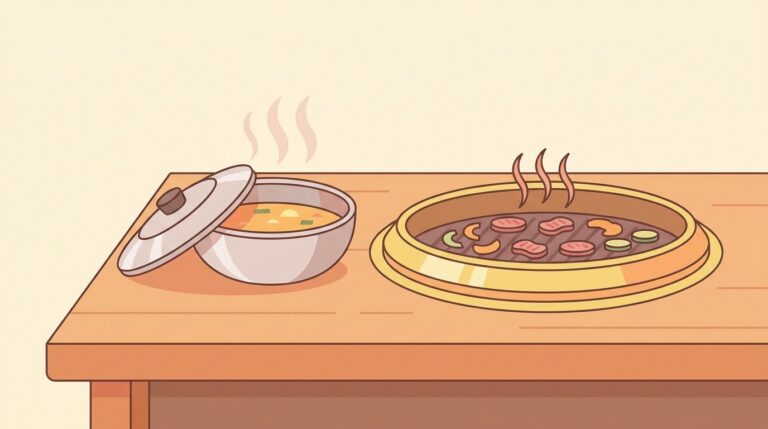
Master Korean Dining: How to Order Extra Rice Like a True Local
Phase 1: Empathy (Story-Driven Opening)
안녕하세요! 매일한글 에디터입니다. (Hello! It is your Daily Hangul editor.)
Picture this: You are sitting at a bustling Korean barbecue restaurant in Hongdae, Seoul. The sound of sizzling pork belly fills the room, the aroma of caramelized kimchi surrounds you, and your tabletop is filled with colorful side dishes. You take a bite of savory stew, reach for your iconic stainless-steel rice bowl, and realize with horror—it is completely empty! You still have plenty of grilled meat left, but no rice to pair it with. You look around, see the busy waitstaff dashing between tables, and suddenly freeze. What do you say? Do you yell “Hey!”? Do you wave your hands frantically?
If you have ever felt nervous about speaking up in a foreign restaurant, you are not alone. Hundreds of beginner learners tell us that calling a server in Korea feels intimidating. But with just one golden phrase, you can turn this awkward moment into your proudest travel achievement. Today, based on real learner feedback and years of on-the-ground dining experience, we will master the magical expression: 공깃밥 하나 추가해 주세요 (Gong-git-bap ha-na chu-ga-hae ju-se-yo). Let’s make sure you never leave a Korean restaurant hungry again!
Phase 2: Core Expressions (3 In-Depth Breakdowns)
1. 공깃밥 하나 추가해 주세요 (Gong-git-bap ha-na chu-ga-hae ju-se-yo)
- Pronunciation: [Gong-git-bap ha-na chu-ga-hae ju-se-yo] (Sounds like: “Gohng-geet-bahp hah-nah chew-gah-heh joo-seh-yoh” — ‘gong’ rhymes with ‘song’, and ‘chu-ga’ sounds like ‘chew-gah’)
- Meaning: Literal: “Air-bowl-rice one addition please do” | Real Nuance: “Please add one bowl of rice!”
- K-Culture Moment: Seen in nearly every culinary K-Drama, from Let’s Eat to Weightlifting Fairy Kim Bok-joo, whenever the main characters reach peak appetite and need a fresh round of carbs!
- Editor’s Insight: In Korean restaurants, steamed rice is served in a distinctive lidded metal bowl called a gonggi (공기). Instead of vaguely asking for “rice” (밥 – bap), asking specifically for “공깃밥” marks you instantly as a savvy insider.
- Situation Spectrum:
- Casual: ⚠️ (A bit formal with close friends, but completely fine)
- Semi-formal / Restaurants: ✅ (The absolute gold standard)
- Formal: ✅ (Polite and respectful)
- 🤔 Think About It: English speakers ask, “Can I get another bowl?” focusing on possession, while Koreans say “Please add” (추가). How does the idea of ‘adding’ reflect the continuous, shared nature of a Korean meal?
2. 저기요 (Jeo-gi-yo)
- Pronunciation: [Jeo-gi-yo] (Sounds like: “Juh-gee-yoh” — ‘jeo’ sounds like the ‘ju’ in ‘jug’, followed by ‘gee’ and ‘yo-yo’)
- Meaning: Literal: “Over there” | Real Nuance: “Excuse me! / Over here, please!”
- K-Culture Moment: When K-Pop idols or drama characters are chatting at a casual street-tent bar (pojangmacha) and need more water or food, they raise one index finger and politely call out this exact word.
- Editor’s Insight: Do not use “실례합니다” (sil-lye-ham-ni-da) to call your server! While textbooks translate that as “excuse me,” it is only used when bumping into someone on the street. In restaurants, “저기요” is the universal, polite magic word.
- Situation Spectrum:
- Casual: ✅
- Semi-formal / Eateries: ✅ (Standard etiquette)
- Formal: ⚠️ (In high-end dining, press a call button or address the host as ‘사장님’)
- 🤔 Think About It: Why say “Over there” (저기요) to call someone to you? It gently calls attention to a spot without directly confronting the person!
3. 밥 더 주세요 (Bap deo ju-se-yo)
- Pronunciation: [Bap deo ju-se-yo] (Sounds like: “Bahp duh joo-seh-yoh” — ‘deo’ sounds like ‘duh’ in everyday English)
- Meaning: Literal: “Rice more please give” | Real Nuance: “Please give me more rice.”
- K-Culture Moment: Seen when a hungry student at a cozy local diner (Baekban-jip) holds out an empty bowl to a warm, maternal restaurant owner.
- Editor’s Insight: While “공깃밥 하나 추가해 주세요” is the standard business transaction (since rice usually costs 1,000 KRW), “밥 더 주세요” sounds friendly and sweet in home-style eateries where refills are complimentary.
- Situation Spectrum:
- Casual: ✅
- Semi-formal: ✅
- Formal: ⚠️
- 🤔 Think About It: The word bap (밥) means both “cooked rice” and “a whole meal.” What does this equate to regarding how Koreans view nourishment?
Phase 3: Textbook Korean vs. Real Korean
Situation 1: Ordering an additional bowl of rice
- 📖 교과서 한국어: 쌀밥 한 그릇을 더 주문할 수 있습니까? (Ssal-bap han geu-reu-seul deo ju-mun-hal su it-seum-ni-ka? / May I order one more bowl of white rice?)
- 🗣️ 진짜 한국어: 공깃밥 하나 추가해 주세요! (Gong-git-bap ha-na chu-ga-hae ju-se-yo! / One extra bowl of rice, please!)
- 💡 왜 다를까?: “Ssalbap” sounds like an agricultural report! Native speakers use the set food term “gong-git-bap” combined with “chu-ga-hae ju-se-yo” (please add) for a natural, flowing request.
Situation 2: Catching the restaurant staff’s attention
- 📖 교과서 한국어: 종업원님, 이쪽으로 와 주십시오. (Jong-eop-won-nim, i-jjok-eu-ro wa ju-sip-si-o. / Employee, please come this way.)
- 🗣️ 진짜 한국어: 사장님~ 여기 공깃밥 하나요! (Sa-jang-nim~ yeo-gi gong-git-bap ha-na-yo! / Boss~ one rice bowl over here, please!)
- 💡 왜 다를까?: Nobody addresses waitstaff as “종업원” in real life. Calling the restaurant host “사장님” (boss/owner) flatters them and creates instant warmth!
Phase 4: K-Culture Deep Dive & Non-Verbal Manners
4-1. Nunchi (눈치) & Gestures
Before shouting across the dining room, practice a little nunchi (situational awareness). Scan your table! Do you see a small round silver or plastic bell embedded into the wood? That is the table call button (호출벨). Press it once; there is no need to yell.
If there is no bell, wait until a server is facing your general direction, raise your hand gently at shoulder height, and say “저기요~” (Jeo-gi-yo). When your piping hot stainless-steel bowl arrives, receive it with two hands (or touch your forearm with your left hand). This shows deep respect and prevents you from burning your fingers on hot metal!
4-2. Cultural Code Analysis: The Power of Rice (밥심)
In Korea, rice is emotional currency. The traditional daily greeting is not “Hello,” but “밥 먹었어요?” (Bap meog-eoss-eo-yo? – Have you eaten rice?). Historically, sharing rice was how communities survived difficult seasons together. When you ask for an extra bowl of rice in Korea, the restaurant owner does not think you are greedy; they see it as the ultimate compliment to their cooking!
Phase 5: Real-Life Roleplay Scenario
- Setting: A bustling, smoke-scented Galbi (barbecue) joint in Mapo, Seoul.
- Characters: Alex (First-time visitor) & Imo-nim (The friendly restaurant auntie).
- Alex: 🎭 [Raises one hand gently, smiling] 저기요, 사장님! (Jeo-gi-yo, sa-jang-nim! / Excuse me, boss!)
- Imo-nim: 🎭 [Hurrying over with a smile] 네! 뭐 더 드릴까요? (Ne! Mwo deo deu-ril-kka-yo? / Yes! What can I get you?)
- Alex: 🎭 [Points to the empty metal bowl] 공깃밥 하나 추가해 주세요. (Gong-git-bap ha-na chu-ga-hae ju-se-yo. / Please add one bowl of rice.)
- Imo-nim: 🎭 [Nodding enthusiastically] 네, 공깃밥 하나요! 된장찌개도 데워 줄까요? (Ne, gong-git-bap ha-na-yo! Doen-jang-jji-gae-do de-wo jul-kka-yo? / Sure, one rice! Shall I reheat your soybean stew too?)
- Alex: 🎭 [Hands together gratefully] 네, 감사합니다! (Ne, gam-sa-ham-ni-da! / Yes, thank you!)
- Imo-nim: 🎭 [Places a steaming bowl on the table] 자, 뜨거우니까 조심해요! (Ja, tteu-geo-u-ni-kka jo-sim-hae-yo! / Here you go, careful, it is hot!)
- Alex: 🎭 [Receives with two hands and bows head] 잘 먹겠습니다! (Jal meok-get-seum-ni-da! / I will eat well!)
- Imo-nim: 🎭 [Pats Alex’s shoulder cheerfully] 맛있게 먹어요~ (Mat-it-ge meog-eo-yo~ / Enjoy your meal~)
🔀 Interactive Decision Branch
You just finished your bowl and need another one right away. What do you do?
* Choice A: Wave your metal chopsticks in the air and yell: “Hey! Rice!”
* Choice B: Make gentle eye contact, raise your hand, and say: “공깃밥 하나 추가해 주세요!”
* Choice C: Walk directly into the back kitchen and open the big electric rice cooker yourself.
Feedback:
* Choice A (Risk): Waving chopsticks is impolite at Korean tables, and shouting English will stress out busy staff.
* Choice B (Best): Perfect, natural, and respectful! You will get warm service and quick food.
* Choice C (Bad): Walking into a commercial kitchen violates food safety rules and will startle the cook!
Phase 6: 10-Second Emotion Shadowing Drill
Read these aloud, pausing at the slashes / while channeling the emotion tag!
[🙋♂️ 밝고 공손하게 - Bright & Polite]
저기요! / 공깃밥 하나 / 추가해 주세요.
(Jeo-gi-yo! / Gong-git-bap ha-na / chu-ga-hae ju-se-yo.)-
[🤤 배고프고 간절하게 - Hungry & Eager]
사장님, / 밥 하나만 / 더 주세요!
(Sa-jang-nim, / bap ha-na-man / deo ju-se-yo!) -
[🙏 두 손 모아 진심으로 - Heartfelt & Grateful]
따뜻한 밥 / 감사합니다! / 잘 먹겠습니다.
(Tta-tteut-han bap / gam-sa-ham-ni-da! / Jal meok-get-seum-ni-da.)
Phase 7: K-Culture Mini Dictionary
- 공깃밥 (Gong-git-bap): Steamed white rice served in a standard stainless steel lidded bowl. Standard staple at BBQ, soup, and stew restaurants.
- 추가 (Chu-ga): Addition or add-on. Essential for asking for extras: “고기 추가” (extra meat), “반찬 추가” (extra side dishes).
- 반찬 (Ban-chan): Korean side dishes. In Korea, refills on side dishes are virtually always free; just say “반찬 더 주세요” (Ban-chan deo ju-se-yo).
- 이모님 (I-mo-nim): Literally “maternal aunt.” A warm, affectionate title for middle-aged female restaurant staff that fosters instant rapport.
Phase 8: Traveler’s Survival Kit
TOP 3 Dining Survival Expressions
- 물 좀 주세요 (Mul jom ju-se-yo) — Please give me some water.
(Pro Tip: Many casual diners are self-service for water. Look around for a water cooler labeled “물은 셀프” – Mul-eun sel-peu!) - 계산해 주세요 (Gye-san-hae ju-se-yo) — Check, please.
(Pro Tip: In Korea, you do not pay at the table. Take your paper receipt slip to the front counter near the exit door.) - 화장실 어디예요? (Hwa-jang-sil eo-di-ye-yo?) — Where is the restroom?
(Pro Tip: Restroom door passcodes are often printed at the very bottom of your receipt, or written on a key hanging by the door.)
Editor’s Travel Note
Before stepping into Seoul’s foodie alleys, download the 네이버 지도 앱 (Naver Map App Download) on your phone. Google Maps does not provide accurate walking or transit navigation in Korea due to local mapping regulations! Also remember: Tipping is 0% in South Korea. Quality service is already included, so a cheerful “감사합니다” (Gam-sa-ham-ni-da) is the best gesture you can give.
Phase 9: “One Step Deeper” (Reflective Question)
In Korean culture, the idiom “밥심으로 산다” (We live on rice power) highlights how eating together transcends mere calorie consumption. Rice represents community bonding, hospitality, and enduring resilience across generations. When you sit down and request another bowl of warm rice, you are participating in a rich social ritual that has sustained Korean families for centuries.
💬 Your Turn: What is the ultimate comfort food in your home culture that carries the same deep emotional comfort as a bowl of warm rice does in Korea? Let’s chat in the comments below!
Phase 10: FAQ & Avoiding Misunderstandings
Q: Is 공깃밥 (gong-git-bap) free of charge when I ask for it?
A: While banchan (side dishes) are free to refill, extra bowls of rice usually cost between 1,000 KRW and 2,000 KRW (about $1 to $1.50 USD), unless the restaurant explicitly advertises “밥 무한리필” (Unlimited rice refills).
Q: What if I only want half a bowl because I am getting full?
A: Rice comes pre-portioned in sealed stainless steel containers in the warmer, so staff cannot serve half-bowls. Instead, order one bowl and ask for an extra sharing bowl by saying: “앞접시 하나 주세요” (Ap-jeop-si ha-na ju-se-yo – Please give me a front/sharing plate).
Q: What should I say if I accidentally drop my metal chopsticks on the floor?
A: Do not worry! Just press the bell or call your server and say: “저기요, 젓가락 하나만 더 주세요” (Jeo-gi-yo, jeot-ga-rak ha-na-man deo ju-se-yo – Excuse me, please give me one pair of chopsticks).
🚨 Common Mistakes Warning Board
- Mistake: Waving arms or shouting “Waiter!” across the room.
Correct Action: Press the table call bell or make eye contact and softly say “저기요” (Jeo-gi-yo). - Mistake: Sticking your metal chopsticks upright into the bowl of rice.
Correct Action: Never stick chopsticks vertically! This mimics incense burning at ancestral memorial rites (jesa) and is considered bad luck. Lay them flat on your dish or chopstick rest. - Mistake: Lifting the metal rice bowl up to your mouth with your hands while eating.
Correct Action: Unlike Japanese or Chinese dining customs, in Korea the rice bowl remains flat on the table, and you eat your rice using your spoon!
Phase 11: Action Missions & Engagement
- 🥉 Bronze Mission (Solo Practice): Stand in front of your mirror, hold up an imaginary bowl, and say “공깃밥 하나 추가해 주세요!” 3 times with confidence.
- 🥈 Silver Mission (Social Share): Next time you eat rice at home or dining out, snap a photo, tag @DailyHangul on Instagram or your favorite social app, and write “공깃밥 추가!” as the caption.
- 🥇 Gold Mission (Real Life): Visit your nearest Korean restaurant or supermarket food court this weekend, order extra rice completely in Korean, and report back to us in the comments!
- 🎮 K-Culture Mission: In the next K-Drama episode you watch that features a dinner scene, listen carefully. Can you spot someone saying “저기요” or “추가”?
Phase 12: Interactive Quiz Challenge
1. [Situation Judgment] You are finishing your stew and want another bowl of rice. Which sentence is polite and natural?
* A) 밥 이리 가져와 (Bap i-ri ga-jyeo-wa)
* B) 공깃밥 하나 추가해 주세요 (Gong-git-bap ha-na chu-ga-hae ju-se-yo)
* C) 실례합니다 종업원 (Sil-lye-ham-ni-da jong-eop-won)
2. [Fill-in-the-Blank] Complete the polite calling phrase:
* “_____, 사장님!” (Hint: 3 syllables meaning ‘over there’)
3. [True or False] In Korean dining etiquette, you should pick up the metal rice bowl and bring it up to your chest while eating with chopsticks. (True / False)
👉 Click here for answers & explanations!
- Answer: B — “공깃밥 하나 추가해 주세요” is the natural, polite restaurant standard. (A is rude impolite talk; C sounds like a robotic computer translation).
- Answer: 저기요 (Jeo-gi-yo) — The universally accepted way to catch your server’s attention.
- Answer: False — In Korean table etiquette, bowls stay resting on the table, and you eat rice using your spoon (숟가락 – sut-ga-rak)!
🎬 Watch Our Daily Videos! (Daily Hangul Official Instagram)
Review the expressions you learned in this article with our fun daily short videos! Check out native pronunciation and real-life nuances in action.
- Instagram @dailyhangul_en







