

Phase 1: 공감 (Empathy & Opening)
안녕하세요! 매일한글 에디터입니다. (Hello! I’m your Daily Hangul editor.)
Picture this: You step through the sliding glass doors of a bright, spotlessly clean bank in downtown Seoul. You need to open a bank account to receive your salary or get a debit card for public transit and late-night convenience store runs. But the moment you walk in, the bank is dead silent except for a crisp electronic chime—Ding-dong!—followed by an automated robotic voice echoing across the room.
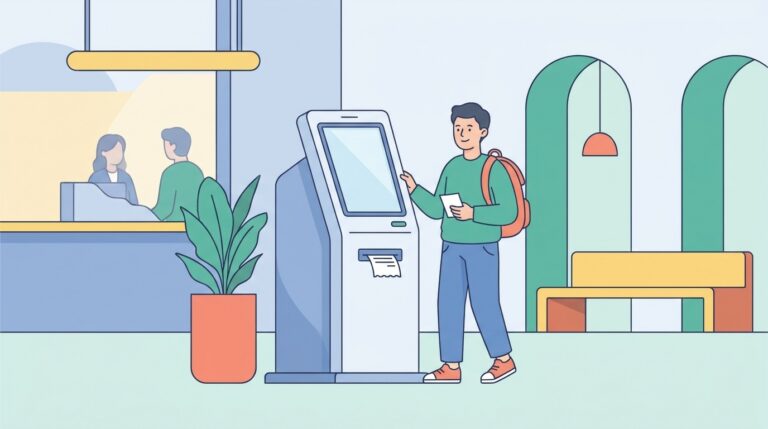
Right by the entrance stands a digital kiosk with a touch screen full of unfamiliar Sino-Korean vocabulary: 예금 (Deposits), 대출 (Loans), 공과금 (Utility bills)… and standing right beside the kiosk is a tall, sharp-looking security officer in uniform looking straight at you. Your palms get sweaty. Which button do you press? What if you take the wrong ticket and wait 40 minutes only to be turned away?
One of our community members, Alex, told us he was so intimidated during his first bank visit in Sinchon that he pretended to answer a fake phone call and walked right back out! If you have ever felt that kiosk-induced panic, take a deep breath. Today, we are breaking down everything you need to know about getting your ticket, interacting with the bank staff, and waiting smoothly like a seasoned Seoul resident. This step-by-step guide is built directly on real beginner challenges and proven survival strategies. Let’s master this together!
Phase 2: 핵심 표현 3선 심층 분석 (Top 3 Key Expressions)
1. 번호표를 뽑아야 해요 (Beonhopyo-reul ppob-aya haeyo)
- Pronunciation: [Beon-ho-pyo-reul ppob-ah-yah hae-yo] (Sounds like: “Burn-ho-pyo” with an energetic popping “p” sound on “ppob”)
- Meaning: Literal: “I must pull a number ticket.” / Real Nuance: “First things first: I need to get a queue ticket from the kiosk.”
- K-Culture Moment: Seen in almost every slice-of-life drama (like My Liberation Notes) where exhausted office workers or students quietly walk up to a machine, hit the button without looking, and grab their paper ticket.
- Editor’s Insight: The verb 뽑다 (ppobda) literally means “to pluck” or “to pull out” (like pulling out a tissue or pulling a winning lottery ticket). Even though modern bank kiosks now have touchscreen buttons, Koreans still say “번호표를 뽑다” (to pull a ticket) because the paper rolls out from the slot.
- Situation Spectrum: Casual: ⚠️ (번호표 뽑아야 돼) | Semi-formal: ✅ (번호표 뽑아야 해요) | Formal: ✅ (번호표를 뽑으셔야 합니다)
- 🤔 Think About It: In many Western countries, you might simply line up physically behind a velvet rope. Why did Korea adopt automated queue ticket systems so early across virtually all public services?
2. 통장 만들러 왔어요 (Tongjang mandeulleo wasseoyo)
- Pronunciation: [Tong-jang man-deul-leo wah-sseo-yo] (Rhymes with: “Tong-jahng mahn-deul-luh wah-so-yo”)
- Meaning: Literal: “I came to make a bankbook.” / Real Nuance: “I’m here to open a new checking/savings account.”
- K-Culture Moment: In K-Dramas, when a young protagonist lands their first part-time job or corporate role, they proudly show off their newly printed paper bankbook (통장) to their parents.
- Editor’s Insight: Koreans use the word 통장 (tongjang, the physical paper bankbook) interchangeably with “bank account” (계좌 / gyejwa). While bank tellers might use the formal phrase “계좌 개설” (opening an account), everyday speakers and friendly staff almost always say “통장 만들러 왔어요.”
- Situation Spectrum: Casual: ⚠️ (통장 만들러 왔어) | Semi-formal: ✅ (통장 만들러 왔어요) | Formal: ✅ (계좌를 개설하러 왔습니다)
- 🤔 Think About It: Even in a hyper-digital country like South Korea where mobile banking dominates, why do physical paper bankbooks still hold a deep symbolic meaning of adult responsibility?
3. 제 차례예요? (Je charye-yeyo?)
- Pronunciation: [Je cha-rye-ye-yo?] (Think of “Je” like the French “Je”, and “charye” like “cha-ree-yea”)
- Meaning: Literal: “Is it my turn?” / Real Nuance: “Is my number being called right now?”
- K-Culture Moment: When a character is daydreaming or texting in a waiting area and suddenly realizes their number might have flashed across the LED display screen, they nervously approach the counter asking this exact phrase.
- Editor’s Insight: 차례 (charye) means one’s order or turn in a sequence. If you aren’t sure whether the chime was for counter #3 or #4, this polite question instantly clears up the confusion without sounding demanding.
- Situation Spectrum: Casual: 🚫 (내 차례야? – too blunt for staff) | Semi-formal: ✅ (제 차례예요?) | Formal: ✅ (제 차례인가요?)
- 🤔 Think About It: Notice the humble first-person pronoun “제” (je) instead of “내” (nae). Using “제” automatically signals respect toward the service worker in Korean social hierarchy.
Phase 3: 교과서 한국어 vs 진짜 한국어 (Textbook vs. Real Korean)
Situation 1: Asking which button to press on the ticket kiosk
- 📖 교과서 한국어: 어느 버튼을 눌러야 합니까? (Eoneu beoteun-eul nulleoya hamnikka? / Which button must I press?)
- 🗣️ 진짜 한국어: 저, 계좌 만들려면 뭐 눌러야 돼요? (Jeo, gyejwa mandeullyeomyeon mwo nulleoya dwaeyo? / Excuse me, what should I press to open an account?)
- 💡 왜 다를까? Textbook Korean teaches rigid declarative interrogatives (
-합니까?). In real Korean banks, starting with a gentle “저…” (excuse me / um…) and using the soft conditional-려면(-if I want to…) sounds infinitely warmer and natural.
Situation 2: Asking the teller if you can come over
- 📖 교과서 한국어: 지금 창구로 가도 됩니까? (Jigeum changguro gado doemnikka? / May I proceed to the counter now?)
- 🗣️ 진짜 한국어: 104번 맞나요? (Baek-sa-beon mannayo? / Is that number 104?)
- 💡 왜 다를까? Instead of asking long bureaucratic questions about permission to approach the counter, native Koreans simply verify their ticket number directly with a bright, rising intonation.
Phase 4: K-Culture 딥다이브 & 비언어적 매너 (Deep Dive & Non-Verbal Manners)
4-1. 눈치 (Nunchi) & Body Language at the Bank
When you enter a Korean bank, the uniformed staff member standing by the door is not a police officer or intimidating bouncer; they are a 청원경찰 (Cheongwon-gyeongchal), an on-site security and customer concierge.
* The 15-degree Nod: As soon as you make eye contact, offer a polite 15-degree nod. If you look slightly lost, they will immediately ask, “어떤 일로 오셨어요?” (What brings you in today?).
* Ticket Holding Manner: Once you receive your ticket slip, hold it gently or keep it on your lap while seated. Do not wave it around or crush it. Keep one eye on the electronic LED boards above the counters. When the bell dings, your ticket number and counter number will flash simultaneously.
4-2. Cultural Code: The High-Speed Banking Ecosystem
Korean banks operate on maximum efficiency (Palli-Palli culture). Waiting areas are equipped with free water, phone charging stations, and reading glasses for seniors. Because Korean banks typically close their customer counters at 4:00 PM, lunchtime (11:30 AM – 1:30 PM) is notoriously crowded. If you visit during peak lunch hours, your ticket may show a “대기인수” (number of people waiting) of 20+ people! Visiting right around 9:30 AM or 2:00 PM will save you tons of time.
Phase 5: 실전 롤플레이 시나리오 (Real-Life Roleplay)
Setting: A bustling branch of Hana Bank near Hongdae. Soft piano music plays in the background. The ticket machine emits a soft beep.
Characters:
* You (A2 Korean Learner): Holding an alien registration card or passport, wanting to open a bank account.
* Mr. Park (Friendly Security Officer / 청원경찰): Standing attentively beside the kiosk with a warm smile.
Dialogue:
1. Mr. Park: 어서 오세요! 어떤 업무 때문에 오셨어요? (Eoseo oseyo! Eotteon eommu ttaemune osyeosseoyo? / Welcome! What business brings you in today?)
🎭 Smiles warmly and gestures his hand toward the touchscreen kiosk.
2. You: 안녕하세요! 저, 통장 만들러 왔어요. (Annyeonghaseyo! Jeo, tongjang mandeulleo wasseoyo. / Hello! Um, I came to open a bank account.)
🎭 Gives a slight polite nod and holds your hands together respectfully.
3. Mr. Park: 아, 신규 통장이요? 외국인 등록증 가지고 오셨나요? (Ah, singyu tongjang-iyo? Oeguk-in deungnokjeung gajigo osyeonnayo? / Ah, a new account? Did you bring your Alien Registration Card?)
🎭 Taps the screen options lightly while asking smoothly.
4. You: 네, 여기 있어요. (Ne, yeogi isseoyo. / Yes, I have it right here.)
🎭 Briefly shows the card from your wallet.
5. Mr. Park: 좋습니다. 개인 금융 누르시고 번호표 받으세요. (Jotseumnida. Gaein geumyung nureusigo beonhopyo badeuseyo. / Great. Press ‘Personal Banking’ and take your number ticket.)
🎭 Points his finger to the large green button on the screen.
6. You: 감사합니다. 여기서 기다리면 돼요? (Gamsahamnida. Yeogiseo gidarimyeon dwaeyo? / Thank you. Can I wait over here?)
🎭 Takes the printed ticket and gestures toward the waiting chairs.
7. Mr. Park: 네, 소파에 앉아 계시면 번호 불러 드릴 거예요. (Ne, sopae anja gyesimyeon beonho bulleo deuril geoyeyo. / Yes, if you sit on the sofa, they will call your number.)
🎭 Politely bows his head toward the seating lounge.
8. You: 네, 친절하게 알려주셔서 감사합니다! (Ne, chinjeolhage allyeojusyeoseo gamsahamnida! / Yes, thank you for kindly letting me know!)
🎭 Walks over to the waiting area with ticket #142 in hand.
🔀 인터랙티브 분기점 (Interactive Scenario Fork)
You grab your ticket, sit down on the sofa, and look down at your slip. It says: 대출 상담 (Loan Consultation) – 대기인수: 0명. Oops! You pressed the wrong button! What do you do?
- Option A: Stay seated and wait. When they call your number, explain that you actually want a checking account and debit card.
- Outcome (Risk ⚠️): Loan officers (대출 창구) cannot process simple deposits or debit cards in Korean banks. They will politely ask you to walk back to the machine, pick the correct ticket, and wait all over again!
- Option B: Silently stand up, go back to the kiosk, and ask the security guard: “저, 통장 만들려면 다시 뽑아야 해요?” (Jeo, tongjang mandeullyeomyeon dasi ppob-aya haeyo? / Excuse me, do I need to pull a ticket again to open an account?)
- Outcome (Best ✅): Perfect! Mr. Park will smile, press the “개인 입출금/예금” (Personal Deposits) button for you, and hand you the right ticket without any awkwardness.
- Option C: Walk straight to an empty counter and say: “저 지금 바빠요! 빨리 해주세요.” (Jeo jigeum bappayo! Ppal-li hae-juseyo. / I’m busy right now! Please do it fast.)
- Outcome (Bad 🚫): Immediate social penalty! Skipping the queue violates strict Korean public etiquette, and the teller will ask you to take a ticket.
Phase 6: 10초 감정 섀도잉 드릴 (10-Second Emotion Shadowing)
Practice reading these out loud, pausing where you see / and matching the emotion cue!
[😊 공손하고 씩씩하게 / Polite and confident]- 안녕하세요! / 통장 만들러 / 왔어요.
(Annyeonghaseyo! / Tongjang mandeulleo / wasseoyo.)
- 안녕하세요! / 통장 만들러 / 왔어요.
[🤔 살짝 조심스럽고 궁금하게 / Slightly careful and inquisitive]- 저기요, / 여기서 / 번호표 뽑는 거 맞아요?
(Jeogiyo, / yeogiseo / beonhopyo ppomneun geo majayo?)
- 저기요, / 여기서 / 번호표 뽑는 거 맞아요?
[👀 화들짝 놀라며 확인하듯 / Alert and checking your turn]- 딩동! / 혹시 / 제 차례예요?
(Ding-dong! / Hoksi / je charye-yeyo?)
- 딩동! / 혹시 / 제 차례예요?
Phase 7: K-Culture 미니 사전 (Mini Dictionary)
- 번호표 (Beon-ho-pyo) | Queue Number Ticket
- Usage: The essential thermal paper slip printed at kiosks in banks, post offices, and immigration offices.
- 창구 (Chang-gu) | Service Counter / Teller Window
- Usage: Refers to the physical desk where tellers sit. “1번 창구로 가세요” means “Please proceed to Counter 1.”
- 대기인수 (Dae-gi-in-su) | Number of People in Queue
- Usage: Printed on your ticket. If it says “대기인수: 5명”, it means five customers are ahead of you.
- 청원경찰 (Cheong-won-gyeong-chal) | Bank Security Concierge
- Usage: The helpful uniformed officer standing by the entrance. They are your best ally for navigating kiosk buttons!
Phase 8: 여행자를 위한 생존 키트 (Traveler’s Survival Kit)
Top 3 Survival Phrases for Korean Banks
- 체크카드도 같이 만들고 싶어요. (Chekeukadeudo gachi mandeulgo sipeoyo.)
- Meaning: “I’d like to get a debit card issued as well.”
- Pro Tip: In Korea, debit cards connected to checking accounts are called “체크카드” (check cards), not 데빗카드 (debit cards).
- 얼마나 기다려야 해요? (Eolmana gidaryeoya haeyo?)
- Meaning: “Approximately how long is the wait?”
- Pro Tip: Use this if the lobby looks packed and you have a scheduled appointment coming up.
- 외국인 등록증 있어요. (Oeguk-in deungnokjeung isseoyo.)
- Meaning: “I have my Alien Registration Card (ARC).”
- Pro Tip: Have this card physically out of your wallet before your number is called to save precious time.
Editor’s Travel Note 💡
Korean bank operating hours are notoriously short: typically 09:00 AM to 04:00 PM on weekdays, completely closed on weekends and national holidays. Before heading out, search for your nearest branch on 네이버 지도 앱 다운로드 (Naver Map) to verify the exact branch closing hours and avoid showing up at 4:05 PM to locked glass doors!
Phase 9: “한 발 더 깊이” (Cultural Reflection)
In South Korea, waiting in public spaces is rooted in an unspoken social contract of collective order and technological fairness. The automated queue number ticket system isn’t just about efficiency; it guarantees that everyone—regardless of social rank, wealth, or age—is served in exact chronological sequence. When you sit patiently in the waiting lobby listening for the electronic chime, you are participating in a core civic ritual of modern Korean life.
💬 Your Turn: How does queuing in your home country compare to Korea’s automated kiosk system? Do you prefer physical lines or numbered slips? Share your thoughts in the comments below!
Phase 10: FAQ & 흔한 실수 예방 (FAQ & Mistakes)
Q: Can I open a Korean bank account on a short-term 90-day tourist visa?
A: Generally, major commercial banks (KB Kookmin, Shinhan, Hana, Woori) require an Alien Registration Card (ARC) or a long-term visa (study, work, working holiday) to issue a full-service checking account and domestic debit card. Tourists can exchange currency at counters without an ARC, but regular account opening requires legal residency documentation.
Q: What is the difference between ‘예금’ and ‘대출’ on the ticket machine?
A: 예금 (Yegeum) covers deposits, withdrawals, new checking accounts, debit cards, and general banking. 대출 (Daechul) is strictly for loans and mortgages. For account creation, always select 예금/입출금 (Deposits/General).
Q: What happens if I miss my number when it’s called?
A: Tellers will usually ring the bell twice and wait about 15-20 seconds. If nobody approaches, they press the button for the next ticket. If you miss your turn, politely show your ticket to the security officer or teller; in quiet branches they may accommodate you, but during rush hours you will likely need to pull a new ticket.
🚨 흔한 실수 (Common Mistakes) Warning Board
- Mistake: Throwing away your paper ticket slip while waiting.
- Correct Action: Keep it in hand! The teller will look at your slip to confirm your number matches their screen.
- Mistake: Confusing your ticket number with the counter number.
- Correct Action: Your ticket shows a large number (e.g., 205). The LED display shows:
[대기번호 205 -> 3번 창구](Ticket 205 go to Counter 3).
- Correct Action: Your ticket shows a large number (e.g., 205). The LED display shows:
- Mistake: Bringing only a digital photo of your passport or ARC on your smartphone.
- Correct Action: Korean financial regulations require physical, original IDs. Digital scans on phones will be rejected at the counter.
Phase 11: 액션 미션 (Action Missions)
- 🥉 Bronze Mission (Solo Shadowing): Stand in front of your mirror and practice saying: “안녕하세요! 통장 만들러 왔어요.” three times without stumbling.
- 🥈 Silver Mission (Community Share): Leave a comment on this post writing out your favorite Korean phrase from today’s lesson using Hangul and English.
- 🥇 Gold Mission (Real-Life Challenge): Next time you visit a Korean bank, post office (우체국), or district office (주민센터), walk up to the security concierge and ask: “번호표 어디서 뽑아요?” (Where do I pull a number ticket?).
- 🎮 K-Culture Mission: Watch an episode of a modern workplace K-Drama (like Misaeng or Start-Up) and listen carefully for the distinctive Korean bank kiosk chime sound (Ding-dong!) in any public building scene!
Phase 12: 인터랙티브 퀴즈 챌린지 (Interactive Quiz)
1. Situation Judgment: You walk into a bank in Seoul to open a checking account. Which button on the digital kiosk should you tap?
* (A) 대출 (Daechul)
* (B) 공과금 수납 (Gong-gwageum sunap)
* (C) 예금 / 일반 창구 (Yegeum / Ilban changgu)
* (D) 기업 금융 (Gieop geumyung)
2. Fill-in-the-Blank: Complete the sentence you say to the concierge:
* “저, 통장 ________ 왔어요.” (I came to make a bankbook.)
3. True or False: In Korea, debit cards linked to checking accounts are called ‘데빗카드’ (Debit Card) at the counter.
* (True / False)
👉 Click here to reveal answers and explanations!
- Answer: (C) 예금 / 일반 창구 (Yegeum / Ilban changgu)
- Explanation: ‘예금’ means deposits/accounts. ‘대출’ is for loans, ‘공과금’ is for paying utility taxes, and ‘기업 금융’ is for corporate business accounts.
- Answer: 만들러 (mandeulleo)
- Explanation: Combined with 오다 (to come), the pattern
-(으)러 오다expresses purpose: 만들다 (to make) + -러 왔어요 = “came to make.”
- Explanation: Combined with 오다 (to come), the pattern
- Answer: False
- Explanation: Koreans virtually never say ‘데빗카드’. They call it a 체크카드 (Check Card)!
- Explanation: Koreans virtually never say ‘데빗카드’. They call it a 체크카드 (Check Card)!
🎬 Watch Our Daily Videos! (Daily Hangul Official Instagram)
Review the expressions you learned in this article with our fun daily short videos! Check out native pronunciation and real-life nuances in action.
- Instagram @dailyhangul_en







