

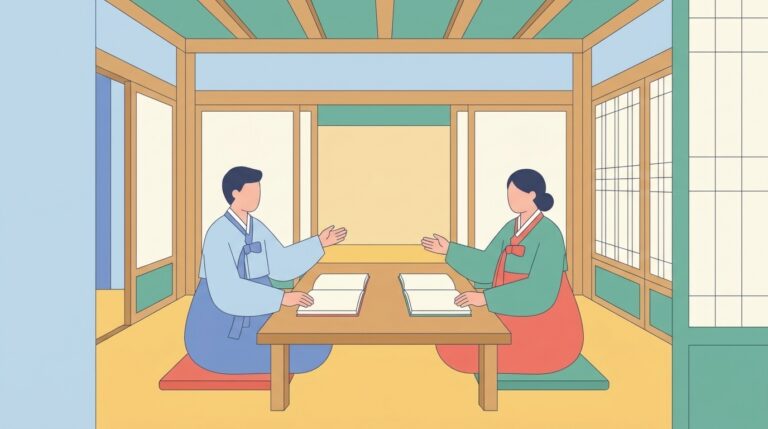
Phase 1: Empathy (Story-Immersive Opening)
안녕하세요! 매일한글 에디터입니다. (Annyeonghaseyo! Maeil Hangul editeo-imnida. – “Hello! This is your Daily Hangul editor.”)
Picture this: You are sitting in a cozy, book-lined seminar cafe near Sinchon or Daehak-ro, surrounded by graduate students and researchers passionately debating over steaming mugs of Americano. The discussion pivots to the philosophy of science. In your native language, you could effortlessly deconstruct Karl Popper’s critique of induction or Thomas Kuhn’s theory of incommensurable paradigms. But the moment you open your mouth in Korean, you find yourself hesitant. How do you challenge a peer’s premise without sounding confrontational? How do you distinguish between everyday “proof” and rigorous “falsifiability” (반증 가능성) without sounding like an archaic textbook?
Many of our advanced C2 learners tell us: “I know the philosophy, but Korean academic discourse feels like a completely different cultural maze.” In Korean intellectual circles, articulating epistemological questions isn’t just about translating technical vocabulary; it is about calibrating intellectual modesty with razor-sharp analytical precision. Over the past decade of coaching foreign academics, diplomats, and cultural researchers, I have distilled the exact communicative framework you need to articulate deep epistemology (인식론) naturally. By mastering these expressions, you will no longer feel like an observer in Korean academic discussions—you will command the room with the eloquence of a native scholar.
Phase 2: Top 3 Core Expressions In-Depth
1. 반증 가능성 (Banjeung ganeungseong)
- Pronunciation: [Banjeung ganeungseong] (Sounds like “Bahn-jeung gah-neung-sung”; think of ‘ban’ as in banner, and ‘sung’ like a choir note)
- Meaning: Literal: “Counter-evidence possibility” | Real Academic Nuance: Karl Popper’s “Falsifiability”—the essential criterion distinguishing empirical science from dogma.
- K-Culture Moment: Seen frequently on intellectual TV talk shows such as The Dictionary of Useless Knowledge (알아두면 쓸데없는 신비한 잡학사전), where scientific panelists challenge sweeping societal assumptions.
- Editor’s Insight: While beginners rely on 증명 (jeungmyeong – proof), C2 masters deploy 반증 (banjeung). It immediately frames your argument around empirical scrutiny rather than mere contradiction.
- Situation Spectrum: Casual: 🚫 | Semi-formal: ⚠️ | Formal: ✅
- 🤔 Think About It: In English, we say “You can’t prove that wrong.” In Korean intellectual settings, asking “반증 가능성이 열려 있습니까?” (Is the possibility of falsification open?) shifts the focus from interpersonal doubt to collaborative scientific inquiry.
2. 패러다임의 전환 (Paereodaim-ui jeonhwan)
- Pronunciation: [Paereodaim-ui jeonhwan] (Sounds like “Peh-ruh-dah-eem-ui jyun-hwahn”)
- Meaning: Literal: “Shift of paradigm” | Real Academic Nuance: Thomas Kuhn’s “Paradigm Shift”—a fundamental rupture in the conceptual framework of a discipline.
- K-Culture Moment: Widely used in Korean business journals, cultural documentaries, and high-stakes legal dramas like Law School (로스쿨) when a revolutionary interpretation overturns established precedent.
- Editor’s Insight: Be careful not to use this for trivial changes. Reserving it for deep structural shifts signals profound analytical judgment.
- Situation Spectrum: Casual: ⚠️ | Semi-formal: ✅ | Formal: ✅
- 🤔 Think About It: Korean discourse often emphasizes continuity and tradition. Invoking a ‘패러다임의 전환’ implies a radical epistemological disruption that demands rigorous justification.
3. 인식론적 토대 (Insingnonjeok todae)
- Pronunciation: [Insingnonjeok todae] (Notice the nasal assimilation: 인식론 becomes in-sing-non)
- Meaning: Literal: “Epistemological foundation” | Real Academic Nuance: The fundamental axioms and justification criteria underlying a truth claim.
- K-Culture Moment: Frequently cited in university keynote lectures and high-level editorial critiques in publications such as The Hankyoreh or Kyunghyang Shinmun.
- Editor’s Insight: Using this phrase demonstrates that you are not merely evaluating facts, but auditing the very worldview from which those facts were derived.
- Situation Spectrum: Casual: 🚫 | Semi-formal: ⚠️ | Formal: ✅
- 🤔 Think About It: Why does Korean academic speech value locating the ‘토대’ (soil/base)? It reflects a deeply rooted philosophical impulse to verify the roots before examining the branches.
Phase 3: Textbook Korean vs. Real Korean
Situation 1: Challenging an Unfalsifiable Generalization
- 📖 교과서 한국어 (Textbook Korean):
그 이론은 반증될 수 없기 때문에 과학적이지 않습니다.
(Geu ironeun banjeungdoel su eopgi ttaemune gwahakjeogiji anseumnida. – That theory cannot be disproven, so it is not scientific.) - 🗣️ 진짜 한국어 (Real Native Korean):
그 가설은 반증 가능성이 결여되어 있어서, 과학적 구획 기준을 충족하기 어렵다고 봅니다.
(Geu gaseoreun banjeung ganeungseongi gyeoryeodoeeo isseoseo, gwahakjeok guhoek gijuneul chungjokhagi eoryeopdago bomnida. – That hypothesis lacks falsifiability, making it difficult to meet the criterion of scientific demarcation.) - 💡 왜 다를까? (Why the difference?):
C2 academic discussions rarely use blunt dismissals like “과학적이지 않다”. Instead, they reference philosophical metrics such as “구획 기준” (criterion of demarcation) combined with cautious humility (“~라고 봅니다”).
Situation 2: Highlighting a Revolutionary Epistemic Shift
- 📖 교과서 한국어 (Textbook Korean):
토마스 쿤에 따르면 과학은 완전히 새로운 생각으로 변합니다.
(Tomaseu kune ttareumyeon gwahageun wanjeonhi saeroun saenggageuro byeonhamnida. – According to Thomas Kuhn, science changes into completely new thoughts.) - 🗣️ 진짜 한국어 (Real Native Korean):
쿤의 관점에서 보면, 이는 단순한 지식의 누적이 아니라 인식의 틀 자체가 재편되는 패러다임의 전환입니다.
(Kuneui gwanjeom-eseo bomyeon, ineun dansunhan jisigui nujeogi anira insigui teul jachega jaepyeondoeneun paereodaimui jeonhwan-imnida. – From Kuhn’s perspective, this is not a mere accumulation of knowledge, but a paradigm shift in which the framework of cognition itself is reorganized.) - 💡 왜 다를까? (Why the difference?):
Natural scholarly Korean distinguishes between cumulative progress (누적적 축적) and gestalt transformation (틀의 재편).
Phase 4: K-Culture Deep Dive & Non-Verbal Manners
4-1. 눈치 (Nunchi) & Physical Debating Etiquette
In Anglo-American seminars, aggressive intellectual confrontation is often celebrated as passion. In Korean intellectual culture, however, epistemological rigor must be tempered with relational grace (예의).
* The Softened Gaze and Head Tilt: When questioning another scholar’s theoretical foundation, do not maintain an unbroken, penetrating stare. Tilt your head slightly, nod slowly to validate their logic, and preface your counterpoint with a cushion phrase: “말씀해 주신 문제의식에는 깊이 공감합니다만…” (I deeply empathize with the problem you raised, however…).
* Two-Handed Notes: When referencing another participant’s paper or quoting Popper/Kuhn, handle documents with both hands. It symbolizes intellectual reverence toward the shared space of discourse.
4-2. Cultural Code Analysis: The Intellectual Talk Show Era
Over the last decade, Korean popular culture has witnessed a surge of intellectual programming—from tvN’s Alssinjobjak to YouTube philosophical salons like Sapience Studio. Koreans admire erudite thinkers who combine profound academic depth with warmth and humility (지적 겸손). Mastering epistemological discourse in Korean allows you to participate in this vibrant cultural landscape, where deep philosophical frameworks are applied to everyday K-Pop trends, cinematic masterpieces like Parasite, and contemporary societal dilemmas.
Phase 5: Real-Life Roleplay Scenario
Setting: A quiet evening seminar room at Seoul National University’s College of Humanities. The scent of roasted barley tea fills the air as graduate researchers critique a newly proposed methodology.
Characters: You (Visiting Researcher) and Min-seo (Senior PhD candidate in Philosophy of Science).
- 민서 (Min-seo):
🎭 자료를 넘기며 안경을 고쳐 쓴다.
선생님, 이번 논문에서 제시하신 모형은 귀납적 관찰 결과에만 지나치게 기대고 있는 것 아닐까요?
(Seonsaengnim, ibeon nonmun-eseo jesihasin moyeongeun gwinapjeok gwanchal gyeol-gwa-eman jinachige gidaego inneun geot anilkkayo?)
“Colleague, isn’t the model you presented in this paper relying too heavily on inductive observation alone?” -
You:
🎭 미소를 띠며 천천히 고개를 끄덕인다.
지적 감사합니다, 민서 님. 포퍼가 지적했듯 백조의 사례처럼 귀납적 일반화는 언제나 한계에 부딪히기 마련이죠.
(Jijeok gamsahamnida, Minseo nim. Popeoga jijeokhaetdeut baekjoui saryecheoreom gwinapjeok ilbanhwaneun eonjena han-gye-e budithigi maryeon-ijyo.)
“Thank you for the insight, Min-seo. As Popper pointed out with the white swan example, inductive generalization is always bound to run into limits.” -
민서 (Min-seo):
🎭 흥미롭다는 듯 눈을 반짝이며 몸을 앞으로 기울인다.
그렇다면 해당 가설의 경험적 반증 가능성은 구체적으로 어떻게 확보할 계획이신가요?
(Geureotdamyeon haedang gaseorui gyeongheomjeok banjeung ganeungseongeun guchejeogeuro eotteoke hwakbohal gyehoeg-isinkayo?)
“In that case, how specifically do you plan to secure the empirical falsifiability of that hypothesis?” -
You:
🎭 연구 노트를 펼쳐 도표를 짚으며 차분하게 답한다.
예외적 사례가 발견되었을 때 보조 가설로 도피하지 않고, 기각될 수 있는 엄격한 시험 조건을 설정해 두었습니다.
(Yeoejeok saryega balgyeondoeeosseul ttae bojo gaseollo dopihaji anko, gigakdoel su inneun eomgyeokan siheom jogeoneul seoljeonghae dueotseumnida.)
“I have set strict testing conditions under which it can be rejected, rather than escaping into ad hoc auxiliary hypotheses when counter-instances appear.” -
민서 (Min-seo):
🎭 감탄하며 고개를 끄덕인다.
반증주의적 태도가 매우 철저하시네요. 하지만 쿤의 입장을 취하는 연구자들은 이를 통약 불가능한 패러다임 간의 충돌로 해석할 수도 있을 텐데요.
(Banjeungjuuijeok taedoga maeu cheoljeohasineyo. Hajiman Kunui ipjangeul chwihaneun yeon-gujadeureun ireul tong-yak bulganeunghan paereodaim ganui chungdollo haeseokal sudo isseul tendeyo.)
“Your falsificationist approach is remarkably rigorous. However, scholars taking Kuhn’s stance might interpret this as a conflict between incommensurable paradigms.” -
You:
🎭 차 한 모금을 마신 뒤 차분하게 논리를 잇는다.
충분히 타당한 지적입니다. 서로 다른 패러다임 속에서 개념의 의미가 달라질 수 있다는 점은 인정합니다.
(Chungbunhi tadanghan jijeog-imnida. Seoro dareun paereodaim sog-eseo gaenyeomui uimiga dallajil su itdaneun jeomeun injeonghamnida.)
“A very valid point. I acknowledge that the meaning of concepts can shift across divergent paradigms.” -
민서 (Min-seo):
🎭 따뜻한 미소로 화답한다.
그럼에도 불구하고 두 패러다임이 만나는 접점을 찾으시려는 것이군요?
(Geureom-edo bulguhago du paereodaim-i mannaneun jeopjeomeul chajeusiryeoneun geosigun-yo?)
“So, nevertheless, you are attempting to locate the point of contact between the two paradigms?” -
You:
🎭 눈을 마주치며 신념을 담아 맺는다.
네, 그것이야말로 우리가 지식의 진보를 논할 수 있는 최소한의 인식론적 토대라고 믿기 때문입니다.
(Ne, geugeos-iyamallo uriga jisigui jinboreul nonhal su inneun choesohanui insingnonjeok todaerago mitgi ttaemun-imnida.)
“Yes, because I believe that is the bare minimal epistemological foundation through which we can discuss the progress of knowledge.”
🔀 Interactive Branching Moment
Min-seo challenges your epistemology: “Do you truly believe scientific knowledge progresses linearly toward truth?” How will you respond?
- Option A: “그건 과학을 모르는 소리예요. 쿤의 이론은 상대주의에 빠질 위험이 있어서 완전히 틀렸습니다.” (That’s an unscientific claim. Kuhn’s theory risks falling into relativism and is totally wrong.)
- Feedback: 🚫 Bad. Extremely confrontational and dismissive. In a Korean seminar, this creates immediate conversational freezing (갑분싸).
- Option B: “진리의 궁극적 도달 여부는 유보하더라도, 반증을 통한 오류 제거 과정 자체가 학문적 진보라고 봅니다.” (Even if we suspend judgment on reaching ultimate truth, I view the very process of error elimination through falsification as academic progress.)
- Feedback: ✅ Best. Masterful C2 synthesis! It combines Karl Popper’s fallibilism with intellectual tact and linguistic sophistication.
- Option C: “포퍼 말만 맞고 쿤은 좀 비과학적이지 않나요?” (Isn’t Popper just right and Kuhn somewhat unscientific?)
- Feedback: ⚠️ Risk. Grammatically understandable, but conceptually naive and overly casual for an advanced philosophical forum.
Phase 6: 10-Second Emotional Shadowing Drill
Read aloud along the pause marks (/) while channeling each emotional cue:
[🤔 지적 호기심을 담아 차분하게 - Calm & Intellectually Inquisitive]
우리는 무엇을 / 어떻게 알 수 있는가라는 질문은 / 모든 학문적 사유의 / 출발점입니다.
(Urineun mueoseul / eotteoke al su inneun-garaneun jilmuneun / modeun hakmunjeok sayu-ui / chulbaljeom-imnida. – The question of what and how we can know is the starting point of all academic thought.)-
[⚡ 단호하고 논리정연하게 - Firm & Analytically Decisive]
어떤 가설이든 / 반증 가능성을 열어두지 않는다면 / 그것은 신념일 뿐 / 과학적 지식이라 부를 수 없습니다.
(Eotteon gaseorideun / banjeung ganeungseongeul yeoreoduji anneundamyeon / geugeoseun sinnyeomil ppun / gwahakjeok jisigira bureul su eopseumnida. – If any hypothesis does not leave open the possibility of falsification, it is merely dogma, not scientific knowledge.) -
[🌌 깊은 통찰을 담아 무게감 있게 - Profound & Insightful]
과학의 역사는 / 지식의 단순 축적이 아니라 / 세계를 바라보는 틀 자체가 전복되는 / 패러다임의 전환이었습니다.
(Gwahagui yeoksaneun / jisigui dansun chukjeogi anira / segyereul baraboneun teul jachega jeonbokdoeneun / paereodaimui jeonhwan-ieosseumnida. – The history of science was not a mere accumulation of knowledge, but a paradigm shift in which the very framework of viewing the world was overturned.)
Phase 7: K-Culture Mini Dictionary
- 반증하다 (Banjeunghada) | To falsify / To disprove with empirical counter-evidence
- Usage: Used in both laboratory sciences and analytical humanities when an anomaly dismantles an existing theory. E.g., “이 단 하나의 반례가 기존 정설을 반증합니다.” (This single counterexample falsifies the established orthodoxy.)
- 통약 불가능성 (Tong-yak bulganeungseong) | Incommensurability (Kuhnian concept)
- Usage: The state where two paradigms cannot be directly compared or translated using a neutral common standard. Highly prized in graduate seminars comparing divergent methodologies.
- 정당화된 참된 신념 (Jeongdanghwadoen chamdoen sinnyeom) | Justified True Belief (JTB)
- Usage: The classical epistemological definition of knowledge originating from Plato. Used whenever analyzing whether an intuition qualifies as objective knowledge.
- 귀납적 한계 (Gwinapjeok han-gye) | Inductive limitation / Problem of induction
- Usage: The vulnerability inherent in drawing universal laws from finite empirical observations (David Hume / Karl Popper).
Phase 8: Scholar’s Survival Kit
Top 3 Academic Survival Phrases
- 논지를 다시 한번 정리해 주실 수 있을까요?
(Nonjireul dasi hanbeon jeongnihae jusil su isseulkkayo?)
Pro Tip: Deploy this when an academic argument gets too tangled; it buys you time while sounding exceptionally focused. - 그 주장의 방법론적 전제에 대해 여쭙고 싶습니다.
(Geu jujang-ui bangbeomnonjeok jeonje-e daehae yeojjutgo sipseumnida.)
Pro Tip: The most elegant way to probe someone’s philosophical grounding without sounding belligerent. - 상호 패러다임 간의 대화 가능성을 모색해 볼 가치가 있습니다.
(Sangho paereodaim ganui daehwa ganeungseongeul mosaekhae bol gachiga isseumnida.)
Pro Tip: The ultimate bridge-building phrase to bring a deadlocked academic dispute to a harmonious close.
Editor’s Travel Note: Intellectual Exploration in Seoul
If you want to experience Korea’s vibrant scholarly culture firsthand, head straight to Paju Book City (파주출판도시) or spend an afternoon in the philosophy aisles of Kyobo Book Centre Gwanghwamun (교보문고 광화문점). For navigating campus transit or locating quiet academic book cafes in Hyehwa-dong, remember that Google Maps often lacks real-time walking and transit precision in Korea. Make sure to download and use the Naver Map app download for flawless navigation between university archives and indie academic bookstores.
Phase 9: “One Step Deeper” (Reflective Essay)
In Western intellectual history, epistemology has often been propelled by sharp dialectical confrontations—the Cartesian quest for indubitable certainty or Popper’s battle against verificationism. Interestingly, when Koreans absorbed Western philosophy of science in the 20th century, it encountered a profound indigenous tradition of Neo-Confucian epistemology, such as the debate over Gyeokmulchiji (격물치지 – the investigation of things to extend knowledge). In Korea, truth is rarely viewed in complete isolation from human relationship and communal responsibility. When Korean scholars vigorously debate Popper’s falsificationism and Kuhn’s paradigm shifts today, they are not merely engaging in cold logical algebra; they are seeking an ethical, grounded methodology for how human beings should live and understand reality together.
💬 Your Turn: Do you side more with Popper’s relentless quest for falsification, or Kuhn’s recognition of historical and social paradigms? How do you say “knowledge” in your native culture? Share your philosophical take in the comments below! (한국어로 남겨주시면 더욱 좋아요!)
Phase 10: Structured FAQ & Common Mistakes
Q: What is the exact difference between ‘반증 (banjeung)’ and ‘반박 (banbak)’?
A: While both involve disagreement, 반박 (banbak) means “refutation” or verbal counterargument in a debate setting, whereas 반증 (banjeung) specifically refers to empirical falsification—providing tangible counter-evidence that disproves a theoretical law.
Q: Can I use the word ‘패러다임 (paradigm)’ in casual daily Korean conversations?
A: Yes, but with caution. In casual settings, using it for small lifestyle adjustments can sound pretentious. However, native speakers often use it playfully or ironically, such as: “이 배달 앱은 야식 문화의 패러다임 전환이야!” (This delivery app is a paradigm shift in late-night snacking culture!).
Q: Why do Korean scholars frequently use passive or indirect endings like ‘~로 사료됩니다’ or ‘~라고 볼 수 있습니다’?
A: In Korean intellectual discourse, excessive dogmatism is seen as an epistemological blind spot. Indirect endings indicate intellectual fallibilism—acknowledging that one’s current knowledge is open to ongoing verification and respectful scholarly consensus.
🚨 Common Mistakes Alert
- Confusing ‘틀리다 (teullida – to be wrong)’ with ‘다르다 (dareuda – to be different)’: When discussing competing paradigms, saying “저 패러다임은 틀려요” borders on an epistemological offense. Say “관점의 차이에서 비롯된 상이한 패러다임입니다” (It is a divergent paradigm arising from a difference in perspective).
- Overusing ‘증명할 수 없다 (Cannot be proved)’: Beginners often default to this for everything. In philosophical critique, use “경험적으로 검증되거나 반증되기 어렵습니다” (It is difficult to be empirically verified or falsified).
- Mispronouncing ‘인식론’ as [In-sik-ron]: Due to Korean nasalization rules, ‘ㄱ’ before ‘ㄹ’ mutates to ‘ㅇ’, and ‘ㄹ’ becomes ‘ㄴ’. It must be pronounced as [인싱논 – In-sing-non].
Phase 11: Action Missions & Community Engagement
- 🥉 Bronze Mission (Solo Practice): Read Phase 6’s Shadowing Drill three times out loud. Focus especially on the nasal assimilation in 인식론적 [In-sing-non-jeok].
- 🥈 Silver Mission (Social Media Share): Write a 1-sentence thought on your favorite scientific theory using the word 반증 가능성 or 패러다임의 전환 on Instagram/Threads and tag
@DailyHangul. - 🥇 Gold Mission (Live Action): Next time you watch an intellectual Korean debate show on YouTube or talk with a Korean friend about deep topics, use the cushion phrase: “그 문제의식에는 충분히 공감하지만, 인식론적 전제를 다시 짚어볼 필요가 있어요.”
🎮 K-Culture Mission: Watch an episode of a Korean investigative reporting show like Unanswered Questions (그것이 알고 싶다) or an intellectual round-table, and listen for how experts challenge evidence using forms of 반증.
Phase 12: Interactive Quiz Challenge
Test your mastery of Korean philosophy of science!
- Contextual Judgment: Which of the following is the most natural, scholarly Korean response when an interlocutor makes an unfalsifiable claim?
- (A) “그건 틀렸으니까 다시 연구해 오세요.”
- (B) “그 주장은 반증 가능성이 결여되어 있어 학문적 가설로 성립하기 어렵습니다.”
- (C) “제 말이 무조건 맞으니까 그냥 들으세요.”
- Fill-in-the-Blank: 토마스 쿤에 따르면 과학의 발전은 점진적인 축적이 아니라, 이전 체계와의 단절을 수반하는 ( _______ )의 전환을 통해 이루어진다.
- Clue: P_ _ _ _ _ _
- True / False Culture Check: In Korean academic culture, showing 100% emotional assertiveness without cushion phrases is considered a mark of supreme scholarship.
- (True / False)
👉 정답 및 해설 확인하기 (Click to reveal answers & explanations)
- 정답: (B)
해설: (B) accurately invokes Karl Popper’s standard of scientific demarcation (반증 가능성) while maintaining polite academic register. (A) and (C) are aggressive and socially inappropriate. -
정답: 패러다임 (Paradigm)
해설: Thomas Kuhn defined the revolutionary progress of science as a shift in paradigms (패러다임의 전환). -
정답: False
해설: Korean academic etiquette highly values intellectual modesty (지적 겸손) and softening cushion statements to create constructive, collaborative inquiry.
🎬 Watch Our Daily Videos! (Daily Hangul Official Instagram)
Review the expressions you learned in this article with our fun daily short videos! Check out native pronunciation and real-life nuances in action.
- Instagram @dailyhangul_en







