

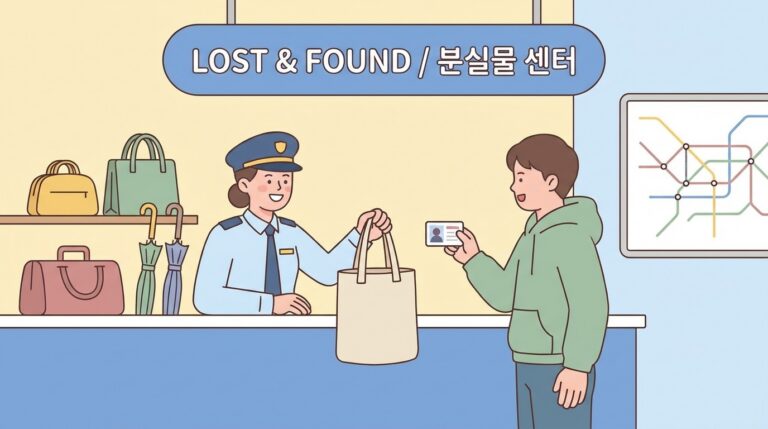
Phase 1: Empathy (Story-Driven Opening)
안녕하세요! (Annyeonghaseyo!) It’s your Daily Hangul editor here, your trusted local culture navigator!
Picture this: You just spent an incredible afternoon cafe-hopping in Seongsu-dong, hopped on Subway Line 2 humming your favorite K-pop track, and stepped out onto the platform at Hongdae. Suddenly, cold sweat hits your neck. Your tote bag—containing your passport, travel wallet, and limited-edition concert merch—is still sitting quietly on the overhead luggage rack as the green train doors slide shut! In a K-drama, a dashing CEO might race across the city on a motorbike to retrieve it for you. But in real-life Seoul, you have something even more reliable: Korea’s world-renowned subway Lost and Found network.
Every week, thousands of items are cataloged with meticulous care. However, many foreign travelers panic because they don’t know what to say or assume their belongings are gone forever. Today, based on real student experiences and field-tested survival Korean, I’ll teach you the simple, polite A2-level phrase you will hear: 신분증을 가지고 분실물 센터로 방문하시면 찾을 수 있어요 (You can pick it up by visiting the Lost and Found with your ID), along with everything you need to confidently reclaim your treasures.
Phase 2: Top 3 Core Expressions Deep Dive
1. 신분증을 가지고 오시면 돼요 (Sinbunjeung-eul gajigo osimyeon dwaeyo)
- Pronunciation: [Sin-boon-jeung-eul ga-ji-go oh-si-myeon dway-yo] (Sounds like “seen-boon-jung” with a breezy “dway-yo” at the end)
- Meaning: Literal: “If you come having your ID, it is fine.” | Actual Nuance: “All you need to do is bring your identification card.”
- K-Culture Moment: You will hear this reassuring phrase from public officers, hotel concierges, or concert ticket booths whenever identity confirmation is required.
- Editor’s Insight: The grammar
-(으)면 돼요is a lifesaver for A2 learners! It turns a complicated instruction into a comforting “you just need to…” statement. - Situation Spectrum: Casual: ⚠️ (Use
신분증 가져오면 돼with close friends) | Semi-formal: ✅ (신분증 가지고 오시면 돼요) | Formal: ✅ (신분증을 지참해 주시기 바랍니다) - 🤔 Think About It: In many Western countries, verbal descriptions or email receipts are often enough. Why do Korean facilities prioritize official photo IDs (
신분증) before handing anything over?
2. 제 물건을 찾으러 왔어요 (Je mulgeon-eul chajeureo wasseoyo)
- Pronunciation: [Je mool-geon-eul cha-jeu-reo wah-sseo-yo] (Think of “mulgeon” like “mool-gun” and “chajeureo” like “cha-jew-row”)
- Meaning: Literal: “I came in order to find/pick up my item.” | Actual Nuance: “I’m here to collect my lost property.”
- K-Culture Moment: The magic sentence you say when you slide open the frosted glass door of the Lost and Found center.
- Editor’s Insight: The verb
찾다means both ‘to search’ and ‘to retrieve/claim’. Pairing it with-(으)러 오다(to come in order to do something) clearly announces your purpose without awkward rambling. - Situation Spectrum: Casual: 🚫 | Semi-formal: ✅ | Formal: ✅ (
물품을 수령하러 방문했습니다) - 🤔 Think About It: Notice how polite Korean phrases explicitly state the visitor’s goal right away to respect the listener’s time.
3. 분실물 센터가 어디에 있어요? (Bunsilmul senteoga eodie isseoyo?)
- Pronunciation: [Boon-sil-mool sen-teo-ga eoh-di-eh ee-sseo-yo?] (Say “boon-seal-mool” smoothly)
- Meaning: Literal: “Lost item center where is?” | Actual Nuance: “Where is the Lost and Found office?”
- K-Culture Moment: Said to the station master at the help booth through the intercom window when you need directions inside a massive metro transfer hub.
- Editor’s Insight:
분실물(lost item) is the formal Sino-Korean term used across public transit. Even if your grammar is broken, saying분실물 센터 어디예요?will instantly point station staff in the right direction. - Situation Spectrum: Casual: ⚠️ (
분실물 센터 어디 있어?) | Semi-formal: ✅ | Formal: ✅ (분실물 센터 위치가 어디입니까?) - 🤔 Think About It: How does your home country distinguish between formal administrative vocabulary and everyday speech?
Phase 3: Textbook Korean vs. Real Korean
Situation 1: Inquiring if your lost bag arrived
- 📖 교과서 한국어 (Textbook): 제 가방이 여기에 보관되어 있습니까? (Je gabang-i yeogie bogwandweo isseumnikka? / Is my bag stored here?)
- 🗣️ 진짜 한국어 (Real-life): 혹시 검은색 가방 들어온 거 있나요? (Hoksi geomeunsaek gabang deureoon geo innayo? / By any chance, has a black bag been brought in?)
- 💡 왜 다를까? (Why the difference?): Real Koreans soften inquiries with
혹시(by any chance) and use the sensory phrasal verb들어오다(to come in) rather than stiff passive verbs like보관되다(to be stored).
Situation 2: Expressing deep gratitude upon getting it back
- 📖 교과서 한국어 (Textbook): 당신의 노고에 진심으로 감사드립니다. (Dangsin-ui nogoe jinsimeuro gamsadeurimnida. / I sincerely thank you for your hard work.)
- 🗣️ 진짜 한국어 (Real-life): 찾아주셔서 정말 감사합니다! (Chajajusyeoseo jeongmal gamsahamnida! / Thank you so much for finding it for me!)
- 💡 왜 다를까? (Why the difference?): Textbook phrases can sound like a formal corporate speech! In everyday life, acknowledging their direct favor with
-아/어 주셔서creates authentic, warm human connection.
Phase 4: K-Culture Deep Dive & Non-Verbal Manners
4-1. 눈치 (Nunchi) & Gestures
When visiting the Lost and Found center:
1. Two-Hand Rule (두 손 사용): Always hand over your ID card (passport, Alien Registration Card, or driver’s license) using both hands, holding the corners with a slight 15-degree head bow. Tossing an ID onto the counter with one hand comes off as rude, even if you speak fluent Korean!
2. Eye Contact & Patience: Lost and found managers will carefully match serial numbers or contents. Maintain soft, patient eye contact without hovering impatiently over their desk partition.
4-2. Cultural Code Analysis: The Safe City Phenomenon
Tourists often marvel at how people in Seoul leave laptops on cafe tables to visit the restroom. This isn’t just luck; it’s reinforced by an intricate network of CCTV cameras and a community mindset called Dodeok (civic morality). Subway cleaners and fellow commuters routinely hand items to station offices within minutes. Everything is photographed and entered into the national database. Showing your ID ensures items return to their legitimate owner, preventing fraudulent claims.
Phase 5: Real-World Roleplay Scenario
Setting: Seoul Metro Line 2 City Hall Station Lost & Found Center (시청역 유실물센터).
Characters:
* Officer Kim (직원): A dedicated, kind subway officer wearing neat navy gloves.
* Alex (알렉스): An exchange student who left a backpack on Line 2.
- Officer Kim:
🎭 (Looks up with a warm smile)어서 오세요. 어떻게 오셨어요? (Eoseo oseyo. Eotteoke osyeosseoyo? / Welcome. How can I help you?) - Alex:
🎭 (Slight bow, hands clasped)안녕하세요! 제 물건을 찾으러 왔어요. (Annyeonghaseyo! Je mulgeon-eul chajeureo wasseoyo. / Hello! I came to pick up my item.) - Officer Kim:
🎭 (Opens the inquiry log)어떤 물건 잃어버리셨어요? (Eotteon mulgeon ireobeorisyeosseoyo? / What kind of item did you lose?) - Alex:
🎭 (Shows a photo of the bag on phone)검은색 백팩이에요. 2호선에 두고 내렸어요. (Geomeunsaek baekpaek-ieyo. I-hoseone dugo naeryeosseoyo. / It’s a black backpack. I left it on Line 2.) - Officer Kim:
🎭 (Checks the shelf and brings out a bag)이거 맞으세요? 지갑이랑 충전기가 들어있네요. (Igeo majeuseyo? Jigan-irang chungjeongiga deureoinneyo. / Is this the one? There is a wallet and charger inside.) - Alex:
🎭 (Gasps in relief)네, 맞아요! 정말 감사합니다! (Ne, majayo! Jeongmal gamsahamnida! / Yes, that’s right! Thank you so much!) - Officer Kim:
🎭 (Hands over a claim slip and pen)본인 확인을 위해 신분증을 보여주세요. (Bon-in hwag-in-eul wihae sinbunjeung-eul boyeojuseyo. / Please show your ID for identity verification.) - Alex:
🎭 (Presents passport with both hands)여기 여권 있어요. (Yeogi yeogwon isseoyo. / Here is my passport.)
🔀 Interactive Decision Point
Officer Kim finishes checking your passport. How will you respond to complete the interaction?
- Choice A: “여권 줬으니까 이제 가방 줘요.” (I gave you my passport, now give me the bag.)
- Choice B: “도와주셔서 정말 감사합니다! 좋은 하루 보내세요!” (Thank you so much for your help! Have a great day!)
- Choice C: Just take the bag silently and turn around to walk out.
-
Choice Analysis:
- Choice A (Risk): Very blunt and sounds demanding due to low politeness register. Officer Kim will feel disrespected.
- Choice B (Best): Perfect! It wraps up the interaction with sincere gratitude and a warm Korean blessing.
- Choice C (Bad): Discarding basic courtesies makes you seem cold. A quick bow and thanks is expected in Korean culture.
Phase 6: 10-Second Emotion Shadowing Drill
Practice matching pitch, speed, and emotion by pausing at /:
[🥺 Desperate & Polite]
저기요… / 혹시 / 검은색 가방 들어온 거 있나요? / (Jeogiyo… / hoksi / geomeunsaek gabang deureoon geo innayo?)[😊 Immensely Relieved]
네! / 그거 제 거 맞아요! / 정말 다행이에요! / (Ne! / geugeo je geo majayo! / jeongmal dahaeng-ieyo!)[🙏 Respectful & Grateful]
신분증 여기 있습니다. / 찾아주셔서 / 정말 감사합니다! / (Sinbunjeung yeogi itseumnida. / chajajusyeoseo / jeongmal gamsahamnida!)
Phase 7: K-Culture Mini Dictionary
- 신분증 (Sinbunjeung) | ID Card / Identification
- Daily/Business Use: Essential whenever visiting banks, picking up parcels, checking into hotels, or claiming lost property.
- 분실물 (Bunsilmul) | Lost Item
- Daily/Business Use: Synonym of
유실물 (Yusilmul). Commonly seen on subway station signage alongside arrows.
- Daily/Business Use: Synonym of
- 유실물센터 (Yusilmul senteo) | Lost and Found Center
- Daily/Business Use: The official administrative title for lost property centers located at hub stations like City Hall, Wangsimni, and Express Bus Terminal.
- 보관하다 (Bogwanhada) | To keep / To hold in custody
- Daily/Business Use: Used by staff to explain how long an item stays at the station before being transferred to the National Police Agency.
Phase 8: Traveler’s Survival Kit
Top 3 Survival Phrases
- 지하철에 물건을 두고 내렸어요. (Jihacheore mulgeon-eul dugo naeryeosseoyo.)
- Pro Tip: Memorize your train line number and the exact time you got off to help staff trace the train immediately.
- 몇 호선 분실물 센터로 가야 해요? (Myeot hoseon bunsilmul senteoro gaya haeyo?)
- Pro Tip: Seoul Metro divides lost centers by line operator (Lines 1-8 vs Line 9 vs Airport Railroad).
- 제 이름으로 보관되어 있나요? (Je ireumeuro bogwandweo innayo?)
- Pro Tip: Use this if a station staff member previously phoned ahead for you.
Editor’s Travel Note
- Install the comprehensive transit guide via the official KakaoMetro subway map app to check live train car numbers (e.g., Car 4-2). Knowing your door location doubles your chance of recovery!
- Check the nationwide search portal at the Korean National Police Lost112 website where all unclaimed subway items migrate after 7 days.
Phase 9: One Step Deeper (Reflection)
In Korea, retrieving lost items requires presenting a verified ID (신분증) because ownership validation is rooted in mutual civic responsibility. Historically, Korea’s resident registration system established high administrative accountability. While losing something can feel vulnerable, the requirement for an ID protects your personal belongings from opportunistic claims.
💬 Your Turn: Have you ever lost an item while traveling abroad? How was the recovery process different from Korea’s system? Share your story in the comments below!
Phase 10: FAQ & Common Mistakes
Q: What kinds of ID are accepted if I am a tourist without a Korean ARC?
A: Your foreign passport is universally accepted! A clear photo of your passport on your smartphone might work for initial verification, but physical passports or international driving permits are strongly preferred.
Q: What happens if I can’t visit the center before my flight departs?
A: You can authorize a local friend or guide to pick it up on your behalf. They will need a signed letter of attorney (위임장), a copy of your passport, and their own ID.
Q: How long will the subway station keep my lost item?
A: Subway centers hold items for about 7 days. After that, items are transferred to the local police station and logged on the police Lost112 portal.
🚨 Common Mistakes Alert
- ❌ Mistake 1: Running directly to the destination station without noting the train car number.
- Correct Action: Look at the platform floor where you boarded (e.g.,
5-3) and check your payment app to note the exact timestamp.
- Correct Action: Look at the platform floor where you boarded (e.g.,
- ❌ Mistake 2: Expecting the center to be open 24/7.
- Correct Action: Most metro lost and found offices operate on weekdays from 09:00 to 18:00. Check operational hours before traveling across town.
- ❌ Mistake 3: Saying “I lost it” using the verb
잃다 (ilta)instead of잃어버리다 (ireobeorida)or두고 내리다 (dugo naerida).- Correct Action: Say
두고 내렸어요(I left it behind and got off), which is the natural native idiom.
- Correct Action: Say
Phase 11: Action Mission & Engagement
- 🥉 Bronze Mission: Practice saying
제 물건을 찾으러 왔어요out loud in front of a mirror 5 times. - 🥈 Silver Mission: Save the nearest Subway Lost & Found phone number and screenshot your passport picture on your phone for emergency backup.
- 🥇 Gold Mission: Help a fellow traveler or write a simulated inquiry post using our core vocabulary on social media!
- 🎮 K-Culture Mission: Watch an episode of a slice-of-life drama (like Extraordinary Attorney Woo or My Mister) and listen closely for whenever someone hands over a
신분증!
Phase 12: Interactive Quiz Challenge
1. Situational Judgment:
You left your shopping bag on Line 4 and arrived at the Lost and Found counter. What is the most natural, polite opening statement?
* A) 가방 줘요. (Gabang jwoyo.)
* B) 안녕하세요, 제 물건을 찾으러 왔어요. (Annyeonghaseyo, je mulgeon-eul chajeureo wasseoyo.)
* C) 신분증 필요 없어요. (Sinbunjeung piryo eopseoyo.)
2. Fill-in-the-Blank:
“You just need to bring your ID.”
______을 가지고 오시면 돼요.
3. True or False:
If you don’t have a Korean ID card, subway staff will immediately confiscate your lost belongings. (True / False)
👉 Click to view answer & explanation
- Answer: B | Polite and clearly states your purpose using A2 conversational grammar.
- Answer: 신분증 (Sinbunjeung) | Meaning identification card.
- Answer: False | Foreign tourists can freely claim items using their physical passport!
🎬 Watch Our Daily Videos! (Daily Hangul Official Instagram)
Review the expressions you learned in this article with our fun daily short videos! Check out native pronunciation and real-life nuances in action.
- Instagram @dailyhangul_en







