

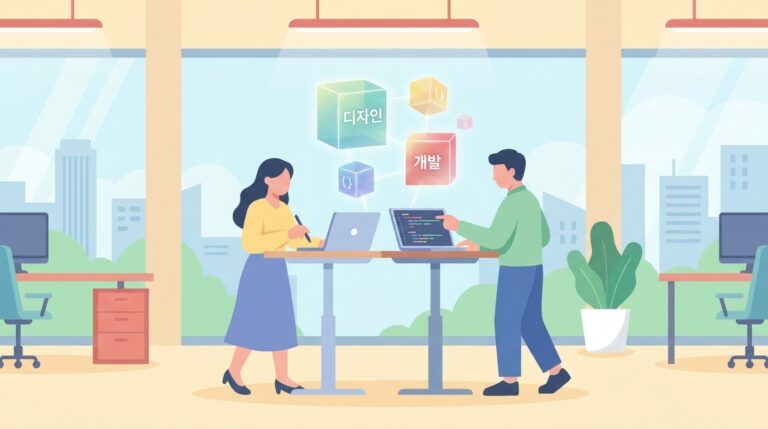
Bridge the Gap Between Figma and Code: Korean Tech Handoff Lingo
Phase 1: Empathy (Story Immersion Opening)
안녕하세요! (Annyeonghaseyo!) It is your trusted Daily Hangul editor and cultural navigator here! If you have ever stepped foot inside an IT hub in South Korea—whether it is the sprawling digital campuses of Pangyo Techno Valley or the trendy boutique startup offices in Seongsu-dong—you know the vibe immediately. It feels just like a scene out of the K-drama Start-Up (스타트업): sleek standing desks, monitors glowing with Figma frames and VS Code windows, and baristas churning out iced Americanos at lightning speed.
Yet, behind those polished glass partitions lies a battle every global professional knows too well: the friction between designers and developers. Imagine this: you are working at a fast-paced Korean startup, and you carefully hand off your Figma screens. An hour later, a senior front-end developer sends a message on Slack: “이 버튼 컴포넌트, 기존 디자인 시스템이랑 싱크가 안 맞는 것 같아요. 소통 비용이 좀 드네요…” (I think this button component is out of sync with our design system. It is creating communication friction…).
Your stomach drops. Did they just complain about you? Not quite! In Korean tech culture, having a strong design system isn’t just about pretty buttons; it is about eliminating 소통 비용 (communication costs) and preserving team harmony. Through dozens of feedback sessions with international product designers and software engineers working in Seoul, we have crafted this ultimate B2-level guide to help you master the exact language needed to streamline handoffs and earn the instant respect of your Korean teammates.
Phase 2: Core Expressions Deep Dive (핵심 표현 3선)
1. 소통 비용을 줄이다 (Sotong biyong-eul jurida)
- Pronunciation: [So-tong bi-yong-eul ju-ri-da] (Think: So-tong sounds like “sew-tone”, and biyong sounds like “bee-yong”).
- Meaning: Literally “to reduce communication costs” -> Refers to minimizing unnecessary back-and-forth, misunderstandings, and meeting fatigue through standardized processes.
- K-Culture Moment: In modern Korean corporate culture—especially in tech giants like Naver, Kakao, and Toss—efficiency is king. When project managers propose documentation or reusable systems, they always frame it around eliminating “소통 비용”.
- Editor’s Insight: Koreans value speed and harmony (눈치, nunchi). When you tell your team, “이 방식으로 소통 비용을 줄일 수 있어요” (We can cut down on communication friction this way), you instantly sound like a considerate, highly strategic senior colleague.
- Situation Spectrum: Casual: ⚠️ | Semi-formal: ✅ | Formal: ✅
- 🤔 Think About It: Why does Korean corporate culture view excessive questions as a “cost” (비용) rather than natural discovery? Consider how collectivism prioritizes workflow momentum.
2. 싱크를 맞추다 (Singkeu-reul matchuda)
- Pronunciation: [Sing-keu-reul mat-chu-da] (Sounds like “sync-ew-reul maht-choo-dah”).
- Meaning: Literally “to match the sync” -> To align expectations, synchronize design tokens with codebase components, or hold an alignment sync.
- K-Culture Moment: You will hear this constantly during sprint planning or 1-on-1 coffee chats. Instead of saying “회의합시다” (Let’s have a meeting), colleagues casually say, “잠깐 싱크 맞출까요?” (Shall we do a quick sync?).
- Editor’s Insight: While borrowed from the English word “sync”, pairing it with the native Korean verb 맞추다 (to adjust/fit together) makes it an active, collaborative effort to get on the exact same page.
- Situation Spectrum: Casual: ✅ | Semi-formal: ✅ | Formal: ⚠️
- 🤔 Think About It: English speakers say “get in sync” (intransitive), but Koreans say “맞추다” (transitive action). Does this imply that team alignment requires conscious, deliberate mutual effort?
3. 컴포넌트를 재사용하다 (Keomponeonteu-reul jaesayonghada)
- Pronunciation: [Keom-po-neon-teu-reul jae-sa-yong-ha-da] (Pronounce jae like “J” in jay, meaning “re-“).
- Meaning: Literally “to reuse components” -> Building and implementing modular UI assets to guarantee consistency across platforms.
- K-Culture Moment: Korean tech firms champion “Extreme Agility”. Reusing components is seen as professional respect toward developers’ workload. Saying this proves you are mindful of implementation effort.
- Editor’s Insight: The prefix 재- (再) denotes repetition or renewal. Use this when advocating for modularity during Figma component audits.
- Situation Spectrum: Casual: ⚠️ | Semi-formal: ✅ | Formal: ✅
- 🤔 Think About It: How does advocating for component reusability reflect the Korean concept of baeryeo (배려, consideration for others’ labor)?
Phase 3: Textbook Korean vs. Real-World Korean
Situation 1: Asking developers to follow the standardized design rules
- 📖 교과서 한국어 (Textbook): 규칙대로 작업해 주시기 바랍니다. (Gyu-chik-dae-ro jak-eop-hae ju-si-gi ba-ram-ni-da.) — “Please perform the task according to the regulations.”
- 🗣️ 진짜 한국어 (Real-World): 디자인 토큰 맞춰서 작업해 주시면 감사하겠습니다. (Dijain to-keun mat-chwo-seo jak-eop-hae ju-si-myeon gam-sa-ha-get-seum-ni-da.) — “I would appreciate it if you could align the implementation with our design tokens.”
- 💡 왜 다를까? (Why the difference?): Standard textbook Korean sounds like a sterile legal disclaimer. Real Korean product teams talk specifically about tokens, variants, and guidelines using polite conditional requests (
-해 주시면 감사하겠습니다).
Situation 2: Informing engineers that the specs are organized in Figma
- 📖 교과서 한국어 (Textbook): 개발자에게 설계 문서를 전송했습니다. (Gae-bal-ja-e-ge seol-gye mun-seo-reul jeon-song-haet-seum-ni-da.) — “I have dispatched the architectural blueprint documents to the programmer.”
- 🗣️ 진짜 한국어 (Real-World): 핸드오프 페이지에 스펙 다 정리해 뒀어요! (Haen-deu-o-peu pe-i-ji-e seu-pek da jeong-ni-hae dwo-sseo-yo!) — “I have organized all the specs on the handoff page for you!”
- 💡 왜 다를까? (Why the difference?): Modern Korean professionals rarely use archaic words like “전송” or “설계 문서” for digital design handoffs. They fluidly integrate global tech loanwords into conversational Korean grammar.
Phase 4: K-Culture Deep Dive & Non-Verbal Etiquette
4-1. 눈치 (Nunchi) & Digital Body Language in Pangyo
When collaborating with Korean engineers, eye contact and formal bowing are only half the story—Digital Nunchi is where the magic happens:
1. Figma Cursor Etiquette: Avoid abruptly dragging frames while a developer is inspecting CSS values. Leave a friendly cursor chat comment or park your cursor neatly in the margin.
2. The Softening Emoticons on Slack: Ending a sentence with just a period in tech communication can feel chillingly cold to Koreans. Adding a small polite wave (👋) or the classic smiling eyes (^^) softens the tone dramatically when requesting code fixes.
3. The Quick Acknowledgment Nod: In Korean standup meetings, when an engineer mentions a blocker, do not just stay blank-faced. Give a slow, rhythmic head nod (끄덕끄덕) to indicate empathy before chiming in with your solution.
4-2. The Pangyo Techno Valley Ecosystem
Pangyo, located just south of Seoul, is South Korea’s Silicon Valley. In this high-density environment, standard hierarchies have melted away into modern English nicknames (e.g., “Jason 님”, “Sarah 님”). However, the underlying collaborative spirit remains deeply Korean: shared responsibility, extreme velocity, and seamless mutual respect. In this world, a rock-solid design system is heralded as the ultimate peace treaty between artistic vision and code pragmatism.
Phase 5: Real-World Roleplay Scenario
Setting: A cozy meeting pod at a fintech startup in Pangyo. Minho (Senior Frontend Engineer) and Jiwon (Product Designer) are reviewing the new payment flow.
- 민호 (Minho): 지원 님, 이번 결제 플로우 핸드오프 문서 확인했는데요. (Jiwon nim, ibeon gyeolje peul-lo-u haen-deu-o-peu munseo hwaginhaenneundeyo.)
🎭 [안경을 살짝 고쳐 쓰며, 화면을 가리킨다 / Adjusting his glasses slightly, pointing at the monitor]
(Jiwon, I checked the handoff document for the new payment flow.) -
지원 (Jiwon): 네, 민호 님! 혹시 보시면서 어색하거나 걸리는 부분 있으셨나요? (Ne, Minho nim! Hoksi bosimyeonseo eosaekhageona geollineun bubun isseosyeonnayo?)
🎭 [미소를 띤 채 귀를 기울이며 / Smiling and listening intently]
(Yes, Minho! Did you spot anything awkward or concerning while looking through it?) -
민호 (Minho): 이번 모달 버튼 패딩값이 기존 디자인 시스템이랑 살짝 다른 것 같아요. (Ibeon modal beoteun paedinggapsi gijon dijain siseutemirang saljjak dareun geot gatayo.)
🎭 [살짝 곤란한 듯 머리를 긁적이며 / Scratching the back of his head with an apologetic tone]
(The modal button padding seems slightly different from our existing design system.) -
지원 (Jiwon): 아, 맞아요! 예외 케이스로 잡았었는데, 기존 컴포넌트로 재사용하는 게 개발하시기 더 편할까요? (A, majayo! Yewoe ke-i-seu-ro jab-at-seon-neun-de, gijon keomponeonteu-ro jaesayonghaneun ge gae-bal-ha-si-gi deo pyeon-hal-kka-yo?)
🎭 [메모 앱을 켜며 적극적인 태도로 / Opening her notes app with a proactive attitude]
(Ah, you are right! I made it an edge case, but would reusing our existing component make development easier for you?) -
민호 (Minho): 네! 기존 컴포넌트를 쓰면 소통 비용도 줄고 QA 일정도 훨씬 단축될 것 같습니다. (Ne! Gijon keomponeonteu-reul sseumyeon sotong biyongdo julgo QA iljeongdo hwolssin danchukdoel geot gatseumnida.)
🎭 [안도하는 표정으로 고개를 끄덕이며 / Nodding with an expression of relief]
(Yes! If we use the existing component, it will cut communication overhead and significantly shorten the QA schedule.) -
지원 (Jiwon): 좋아요. 그럼 시스템 토큰에 맞춰서 바로 수정해 둘게요! (Jowayo. Geureom siseutem tokeune matchwoseo baro sujeonghae dulgeyo!)
🎭 [Figma에서 레이아웃을 즉시 수정하며 / Instantly adjusting the layout in Figma]
(Awesome. I will align it with our system tokens and update it right away!) -
민호 (Minho): 감사합니다! 슬랙으로 싱크 한번 더 맞춰 주시면 바로 작업 들어갈게요. (Gamsahamnida! Seullaeg-euro singkeu hanbeon deo matchwo jusimyeon baro jak-eop deureogalgeyo.)
🎭 [밝게 웃으며 엄지를 가볍게 올린다 / Smiling brightly with a light thumbs-up]
(Thank you! Once we do a quick final sync on Slack, I will jump right into coding.) -
지원 (Jiwon): 넵, 10분 내로 수정하고 슬랙 드릴게요. 화이팅! (Nep, sip-bun naero sujeonghago seullaek deurilgeyo. Hwaiting!)
🎭 [두 손을 모아 가볍게 인사하며 / Clasping hands gently in a friendly closing bow]
(Got it, I will tweak it within 10 minutes and ping you on Slack. Fighting!)
🔀 Interactive Decision Point
Suppose Minho points out a button inconsistency. How should you respond?
- Option A: “디자인 의도니까 그냥 시안대로 개발해 주세요.” (It is my design intent, so please just code it exactly as shown.)
- Feedback [Bad 🚫]: Shuts down collaboration instantly. In Korean teams, ignoring engineering constraints creates immediate friction and damages team trust.
- Option B: “시스템 컴포넌트 재사용할 수 있게 수정할게요. 소통 비용 줄여 봐요!” (I will adjust it so we can reuse our system component. Let’s keep communication friction low!)
- Feedback [Best ✅]: Outstanding! Demonstrates flexible thinking, respect for dev constraints, and fluent professional terminology.
- Option C: “모르겠어요. PM 님한테 물어보세요.” (I don’t know. Go ask the PM.)
- Feedback [Risk ⚠️]: Deflective and passive. Shows an unwillingness to take ownership of your design specifications.
Phase 6: 10-Second Emotion Shadowing Drill
Practice saying these lines with the exact emotional intonation indicated!
- [🤝 사려 깊고 협력적인 톤으로 / Considerate & Collaborative]
“기존 컴포넌트를 재사용하면 / 소통 비용을 / 훨씬 줄일 수 있어요.”
(Gijon keomponeonteu-reul jaesayonghamyeon / sotong biyong-eul / hwolssin juril su isseoyo.) -
[💡 번뜩이는 제안을 던지듯 / Proactive & Bright]
“핸드오프 전에 / 개발팀이랑 / 디자인 싱크 한번 맞출까요?”
(Haen-deu-o-peu jeone / gaebaltimirang / dijain singkeu hanbeon matchulkkayo?) -
[😊 감사하고 든든한 태도로 / Reassuring & Friendly]
“토큰 네이밍 통일해 주셔서 / 작업 속도가 / 진짜 빨라졌어요!”
(Tokeun neiming tong-il-hae jusyeoseo / jak-eop sokdoga / jinjja ppallajyeosseoyo!)
Phase 7: K-Culture Mini Dictionary
- 핸드오프 (Haendeo-opeu) — Design Handoff
- Meaning: The pivotal milestone where finalized designs and spec sheets are transferred to software engineers. Used daily in Korean agile environments.
- 디자인 토큰 (Dijain tokeun) — Design Tokens
- Meaning: Standardized variables (colors, spacing, typography) shared identically across design files and CSS/codebases.
- 싱크 (Singkeu) — Sync / Alignment
- Meaning: Short for synchronization. Commonly used as a verb phrase “싱크 맞추다” to clarify requirements before beginning execution.
- 소통 비용 (Sotong biyong) — Communication Overhead / Friction
- Meaning: The time, effort, and emotional bandwidth wasted when requirements are unclear. Reducing this is a badge of honor for Korean product teams.
Phase 8: Expat & Tech Professional Survival Kit
Survival Phrases TOP 3
- “이거 컴포넌트화 되어 있나요?” (Igeo keomponeonteuhwa doe-eo innayo?) — Is this turned into a reusable component?
- Pro Tip: Use this during design reviews to check whether an asset belongs to the master design system library.
- “핸드오프 문서 링크 슬랙에 남겨 드렸어요.” (Haen-deu-o-peu munseo ringkeu seullaege namgyeo deuryeosseoyo.) — I left the link to the handoff doc on Slack for you.
- Pro Tip: In Korea, dropping a polite notification immediately after updating docs prevents idle waiting.
- “QA 들어가기 전에 싱크 한번 해요.” (QA deureogagi jeone singkeu hanbeon haeyo.) — Let’s sync up once before moving into QA.
- Pro Tip: Suggesting a quick alignment meeting saves days of QA bug disputes later.
Editor’s Travel & Expat Note
If you are visiting tech offices around Pangyo or Teheran-ro in Gangnam, be sure to install the Naver Map app on your smartphone, as foreign mapping apps do not provide real-time indoor transit navigation inside Korea’s massive tech complexes. When meeting Korean colleagues for coffee chats (커피챗), ordering an Iced Americano (아아, Ah-Ah) regardless of freezing winter weather is the unofficial rite of passage!
Phase 9: “One Step Deeper” (한 발 더 깊이)
In Western individualist workplaces, a design system is often praised primarily for mechanical speed and code maintainability. However, in Korean workplace culture, where the collective 우리 (Uri – “We / Us” ) mindset remains foundational, a well-orchestrated design system is viewed as an act of empathy. When a designer adheres to shared components, they are silently saying to the developer: “I value your time, and I respect your night from overtime work (야근).” It transforms cold UI tokens into warm social consideration.
💬 Your Turn: In your home culture, is standardizing work processes seen as creative restriction or professional teamwork? How do you think this influences collaboration between creative and technical roles? Let us know in the comments below!
Phase 10: FAQ & Common Pitfalls
Q: Can I use the term “핸드오프” with non-tech staff in Korea?
A: It is best understood within product squads (developers, designers, POs). If speaking with traditional executive management or sales teams, use broader business terms like 인수인계 (insu-in-gye – handover/transition) or 산출물 전달 (sanchulmul jeondal – deliverables transfer).
Q: What is the most polite way to tell a Korean engineer that they missed a UI detail?
A: Soften the blow using the “~것 같아요” (it seems like…) pattern. For example: “시안이랑 패딩값이 조금 다르게 구현된 것 같아요! 확인 부탁드려요 ^^” (It seems the padding was implemented slightly different from the mockup! Could you please take a look? ^^).
Q: Is “소통 비용” considered rude if I say it to a superior?
A: If you say “팀장님 때문에 소통 비용이 들어요” (Because of you, boss, communication costs are high), that is offensive. But if used objectively toward the process—e.g., “시스템을 정비하면 소통 비용을 줄일 수 있습니다” (If we organize the system, we can reduce communication costs)—it is highly praised as strategic thinking.
🚨 Common Mistakes Alert!
- Mistake 1: Calling every small chat “회의” (meeting). Saying “회의해요” sounds formal and burdensome. Instead, say: “잠깐 싱크 맞춰요” (Let’s sync up for a second).
- Mistake 2: Using textbook honorifics for digital UI terms (e.g., “컴포넌트님”). Technical terms never take personified honorifics! Only add ~님 to your colleagues’ names.
- Mistake 3: Dropping spec links without a polite closing summary. Always accompany Figma links with a one-sentence summary on Slack to respect their reading time.
Phase 11: Action Mission & Engagement
- 🥉 Bronze Mission (Solo Shadowing): Say “소통 비용을 줄이기 위해 싱크를 맞춰 봐요!” aloud 5 times until the Korean syllables flow off your tongue without pausing.
- 🥈 Silver Mission (Digital Engagement): Leave a comment below with a sentence using the word 싱크 (sync) describing your current project workflow!
- 🥇 Gold Mission (Real-World Deployment): In your next standup, pull request review, or Slack thread with a Korean collaborator, drop the phrase: “컴포넌트 재사용으로 소통 비용을 줄여 봐요!”
🎮 K-Culture Mission: Watch an episode of a Korean workplace drama (like Misaeng or Start-Up) and listen carefully for how colleagues soften requests using indirect phrases like “~것 같아요”!
Phase 12: Interactive Quiz Challenge
Q1. Situational Judgment: You want to ask a Korean engineer to have a quick 5-minute alignment on button states before you finalize the handoff. Which phrase is the most natural?
* A) 지금 당장 회의실로 오셔서 제 디자인 규정을 확인하십시오.
* B) 개발자님, 버튼 상태 관련해서 5분만 싱크 맞출 수 있을까요?
* C) 핸드오프 문서를 전송하였으니 지체 없이 코딩하세요.
👉 Click to Reveal the Answer & Explanation
Correct Answer: B
Explanation: Option B uses the ideal natural tech phrase “싱크 맞출 수 있을까요?” combined with polite honorifics. Option A and C sound unrealistically authoritative and robotic!
Q2. Fill-in-the-Blank:
잘 만든 디자인 시스템은 UI 일관성을 지킬 뿐만 아니라, 팀 간의 [______]을 획기적으로 줄여 줍니다.
(A well-built design system not only safeguards UI consistency, but also dramatically reduces team [______].)
👉 Click to Reveal the Answer & Explanation
Correct Answer: 소통 비용 (Sotong biyong – Communication costs/friction)
Explanation: “소통 비용” is the premier modern Korean corporate keyword for describing friction or unnecessary overhead in cross-functional collaboration.
Q3. True or False:
In Korean IT companies, using loanwords like “핸드오프” (handoff) and “토큰” (token) is considered poor Korean and should always be replaced with traditional Sino-Korean dictionary vocabulary.
👉 Click to Reveal the Answer & Explanation
Correct Answer: False
Explanation: Tech loanwords are an organic, indispensable part of everyday modern Korean professional speech. Attempting to force-translate “design tokens” or “handoff” into archaic Sino-Korean words makes communication confusing and unnatural!
“,
“generate_image_prompt”: “Minimal flat vector illustration of Korean UI designer and software developer collaborating in a modern Pangyo office with glowing digital design component blocks.”,
“title”: “Cut Communication Friction: Essential Korean Tech Lingo for Designer-Developer Handoffs”,
“seo_title”: “Korean Tech Slang: Design Systems”,
“seo_desc”: “Learn real Korean tech slang to streamline designer-dev handoffs smoothly.”,
“keyword”: “한국어 회화, 한국 IT 용어, 디자인 시스템, 개발자 디자이너 협업, 비즈니스 한국어, Daily Hangul”
}
“`
🎬 Watch Our Daily Videos! (Daily Hangul Official Instagram)
Review the expressions you learned in this article with our fun daily short videos! Check out native pronunciation and real-life nuances in action.
- Instagram @dailyhangul_en







