

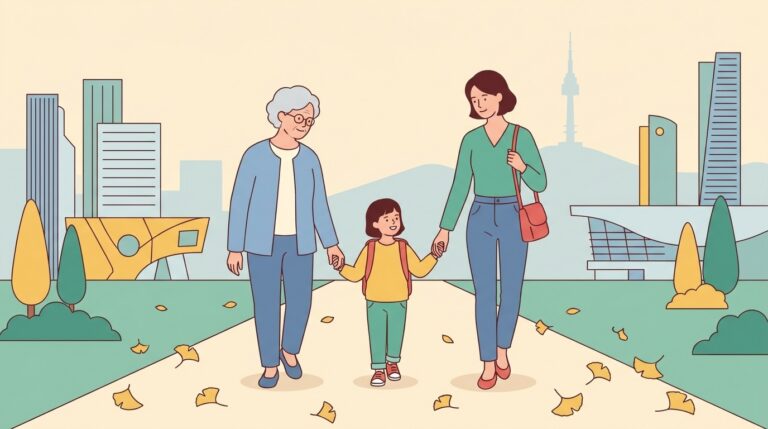
Beyond Generational Divides: How to Talk About the Universal Social Contract in C1 Korean
Phase 1: 공감 (Story-Immersive Opening)
안녕하세요! 매일한글 에디터입니다. (Hello! This is your Daily Hangul Editor!)
Picture this: You are sitting at a bustling pojangmacha (street cart) near Jongno with your Korean colleagues. On your left is Manager Park, a 52-year-old father who sacrificed his twenties working 14-hour days during Korea’s rapid industrialization and now faces early retirement anxieties. Across the table sits Minji, a 27-year-old brilliant designer burdened by skyrocketing apartment rents and precarious freelance contracts. As the conversation drifts to the national pension reform and housing policy, the room tightens. Manager Park sighs, “우리 때는 야근을 밥 먹듯 해도 불평 안 했는데…” (In our days, we worked overtime like eating meals without complaining…), while Minji quietly clenches her glass, feeling completely misunderstood.
If you have ever found yourself trapped in the middle of this classic cross-generational tension in Seoul, you know how delicate it feels. Foreign professionals and advanced learners frequently tell me: “I know words like 청년 실업 (youth unemployment) and 노인 빈곤 (elderly poverty), but whenever the debate starts, I sound either like an emotionless textbook or accidentally offensive!”
That stops today. Navigating high-level social discourse in South Korea requires more than memorized statistics. It requires the language of empathy-driven structural reform—shifting the narrative away from generational finger-pointing toward a universal lifecycle social contract. By mastering this unit, you will gain the linguistic poise to participate in mature, nuanced discussions at work, academic symposiums, and dinner tables, elevating your Korean to a true C1 sophistication.
Phase 2: 핵심 표현 3선 심층 분석 (Top 3 Core Expressions)
1. 각자도생 (Gak-ja-do-saeng)
- Pronunciation: [Gak-ja-do-saeng] (Sounds like gahk-jah-doh-seng)
- Meaning: Literally “each person seeks their own survival,” used to describe a cynical state of “every man for himself.”
- K-Culture Moment: Regularly featured in thought-provoking K-dramas like Squid Game and cultural essays to critique the harsh hyper-individualism forced by social blind spots.
- Editor’s Insight: This four-character idiom (사자성어) is vital for diagnosing structural precarity. When you utter “사회가 각자도생의 늪에 빠져 있다” (Society has fallen into the swamp of every man for himself), you instantly demonstrate an acute comprehension of Korea’s post-1997 economic trauma.
- Situation Spectrum: Casual (✅) | Semi-formal (✅) | Formal (✅)
- 🤔 Think About It: Does your native culture frame self-reliance as an empowering virtue, or does it carry an undertone of systemic neglect like Korea’s 각자도생?
2. 생애주기별 사회안전망 (Saeng-ae-ju-gi-byeol sa-hoe-an-jeon-mang)
- Pronunciation: [Saeng-ae-ju-gi-byeol sa-hoe-an-jeon-mang] (seng-eh-joo-gee-byul sah-hweh-ahn-jeon-mahng)
- Meaning: “Lifecycle-based social safety net.”
- K-Culture Moment: The centerpiece of modern policy debates on 100-Minute Debate (100분 토론) and civic forums addressing low birth rates and aging demographics.
- Editor’s Insight: Instead of dividing budgets into zero-sum youth versus senior programs, this phrase reframes welfare as a protective continuum from cradle to grave. Using this elevates your argument from an emotional complaint to a systemic solution.
- Situation Spectrum: Casual (⚠️) | Semi-formal (✅) | Formal (✅)
- 🤔 Think About It: How does phrasing welfare as a “lifecycle journey” rather than a “tax handout” change the moral responsibility between age groups?
3. 세대 갈등의 프레임을 넘다 (Se-dae gal-deung-ui peu-re-im-eul neom-da)
- Pronunciation: [Se-dae gal-deung-ui peu-re-im-eul neom-da] (seh-deh gahl-deung-ui peu-reh-eem-eul nuhm-dah)
- Meaning: “To transcend the frame of intergenerational conflict.”
- K-Culture Moment: Often heard when intellectuals, authors, or cultural commentators analyze youth vs. senior friction on talk shows like Alssinjobjob.
- Editor’s Insight: Notice the use of the loanword 프레임 (frame). In Korean sociopolitical discourse, framing refers to artificial media polarization. By saying you want to 넘다 (transcend/cross over) this frame, you position yourself as a mediator seeking common ground.
- Situation Spectrum: Casual (⚠️) | Semi-formal (✅) | Formal (✅)
- 🤔 Think About It: Who benefits when public debate reduces broad systemic crises down to a petty dispute between age cohorts?
Phase 3: 교과서 한국어 vs 진짜 한국어 (Textbook vs. Native Korean)
Situation 1: Discussing anxieties surrounding the National Pension
- 📖 교과서 한국어 (Textbook):
젊은 사람들은 나중에 연금을 못 받을까 봐 불안해합니다.
(Jeolmeun saramdeureun najunge yeongeumeul mot badeulkka bwa buranhaehamnida.)
“Young people are anxious that they might not receive pensions later.” - 🗣️ 진짜 한국어 (Real Native C1):
연금 고갈 우려로 인해 청년층 사이에서 박탈감과 미래에 대한 불확실성이 극에 달하고 있어요.
(Yeon-geum go-gal u-ryeo-ro in-hae cheong-nyeon-cheung sa-i-e-seo bak-tal-gam-gwa mi-rae-e dae-han bul-hwak-sil-seong-i geuk-e dal-ha-go iss-eo-yo.)
“Due to fears of pension fund depletion, the sense of deprivation and future uncertainty among young adults is reaching a peak.” - 💡 왜 다를까? (Why is it different?):
Textbooks stick to simple emotive verbs like 불안해하다. Native C1 speakers synthesize nominalized sociological concepts such as 고갈 우려 (depletion concerns) and 상대적 박탈감 (relative deprivation) to articulate nuanced collective moods.
Situation 2: Advocating mutual solidarity over generational sacrifice
- 📖 교과서 한국어 (Textbook):
노인 복지만 챙기지 말고 젊은 사람도 도와줘야 합니다.
(Noin bokjiman chaenggiji malgo jeolmeun saramdo dowajwoya hamnida.)
“We should not only look after senior welfare; we must help young people too.” - 🗣️ 진짜 한국어 (Real Native C1):
특정 세대의 일방적 희생을 요구하기보다, 전 생애주기를 아우르는 보편적 연대가 절실한 시점입니다.
(Teuk-jeong se-dae-ui il-bang-jeok hui-saeng-eul yo-gu-ha-gi-bo-da, jeon saeng-ae-ju-gi-reul a-u-reu-neun bo-pyeon-jeok yeon-dae-ga jeol-sil-han si-jeom-im-ni-da.)
“Rather than demanding the unilateral sacrifice of a specific generation, this is a critical juncture where universal solidarity embracing the entire lifecycle is imperative.” - 💡 왜 다를까? (Why is it different?):
Saying 도와줘야 한다 (should help) makes complex fiscal policy sound like private charity. Real policy discussions employ holistic terms like 일방적 희생 (unilateral sacrifice) and 아우르는 보편적 연대 (encompassing universal solidarity).
Phase 4: K-Culture 딥다이브 & 비언어적 매너 (Cultural Nuance & Non-Verbal Manners)
4-1. 눈치 (Nunchi) & Gestures in Heated Discussions
When discussing wealth inequality or generational entitlement in Korea, emotional stakes run high. Never point with a single index finger or chop your hand rigidly through the air; both denote confrontational aggression. Instead:
* The Open-Palm Pivot: Keep your hands visible on the table, palms turned slightly upward or softly cupped.
* The Empathetic Nod (경청의 끄덕임): Before offering a counter-perspective, nod three times while softly muttering “그 말씀에 담긴 무게도 십분 이해합니다…” (I fully appreciate the gravity of what you just shared). This signals respect for their lived generational struggle before you introduce structural critiques.
4-2. Cultural Code Analysis: The Tragedy of Compressed Modernity
Korean cinema and TV shows frequently showcase the clash between the generational zeitgeists. Consider My Mister (나의 아저씨) and Dear My Friends (디어 마이 프렌즈). While youth face precarious contract employment (비정규직), senior generations battle the highest elderly poverty rates in the OECD after spending their assets educating children who can no longer afford to support them. In Korean culture, this isn’t simply economic tension; it is a breakdown of the traditional filial contract (효, Hyo). Recognizing that both sides feel betrayed by rapid socioeconomic transitions is the key to demonstrating authentic empathy.
Phase 5: 실전 롤플레이 시나리오 (Real-World Roleplay Scenario)
Setting: A quiet lounge bar near Gwanghwamun after a forum on demographic shifts.
Characters:
* Manager Kang (50s): Worn-out executive feeling pressured by early retirement.
* Sora (20s): Junior analyst frustrated by rising housing costs.
* You (Alex, C1 Researcher): The balanced cross-cultural mediator.
Kang: 솔직히 우리 때는 복지 혜택 같은 건 꿈도 못 꿨어요. 젊을 때 고생하는 건 당연한 통과의례 아닌가요?
(Sol-jik-hi u-ri ddae-neun bok-ji hye-taek gat-eun geon kkum-do mot kkwoss-eo-yo. Jeolm-eul ddae go-saeng-ha-neun geon dang-yeon-han tong-gwa-ui-rye a-nin-ga-yo?)
“Honestly, in our time, welfare benefits were unthinkable. Isn’t struggling in one’s youth a natural rite of passage?”
🎭 Sighs deeply, setting down his whiskey glass.
Sora: 부장님 말씀도 맞지만, 지금 청년들이 겪는 자산 격차는 개인의 노력만으로 극복할 수 없는 수준이에요!
(Bu-jang-nim mal-sseum-do mat-ji-man, ji-geum cheong-nyeon-deul-i gyeokk-neun ja-san gyeok-cha-neun gae-in-ui no-ryeok-man-eu-ro geuk-bok-hal su eopt-neun su-jun-i-e-yo!)
“What you say has truth, Director, but the asset gap youth face today simply cannot be overcome by individual grit alone!”
🎭 Leaning forward, voice tight with indignation.
Alex (You): 두 분 말씀 모두 한국 사회가 겪어온 급격한 변화의 이면을 짚고 계신 것 같아요.
(Du bun mal-sseum mo-du han-guk sa-hoe-ga gyeokk-eo-on geup-gyeok-han byeon-hwa-ui i-myeon-eul jip-go gye-sin geot gat-a-yo.)
“I believe both of your insights illuminate the two sides of Korea’s rapid transformation.”
🎭 Nodding calmly, placing open palms loosely on the table.
Kang: 그럼 알렉스 씨는 누구 편인데요? 청년 주거 지원을 늘리면 노인 빈곤 예산은 깎일 수밖에 없잖아요?
(Geu-reom Al-lek-seu ssi-neun nu-gu pyeon-in-de-yo? Cheong-nyeon ju-geo ji-won-eul neul-ri-myeon no-in bin-gon ye-san-eun kkak-kil su-bak-e eopt-janh-a-yo?)
“Then whose side are you on, Alex? If we expand youth housing aid, senior poverty budgets inevitably get slashed, right?”
🎭 Arms crossed, testing your viewpoint.
Alex (You): [Branching Choice Point – Choose Your Response Below]
🔀 인터랙티브 분기점 (Choose Alex’s Line)
- Selection A (Best): “예산을 제로섬 게임으로 보기보다는, 특정 세대의 희생 대신 전 생애주기에 걸쳐 빈곤과 불안을 덜어 주는 보편적 사회 계약이 해법이라고 생각해요.”
(Rather than viewing the budget as a zero-sum game, I believe the true solution lies in a universal lifecycle social contract that relieves poverty and precarity across every age group instead of relying on one generation’s sacrifice.) - Selection B (Bad): “부장님 세대가 부동산으로 이득을 보셨으니 청년들에게 양보하셔야죠.”
(Your generation profited from real estate, Director, so you should yield to young people.) - Selection C (Risk): “복지 문제는 너무 복잡해서 그냥 알아서 각자도생하는 게 속 편합니다.”
(Welfare issues are too complicated; it’s easier if everyone just fends for themselves.)
Feedback on Your Choice:
- If you chose A: Masterful (Best)! You dismantled the zero-sum premise (제로섬 게임) and reframed the conversation constructively around lifecycle universality (보편적 사회 계약). Both Kang and Sora nod thoughtfully.
- If you chose B: Catastrophic (Bad)! You personalized a structural crisis and directly attacked your senior colleague, violating professional decorum (예의) and escalating animosity.
- If you chose C: Disappointing (Risk): Cynicism dismisses the genuine pain of both interlocutors, shutting down what could have been a deeply profound intellectual exchange.
Phase 6: 10초 감정 섀도잉 드릴 (10-Second Emotion Shadowing Drill)
Practice reading these sentences aloud, matching the pauses (/) and internalizing the designated emotional color.
Drill 1: Calm, Empathetic Reassurance
[🤝 차분하고 진정성 있는 어조로]
어느 한 세대의 일방적 희생에 기대기보다는, / 전 생애주기를 아우르는 / 촘촘한 사회 안전망을 설계해야 합니다.
(Eo-neu han se-dae-ui il-bang-jeok hui-saeng-e gi-dae-gi-bo-da-neun, / jeon saeng-ae-ju-gi-reul a-u-reu-neun / chom-chom-han sa-hoe an-jeon-mang-eul seol-gye-hae-ya ham-ni-da.)
“Rather than relying on the unilateral sacrifice of one particular generation, / we must engineer a tight social safety net / that spans the entire lifecycle.”
Drill 2: Firm, Analytical Conviction
[💡 설득력 있고 당당한 눈빛으로]
청년의 미래 불안과 / 노년의 생계 빈곤은 / 대립하는 문제가 아니라 / 동일한 사회적 균열에서 기인한 과제입니다.
(Cheong-nyeon-ui mi-rae bul-an-gwa / no-nyeon-ui saeng-gye bin-gon-eun / dae-rip-ha-neun mun-je-ga a-ni-ra / dong-il-han sa-hoe-jeok gyun-yeol-e-seo gi-in-han gwa-je-im-ni-da.)
“The future anxiety of youth / and the existential poverty of the elderly / are not adversarial conflicts; / they are challenges stemming from the exact same structural rupture.”
Phase 7: K-Culture 미니 사전 (Key Vocabulary Quartet)
- 각자도생 (Gak-ja-do-saeng) | Self-survival in an unprotective world
A critique of rampant neo-liberal individualism where citizens feel abandoned to handle sickness, aging, and housing completely alone. - 생애주기 (Saeng-ae-ju-gi) | Lifecycle Stages
Refers to the progression from early childhood, youth, working adulthood, to twilight retirement. Vital for discussing holistic social security. - 상생 (Sang-saeng) | Mutual Coexistence & Synergy
The philosophical opposite of a zero-sum game (제로섬). Used extensively in government proposals and corporate social responsibility reports. - 박탈감 (Bak-tal-gam) | Sense of Deprivation / Alienation
The emotional toll felt when citizens work diligently yet feel locked out of housing markets and stable pensions relative to other cohorts.
Phase 8: 여행자 & 체류자를 위한 생존 키트 (Expat & Traveler Survival Kit)
Survival TOP 3 Formulations
- “세대 간의 상생을 모색하는 논의가 필요한 것 같아요.”
(Se-dae gan-ui sang-saeng-eul mo-saek-ha-neun non-ui-ga pil-yo-han geot gat-a-yo.)
Pro Tip: Use this when a dinner chat gets too heated. It steers participants toward solutions without blaming either side. - “어느 한쪽만의 책임으로 돌리기는 어렵지 않을까요?”
(Eo-neu han-jjok-man-ui chaek-im-eu-ro dol-li-gi-neun eo-ryeop-ji anh-eul-kka-yo?)
Pro Tip: A gentle, non-confrontational rhetorical question that de-escalates zero-sum claims. - “구조적인 관점에서 제도를 재정비해야 할 시점입니다.”
(Gu-jo-jeok-in gwan-jeom-e-seo je-do-reul jae-jeong-bi-hae-ya hal si-jeom-im-ni-da.)
Pro Tip: Instant C1 credibility booster during company seminars or academic meetings.
Editor’s Travel & Society Note
To observe these dialogues in action, take a weekend stroll past Seoul City Hall or Tapgol Park. For deeper reading into Korean public policy initiatives, check out the 대한민국 정책브리핑 공식 포털 to explore real-world policy briefings on pension modernization and youth support systems.
Phase 9: “한 발 더 깊이” (Philosophical Essay)
South Korea completed an economic journey in half a century that took Western democracies two centuries to traverse. This miracle—termed the Miracle on the Han River—created chronological time travelers living under the same roof. Grandparents who survived wartime destitution, parents who endured military dictatorship and the 1997 IMF crisis, and digital-native children facing sluggish global growth inhabit radically dissimilar existential realities. When we dismiss their friction as mere “selfishness,” we fail to honor their lived history. True fluency in Korean culture begins when we stop asking who deserves more, and instead ask how our shared social architecture can cradle every stage of life.
💬 Your Turn: Have you noticed generational tensions around social welfare in your home country? How does the framing compare to Korea’s discourse? Share your thoughts below!
Phase 10: FAQ & 흔한 실수 (FAQ & Common Mistakes)
Q: Isn’t using “각자도생” considered rude or inappropriate in formal business meetings?
A: Not at all! While it is a sharp critique, it is standard vocabulary in academic journals, corporate strategy meetings, and editorial columns. The key is to use it descriptively rather than casually complaining about coworkers.
Q: Can I use “노인” (Noin) directly when speaking with elderly people?
A: Never address an older person directly as 노인 (it sounds cold and clinical). Address them as 어르신 (esteemed elder) in conversation. Reserve 노인 for macro-level statistical or policy contexts (e.g., 노인 복지 예산).
Q: What is the exact difference between “상생” (Sang-saeng) and “협력” (Hyeop-ryeok)?
A: 협력 means straightforward cooperation to complete a specific task. 상생 carries a deeper philosophical weight: “living together so that neither entity perishes.” It is specifically chosen when overcoming existential or zero-sum conflicts.
🚨 흔한 실수 (Common Mistakes) Top 3
- Calling generational friction “꼰대 문제” in formal debates:
Wrong: 이건 다 꼰대들 때문에 생긴 문제예요.
Correct Action: Use 기성세대와 미래세대의 관점 차이 (differing perspectives between the established generation and future generations). - Confusing “복지” (welfare) with “시혜” (condescending charity):
Avoid framing the social contract as a favor. Treat it as a fundamental civic right (사회적 기본권). - Over-relying on “도와주다” (to help):
At a C1 level, swap out 청년을 도와주다 for 청년층의 사회적 자립 기반을 강화하다 (reinforce the foundations of youth self-reliance).
Phase 11: 액션 미션 & 참여 유도 (Action Missions)
- 🥉 Bronze Mission (Solo Mastery): Record yourself reading the Phase 6 Shadowing Drill sentences with correct pauses and pitch contours.
- 🥈 Silver Mission (Social Engagement): Write a 2-sentence comment on a Korean news clip or forum regarding pension reforms using the phrase 생애주기별 사회안전망.
- 🥇 Gold Mission (Real-World Application): In your next Korean dinner or business meeting, use the phrase “어느 한쪽의 희생보다는 상생의 해법이 중요해 보입니다” when a social topic arises.
- 🎮 K-Culture Challenge: Watch an episode of a sociopolitical drama (such as Misaeng or My Mister) and identify three moments where characters express anxiety born of 각자도생.
Phase 12: 인터랙티브 퀴즈 챌린지 (Interactive Quiz Challenge)
1. Situational Decision Quiz
During a formal office seminar on talent retention, your team leader asks how the company can support both burnout-prone veterans and disillusioned new hires. Which phrase best demonstrates an empathetic, C1-level perspective?
* (A) 그냥 젊은 사람들한테 월급을 더 줘야 문제가 풀립니다.
* (B) 세대 간 갈등을 제로섬으로 보지 않고, 전 생애주기적 관점에서 사내 복지를 재설계해야 합니다.
* (C) 회사는 각자도생하는 곳이니 개인이 버텨야 합니다.
2. Fill-in-the-Blank
“특정 세대의 일방적인 ( )을 강요하기보다 모두를 품는 사회안전망이 필요합니다.”
* Hint: Meaning “unilateral sacrifice” (2 Korean syllables).
3. Cultural True/False
True or False: In contemporary Korean sociology, 각자도생 describes a healthy, celebrated spirit of frontier self-reliance.
👉 Click to view answers and detailed explanations!
- Answer: (B)
Explanation: Option B deploys the exact high-level framework needed for institutional reform (제로섬 프레임을 탈피하고, 전 생애주기적 관점에서 재설계). Option A is overly simplistic, and Option C is needlessly cynical. -
Answer: 희생 (Hui-saeng / Sacrifice)
Full Sentence: 특정 세대의 일방적인 희생을 강요하기보다 모두를 품는 사회안전망이 필요합니다. -
Answer: False
Explanation: 각자도생 is almost universally used as a mournful or critical assessment of a hyper-competitive society where citizens are left without adequate institutional safety nets.
🎬 Watch Our Daily Videos! (Daily Hangul Official Instagram)
Review the expressions you learned in this article with our fun daily short videos! Check out native pronunciation and real-life nuances in action.
- Instagram @dailyhangul_en






