

Phase 1: 공감 (Story-driven Empathy Opening)
안녕하세요! 매일한글 에디터입니다.
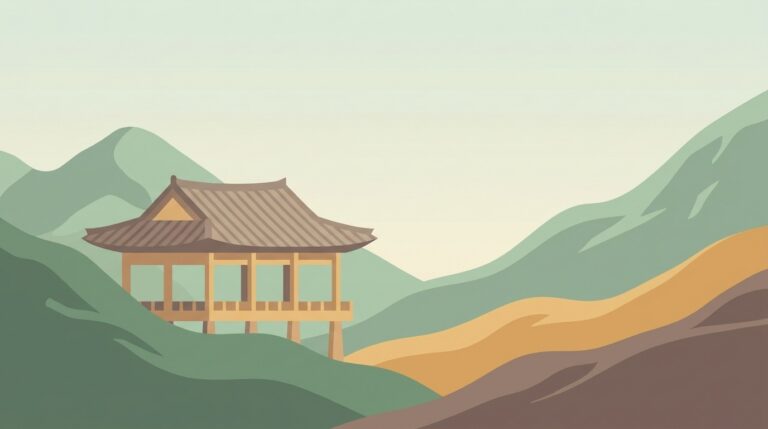
Picture this: You are walking through the winding paths of the Secret Garden (Huwon) at Changdeokgung Palace alongside an art historian friend. Having studied classical European palaces like Versailles or Italian Renaissance villas, you instinctively search for an imposing central axis, sculpted topiary, or monumental terraces asserting human dominance over the terrain. Instead, you stumble upon Buyongjeong Pavilion. Its pillars stand ankle-deep in a lotus pond, its wooden eaves gently lifting like the wings of a crane, deliberately yielding to the undulating slope of the hillside behind it.
You want to express this exquisite spatial sensation, but you find yourself trapped in elementary platitudes: “Geonmuri yeppeoyo” (The building is pretty) or “Jayeongwa eoullyeoyo” (It matches with nature). It feels frustrating, doesn’t it? As a C2-level speaker who appreciates subtle cultural philosophy, your linguistic palette should match your intellectual depth. You want to articulate how Joseon scholars perceived beauty—not through forceful symmetry, but through what pioneer art critic Ko Yu-seop famously identified as “Mu-gi-gyo-ui gi-gyo” (artless art) and “gusu-han keun mat” (an unpretentious, savory grandeur). Based on years of analyzing historical archives and coaching advanced scholars, this guide will elevate your discourse from casual sightseeing remarks to sophisticated architectural critique.
Phase 2: 핵심 표현 3선 심층 분석
1. 무기교의 기교 (Mugigyo-ui gigyo)
- Pronunciation: [Moo-gi-gyo-eui gi-gyo] (Think of ‘moo’ like a cow, followed by ‘gi-gyo’ rhyming with ‘gecko’)
- Meaning: Literal: “Technique without technique” | Nuanced: The paradoxical aesthetic mastery where supreme refinement disguises itself as effortless, unforced spontaneity.
- K-Culture Moment: Seen in documentaries and curator talks when describing the subtle asymmetry of Joseon white porcelain moon jars (Dalhangari) or the crooked wooden pillars of Gaesimsa Temple.
- Editor’s Insight: First coined by aesthetician Ko Yu-seop in the 1930s, this term represents the anti-monumental soul of Joseon art. It doesn’t mean a lack of skill; rather, it denotes the deliberate restraint of human ego so that the inherent character of the material shines through.
- Situation Spectrum: Casual: 🚫 | Semi-formal: ⚠️ | Formal: ✅
- 🤔 Think About It: Does your native culture elevate hyper-symmetrical precision as the pinnacle of achievement, or does it also value deliberate, organic imperfection?
2. 자연의 능선에 순응하다 (Jayeon-ui neungseone suneunghada)
- Pronunciation: [Ja-yeon-eui neung-seon-e soon-eung-ha-da] (Smoothly connect ‘soon’ and ‘eung’ like an exhale of agreement)
- Meaning: Literal: “To comply with the natural ridges” | Nuanced: To design and construct spaces that humbly submit to and harmonize with topography rather than flattening it.
- K-Culture Moment: Architectural dialogues in heritage travel programs such as My Golden Children architecture specials or RM’s cultural museum vlogs.
- Editor’s Insight: In Western classical architecture, earthworks flatten landscapes to impose Euclidean geometry. In contrast, Joseon builders bent the wooden frame to match the bedrock. Using suneunghada (순응하다) conveys deep ecological humility.
- Situation Spectrum: Casual: ⚠️ | Semi-formal: ✅ | Formal: ✅
- 🤔 Think About It: How does phrasing spatial planning as “submission/adaptation” (suneung) shift our ethical relationship with urban landscapes?
3. 차경의 미학을 누리다 (Chagyeong-ui mihageul nurida)
- Pronunciation: [Cha-gyeong-eui mi-ha-geul noo-ri-da] (‘Cha’ as in ‘charter’, ‘gyeong’ rhyming with ‘young’)
- Meaning: Literal: “To enjoy the aesthetic of borrowed scenery” | Nuanced: Experiencing architecture where windows, pillars, and doorframes act as living picture frames that “borrow” surrounding nature without owning or altering it.
- K-Culture Moment: Featured prominently in upscale traditional hanok stays, teahouse reviews, and architectural essays analyzing Sosu Seowon or Byeongsan Seowon.
- Editor’s Insight: Chagyeong (借景) replaces walls with open wooden latticework (changho). When you sit on the wooden floor (daecheongmaru), the mountain peak miles away feels like it hangs in your personal living room.
- Situation Spectrum: Casual: ⚠️ | Semi-formal: ✅ | Formal: ✅
- 🤔 Think About It: In an era obsessed with private property and enclosed luxury, what does the concept of “borrowing” scenery teach us about ownership?
Phase 3: 교과서 한국어 vs 진짜 한국어
Situation 1: Describing a historic building blending into a mountain ridge
- 📖 교과서 한국어:
이 정자는 산과 아주 잘 어울리게 지어졌습니다.
(I jeongjaneun sangwa aju jal eoullige jieojyeotsseumnida.)
“This pavilion was built to match very well with the mountain.” - 🗣️ 진짜 한국어:
인위적인 기하학 대신 지형의 굴곡에 스스로를 낮춰 포근히 안착했네요.
(In-wijeogin gihahak daesin jihyeong-ui gulgoge seuseuro-reul natchwo pogeunhi anchakhaenneyo.)
“Instead of artificial geometry, it humbles itself along the contours of the terrain, settling in with serene warmth.” - 💡 왜 다를까? C2-level discourse abandons generic predicates like eoullida (to match) in favor of evocative spatial verbs (anchakhada, natchuda) that attribute respectful agency to the structure.
Situation 2: Commenting on unhewn, naturally bent wooden pillars
- 📖 교과서 한국어:
기둥의 나무 모양이 똑바르지 않지만 멋있습니다.
(Gidung-ui namu moyangi ttokbareuji anchiman meositsseumnida.)
“The shape of the pillar’s wood is not straight, but it is cool.” - 🗣️ 진짜 한국어:
다듬지 않은 목재의 휨을 그대로 살려 무기교의 기교가 여실히 드러납니다.
(Dadeumji aneun mokjae-ui hwimeul geudaero sallyeo mugigyo-ui gigyoga yeosilhi deureonamnida.)
“By preserving the natural curvature of the unplaned timber, the artless art reveals itself vividly.” - 💡 왜 다를까? Textbook Korean treats natural variance as an imperfection needing defense (“not straight, but…”), whereas sophisticated architectural Korean honors non-intervention as deliberate artistry.
Phase 4: K-Culture 딥다이브 & 비언어적 매너
4-1. 눈치 (Nunchi) & Spatial Etiquette in Traditional Architecture
When stepping onto the wooden floorboards (daecheongmaru) of a historic pavilion or historic academy (seowon), physical posture reflects aesthetic respect.
* Gaze Trajectory: Do not cast your gaze downward toward individual ornaments. Look through the openings between pillars toward the distant ridges. The architecture is deliberately designed as an empty aperture.
* Bodily Decorum: Never stand rigidly upright in the middle of a pavilion threshold. Lower your center of gravity; sit gracefully cross-legged (yangban-dari) or kneel along the floor edge. In Joseon aesthetics, human scale must never compete with the vertical horizon framed by the eaves.
4-2. Cultural Code Analysis: The Philosophy of Hanok & Landscape
In traditional Korean design, landscape is not a backdrop to be conquered, but an elder companion to be accommodated. While French Baroque landscaping altered riverbeds to forge infinity perspectives celebrating royal absolutism, Joseon scholars practiced Toegye Yi Hwang’s philosophy of Gyeong (敬, reverence).
This ethos ripples across modern Korean culture—from contemporary architectural masterpieces like the Amorepacific Headquarters designed by David Chipperfield (which features an internal courtyard framing the Namsan skyline) to the serene aesthetic choices in historical K-Dramas like The Red Sleeve (Otsome Deon Kkeut-dong). When characters converse on open verandas, dialogue breathes between pauses in the breeze, reflecting emotional alignment with the weather and changing seasons.
Phase 5: 실전 롤플레이 시나리오
Setting: Walking through the rear courtyard of Byeongsan Seowon alongside Professor Min, a renowned Joseon architectural historian.
- Professor Min: 여기가 바로 만대루(Mandaeru)입니다. 기둥 사이로 낙동강과 절벽이 한눈에 들어오지요?
(Yeogiga baro Mandaeru-imnida. Gidung sairo Nakdongganggwa jeolbyeogi hannune deureo-ojiyo?)
“This is Mandaeru. Notice how the Nakdong River and the cliffs enter your field of vision between the pillars?” -
You: 🎭 [Slowly sitting down on the wooden floor, taking in the panoramic vista with quiet admiration]
정말 압도적이네요. 인공적인 조경수를 심는 대신 대자연을 그대로 끌어안았군요.
(Jeongmal apdojeogineyyo. Ingongjeogin jogyeongsureul simneun daesin daejayeoneul geudaero kkeureoanannyoyo.)
“It is truly breathtaking. Instead of planting artificial topiary, it embraces wild nature itself.” -
Professor Min: 맞습니다. 많은 이들이 화려한 궁궐보다 이곳의 질박함에서 더 깊은 감동을 받곤 합니다.
(Masseumnida. Maneun ideuri hwaryeohan gunggwolboda igosui jilbakhameseo deo gipeun gamdongeul batgon hamnida.)
“Indeed. Many people find themselves deeper touched by the unadorned simplicity here than by opulent palaces.” -
You: 🎭 [Pointing gently toward the naturally curved wooden columns]
휜 나무를 억지로 깎아내지 않고 주춧돌 위에 얹은 방식에서 무기교의 기교가 느껴집니다.
(Hwin namureul eokjiro kkakka-naeji anko juchutdol wie eonjeun bangsik-eseo mugigyo-ui gigyoga neukkyeojimnida.)
“In placing the naturally curved logs straight onto the foundation stones without shearing them flat, one truly senses the artless art.” -
Professor Min: 정확하게 보셨어요! 고유섭 선생이 말한 ‘구수한 큰 맛’의 정수가 바로 이런 겸양의 건축에 있지요.
(Jeonghwakhage bosyeosseoyo! Ko Yu-seop seonsaengi malhan ‘gusu-han keun mat’-ui jeongsuga baro ireon gyeomyang-ui geonchuge itjiyo.)
“You saw that precisely! The essence of what Master Ko Yu-seop termed the ‘savory grandeur’ lies within this architecture of humility.” -
You: 🎭 [Lowering your voice respectfully as wind rustles through the courtyard]
자연을 지배하려 들지 않고 능선에 기대어 스스로를 낮춘 철학적 태도가 가슴에 와닿습니다.
(Jayeoneul jibaeharyeo deulji anko neungseone gidaeeo seuseuro-reul natchun cheolhakjeok taedoga gaseume wadatsseumnida.)
“The philosophical posture of leaning against the mountain ridge and humbling oneself rather than conquering nature resonates profoundly with me.” -
Professor Min: 바로 그겁니다. 서양식 정원이 ‘소유’라면, 우리의 정원은 ‘차경’을 통한 ‘향유’인 셈이죠.
(Baro geogeomnida. Seoyangsik jeongwoni ‘soyu’ramyeon, uri-ui jeongwoneun ‘chagyeong’-eul tonghan ‘hyang-yu’in sem-ijyo.)
“Precisely that. If Western gardens are about ‘ownership’, our garden aesthetic is about ‘enjoyment’ through borrowed scenery.” -
You: 🎭 [Nodding with a serene smile]
선조들이 추구했던 순응과 조화의 미학이 오늘날 현대인들에게도 큰 울림을 줍니다.
(Seonjodeuri chuguhaetteon suneunggwa johwa-ui mihagi oneulnal hyeondaeindeuregedo keun ullimeul jumnida.)
“The aesthetics of adaptation and harmony pursued by the ancestors offers profound resonance to contemporary minds as well.”
🔀 인터랙티브 분기점 (Interactive Decision Point)
How do you conclude your observation with Professor Min to leave a lasting impression of C2 mastery?
- Option A: “기하학적 질서가 없어서 처음엔 심심해 보였는데, 알수록 여운이 깊네요.”
(Feedback: Best! Acknowledges the apparent plainness while appreciating the lingering depth—a core tenet of Korean aesthetics.) - Option B: “유럽 궁전보다 훨씬 더 기술적으로 뛰어나고 우월한 방식인 것 같아요.”
(Feedback: Risk. Avoid comparative cultural chauvinism; Korean philosophy emphasizes harmony and non-competition, not technological superiority.) - Option C: “대충 지은 것 같아 보여도 다 계산된 거라니 참 신기합니다.”
(Feedback: Bad. The slangy phrasing ‘대충 지은 것 같다’ trivializes deliberate philosophical simplicity as careless building.)
Phase 6: 10초 감정 섀도잉 드릴
[🌿 차분하고 깊은 사색을 담아]
자연의 흐름을 / 거스르지 않고 / 능선에 조용히 / 깃든 모습이 / 참 평온합니다.
(Jayeon-ui heureumeul / geoseureuji anko / neungseone joyonghi / gitdeun moseubi / cham pyeong-onhamnida.)
“Resting quietly against the mountain ridge without resisting nature’s course feels profoundly peaceful.”-
[🧐 경탄과 지적인 통찰을 실어]
완벽한 대칭을 탈피하여 / 날것의 생명력을 살린 것이야말로 / 진정한 무기교의 기교입니다.
(Wanbyeokhan daechingeul talpihayeo / nalgeosui saengmyeongnyeogeul sallin geosiyamallo / jinjeonghan mugigyo-ui gigyo-imnida.)
“Breaking free from rigid symmetry to preserve raw vitality—that is indeed true artless art.” -
[🍵 온화하고 그윽한 어조로]
창살 너머로 비치는 산자락을 / 잠시 빌려 즐기는 것뿐이니 / 이 얼마나 너그러운 공간인가요.
(Changsal neomeoro bichineun sanjarageul / jamsi billyeo jeulgineun geotppun-ini / i eolmana neogeureoun gong-gan-in-gayo.)
“Merely borrowing the mountain slope revealed beyond the window frames—how magnanimous a space this is.”
Phase 7: K-Culture 미니 사전
-
차경 (Chagyeong | 借景)
- Translation: Borrowed Scenery.
- Usage: Essential when visiting historical sites, teahouses, or modern eco-architectural sites. Used to describe vistas where openings frame external landscapes instead of walling them off.
- 배산임수 (Baesanimsu | 背山臨水)
- Translation: Mountain behind, river in front.
- Usage: The foundational geomantic (Feng Shui) configuration of traditional Korean settlements and estates, maximizing solar warmth, wind protection, and natural irrigation.
- 구수한 큰 맛 (Gusu-han keun mat)
- Translation: Savory, unpretentious grandeur.
- Usage: Originally referring to the deep, roasted comfort of soybean stew or scorch-rice tea (nurungji), Ko Yu-seop adapted this term to characterize the earthy, unpolished, yet deeply comforting majesty of Joseon aesthetics.
- 여백의 미 (Yeobaek-ui mi | 餘白의 美)
- Translation: The beauty of negative space / unpainted void.
- Usage: Universally applied across ink-wash painting, interior architecture, and daily lifestyle to honor empty areas as essential breathing room rather than deficiency.
Phase 8: 여행자를 위한 생존 키트
Survival Architectural Phrases TOP 3
- 이 정자는 주변 풍경과 참 자연스럽게 어우러지네요.
(I jeongjaneun jubyeon punggyeonggwa cham jayeonseureopge eoulleojineyo.)
Pro Tip: Use this when speaking with heritage docents at Changdeokgung or Gyeongbokgung to instantly validate their interpretive guidance. - 창호 너머로 보이는 경치가 한 폭의 그림 같습니다.
(Changho neomeoro boineun gyeongchiga han pogui geurim gatseumnida.)
Pro Tip: Perfect praise when visiting traditional hanok teahouses in Bukchon or Insadong. - 기둥의 자연스러운 휨새가 공간에 생동감을 불어넣네요.
(Gidung-ui jayeonseureoun hwimsaega gong-gan-e saengdonggameul bureoneonne-yo.)
Pro Tip: An analytical compliment to use during temple stays (Gaesimsa, Buseoksa) when noticing rustic timber pillars.
Editor’s Travel Note
Before embarking on your cultural heritage tours, download the 네이버 지도 앱 다운로드 to uncover hidden historic pavilions tucked behind modern alleyways. If you wish to witness Joseon’s quintessential imperial landscaping, make sure to secure a 창덕궁 후원 특별관람 예약하기 well in advance, as visitor caps ensure the silent contemplation of nature is preserved.
Phase 9: “한 발 더 깊이” (Philosophical Essay)
In Western classical landscapes, nature was an untamed chaos requiring mathematical redemption—hedges clipped into rigid parterres, fountains defying gravity, canals slicing arrow-straight across horizons. To the Joseon eye, however, the universe is inherently complete; human intervention is at its finest when it seems almost redundant. Traditional architecture humbles itself along the contours of the mountain ridge because forcing an artificial plane onto a living mountain is perceived as an act of cosmic discourtesy. In an accelerating world dominated by concrete uniformity and digital maximalism, this Joseon aesthetic whispers an urgent antidote: true elegance does not announce its presence; it dissolves gracefully into its surroundings.
💬 Your Turn: Look around your favorite spot in your hometown or your room. Does it conquer its environment, or does it humble itself to its surroundings? Share your reflections in the comments below!
Phase 10: FAQ & 오해 방지
Q: Does ‘Mu-gi-gyo’ (artless) mean Joseon craftsmen lacked construction technology?
A: Absolutely not. To make an irregular, naturally bent log stand structurally sound upon an uneven boulder (deotbol-chotdol) requires far higher carpenter calculations than sawing timber into uniform right angles. It is supreme technique masking its own footprint.
Q: What is the main difference between Japanese Wabi-Sabi and Korean ‘Gusu-han keun mat’?
A: While Japanese Wabi-sabi often emphasizes melancholic loneliness, deliberate austerity, and subtle tension, Joseon’s gusu-han mat embraces earthy warmth, cheerful nonchalance, and spacious humor (haehak).
Q: Can I use “구수하다” (savory/comforting) for things other than food?
A: Yes! When used metaphorically at a high level, it describes human personality (구수한 입담 – warm, unpretentious storytelling) or art pieces that possess an unpolished, deeply endearing quality.
🚨 흔한 실수 (Common Mistakes)
- Mistake 1: Translating “natural architecture” as 자연적인 건축 (Jayeonjeogin geonchuk).
- Correct Action: Use 자연에 순응하는 건축 (Architecture that yields to nature) or 친환경적 차경 to capture the active philosophical philosophy.
- Mistake 2: Calling deliberately crooked Hanok elements 불량하다 (defective) or 기괴하다 (grotesque).
- Correct Action: Describe them using 자연미 (natural beauty) or 무기교의 기교 (artless art).
- Mistake 3: Saying “자연을 이용하다” (exploiting/using nature) when discussing scenic pavilions.
- Correct Action: Say 자연을 품어 안다 (embracing nature) or 차경으로 누리다 (enjoying through borrowed scenery).
Phase 11: 액션 미션 & 참여 유도
- 🥉 Bronze Mission: Stand before a window in your room, take a photo framing the outside world, and whisper the phrase: “차경의 미학을 누리다.”
- 🥈 Silver Mission: Post a picture of your favorite Hanok, park, or natural vista on Instagram with a bilingual caption using #무기교의기교 and tag
@DailyHangul. - 🥇 Gold Mission: Engage in a conversation with a Korean friend or heritage docent using the sentence: “이 공간은 지형의 굴곡을 거스르지 않고 자연에 순응하는 미학이 돋보이네요.”
🎮 K-Culture Mission: Watch an episode of an introspective Korean travel show or a BTS heritage vlog. Pinpoint the exact second a host or member sits on a daecheongmaru and describes the wind or view. Write down the adjective they used in the comment section!
Phase 12: 인터랙티브 퀴즈 챌린지
1. Situation Judgment: You are discussing Changdeokgung’s Huwon with an architectural critic. Which response reflects the highest aesthetic understanding?
– A) “대칭이 전혀 맞지 않아서 좀 더 정교하게 고쳐 지었으면 좋았을 텐데요.”
– B) “인간의 기하학으로 자연을 억누르지 않고, 능선에 순응하는 조화가 참 그윽합니다.”
– C) “건물 크기가 작아서 서양의 베르사유 궁전보다 훨씬 화려하진 않네요.”
2. Fill-in-the-Blank: Joseon aesthetician Ko Yu-seop defined the supreme mastery of unpretentious, effortless beauty as (_______)의 기교.
3. True or False: In traditional Korean garden philosophy (Chagyeong), one should trim external trees and build artificial walls to firmly possess private property within one’s boundary. (T/F)
👉 Click to reveal answers & explanations!
- Answer: B | Explanation: B articulates the core Joseon philosophy of non-conquest and harmonic submission without falling into simplistic comparisons.
- Answer: 무기교 (Mugigyo) | Explanation: 무기교의 기교 (Artless art / Technique without technique).
- Answer: False (F) | Explanation: Chagyeong (借景) rejects absolute possession. It is the art of ‘borrowing’ the unowned external vista through open architectural framing.
🎬 Watch Our Daily Videos! (Daily Hangul Official Instagram)
Review the expressions you learned in this article with our fun daily short videos! Check out native pronunciation and real-life nuances in action.
- Instagram @dailyhangul_en






