

Phase 1: Empathy (Story-Driven Opening)
안녕하세요! (Annyeonghaseyo!) It is your Daily Hangul editor here!
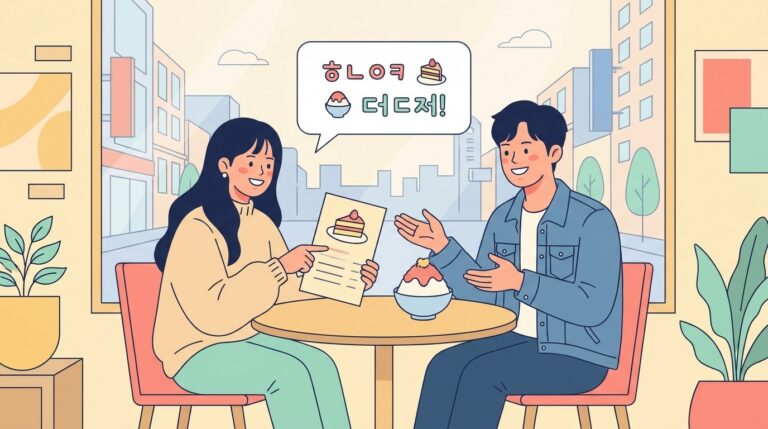
Picture this: You are sitting at a sunlit cafe in Hongdae with your new Korean friends. The waiter brings over a towering bowl of pastel-green Mint Chocolate Bingsu (shaved ice). Your eyes light up, and you happily pick up your spoon. But suddenly, your friend gasps, clutches their heart in theatrical horror, and exclaims: “Wait, did you really just order toothpaste dessert?! How can you eat that?!”
If you have ever spent five minutes in Korea, you know that debates about food, music, and lifestyle are practically an Olympic sport. From the fierce war between dipping sauce vs. pouring sauce (Jjikmeok vs. Bumeok) to passionate K-pop fandom rivalries, Koreans love to playfully test each other’s preferences. In the past, foreign learners often told me they felt frozen in these moments: “Do I apologize? Do I pretend I do not like it? How do I defend my choice without sounding offended or overly formal?”
Take a deep breath! You never have to compromise your true self. Modern Korean youth (the MZ generation) have created the ultimate linguistic shield for this exact moment: 취존 (Chwijon), short for “Please respect my personal taste.”
In this lesson—crafted from real-world conversations and tested by hundreds of our beginner students in Seoul—you will discover how two simple syllables can instantly transform an awkward critique into a moment of laughter, bonding, and genuine cultural connection. Let’s dive into the fun world of Korean slang!
Phase 2: Deep Dive into 3 Core Expressions
1. 취존 (Chwijon)
- Pronunciation: Chwijon (Sounds like “chee-zone” with a crisp, punchy finish at the end)
- Meaning: Literal: “Taste Respect” (취향 존중 – Chwihyang Jonjung) | Actual Nuance: “Hey, no judgment! Please respect my personal preference!”
- K-Culture Moment: Seen constantly on idol variety shows like Going Seventeen or Run BTS whenever idols argue playfully about pineapple on pizza or who has the weirdest fashion sense.
- Editor’s Insight: This word merges the first syllables of 취향 (chwihyang – taste/preference) and 존중 (jonjung – respect). It is never bitter or angry; it is a witty, lighthearted white flag that says, “We can disagree and still be besties!”
- Situation Spectrum: Casual: ✅ | Semi-formal: ⚠️ (Only with friendly coworkers) | Formal: 🚫
- 🤔 Think About It: In English, we say “to each their own” or “no judgment,” but those can sometimes sound distant. How does shortening the phrase into a cute two-syllable word help young Koreans protect personal identity while keeping group harmony?
2. 갠취 (Gaenchi)
- Pronunciation: Gaenchi (Sounds like “gain-chee”, rhyming with kimchi)
- Meaning: Literal: “Individual Taste” (개인 취향 – Gaein Chwihyang) | Actual Nuance: “That is just my personal vibe; it is purely my own thing.”
- K-Culture Moment: Korean beauty YouTubers or fashion vloggers showing an unconventional neon lipstick or oversized jacket and explaining: “이건 제 갠취예요 (This is just my personal vibe!)” before anyone leaves a negative comment.
- Editor’s Insight: While 취존 asks others to back off, 갠취 is the label you put on yourself. It serves as a polite preemptive buffer when presenting an unusual hobby, K-pop bias, or snack choice.
- Situation Spectrum: Casual: ✅ | Semi-formal: ⚠️ | Formal: 🚫
- 🤔 Think About It: Why does claiming an opinion as “personal taste” (갠취) feel much less intimidating than claiming it as an objective fact?
3. 케바케 (Kebake)
- Pronunciation: Kebake (Sounds like “kay-bah-kay”)
- Meaning: Literal: “Case by Case” (케이스 바이 케이스) | Actual Nuance: “It really depends on the situation / Everyone has different preferences.”
- K-Culture Moment: Dating panel shows like Heart Signal or Single’s Inferno, when hosts debate whether partners should call every night and conclude: “Well, that is 케바케!”
- Editor’s Insight: Koreans love linguistic speed. Four English syllables (Case-by-Case) were compressed into three snappy Korean syllables. It is the ultimate diplomatic neutralizer whenever someone asks you a broad question like: “Do Koreans prefer spicy food?”
- Situation Spectrum: Casual: ✅ | Semi-formal: ✅ | Formal: 🚫
- 🤔 Think About It: Notice how English loanwords get adapted and shortened into Korean phonetics. How does this reflect the dynamic, fast-paced rhythm of urban Korean society?
Phase 3: Textbook Korean vs. Real Korean
Let’s see how stiff textbook Korean compares to the vibrant slang real locals use every single day.
Situation 1: Defending your unusual food choice (e.g., ordering mint chocolate or hawaiian pizza)
- 📖 교과서 한국어 (Textbook Korean):
제 취향을 존중해 주시기 바랍니다.
(Je chwihyangeul jonjunghae jusigi baramnida.)
“I request that you please respect my personal preference.” - 🗣️ 진짜 한국어 (Real Korean):
에이, 취존해 줘!
(Ei, chwijonhae jwo!)
“Come on, respect my taste!” - 💡 왜 다를까? (Why the difference?):
The textbook sentence sounds like a formal corporate press release or a legal disclaimer! In contrast, 취존해 줘 uses friendly, warm informal speech with a playful interjection (에이 – “come on”), instantly defusing tension among peers.
Situation 2: Explaining your specific, niche taste in music or fashion
- 📖 교과서 한국어 (Textbook Korean):
그것은 저의 개인적인 취향입니다.
(Geugeoseun jeoui gaeinjeogin chwihyang-imnida.)
“That is an individual inclination of mine.” - 🗣️ 진짜 한국어 (Real Korean):
그건 완전 내 갠취야.
(Geugeon wanjeon nae gaenchiya.)
“That is totally my personal vibe.” - 💡 왜 다를까? (Why the difference?):
Textbook grammar uses heavy Sino-Korean adverbs. Real speakers pair the modern slang 갠취 with 완전 (wanjeon – totally/completely) to express authentic confidence without sounding robotic.
Phase 4: K-Culture Deep Dive & Non-Verbal Manners
4-1. 눈치 (Nunchi) & Body Gestures
When saying 취존!, your non-verbal cues carry 70% of the meaning! Because slang can easily sound blunt if spoken with a flat face, keep these physical manners in mind:
* The Defense Shield Gesture: Raise both open palms slightly in front of your chest, elbows relaxed, playfully blocking an imaginary critique. Tilt your head slightly and smile with your eyes.
* The Bouncy Tone: Keep the pitch of 취존 bright and musical. If you say it with a stern, flat voice, people might think you are genuinely hurt or offended.
* The Friendly Nod: When someone calls 취존 on you, do not double down on teasing. Simply smile, nod, and say “인정!” (Injeong! – “Fair enough / I acknowledge that!”).
4-2. Cultural Code: The Dipping War & MZ Individualism
Historically, Korean meals were rooted in collective sharing—eating together from one central boiling stew (Jjigae) symbolized deep affection (Jeong). In such a communal culture, having eccentric individual tastes was sometimes seen as breaking the group’s harmony.
However, the MZ generation has introduced a revolution: Celebrating Micro-Identities. The most famous example is the nationwide battle of Tangsuyuk (sweet and sour pork): 부먹 (Bumeok – pouring the sauce over the meat) vs. 찍먹 (Jjikmeok – dipping the meat into the sauce). Instead of forcing everyone into one uniform style, Koreans created terms like 취존 so friends could laugh about their differences while happily eating at the same table. It is harmony through mutual acknowledgment!
Phase 5: Real-Life Role-Play Scenario
- Location: A trendy, neon-lit bingsu dessert cafe near Hongdae Station on a Saturday afternoon.
- Character: Minji (민지), your witty Korean language exchange partner who loves playful banter.
1. 민지 (Minji):
설마 그거 민트초코 빙수 시킨 거야?
(Seolma geugeo minteuchoko bingsu sikin geoya?)
[🎭 Leaning back in exaggerated shock, pointing a finger at your green shaved ice]
“No way… did you seriously just order Mint Chocolate Bingsu?!”
2. 나 (Me):
응! 나 민초 진짜 좋아해.
(Eung! Na mincho jinjja joahae.)
[🎭 Grinning proudly while holding your dessert spoon tightly]
“Yup! I really love mint choco!”
3. 민지 (Minji):
으악, 치약 맛을 돈 주고 사 먹다니!
(Euak, chiyak maseul don jugo sa meokdani!)
[🎭 Dramatically waving her hand in front of her nose, teasing you]
“Ugh, paying money to eat toothpaste?!”
4. 나 (Me):
에이, 취존해 줘!
(Ei, chwijonhae jwo!)
[🎭 Raising both palms up in a mini-shield gesture, smiling warmly]
“Come on, respect my taste!”
5. 민지 (Minji):
하하, 알겠어. 근데 넌 왜 하필 민초야?
(Haha, algesseo. Geunde neon wae hapil minchoya?)
[🎭 Chuckling softly as she stirs her iced Americano]
“Haha, alright! But why mint choco out of all flavors?”
6. 나 (Me):
이건 완전 내 갠취거든.
(Igeon wanjeon nae gaenchigeodeun.)
[🎭 Shrugging happily with a relaxed, satisfied expression]
“Because this is totally my personal vibe.”
7. 민지 (Minji):
인정! 그래도 나는 절대 안 먹을래.
(Injeong! Geuraedo naneun jeoldae an meogeullae.)
[🎭 Nodding in concession while smiling]
“Fair enough! But I am still never touching it.”
8. 나 (Me):
맞아, 사람마다 다 케바케지!
(Maja, sarammada da kebakyeji!)
[🎭 Scooping a big sweet bite and laughing together]
“Exactly, it is all case-by-case for everyone!”
🔀 Interactive Branching Point
Minji playfully pretends to slide your dessert bowl away from you. How do you respond?
- Option A: “야, 취존 부탁해!” (Ya, chwijon butakhae! – “Hey, respect my taste, please!”)
👉 Feedback: BEST! Super natural, cute, and hits the sweet spot of playful boundaries. - Option B: “제 취향을 무시하지 마십시오.” (Je chwihyangeul musihaji masipsio. – “Do not ignore my personal preferences.”)
👉 Feedback: BAD. Far too rigid and aggressive; it sounds like you are preparing to file a formal complaint! - Option C: “너 진짜 나빠.” (Neo jinjja nappa. – “You are really mean.”)
👉 Feedback: RISK. Unless your facial expression is very visibly sarcastic, it can sound genuinely hurt or sulky.
Phase 6: 10-Second Emotion Shadowing Drill
Practice these three lines aloud! Follow the emotional cues and pause markers (/) to build native-like rhythm.
[😆 장난스럽고 당당하게 / Playfully & Confidently]
에이, / 취존해 줘!
(Ei, / chwijonhae jwo!)
Pitch tip: Start low on 에이, then bounce up brightly on 취존 and finish softly on 해 줘.-
[😎 쿨하고 여유롭게 / Cool & Easygoing]
이건 / 완전 / 내 갠취야.
(Igeon / wanjeon / nae gaenchiya.)
Pitch tip: Take a tiny micro-breath after 완전 to highlight your unapologetic confidence. -
[🤝 너그럽고 공감하며 / Broad-minded & Understanding]
사람마다 / 다 / 케바케지!
(Sarammada / da / kebakyeji!)
Pitch tip: Keep your voice rhythmic and warm, as if nodding along to the beat.
Phase 7: K-Culture Mini Dictionary
Expand your trendy Seoul vocabulary with these 4 essential companion words:
- 갠취 (Gaenchi) | Personal Taste
A shortened form of 개인 취향 (gaein chwihyang). Used constantly in fashion, makeup, and food to state what you personally gravitate toward. - 찍먹 (Jjikmeok) | Dipping Sauce Style
Short for 찍어 먹기 (jjigeo meokgi). Used by crisp-texture lovers who refuse to let their fried pork or dumplings get soggy. - 인정 (Injeong) | Acknowledged / Agreed
Short verbal reaction used by MZ Koreans to say “Fair point!” or “I respect that.” The standard response after hearing 취존. - 갓생 (Gatsaeng) | Living a God-tier, Productive Life
Combining English “God” with Korean 생 (saeng – life). Used to praise someone who balances fitness, studying Korean, and self-care diligently.
Phase 8: Traveler’s Survival Kit
Top 3 Survival Expressions for Beginners
- 취존해 주세요! (Chwijonhae juseyo!)
Meaning: “Please respect my taste!”
Pro Tip: Adding 주세요 makes this slang sentence polite enough to use with older acquaintances or friendly tour guides. - 제 갠취예요. (Je gaenchiyeyo.)
Meaning: “It is just my personal taste.”
Pro Tip: Perfect when shopping in Seoul’s fashion alleys in Dongdaemun or Seongsu-dong when a clerk suggests an outfit that is not your style. - 소스 따로 주세요! (Soseu ttaro juseyo!)
Meaning: “Please give me the sauce on the side!”
Pro Tip: The ultimate survival sentence for Jjikmeok (dipping) fans visiting local Chinese-Korean restaurants.
Editor’s Travel Note
When discovering niche dining spots and themed cafes in Seoul, standard international maps frequently lack updated operating hours and custom ordering details. Before heading out, make sure to check the Naver Map app download to read authentic reviews left by local MZ foodies. Furthermore, if you want to explore quirky late-night dessert pairings from the comfort of your hotel room, check our Baemin delivery app guide for easy ordering without phone calls! Always keep your T-Money card charged for quick hop-on transitions across subway lines.
Phase 9: “One Step Deeper” (Reflective Essay)
For generations, Korean culture placed communal belonging at the heart of identity. Sharing the same dishes and agreeing with the group’s mood (gibun) was a sign of respect and deep solidarity. In that environment, announcing an unconventional preference could sometimes feel like a disturbance.
Yet, modern Korean society is not abandoning community; it is reinventing it. The popularity of slang terms like 취존 demonstrates that today’s youth have found a playful, healthy mechanism to celebrate diversity while remaining closely bonded. By shrinking long philosophical defenses into a charming, shared joke, young Koreans prove that true harmony does not require everyone to be identical—it simply asks us to hold space for each other’s unique flavors.
💬 Your Turn: What is one food, K-pop song, or quirky hobby that is your ultimate 갠취 (Gaenchi), even if your friends tease you about it? Drop your answer in the comments below using today’s slang!
Phase 10: FAQ & Common Mistakes
Q: Can I use “취존” with my Korean company boss or university professor?
A: No, absolutely avoid it! 취존 is casual slang (banmal). Using it in formal meetings or with elders will sound flippant and disrespectful. Instead, use a dignified, formal phrase such as: “각자의 취향을 존중하는 것이 좋겠습니다” (It would be beneficial to respect everyone’s personal preferences).
Q: What is the best comeback when someone says “취존!” to me?
A: The most natural response is a friendly smile followed by “인정!” (Injeong! – “Agreed / Fair enough!”) or “오케이, 취존할게!” (Okei, chwijonhalge! – “Okay, I will respect that!”).
Q: Is 취존 only used for food debates?
A: Not at all! You can use it when discussing favorite K-pop members (your “bias”), movie genres, video game strategies, fashion aesthetics, or interior design choices.
🚨 Common Mistakes Checklist
- ❌ Mistake 1: Pronouncing it like the English name “John” (Chee-John).
✅ Correct Action: Keep the ending crisp and flat: 존 (jon), rhyming softly with “tone” without the heavy English ‘w’ sound. - ❌ Mistake 2: Saying it with crossed arms or an aggressive scowl.
✅ Correct Action: Remember that 취존 is a lighthearted joke! Always accompany it with a smile, chuckle, or the two-palm defense gesture. - ❌ Mistake 3: Forgetting to add honorifics with people who are not your close peers.
✅ Correct Action: Say “취존해 주세요” (Chwijonhae juseyo) instead of bare “취존” whenever you want to be polite.
Phase 11: Action Missions & Engagement
Ready to put your learning into practice? Take on our 3-tier challenge:
- 🥉 Bronze Mission (Solo Practice): Stand in front of your mirror, raise your hands in the defense gesture, and say “에이, 취존해 줘!” five times until it feels completely effortless.
- 🥈 Silver Mission (Social Share): Snap a photo of a controversial food or drink you enjoy (like pineapple pizza or cold brew with lemonade) and share it on your social media with the caption: “This is my 갠취! 취존해 주세요!”
- 🥇 Gold Mission (Real Life): The next time someone questions your K-pop playlist or cafe order, smile and declare: “이건 내 갠취야, 취존해 줘!”
- 🎮 K-Culture Mission: Watch any recent episode of an idol web show (like Going Seventeen, Run Jin, or Workman) and listen carefully for the words 취존 or 갠취 appearing in the on-screen colorful graphic captions!
Phase 12: Interactive Quiz Challenge
Test what you have mastered today! Tap the spoilers below to check your answers.
Question 1: Situation Check
Your Korean friend laughs and asks why you are listening to retro 1980s Korean city pop instead of the newest billboard hit. What is the most natural, snappy response?
* a) 법을 지켜 주십시오. (Beobeul jikyeo jusipsio.)
* b) 에이, 취존해 줘! (Ei, chwijonhae jwo!)
* c) 저는 음악을 듣고 있습니다. (Jeoneun eumeageul deutgo itseumnida.)
👉 Click here to reveal Answer 1
Correct Answer: b) 에이, 취존해 줘!
Explanation: Option (b) is the authentic MZ slang expression meaning “Come on, respect my taste!” Option (a) means “Please obey the law” (way too dramatic!), and (c) is a mechanical statement meaning “I am listening to music.”
Question 2: Fill in the Blank
When explaining that your unconventional fashion outfit is purely your own preference, you say:
“이건 완전 내 _____ (short for 개인 취향)야!”
👉 Click here to reveal Answer 2
Correct Answer: 갠취 (Gaenchi)
Explanation: 갠취 is the shortened form of 개인 취향 (gaein chwihyang), used to label your unique personal style or taste.
Question 3: Cultural True or False
True or False: It is completely polite and acceptable to say “부장님, 취존!” (Boss, respect my taste!) to your 55-year-old Korean department manager during an official corporate dinner.
👉 Click here to reveal Answer 3
Correct Answer: False!
Explanation: 취존 is casual youth slang (banmal). Using it directly toward a corporate superior or elder will come across as cheeky or impolite. Save this expression for peers, classmates, and close friends!
🎬 Watch Our Daily Videos! (Daily Hangul Official Instagram)
Review the expressions you learned in this article with our fun daily short videos! Check out native pronunciation and real-life nuances in action.
- Instagram @dailyhangul_en







