

Master Late-Night KakaoTalk: How to Say Goodnight Like a Native Korean Friend
Phase 1: Empathy (Story-Driven Opening)
안녕하세요! 매일한글 에디터입니다. (Hello! This is your Daily Hangul editor.)
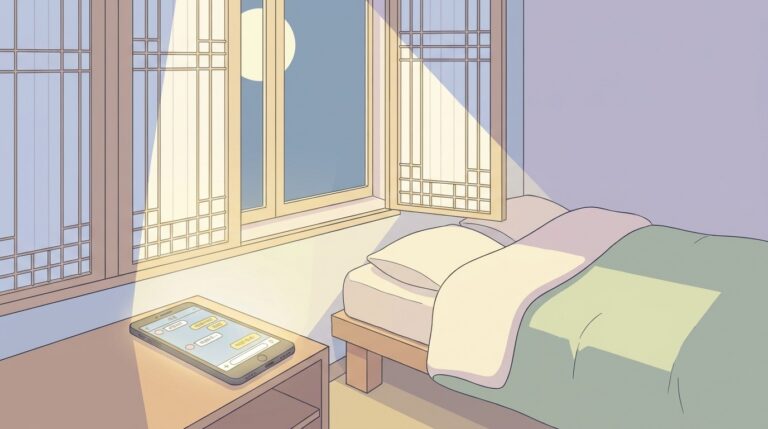
Picture this: It’s 11:45 PM on a Tuesday evening in Seoul. You are cozy in bed, eyes growing heavy, but your phone keeps buzzing. Your Korean friend is excitedly sharing photos of a newly discovered bakery in Seongsu-dong on KakaoTalk. You genuinely want to hear all about it, but your alarm is set for 6:30 AM tomorrow. You need to sleep right now.
Suddenly, anxiety kicks in: How do I end this conversation without sounding cold?
If you type standard textbook Korean like “저는 내일 출근해야 하므로 지금 자러 가겠습니다. 안녕히 주무세요” (Jeoneun naeil chulgeunhaeya hameuro jigeum jareo gagesseumnida. Annyeonghi jumuseyo), you sound like an automated corporate answering machine from 1995. But if you simply stop replying, you worry you’ll seem distant or rude.
At Daily Hangul, our beginner (A2) students constantly tell us this exact frustration: “I know how to say hello and thank you, but I don’t know how to casually exit a late-night KakaoTalk chat!”
Don’t worry! In modern Korean culture, stepping out of a late-night chat is a warm social skill. Today, you’ll learn the exact abbreviations, conversational rhythms, and sweet slang real Koreans use to say: “I’ve got work early tomorrow, so I’m heading to sleep. Good night!”
Phase 2: Top 3 Core Expressions In-Depth
1. 굿밤 (Gut-bam)
- Pronunciation: [Gut-bam] (Sounds like the English word “Good” merged seamlessly with “bahm”, rhyming with “calm”)
- Meaning: Literal: “Good” + “밤” (Night) | Real Nuance: “Nighty-night!” or “Sweet dreams!” A trendy, warm, and affectionate way to sign off in digital chats.
- K-Culture Moment: You will spot K-pop idols texting this on Bubble or Weverse right before they sign off for the night, often paired with a moon or sleeping bear emoji.
- Editor’s Insight: Textbook Korean teaches “안녕히 주무세요” (Annyeonghi jumuseyo), which is very formal. “굿밤” (Gut-bam) is a Konglish blend that feels youthful, cozy, and effortlessly friendly among peers.
- Situation Spectrum: Casual: ✅ | Semi-formal: ⚠️ (Only with close workplace peers) | Formal: 🚫 (Never to your boss or professors)
- 🤔 Think About It: In English, “Good night” works for both your CEO and your best friend. Why do you think Korean youth created playful hybrid slang like 굿밤 specifically for digital messengers?
2. 낼 출근 (Nael chul-geun) / 낼 출근이라 (Nael chul-geun-i-ra)
- Pronunciation: [Nael chul-geun-i-ra] (Sounds like “Nell chool-geun-ee-rah”)
- Meaning: Literal: “Because [it’s] commute tomorrow…” | Real Nuance: “I’ve got work early tomorrow, so (I really have to hit the pillow)!”
- K-Culture Moment: In K-dramas like Misaeng or Work Later, Drink Now, exhausted twenty-somethings drop this exact phrase into group chats around 11 PM to escape without anyone questioning them.
- Editor’s Insight: Koreans love text abbreviations! “내일” (Naeil – tomorrow) shrinks down to “낼” (Nael). Notice how the sentence ends softly with “-이라” (-ira – “because it is…”). Leaving the second half unspoken softens the exit so it sounds considerate rather than abrupt.
- Situation Spectrum: Casual: ✅ | Semi-formal: ✅ (Very common between friendly colleagues) | Formal: ⚠️
- 🤔 Think About It: Why does trailing off with a gentle “because…” feel more polite in Korean than a direct statement like “I am hanging up now”?
3. 먼저 자러 갈게 (Meon-jeo ja-reo gal-ge)
- Pronunciation: [Meon-jeo ja-reo gal-ge] (Sounds like “Mun-juh jah-ruh gahl-geh”)
- Meaning: Literal: “I will go to sleep first.” | Real Nuance: “I’m heading to bed ahead of you / Calling it a night!”
- K-Culture Moment: Friends on Discord gaming calls or KakaoTalk group threads use this line as their polite sign-off before logging off.
- Editor’s Insight: The secret ingredient here is “먼저” (meonjeo), meaning “first” or “ahead of others”. In Korean group-oriented culture, if you leave a shared activity (even a digital chat), acknowledging that you are stepping out ahead of your friend feels warm and respectful.
- Situation Spectrum: Casual: ✅ | Semi-formal: ⚠️ | Formal: 🚫
- 🤔 Think About It: Notice the collectivist root: how does saying you are sleeping “ahead of someone” change the emotional feel of the goodbye?
Phase 3: Textbook Korean vs. Real Korean
Situation 1: Telling your friend you must sleep because of work tomorrow
- 📖 교과서 한국어 (Textbook): “저는 내일 회사에 가야 하므로 지금 잠자리에 들겠습니다.” (Jeoneun naeil hoesae gaya hameuro jigeum jamjarie deulgesseumnida.)
- 🗣️ 진짜 한국어 (Real-Life): “나 낼 출근해야 돼서 먼저 자러 갈게! (Na nael chulgeunhaeya dwaeseo meonjeo jareo galge!)”
- 💡 왜 다를까? (Why is it different?): Native speakers drop heavy subject markers like “저는” (I) in casual chats. They replace stiff expressions like “잠자리에 들다” (to enter bed) with natural verbs like “자러 가다” (to head to bed) and shorten “내일” to “낼”.
Situation 2: Wishing sweet dreams to a close buddy
- 📖 교과서 한국어 (Textbook): “편안한 밤 되시고 좋은 꿈을 꾸십시오.” (Pyeon-an-han bam doesigo joeun kkumeul kkusipsio.)
- 🗣️ 진짜 한국어 (Real-Life): “꿀잠 자고 굿밤 보내~ (Kkuljam jago gut-bam bonae~)”
- 💡 왜 다를까? (Why is it different?): Textbook Korean uses honorifics meant for elders or announcements. In texting, real Koreans love cute, sensory words like “꿀잠” (kkuljam – honey sleep) to show cozy affection.
Phase 4: K-Culture Deep Dive & Non-Verbal Manners
4-1. 눈치 (Nunchi) & KakaoTalk Etiquette
On KakaoTalk, there is a famous number: the little yellow “1” next to your sent message. When that “1” disappears, your friend has read it.
* If you read a message and vanish late at night without saying anything, it’s called 읽씹 (ik-ssip)—the dreaded “read and ignore”.
* High-Nunchi (socially perceptive) Koreans never leave friends on “읽씹”. Instead, when tiredness strikes, they drop a quick “낼 출근이라 먼저 갈게!” followed by a cute Kakao Friends sticker (such as Ryan turning off a bedside lamp or Apeach yawning). This sticker provides a soft visual cushion that signals: “I loved talking to you, I’m just sleeping!”
4-2. The Cultural Power of “출근길” (Morning Commute)
In metropolitan Seoul, the morning subway rush hour (especially on Line 2 or Line 9) is famously called 지옥철 (ji-ok-cheol)—the “hell subway”. Because virtually every Korean adult understands the sheer stamina required to wake up early and battle the morning crowd, stating “내일 출근” (work tomorrow) is universally understood as an undisputed, sacred boundary. No friend will ever guilt-trip you for leaving a chat once you mention tomorrow’s commute!
Phase 5: Real-Life Roleplay Scenario
Setting: It is 11:38 PM on Thursday. You are chatting on KakaoTalk with your Korean friend, Minji (민지). She is excited about weekend plans, but your eyelids are drooping.
- 민지 (Minji): “이번 주 토요일에 성수동 소금빵 맛집 갈래? 웨이팅 엄청 길대! (Ibeon ju toyoire Seongsu-dong sogeumbppang matjip gallae? We-iting eomcheong gildae! – Do you want to go to the famous salt-bread bakery in Seongsu-dong this Saturday? They say the wait is huge!)”
🎭 Sends an Instagram food reel with starry-eyed emojis - You: “와, 대박! 거기 진짜 가보고 싶었어. (Wa, daebak! Geogi jinjja gabogo sipeosseo. – Wow, amazing! I really wanted to go there.)”
🎭 Typing while yawning softly - 민지 (Minji): “그치? 오픈런 해야 될 것 같아ㅋㅋㅋ (Geuchi? Opeun-reon haeya doel geot gataㅋㅋㅋ – Right? I think we need to do an open-run haha)”
🎭 Sends a giggling bunny sticker - You: “완전 좋아ㅋㅋㅋ 근데 민지야, 나 낼 일찍 출근해야 돼서ㅠㅠ (Wanjeon joaㅋㅋㅋ Geunde Minjiya, na nael iljjik chulgeunhaeya dwaeseoㅠㅠ – Love it haha. But Minji, because I have to go to work early tomorrow…ㅠㅠ)”
🎭 Glancing at the digital bedside clock - 민지 (Minji): “헐 벌써 시간이 이렇게 됐네! 내가 너무 늦게까지 붙잡았지? (Heol beolsseo sigani ireoke dwaenne! Naega neomu neutgekkaji butjabatji? – OMG, look at the time! Did I hold you up too late?)”
🎭 Shocked face sticker - You: “아냐 아냐, 넘 재밌었어! 나 이만 먼저 자러 갈게. (Anya anya, neom jaemisseosseo! Na iman meonjeo jareo galge. – No, no, it was super fun! I’m heading to sleep now.)”
🎭 Smiling with relief - 민지 (Minji): “응응 얼른 자! 낼 출근 파이팅하고 꿀잠 자! (Eung-eung eolleun ja! Nael chulgeun paiting-hago kkuljam ja! – Yeah, yeah, go to sleep quick! Good luck with work tomorrow and get sweet honey sleep!)”
🎭 Sends a sleepy character under a blanket - You: “고마워! 민지도 좋은 꿈 꿔, 굿밤~ (Gomawo! Minjido joeun kkum kkwo, gut-bam~ – Thanks! Sweet dreams to you too Minji, good night~)”
🎭 Tapping phone lock button and going to sleep
🔀 Interactive Choice Point
How would you conclude if you wanted to keep it extra brief?
* Option A: “내일 출근해야 하니까 이제 그만 카톡하세요. (Naeil chulgeunhaeya hanikka ije geuman katokhaseyo.)”
* Option B: “나 낼 출근이라 먼저 잘게! 낼 또 톡하자, 굿밤~ (Na nael chulgeun-ira meonjeo jalge! Nael tto tokhaja, gut-bam~)”
* Option C: Turn off your screen and say nothing until tomorrow afternoon.
Feedback:
* Option A (Bad): Ouch! “그만 카톡하세요” sounds like an angry reprimand meaning “Stop messaging me now.” This could seriously hurt your friend’s feelings.
* Option B (Best): Perfect 10/10! It explains the situation casually (“낼 출근이라”), promises future communication (“낼 또 톡하자”), and ends with friendly slang (“굿밤”).
* Option C (Risk): Classic 읽씹 (ik-ssip). Your friend might wonder if they said something wrong or if an emergency happened.
Phase 6: 10-Second Emotional Shadowing Drill
Practice these three short sentences aloud with the indicated pause marks (/) and emotional tone!
[🥱 피곤하지만 미안함을 담아 - Tired but apologetic]
“나 / 낼 아침 일찍 / 출근해야 돼서… ㅠㅠ”
(Na / nael achim iljjik / chulgeunhaeya dwaeseo… ㅠㅠ)
Pronunciation tip: Let out a quiet breath on “나” and soften the ending on “돼서…”.-
[🤗 상냥하고 다정하게 - Warm and cheerful]
“오늘 넘 재밌었어! / 나 먼저 / 자러 갈게~”
(Oneul neom jaemisseosseo! / Na meonjeo / jareo galge~)
Pronunciation tip: Bounce slightly on “재밌었어!” and add a gentle wave to “갈게~” with a melodic tone. -
[🌙 다정하고 산뜻하게 - Sweet bedtime send-off]
“꿀잠 자고 / 내일 또 연락해, / 굿밤!”
(Kkuljam jago / naeil tto yeollakhae, / gut-bam!)
Pronunciation tip: Emphasize the double consonant ‘ㄲ’ in “꿀잠” (kkuljam) like a popping sound, then finish crisp on “굿밤!”.
Phase 7: K-Culture Mini Dictionary
- 굿밤 (Gut-bam) | Good night / Sleep well | A cute compound of English “Good” and Korean “밤” (night). The undisputed champion of casual evening texts.
- 꿀잠 (Kkul-jam) | Honey sleep / Deep restorative sleep | “꿀” (honey) is used in Korean slang to describe anything delightful or high quality. “꿀잠 잤어?” means “Did you sleep like a baby?”
- 칼퇴 (Kal-toe) | Leaving work right on the dot | Literal: “Knife” (칼) + “Clocking out” (퇴근). Slipping out of the office the exact minute work finishes. If you pulled off a 칼퇴 today, you can definitely tell your friends!
- 갓생 (God-saeng) | Living a productive, disciplined life | Compound of English “God” and Korean “인생” (life). Going to bed early to conquer work tomorrow is prime “갓생” energy.
Phase 8: Traveler’s Survival Kit
Top 3 Survival Expressions for Late Evenings
- “저 내일 일찍 나가야 해서 먼저 일어날게요.” (Jeo naeil iljjik nagaya haeseo meonjeo ireonalgeyo.)
Meaning: “I have to head out early tomorrow, so I will stand up (leave) first.”
Pro Tip: Use this polite semi-formal phrase if you are at a casual dinner or pub in Korea and need to excuse yourself before midnight. - “막차 끊기기 전에 가야 돼요!” (Makcha kkeunkkigi jeone gaya dwaeyo!)
Meaning: “I have to go before the last train stops!”
Pro Tip: The ultimate universal excuse in Seoul. Nobody argues with the last subway train schedule. - “집에 도착하면 톡해!” (Jibe dochakhamyeon tokhae!)
Meaning: “Text me when you get home!”
Pro Tip: The warmest phrase you can say to Korean friends after parting ways at night.
Editor’s Travel Note
- Essential Navigation & Transport: Make sure you install the Naver Map app navigation guide to monitor real-time subway closing times. In Seoul, most subways stop running between midnight and 1:00 AM.
- Late-Night Ride Hailing: If your chat or party runs too late, download the Kakao T taxi booking app so you don’t get stranded on the street trying to wave down late-night taxis in Hongdae or Gangnam.
Phase 9: “One Step Deeper” (Reflective Essay)
In Korean culture, how you say goodbye reveals your depth of 정 (Jeong)—the warm, invisible bond of mutual caring. Unlike individualistic communication styles where closing a laptop or setting a phone to “Do Not Disturb” is completely neutral, Korean texting thrives on community awareness. Abruptly disappearing from a conversation can unintentionally create emotional distance.
By saying “낼 출근이라 먼저 자러 갈게” (I have work tomorrow so I’ll sleep first), you accomplish two beautiful things at once: you set a healthy personal boundary for your own sleep, while actively validating your friend by explaining why you are signing off. It transforms a simple “goodbye” into an act of kindness.
💬 Your Turn: In your home culture, is it common to suddenly stop texting when you get sleepy, or do you always send a dedicated goodnight message? Let’s discuss in the comments below!
Phase 10: FAQ & Misconceptions
Q: Can I say “굿밤” (Gut-bam) to my Korean boss or university professor?
A: No, absolutely not! “굿밤” is playful slang. To professors, senior managers, or elderly people, you must always use honorific forms: “안녕히 주무십시오” (Annyeonghi jumusipsio) or “편안한 밤 되세요” (Pyeon-an-han bam doeseyo – Have a comfortable night).
Q: What does the text “ㄱㅂ” mean when sent at night?
A: “ㄱㅂ” is the lightning-fast consonant abbreviation (초성) for 굿밤 (G-B)! You’ll often see close Korean friends send just “ㄱㅂ” when their eyes are literally shutting down.
Q: Is it rude to just send a sleeping emoji sticker instead of typing words?
A: Not at all! With friends and peers, sending a Kakao Friends sleeping sticker (like Ryan curled up in pajamas) is widely recognized as a very cute and polite “I’m falling asleep” gesture.
🚨 Common Mistakes Alert Board
- Mistake: Translating English “Good night” word-for-word as “좋은 밤 되세요” (Joeun bam doeseyo).
Why it’s unnatural: While grammatically possible, native Koreans rarely say “좋은 밤” in casual peer texting.
Correct Action: Use “굿밤!” with peers, or “편안한 밤 되세요” in professional contexts. - Mistake: Using “잘 자” (Jal ja) with older coworkers or acquaintances.
Why it’s unnatural: “잘 자” is strict 반말 (informal low-respect language). Using it with older colleagues can cause immediate awkwardness.
Correct Action: Say “편히 쉬세요” (Pyeonhi swiseyo – Rest comfortably). - Mistake: Forgetting the word “먼저” (meonjeo – first).
Why it’s unnatural: Saying just “나 잘게” (I’m sleeping) can sound slightly curt.
Correct Action: Add 먼저 -> “나 먼저 잘게!” (I’ll sleep ahead of you). It sounds 100% warmer!
Phase 11: Action Missions
- 🥉 Bronze Mission (Solo Drill): Stand in front of your mirror and practice saying: “나 낼 출근해야 돼서 먼저 자러 갈게! 굿밤~” three times with a cozy, sleepy smile.
- 🥈 Silver Mission (Social Challenge): Share your favorite late-night Kakao sticker on your Instagram Story and caption it with #굿밤 #DailyHangul.
- 🥇 Gold Mission (Real Action): The next time you wrap up a KakaoTalk or Instagram chat with a Korean friend around bedtime, use “낼 출근이라 먼저 갈게, 꿀잠 자!”
- 🎮 K-Culture Mission: Open Weverse or your favorite idol’s social media. Search their past evening posts for the keywords “굿밤”, “꿀잠”, or “꿈꿔” (dream sweet). Notice how they punctuate their sentences!
Phase 12: Interactive Quiz Challenge
Test your real-world KakaoTalk fluency! Can you solve all 3 questions?
1. Situational Judgment:
You are chatting with a close Korean university classmate at 11:50 PM. You have an 8:00 AM class tomorrow. Which message is the MOST natural and warm?
a) 저는 내일 학교에 가야 하므로 대화를 중단합니다.
b) 나 낼 수업 있어서 먼저 자러 갈게! 꿀잠 자고 굿밤~
c) 잘 자라. 카톡 그만해라.
d) 안녕히 주무십시오, 학우님.
2. Fill in the Blank:
Complete this natural sign-off phrase:
“나 내일 일찍 일어나야 돼서 ( ) 자러 갈게!”
(Hint: The magic word meaning ‘ahead / first’)
3. True or False:
Saying “굿밤” (Gut-bam) to your 55-year-old Korean department manager in an official email is polite and acceptable.
(True / False)
👉 Click here to reveal answers & explanations!
Quiz Solutions
- Answer: b) 나 낼 수업 있어서 먼저 자러 갈게! 꿀잠 자고 굿밤~
Explanation: Option a is way too robotic and stiff; option c sounds aggressive and hostile; option d sounds like a historic drama speech! Option b strikes the exact friendly, warm A2 tone. -
Answer: 먼저 (meonjeo)
Explanation: “먼저” means “first/ahead”. Saying “나 먼저 자러 갈게” (I’ll go to sleep first) is the hallmark of considerate Korean texting etiquette. -
Answer: False
Explanation: “굿밤” is informal youth slang/Konglish. Never use it in formal business emails or to corporate superiors! Use “편안한 밤 되십시오” instead.
Ready for more real-world texting secrets? Subscribe to Daily Hangul and level up your Korean every single day!
🎬 Watch Our Daily Videos! (Daily Hangul Official Instagram)
Review the expressions you learned in this article with our fun daily short videos! Check out native pronunciation and real-life nuances in action.
- Instagram @dailyhangul_en







