

Beating Burnout in Korea: Why Scolding Yourself Makes It Harder and What to Say Instead
Phase 1: 공감 (Story-Immersive Opening)
안녕하세요! 매일한글 에디터입니다. (Hello! I’m your Daily Hangul editor.)
Picture this scene from a relatable slice-of-life K-drama: It’s 11:30 PM on a chilly Thursday night. You are staring blankly at your laptop screen in a 24-hour study café in Sinchon. You had planned to finish three chapters of your project, send out resumes, and review your vocabulary flashcards. Instead, you spent the last two hours doomscrolling short-form reels, paralyzed by fatigue. An inner voice whispers sharply: “내가 왜 이렇게 나태해졌지? 남들은 다 ‘갓생(diligent life)’ 사는데 왜 나만 이 모양일까?” (Why have I become so lazy? Everyone else is living a productive life, so why am I like this?)
If you have ever pushed yourself through creative or professional burnout while studying Korean or living in Korea, you know this feeling intimately. In Korea’s fast-paced society, feeling unmotivated is often quickly misdiagnosed as sheer laziness. We push ourselves harder, criticize our slumps, and try to force productivity. But as many of our intermediate learners discover, harsh self-criticism only tightens the knot in your chest: “처음에는 ‘내가 왜 이렇게 나태해졌지?’라며 스스로를 다그쳤는데 그럴수록 마음만 더 힘들어지더라고요.” (At first I scolded myself wondering why I had become so lazy, which only made my mind suffer more.)
In this guide, curated from real classroom coaching sessions with B1 students navigating life and study pressures, we will unpack how to express exhaustion, reflect on mental well-being authentically, and speak the language of genuine comfort without sounding robotic or textbook-stiff. Let’s take a deep breath together and learn how to speak kindly to ourselves in Korean.
Phase 2: 핵심 표현 3선 심층 분석 (Core Expressions Deep-Dive)
1. 스스로를 다그치다 (Seuseuro-reul dakeuchida)
- Pronunciation: [Seu-seu-ro-reul da-geu-chi-da] (Sounds like “soh-soh-ro” followed by a crisp “da-gu-chi-da”, rhythmically similar to tapping your fingers impatiently on a desk)
- Meaning: Literal: “To urge/scold oneself repeatedly” | Nuance: Pushing yourself aggressively to do better, often driven by self-criticism or internalized perfectionism.
- K-Culture Moment: Seen frequently in career dramas like Doctor Slump or Misaeng (Incomplete Life), where an exhausted protagonist looks in the bathroom mirror and sighs: “스스로를 너무 다그치지 마 (Don’t be so hard on yourself).”
- Editor’s Insight: While ‘혼내다’ means to scold someone outward, ‘다그치다’ implies pressing someone (or oneself) for results, urgency, or answers. When paired with ‘스스로’ (oneself), it exposes the heavy emotional weight of self-blame.
- Situation Spectrum:
- Casual (Friends/Peers): ✅ “나 요즘 나 자신을 너무 다그쳤나 봐.” (Na yojeum na jasineul neomu dakeuchyeonna bwa.)
- Semi-formal (Polite conversations): ✅ “스스로를 다그치지 않는 연습을 하고 있어요.” (Seuseuro-reul dakeuchiji anneun yeonseubeul hago isseoyo.)
- Formal (Interviews/Lectures): ✅ “과도하게 자신을 다그치는 태도는 번아웃을 유발합니다.” (Gwadohage jasineul dakeuchineun taedoneun beon-a-useul yubalhamnida.)
- 🤔 Think About It: In English, we say “Don’t beat yourself up.” Korean uses ‘다그치다’, an image of pressing an ox or a runner to speed up. What does this tell us about the societal pace in Korea?
2. 그럴수록 마음만 더 힘들어지더라고요 (Geureolsurok maeumman deo himdeureojideoragoyo)
- Pronunciation: [Geu-reol-su-rok ma-eum-man deo him-deu-reo-ji-deo-ra-go-yo] (Notice the smooth glide on “-surok” like “soo-rok”, and the reflective, melodic drop on “-deoragoyo”)
- Meaning: Literal: “The more [I did] that, the harder my heart/mind became, as I personally realized.”
- K-Culture Moment: Used in intimate talk shows, podcasts, and counseling reality shows (like Golden Clinic) when guests open up about their turning points.
- Editor’s Insight: This phrase bundles two essential B1 grammar patterns:
-(으)ㄹ수록(the more… the more…) and-더라고요(sharing personal, reflective realization based on firsthand experience). It shifts the conversation from complaining to vulnerable wisdom. - Situation Spectrum:
- Casual: ⚠️ Use “그럴수록 마음만 더 힘들더라” (Geureolsurok maeumman deo himdeuldeora) instead.
- Semi-formal (Polite daily setting): ✅ “그럴수록 마음만 더 힘들어지더라고요.” (Geureolsurok maeumman deo himdeureojideoragoyo.)
- Formal (Public speeches): 🚫 Too conversational; use “그럴수록 심리적 부담감만 가중되었습니다” (Geureolsurok simrijeok budamgamman gajungdoeeotseumnida).
- 🤔 Think About It: Why does ending with
-더라고요make you sound so much gentler than ending with-었어요? Because it offers your experience as a soft discovery rather than an absolute rule.
3. 무기력증에 빠지다 (Mugiryeokjjeunge ppajida)
- Pronunciation: [Mu-gi-ryeok-cceung-e ppa-ji-da] (The ‘ㄱ’ at the end of 력 makes the ‘증’ pronounce firmly with a double ‘ㅉ’ sound: [무기력쯩])
- Meaning: Literal: “To fall into lethargy/apathy syndrome” | Nuance: Feeling completely drained of physical, emotional, and mental willpower to take action.
- K-Culture Moment: YouTube vlogs focused on healing, reading essays in Yeonnam-dong, titled “무기력증에 빠졌을 때 나를 구한 작은 루틴들” (Tiny routines that saved me when I sank into lethargy).
- Editor’s Insight: Koreans distinguish between simply being tired (피곤하다) and losing the will to act (무기력하다). If your body is fine after sleep but you stare at the ceiling unable to start your day, this is ‘무기력증’.
- Situation Spectrum:
- Casual: ✅ “나 요즘 무기력증에 빠진 것 같아.” (Na yojeum mugiryeokjjeunge ppajin geot gata.)
- Semi-formal: ✅ “한동안 무기력증에 빠져서 고생했어요.” (Handong-an mugiryeokjjeunge ppajyeoseo gosaenghaesseoyo.)
- Formal: ✅ “현대 직장인의 무기력증 극복 방안” (Hyeondae jikjang-in-ui mugiryeokjjeung geukbok bang-an)
- 🤔 Think About It: English uses the phrase “slump” or “burnout,” but Korean often uses ‘빠지다’ (to fall/sink into water). It highlights how helplessness feels like drowning in a deep pool.
Phase 3: 교과서 한국어 vs 진짜 한국어 (Textbook vs. Real Korean)
Situation 1: Talking about complete exhaustion and mental crash
- 📖 교과서 한국어 (Textbook Korean):
“저는 요즘 스트레스가 심해서 번아웃 증후군이 온 것 같습니다.”
(Jeoneun yojeum seuteureseuga simhaeseo beon-a-ut jeunghuguni on geot gatseumnida. / “I think burnout syndrome has arrived because my stress is severe these days.”) - 🗣️ 진짜 한국어 (Real Korean):
“저 요즘 완전 방전됐어요. 머리가 멍하고 아무것도 손에 안 잡혀요.”
(Jeo yojeum wanjeon bangjeondoeeosseoyo. Meoriga meonghago amugeotdo sone an japhyeoyo. / “I am totally drained like a dead battery. My head is blank and I can’t get a grip on anything.”) - 💡 왜 다를까? (Why the difference?):
Textbooks teach medical terminology (‘번아웃 증후군’). Native speakers, however, love visual metaphors like ‘방전되다’ (to be discharged/battery-dead) and somatic expressions like ‘손에 안 잡히다’ (cannot catch work in one’s hands).
Situation 2: Expressing deep existential frustration and loss of purpose
- 📖 교과서 한국어 (Textbook Korean):
“열심히 일했지만 기대했던 결과가 나오지 않아서 허탈함을 느낍니다.”
(Yeolsimhi ilhaetjiman gidaehaetdeon gyeolgwaga naoji anaseo heotalhameul neukkimnida. / “I worked hard, but because expected results didn’t emerge, I feel desolation.”) - 🗣️ 진짜 한국어 (Real Korean):
“한동안 쉼 없이 달렸는데, 갑자기 현타가 세게 오더라고요.”
(Handong-an swim eopsi dallyeotneunde, gapjagi hyeontaga sege odeoragoyo. / “I sprinted without rest for a while, and then reality hit me hard like a truck.”) - 💡 왜 다를까? (Why the difference?):
‘현타 (Hyeonta)’ is an indispensable modern colloquialism (short for 현실 자각 타임 – “reality check time”). B1 speakers who know when to drop ‘현타’ instantly build emotional rapport with Korean peers.
Phase 4: K-Culture 딥다이브 & 비언어적 매너 (K-Culture Deep Dive)
4-1. 눈치(Nunchi) & Emotional Gestures
When discussing mental fatigue and vulnerability in Korea, non-verbal cues carry half the meaning:
1. The Gentle Downward Gaze: Do not stare intensely into the other person’s eyes when confessing burnout. Looking slightly downward or at your warm coffee mug conveys thoughtful introspection rather than aggressive confrontation.
2. The Soft Inward Sigh (한숨 가볍게 내쉬기): Rather than a loud, theatrical sigh (which signals irritation or disrespect), a gentle, quiet exhalation accompanied by a small nod signals: “I am laying down my heavy burdens right now.”
3. Clasping the Warm Mug with Both Hands: When sharing vulnerable thoughts in a café, holding your hot beverage with both hands displays modest, receptive openness.
4-2. Cultural Code Analysis: The Transition from ‘Gatsaeng’ to ‘Meong-ttaerigi’
Korean society has long been defined by the Ppalli-Ppalli (quick, quick) mindset and the recent internet trend of Gatsaeng (갓생, living a relentless, productive life filled with 5 AM routines and side hustles). However, the counter-reaction to this relentless pressure is now booming in Seoul:
* The Art of ‘Meong-ttaerigi’ (멍때리기): Spacing out with zero thoughts. There are now spaces specifically engineered for this: Bul-meong (watching campfires), Mul-meong (watching flowing rivers), and even silent cafés facing the Bukhansan mountains where talking is prohibited.
* When you share your burnout in Korean, people appreciate the courage to step off the hamster wheel. Admitting you scolded yourself unnecessarily is seen as an emotional milestone towards psychological maturity.
Phase 5: 실전 롤플레이 시나리오 (Real-World Roleplay Scenario)
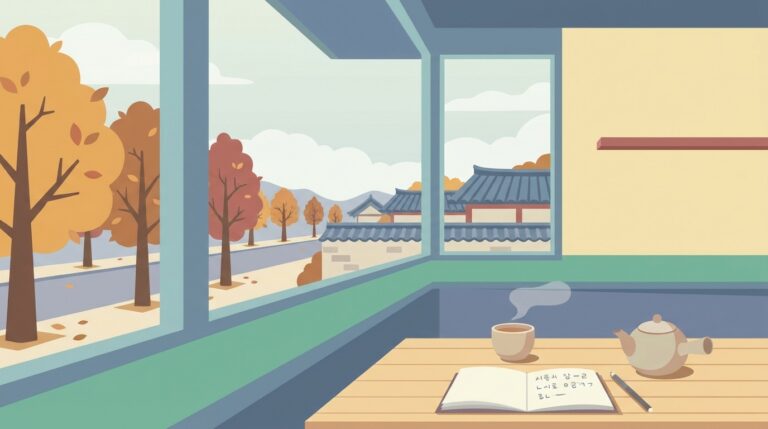
Setting: A quiet second-floor café in Mangwon-dong overlooking autumn ginkgo leaves. Rain is lightly tapping the window. You are sitting across from Min-woo (민우), a supportive Korean study partner and senior colleague.
- Turn 1 (Min-woo):
🎭 Looking at your tired face with genuine concern, setting down his cup.
“요즘 얼굴이 많이 상했네… 한국어 시험 준비랑 일 때문에 많이 바쁘지?”
(Yojeum eolguri mani sanghaenne… Hangugeo siheom junbirang il ttaemune mani bappeuji?)
“You look so worn out these days… Are you super busy with Korean exam prep and work?” -
Turn 2 (You):
🎭 Looking down at your cup, offering a bitter-sweet, self-reflective smile.
“네, 솔직히 번아웃이 좀 심하게 왔나 봐요. 침대에 누우면 아무것도 하기 싫더라고요.”
(Ne, soljiki beon-a-usi jom simhage wanna bwayo. Chimdaee nu-umyeon amugeotdo hagi silteoragoyo.)
“Yeah, honestly I think a severe burnout hit me. Once I lie in bed, I don’t feel like doing anything at all.” -
Turn 3 (Min-woo):
🎭 Nodding slowly in deep agreement, leaning slightly forward.
“그럴 때 있지. 나도 작년에 취업 준비할 때 침대 밖으로 나오는 것조차 무서웠거든.”
(Geureol ttae itji. Nado jangnyeone chwieop junbihal ttae chimdae bakk-euro naoneun geotjocha museowotgeodeun.)
“There are times like that. When I was preparing for job employment last year, even stepping out of bed felt scary.” -
Turn 4 (You):
🎭 Tapping your fingers softly on the table, confessing your honest regret.
“처음에는 ‘내가 왜 이렇게 나태해졌지?’라며 스스로를 다그쳤는데 그럴수록 마음만 더 힘들어지더라고요.”
(Cheo-eumeneun ‘naega wae ireoke nataehaejyeotji?’ramyeo seuseuro-reul dakeuchyeotneunde geureolsurok maeumman deo himdeureojideoragoyo.)
“At first I scolded myself wondering why I had become so lazy, which only made my mind suffer more.” -
Turn 5 (Min-woo):
🎭 Gently shaking his head with an empathetic frown.
“맞아. 에너지가 고갈된 건데 그걸 게으름으로 착각하면 진짜 위험해.”
(Maja. Eneojiga gogaldoen geonde geugeol geeureumeuro chakgakhamyeon jinjja wiheomhae.)
“Exactly. Your energy is just depleted, but mistaking that for laziness is genuinely dangerous.” -
Turn 6 (You):
🎭 Taking a slow breath, feeling unburdened.
“민우 씨도 그런 적이 있어요? 그럼 그 무기력증을 어떻게 버텨냈어요?”
(Min-u ssido geureon jeogi isseoyo? Geureom geu mugiryeokjjeungeul eotteoke beotyeonaesseoyo?)
“Have you been through that too, Min-woo? How did you endure through that lethargy?” -
Turn 7 (Min-woo):
🎭 Taking a sip of tea, smiling warmly.
“그냥 아무것도 안 하는 날을 스스로에게 선물했어. 아무 생각 없이 한강도 걷고.”
(Geunyang amugeotdo an haneun nareul seuseuro-ege seonmulhaesseo. Amu saenggak eopsi hangangdo geotgo.)
“I simply gifted myself days where I did absolutely nothing. Walking by the Han River without a single thought.” -
Turn 8 (You):
🎭 Nodding with newfound resolve, smiling warmly.
“저도 오늘은 나를 다그치지 말고 푹 쉬어야겠어요. 고마워요, 민우 씨.”
(Jeodo oneureun nareul dakeuchiji malgo puk swieoyagesseoyo. Gomawoyo, Min-u ssi.)
“I should stop scolding myself today and get some deep rest too. Thank you, Min-woo.”
🔀 인터랙티브 분기점 (Interactive Fork)
How would you respond if Min-woo asks: “이번 주말에는 어떻게 쉴 계획이에요?” (How do you plan to rest this weekend?)
- Option A: “밀린 공부를 다 끝내고 나서 편하게 쉬려고요!” (I plan to rest comfortably after finishing all my overdue studies!)
- ⚠️ Risk: Contradicts the lesson! You are still putting conditional pressure on resting. Min-woo might say: “또 스스로를 다그치네요!” (You’re scolding yourself again!)
- Option B: “주말 내내 방에 틀어박혀서 스마트폰만 볼 거예요.” (I’ll shut myself in my room all weekend and just look at my smartphone.)
- 🚫 Bad: Too passive-negative. Dopamine scrolling often exacerbates lethargy rather than healing burnout.
- Option C: “핸드폰 꺼두고 근처 공원에서 햇빛 받으면서 산책이라도 해보려고요.” (I’m thinking of turning off my phone and taking a walk in the nearby park getting some sunshine.)
- ✅ Best: Perfect! Demonstrates active self-compassion, physical revitalization, and natural Korean phrasing (
-(으)ㄹ까 해요/-어 보려고요).
- ✅ Best: Perfect! Demonstrates active self-compassion, physical revitalization, and natural Korean phrasing (
Phase 6: 10초 감정 섀도잉 드릴 (10-Second Emotional Shadowing Drill)
Read these sentences aloud, pausing at / and mimicking the emotional cue in brackets!
[😔 자책하듯 낮게 - Low, self-critical, confessing inner conflict]
“처음에는 / ‘내가 왜 이렇게 나태해졌지?’라며 / 스스로를 다그쳤는데…”
(Cheo-eumeneun / ‘naega wae ireoke nataehaejyeotji?’ramyeo / seuseuro-reul dakeuchyeotneunde…)-
[😮💨 한숨을 내쉬며 깨달은 듯이 - Reflective sigh, sharing a hard truth]
“그럴수록 / 마음만 더 / 힘들어지더라고요.”
(Geureolsurok / maeumman deo / himdeureojideoragoyo.) -
[🫂 털어놓듯 다정하게 - Warm, relieved, mutual comfort]
“우리 이제 / 너무 스스로를 다그치지 말아요.”
(Uri ije / neomu seuseuro-reul dakeuchiji marayo.)
(“Let’s not push ourselves so hard anymore.”)
Phase 7: K-Culture 미니 사전 (Mini Dictionary)
-
현타 (Hyeonta)
Translation: Reality check / Post-exertion realization.
Usage: Short for ‘현실 자각 타임’. Used when an illusion shatters or when intense effort suddenly feels vain. E.g., “새벽까지 과제 하다가 갑자기 현타 왔어.” (While doing assignments until dawn, reality hit me hard.) -
번아웃 (Beon-a-ut)
Translation: Burnout.
Usage: Widely borrowed and used directly as a noun. Often paired with verbs ‘오다’ (to come) or ‘겪다’ (to experience). E.g., “번아웃이 왔을 땐 쉬는 게 정답이에요.” (When burnout hits, resting is the right answer.) -
쉼표 (Swimpyo)
Translation: A comma; a purposeful rest pause.
Usage: Beyond punctuation, used metaphorically for taking a healthy hiatus. E.g., “인생에도 잠깐의 쉼표가 필요해요.” (Life needs temporary commas too.) -
갓생 피로증 (Gatsaeng Pirojeung)
Translation: The fatigue of living an excessively productive life.
Usage: Slang describing the exhaustion that follows trying to be 100% productive every second of the day.
Phase 8: 여행자를 위한 생존 키트 (Traveler’s Survival Kit)
서바이벌 표현 TOP 3 (Top 3 Survival Expressions)
- “여기 조용한 자리 있나요?” (Yeogi joyonghan jari innayo?)
Meaning: “Do you have a quiet seat here?”
Pro Tip: When your battery is drained in busy Hongdae or Myeongdong, use this at independent cafés to find a serene corner. - “조금 천천히 말씀해 주시겠어요?” (Jogeum cheoncheonhi malsseumhae jusigesseoyo?)
Meaning: “Could you speak a little more slowly, please?”
Pro Tip: When burnout from processing rapid Korean strikes mid-travel, don’t panic—ask politely with this phrase. - “오늘 일정을 조금 줄여야겠어요.” (Oneul iljeong-eul jogeum juryeoyagesseoyo.)
Meaning: “I think I need to cut back on today’s itinerary a bit.”
Editor’s Travel Note
When modern travel fatigue hits you in Seoul:
* Healing Spot Recommendation: Skip the packed shopping malls and take the subway to Seoul Forest (서울숲). Grab a mat and sit under the birch trees.
* Essential Mobility: Instead of wandering lost when your mind is fried, open the 네이버 지도 앱 다운로드 to locate quiet neighborhood tearooms (전통찻집) in Insadong or Seochon.
Phase 9: “한 발 더 깊이” (Cultural Reflection)
In Korean linguistic culture, the distinction between active effort and overexertion is nuanced. Because the society places tremendous weight on communal contribution and continuous self-improvement (자기계발), individuals often internalize rest as guilt. Notice how Korean grammar reflects this: we say ‘쉬다’ (to rest), but when we feel sorry about taking a break, we frequently preface it with ‘괜히’ (in vain/needlessly). Recognizing that rest is not laziness is a linguistic and psychological breakthrough for anyone learning this beautiful language.
💬 Your Turn: When you experience burnout, what phrase or habit helps you recover? Have you ever scolded yourself in your native language like in this Korean expression? Share your thoughts below in the comments!
Phase 10: FAQ & 흔한 실수 (FAQ Schema & Common Mistakes)
Q: Can I use ‘나태하다’ in casual conversation with close friends?
A: ‘나태하다’ is slightly literary and formal compared to everyday ‘게으르다’ (lazy). However, when self-reflecting (e.g., “내가 왜 이렇게 나태해졌지?”), it adds a dramatic, self-critical nuance often heard in internal monologues or deep conversations.
Q: What is the exact difference between ‘다그치다’ and ‘혼내다’?
A: ‘혼내다’ means to scold or reprimand someone for doing something wrong. ‘다그치다’ means to relentlessly push, press, or urge someone forward to demand speed, perfection, or answers.
Q: Is ‘-더라고요’ rude to use with older people or superiors?
A: Not at all! ‘-더라고요’ is very polite and respectful (존댓말). It just sounds warmer and softer than direct factual assertions like ‘-었습니다’.
🚨 흔한 실수 (Common Mistakes) 경고판
- Mistake: Saying “저는 게을러요” when you are actually exhausted.
Correction: Say “에너지가 다 떨어진 것 같아요” (I feel like my energy is completely gone). Don’t label your identity when it is just temporary fatigue. - Mistake: Overusing “스트레스 받아요” for every emotional state.
Correction: Specify whether it is “무기력증” (apathy/lethargy) or “번아웃” (burnout). Precision helps people offer genuine comfort. - Mistake: Saying “마음이 아파요” when you feel mentally overwhelmed.
Correction: ‘마음이 아프다’ means “heartbroken/sympathetic towards tragedy.” For mental exhaustion or burden, use “마음이 힘들다” or “마음이 복잡하다”.
Phase 11: 액션 미션 & 참여 유도 (Action Missions)
- 🥉 Bronze Mission (Solo Practice): Stand in front of your mirror, gently let out a breath, and record yourself saying Phase 6’s sentence: “너무 스스로를 다그치지 말아요.” three times.
- 🥈 Silver Mission (Journaling): Write one sentence in your Korean journal using the B1 connector
-(으)ㄹ수록: “조급할수록 마음만 더…” (The more hurried I get, the more my mind…). - 🥇 Gold Mission (Real Interaction): Next time your language exchange partner looks tired, send them a message: “요즘 너무 무리하지 말고, 스스로를 너무 다그치지 마세요!” (Don’t overdo it these days, and don’t push yourself too hard!).
- 🎮 K-Culture Mission: Watch an episode of a healing K-drama (like Our Blues or Doctor Slump) and spot moments where characters tell each other to rest.
Phase 12: 인터랙티브 퀴즈 챌린지 (Quiz Challenge)
1. 상황 판단 (Situational Judgment)
Your friend says they have worked 70 hours this week and can’t even get out of bed on Sunday, blaming themselves: “난 왜 이럴까?”. What is the most empathetic, natural Korean response?
* (A) “더 일찍 일어나서 운동을 해보세요.” (Try waking up earlier and working out.)
* (B) “스스로를 너무 다그치지 마. 그동안 정말 열심히 달렸잖아.” (Don’t be so hard on yourself. You’ve sprinted so hard all this time.)
* (C) “게으르면 성공할 수 없어요.” (If you are lazy, you cannot succeed.)
2. 빈칸 채우기 (Fill-in-the-Blank)
- “욕심을 [내다 / 낼수록] 마음의 짐만 더 무거워[져요 / 지더라고요].”
3. True / False Cultural Check
- Modern Koreans view taking breaks (‘멍때리기’) as a disgraceful act of laziness. (True / False)
👉 Click to view answers and explanations
- Answer: (B)
Explanation: When someone experiences burnout, telling them to work out or work harder exacerbates their guilt. (B) warmly acknowledges their depleted state and encourages self-compassion. -
Answer: 낼수록 / 지더라고요
Explanation:-(으)ㄹ수록pairs with ‘욕심을 내다’ (the more one is greedy), and-더라고요expresses personal reflective realization. -
Answer: False
Explanation: In modern Korea, mindful pausing like ‘멍때리기’ (spacing out) is widely celebrated as an essential mental detox tool to survive fast-paced life!
🎬 Watch Our Daily Videos! (Daily Hangul Official Instagram)
Review the expressions you learned in this article with our fun daily short videos! Check out native pronunciation and real-life nuances in action.
- Instagram @dailyhangul_en







