

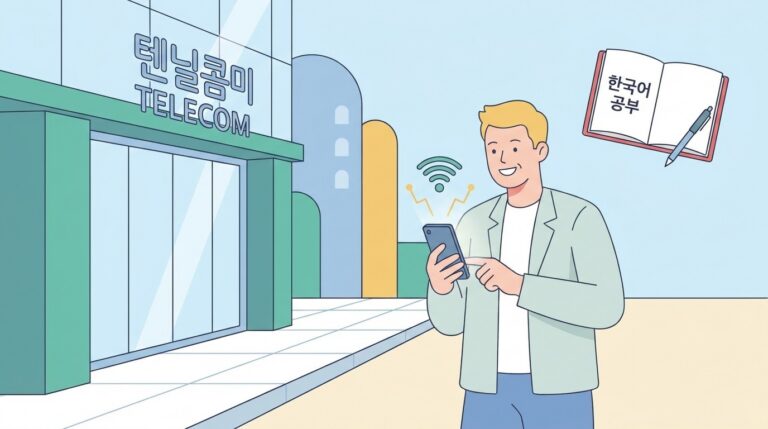
Phase 1: Empathy (Real-Life Telecom Hurdles)
안녕하세요! 매일한글 에디터입니다. (Hello! I’m your Daily Hangul editor.)
Picture this: You are walking down the vibrant, neon-lit streets of Hongdae or preparing for a weekend getaway from Seoul to Tokyo or Jeju Island. Suddenly, a notification pops up on your phone: “Warning: Roaming data disabled.” You freeze. How will you navigate Naver Map? How will you show your reservation QR codes or text your travel buddies on KakaoTalk?
You decide to walk into a mobile carrier store—like SK Telecom (T World), KT, or LG U+—hoping to activate an eSIM or sign up for international roaming. But the moment the store assistant bows and says, “어떤 업무 도와드릴까요? (Eotteon eommu dowadeurilkkayo? / How may I help you?)”, your mind blanks. You worry about getting locked into an expensive contract or being misunderstood.
Don’t worry! You don’t need complicated tech jargon to get connected. Thousands of our beginner learners felt that exact same travel anxiety before mastering just a few simple patterns. Today, I’ll walk you through the real-world phrases that will help you set up roaming or buy an eSIM effortlessly, save money, and feel completely in control.
Phase 2: Key Expressions Breakdown
Here are the 3 essential expressions you must know before entering any telecom store in Korea:
1. 로밍 신청하고 싶어요 (Roming sincheonghago sipeoyo)
- Pronunciation: [Roming sincheonghago sipeoyo] (Sound tip: “Roming” sounds just like English “roaming” with a crisp R; “sincheong” sounds like “seen-chung”.)
- Meaning: “I would like to apply for roaming.” (Literal: “Roaming / application / want to do.”)
- K-Culture Moment: You often hear this in travel variety shows like Earth Arcade or Begin Again right before the cast boards a flight to shoot abroad.
- Editor’s Insight: The ending ~고 싶어요 (~go sipeoyo) is the friendliest, most natural way for an A2 learner to state a desire without sounding bossy or overly stiff.
- Situation Spectrum: Casual: ⚠️ (Use ~고 싶어 with friends) | Semi-formal: ✅ | Formal: ✅
- 🤔 Think About It: In English, we often say “Can I get roaming?” while Korean focuses on the action: “I want to register/apply (신청하다).” Why do you think Korean uses administrative action verbs like 신청 so frequently in everyday service settings?
2. 이심(eSIM) 지원돼요? (Isim jiwondwaeyo?)
- Pronunciation: [Isim jiwondwaeyo?] (Sound tip: “Isim” sounds like “E-SIM”; “ji-won-dwae-yo” sounds like “jee-won-dway-yo”.)
- Meaning: “Does it support eSIM?” (Literal: “eSIM / is it supported?”)
- K-Culture Moment: When K-drama protagonists travel on sudden overseas business trips, they quickly scan an eSIM QR code on their flagship phones instead of swapping physical SIM trays with a pin.
- Editor’s Insight: 지원되다 (jiwondoeda) literally means “to be supported/compatible.” Adding the question intonation ~돼요? (~dwaeyo?) turns any technical question into a polite, easy inquiry.
- Situation Spectrum: Casual: ⚠️ | Semi-formal: ✅ | Formal: ✅
- 🤔 Think About It: Notice how subjects like “my phone” are often dropped in Korean! Asking “이심 지원돼요?” is completely natural without having to specify “Does my phone support…”
3. 데이터 무제한 요금제 있어요? (Deiteo mujehan yogeumje isseoyo?)
- Pronunciation: [Deiteo mujehan yogeumje isseoyo?] (Sound tip: “De-ee-tuh moo-jeh-hahn yo-geum-jeh ee-ssuh-yo”.)
- Meaning: “Do you have an unlimited data plan?” (Literal: “Data / unlimited / price plan / is there?”)
- K-Culture Moment: In food travel shows like Street Food Fighter, host Baek Jong-won constantly checks real-time maps and restaurant ratings using unlimited travel data packs.
- Editor’s Insight: 무제한 (mujehan) is a power word! You’ll see it everywhere in Korea: all-you-can-eat BBQ restaurants (고기 무제한) and unlimited mobile plans (무제한 요금제).
- Situation Spectrum: Casual: ⚠️ | Semi-formal: ✅ | Formal: ✅
- 🤔 Think About It: Koreans prioritize high-speed convenience above all else. How does having access to “무제한” mobile data reflect Korea’s fast-paced digital lifestyle?
Phase 3: Textbook Korean vs. Real Korean
Situation 1: Applying for a travel data roaming pack
- 📖 교과서 한국어 (Textbook): 해외 데이터 로밍 서비스를 이용하고 싶습니다. (Haewoe deiteo roming seobiseureul iyonghago sipsumnida. / “I desire to utilize the overseas data roaming service.”)
- 🗣️ 진짜 한국어 (Real-Life): 로밍 요금제 신청하려고요. (Roming yogeumje sincheongharyeogoyo. / “I’m looking to apply for a roaming plan.”)
- 💡 왜 다를까? (Why is it different?): The textbook sentence uses heavy Sino-Korean words and ultra-formal grammar (~고 싶습니다). Real Koreans use the soft conversational ending ~(으)려고요 (~ryeogoyo), which naturally implies your intention when talking to service clerks.
Situation 2: Checking device compatibility
- 📖 교과서 한국어 (Textbook): 이 휴대 단말기는 전자 가입자 식별 모듈을 지원합니까? (I hyudae danmalgineun jeonja gaippja sikbyeol modyureul jiwonhamnikka? / “Does this mobile terminal unit support the electronic subscriber identity module?”)
- 🗣️ 진짜 한국어 (Real-Life): 제 폰 이심(eSIM) 돼요? (Je pon isim dwaeyo? / “Does my phone work with eSIM?”)
- 💡 왜 다를까? (Why is it different?): Nobody translates “eSIM” into administrative jargon (전자 가입자 식별 모듈) in real life. Simply using 제 폰 (je pon – my phone) with ~돼요? (~dwaeyo? – does it work? / is it possible?) communicates your point instantly and clearly.
Phase 4: K-Culture Deep Dive & Non-Verbal Manners
4-1. 눈치 (Nunchi) & Polite Telecom Store Manners
When you enter a telecom agency (대리점 – daerijeom) in Korea:
* Two-Handed Rule (두 손 예절): Whenever you hand over your passport, credit card, or smartphone, always hold the item with both hands or support your right forearm with your left hand. It shows instant respect and sets a friendly, helpful tone.
* Screen Nunchi: The clerk will frequently turn their computer monitor toward you to show prices and gigabyte tiers. Nodding slightly and saying “아, 네네 (Ah, nene – Ah, yes, right)” shows that you are actively following along, even if you are reading the numbers slowly.
4-2. Cultural Code: The Land of “Fast & Connected”
South Korea has one of the highest smartphone penetration rates in the world. Being offline—even for thirty minutes—is virtually unthinkable. Korean telecom branches are designed for rapid, seamless customer processing. Because Koreans value efficiency (빨리빨리 – ppalli-ppalli), customer representatives will often offer to set up your eSIM profile via a QR code on the spot. Don’t feel rushed! Take a breath, look over the plan duration (e.g., 3 days, 5 days, 30 days), and confirm before scanning.
Phase 5: Real-Life Roleplay Scenario
- Setting: A bustling telecom branch inside an airport or near a central station in Seoul.
- Characters:
- 민호 (Minho): A kind, tech-savvy telecom store clerk.
- You (Traveler): Looking to set up data before your trip.
Turn 1
민호 (Minho): 🎭 [미소 지으며 가볍게 인사한다 / Smiles and bows lightly]
어서 오세요! 어떤 업무 도와드릴까요?
(Eoseo oseyo! Eotteon eommu dowadeurilkkayo?)
"Welcome! How can I help you today?"

Turn 2
You: 🎭 [스마트폰을 보여주며 / Showing your smartphone]
해외여행 가는데, 로밍 신청하고 싶어요.
(Haewoe-yeohaeng ganeunde, roming sincheonghago sipeoyo.)
"I'm going on a trip abroad, and I'd like to apply for roaming."

Turn 3
민호 (Minho): 🎭 [단말기 기종을 확인하며 / Checking your device model]
네! 며칠 동안 여행하세요? 혹시 이심(eSIM)도 괜찮으세요?
(Ne! Myeochil dongan yeohaenghaseyo? Hoksi isim-do gwaenchaneuseyo?)
"Sure! How many days are you traveling? Would you also be open to using an eSIM?"

Turn 4
You: 🎭 [고개를 끄덕이며 / Nodding politely]
일주일 가요. 제 폰 이심(eSIM) 지원돼요?
(Iljuil gayo. Je pon isim jiwondwaeyo?)
"I'm going for a week. Does my phone support eSIM?"

Turn 5
민호 (Minho): 🎭 [화면을 고객 쪽으로 돌려 보여주며 / Turning the screen to show plan options]
네, 지원되는 모델이에요! 일주일 무제한 데이터 요금제 추천해 드릴게요.
(Ne, jiwondoeneun moderieyo! Iljuil mujehan deiteo yogeumje chucheonhae deurilgeyo.)
"Yes, your model supports it! I recommend our one-week unlimited data plan."

Turn 6
You: 🎭 [가격을 확인하며 안도하듯 / Checking the price with relief]
좋아요. 그걸로 해주세요. 여권 보여드리면 되나요?
(Joayo. Geugeollo haejuseyo. Yeogwon boyeodeurimyeon doenayo?)
"Great. I'll take that one. Should I show you my passport?"

Turn 7
민호 (Minho): 🎭 [두 손으로 여권을 받으며 / Receiving the passport with both hands]
네, 여권 확인 후 바로 큐알(QR) 코드 발급해 드릴게요.
(Ne, yeogwon hwagin hu baro kyual kodeu balgeuphae deurilgeyo.)
"Yes, after checking your passport, I'll issue your QR code right away."

Turn 8
You: 🎭 [두 손으로 QR 안내문을 받으며 / Receiving the QR guide with both hands]
감사합니다! 바로 스캔할게요.
(Gamsahamnida! Baro seukaenhalgeyo.)
"Thank you! I will scan it right away."
🔀 Interactive Branching Choice
Suppose the clerk asks: “데이터 몇 기가 필요하세요? (How many gigabytes of data do you need?)” How do you respond?
- Option A: 데이터 무제한 요금제 있어요? (Deiteo mujehan yogeumje isseoyo?)
- Feedback (Best!): Perfect! It politely clarifies whether an unlimited option is available so you don’t have to calculate gigabytes.
- Option B: 제일 싼 거 줘. (Jeil ssan geo jwo.)
- Feedback (Risk): Risky! ~줘 (~jwo) is informal panmal. Talking down to store staff sounds rude. Always add ~주세요 (~juseyo).
- Option C: 인터넷 몰라요. (Inteonet mollayo.)
- Feedback (Bad): Too vague. The agent won’t know whether you want Wi-Fi, physical SIM, or home broadband.
Phase 6: 10-Second Emotion Shadowing Drill
Practice these three lines aloud. Pay attention to the pauses (/) and embody the emotional tag!
[😊 밝고 자연스럽게 / Bright & natural]
해외여행 가는데, / 로밍 신청하고 싶어요.
(Haewoe-yeohaeng ganeunde, / roming sincheonghago sipeoyo.)-
[🤔 궁금하고 조심스럽게 / Curious & polite]
제 폰 / 이심(eSIM) / 지원돼요?
(Je pon / isim / jiwondwaeyo?) -
[🤝 명확하고 확신에 차서 / Clear & confident]
데이터 무제한 요금제로 / 해주세요.
(Deiteo mujehan yogeumjero / haejuseyo.)
Phase 7: K-Culture Mini Dictionary
-
요금제 (Yogeumje) [Yo-geum-jeh]
Meaning: Price plan / Cellular tariff.
Usage: Use this whenever selecting data packages (e.g., 알뜰 요금제 – budget plan, 로밍 요금제 – roaming plan). -
유심 vs. 이심 (Yusim vs. Isim) [Yoo-sim vs. Ee-sim]
Meaning: Physical SIM card vs. Embedded eSIM.
Usage: In Korea, you can buy a physical 유심 at convenience stores or an 이심 online via telecom portals. -
통신사 (Tongsin-sa) [Tong-sin-sah]
Meaning: Telecommunications carrier (SKT, KT, LGU+).
Usage: Often asked when registering for public Wi-Fi or entering Korean phone authentication forms. -
데이터 차단 (Deiteo chadan) [Deh-ee-tuh chah-dahn]
Meaning: Data blocking.
Usage: Crucial safety feature! Ask for “데이터 로밍 차단 (data roaming block)” if you want to avoid accidental pay-per-megabyte charges.
Phase 8: Survival Kit for Travelers
TOP 3 Emergency Phrases
- 와이파이 도시락 있어요? (Waipai dosirak isseoyo?)
Pronunciation: [Wa-ee-pa-ee doh-shee-rahk ee-ssuh-yo?]
Pro Tip: A “Wi-Fi Dosirak” (literally “Wi-Fi Bento Box”) is Korea’s popular slang for a portable pocket Wi-Fi router available at airport counters! - 데이터 로밍 차단해 주세요. (Deiteo roming chadanhae juseyo.)
Pronunciation: [Deh-ee-tuh roh-ming chah-dahn-heh joo-seh-yoh.]
Pro Tip: Tell this to the agent if you only want Wi-Fi and want zero risk of unexpected roaming fees. - QR 코드 다시 보내주실 수 있나요? (Kyual kodeu dasi bonaejusil su innayo?)
Pronunciation: [Kyoo-ahl koh-deu dah-shee boh-neh-joo-sheel soo een-nah-yoh?]
Pro Tip: If your eSIM setup fails or you delete the activation email by mistake, use this phrase to get it re-sent.
Editor’s Travel Note
- App Prep: Before your trip, search for the official mobile carrier portal like the T World customer service app or KT Roaming customer center app on your phone. You can easily track your remaining data in real time.
- Payment & ID: When signing up at an offline store, you will always need your physical passport (여권 – yeogwon) and an international credit card matching your legal name.
Phase 9: A Step Deeper (Cultural Reflection)
In South Korea, your smartphone is far more than a communication device—it is your digital identity. From entering clubs in Gangnam to reserving a table at a famous K-BBQ restaurant via waiting tablets, a mobile connection tied to a valid phone plan or data link dictates daily life. The transition toward paperless eSIM activations reflects how rapidly Korean society embraces digital convenience. When you navigate a Korean telecom store with confidence, you aren’t just buying data; you are taking your first real step toward experiencing Korea at its true, ultra-connected speed.
💬 Your Turn: Have you ever experienced roaming panic while traveling in another country? Which do you prefer: a physical SIM card, an eSIM, or a pocket Wi-Fi router? Let’s chat in the comments below!
Phase 10: FAQ & Avoiding Misunderstandings
Q: Can foreign tourists buy an eSIM at any regular telecom store on the street?
A: Most neighborhood telecom branches (대리점) focus on long-term postpaid contracts for residents with Alien Registration Cards (ARC). For short-term travel eSIMs or prepaid SIMs, it is much faster to visit branches at Incheon/Gimpo International Airport, large flagship stores in Myeongdong/Hongdae, or purchase directly through the carrier’s English travel portal online.
Q: What is the difference between a “data-only” plan and a plan with a Korean phone number?
A: If you want to use Korean ride-hailing apps or join restaurant digital waiting lists (like CatchTable), you often need a plan that includes an incoming 010 number or SMS capability. Ask the clerk: “전화번호 있는 요금제예요? (Does this plan include a phone number?)”
Q: What should I do if my eSIM QR code does not activate right away?
A: Make sure you are connected to the airport or store Wi-Fi when scanning the QR code, as the initial profile download requires an active internet connection. If it still fails, show your screen to the staff and say: “활성화가 안 돼요. 확인해 주세요. (It won’t activate. Please check this for me.)”
🚨 Common Mistakes Alert
- Mistake: Throwing away the physical QR code receipt immediately after leaving the store.
Correct Action: Keep the paper or screenshot until your data is fully verified and active. You may need the SM-DP+ address printed on it if manual setup is required. - Mistake: Forgetting to turn off data roaming on your home primary SIM while using an eSIM.
Correct Action: In your phone settings, set your cellular data line exclusively to your travel eSIM to avoid accidental roaming charges from your home country provider. - Mistake: Using English tech terms with hard consonants.
Correct Action: Pronounce “eSIM” smoothly as 이심 (Isim) and “Roaming” with a soft initial sound as 로밍 (Roming) so local Korean clerks catch your meaning instantly.
Phase 11: Action Missions & Engagement
- 🥉 Bronze Mission (Solo Practice): Stand in front of a mirror with your phone. Pretend you are in a Seoul telecom store and speak aloud: “로밍 신청하고 싶어요. (Roming sincheonghago sipeoyo.)” Record your voice and check your rhythm.
- 🥈 Silver Mission (Social Share): Share your favorite Korean phrase from this lesson on Instagram or X (Twitter). Tag #DailyHangul and tell us your top travel destination!
- 🥇 Gold Mission (Real-World Challenge): The next time you land in Korea or check telecom options at an airport counter, order your data setup entirely in Korean using our Phase 5 script!
- 🎮 K-Culture Mission: Watch an episode of a Korean travel vlog (like Pani Bottle or KwakTube). Listen carefully for when they talk about 데이터 (data), 유심 (USIM), or 와이파이 (Wi-Fi)!
Phase 12: Interactive Quiz Challenge
Test what you learned today! Click on the toggle boxes below to see if your answers are correct.
1. Situational Judgment
You want to ask if the telecom plan offers unlimited data so you can stream your favorite K-pop videos without stress. What should you ask?
* (A) 데이터 차단해 주세요. (Deiteo chadanhae juseyo.)
* (B) 데이터 무제한 요금제 있어요? (Deiteo mujehan yogeumje isseoyo?)
* (C) 유심 버려 주세요. (Yusim beoryeo juseyo.)
👉 Click to reveal Answer & Explanation
Correct Answer: (B)
Explanation: 무제한 (mujehan) means “unlimited.” Option (A) asks to block data, and option (C) asks to throw away the SIM card!
2. Fill in the Blank
Complete the sentence to ask if your device supports an eSIM:
“제 폰 이심(eSIM) ________?”
* (A) 지원돼요 (jiwondwaeyo)
* (B) 비싸요 (bissayo)
* (C) 없어요 (eopseoyo)
👉 Click to reveal Answer & Explanation
Correct Answer: (A)
Explanation: 지원돼요? (jiwondwaeyo?) means “Is it supported?” creating the natural phrase: “제 폰 이심 지원돼요? (Does my phone support eSIM?)”
3. Cultural True or False
True or False: In Korea, you should hand your passport or payment card to the telecom clerk using only one hand to show that you are casual and relaxed.
👉 Click to reveal Answer & Explanation
Correct Answer: False
Explanation: In Korean culture, handing important personal items like passports, credit cards, or cash requires both hands (or supporting your right arm with your left hand) to show proper respect and courtesy.
🎬 Watch Our Daily Videos! (Daily Hangul Official Instagram)
Review the expressions you learned in this article with our fun daily short videos! Check out native pronunciation and real-life nuances in action.
- Instagram @dailyhangul_en







