

Master the Korean Post Office: How to Send International EMS Packages Like a Pro
Phase 1: Empathy (Real-Life Opening)
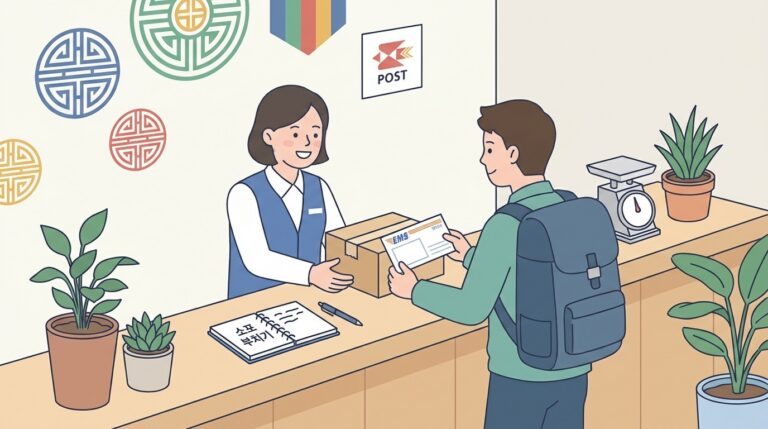
안녕하세요! 매일한글 (Daily Hangul) editor here! Picture this: You’re standing in a bustling Seoul post office. The air smells cleanly of freshly cut cardboard and packaging tape. You’ve spent your morning carefully packing K-pop albums, sheet masks, and crispy honey-butter snacks into a sturdy “No. 3 Box” for your best friend back home. You step up to the counter clutching the red-and-white EMS slip (국제특송 송장). You carefully penned the contents in English—”Cosmetics 3ea, Snacks 2ea, $45″—just as international shipping rules require. But suddenly, your heart thumps when the friendly clerk glances up and asks a question in rapid Korean. You freeze: How do I politely explain that I already wrote the item types, quantities, and prices in English inside the declaration box? Don’t worry! Dozens of our students experienced this exact hesitation. With just one crisp, polite A2 phrase, you will conquer the postal counter with total confidence.
Phase 2: Core 3 Expressions Deep-Dive
1. 상자 안에 든 물건 영어로 적었어요. (Sangja ane deun mulgeon yeongeoro jeogeosseoyo.)
- Pronunciation: [Sang-ja a-ne deun mool-geon yeong-eo-ro jeo-geo-sseo-yo] (Sounds like: “Sahng-jah ah-neh deun mool-guhn yung-uh-roh juh-guh-ssuh-yo”)
- Meaning: Literal: “Inside box items English in wrote.” / Real Nuance: “I’ve written the contents of the box in English.”
- K-Culture Moment: Imagine an exchange student in a slice-of-life K-drama like Twenty-Five Twenty-One, shipping a precious care package across the sea.
- Editor’s Insight: Using
~으로 (~euro)indicates the tool or language (“in English”). This immediately tells the postal clerk they can verify your customs declaration without confusion.- Situation Spectrum:
- Casual (to close friends): 🚫
- Semi-formal / Polite (
-요style): ✅ (Ideal for postal counters)- Formal (
-습니다style): ⚠️ (Acceptable, but can sound overly stiff for an everyday counter transaction)- 🤔 Think About It: In English, we often say “I declared the items.” Why do you think Korean favors describing the concrete action (“I wrote the things inside in English”)?
2. 개수랑 가격도 다 썼어요. (Gaesurang gagyeokdo da sseosseoyo.)
- Pronunciation: [Gae-su-rang ga-gyeok-do da sseo-sseo-yo] (Sounds like: “Geh-soo-rahng gah-gyuk-doh dah ssuh-ssuh-yo”)
- Meaning: Literal: “Quantity and price also all wrote.” / Real Nuance: “I’ve listed all the quantities and values as well.”
- K-Culture Moment: In variety shows like Running Man, cast members show quick check-lists saying “다 했어요! (I finished all of it!)”. Here,
다 썼어요 (da sseosseoyo)shows total readiness.- Editor’s Insight: The particle
~랑 (~rang)is the warm, natural conversational way to say “and” between nouns, perfect for beginner-friendly speaking.- Situation Spectrum:
- Casual: 🚫
- Semi-formal: ✅
- Formal: ⚠️
- 🤔 Think About It: Notice how Korean pairs short helper words like
다 (da, all)right before the verb to express thoroughness.3. 비행기로 보내면 며칠 걸려요? (Bihaenggiro bonaemyeon myeochil geollyeoyo?)
- Pronunciation: [Bi-haeng-gi-ro bo-nae-myeon myeo-chil geol-lyeo-yo] (Sounds like: “Bee-heng-gee-roh boh-neh-myun myuh-cheel guhl-lyuh-yo”)
- Meaning: Literal: “By airplane if sent how many days take?” / Real Nuance: “How many days will it take if I send it by airmail/EMS?”
- K-Culture Moment: A romantic lead tracking a heartfelt letter across borders in Crash Landing on You.
- Editor’s Insight:
비행기 (bihaenggi, airplane)is the universal colloquial term customers use at post offices when distinguishing EMS from slower sea mail (배편, baepyeon).- Situation Spectrum:
- Casual: 🚫
- Semi-formal: ✅
- Formal: ✅
- 🤔 Think About It: Time questions in Korean focus directly on “how many days” (
며칠) rather than “how long” (얼마나 오래), showing Korean communicative efficiency.
Phase 3: Textbook Korean vs. Real Korean
Situation 1: Explaining your customs form
- 📖 교과서 한국어 (Textbook): 세관 신고서에 품명과 수량을 영문으로 기재하였습니다. (Segwan singoseoe pummyeonggwa suryangeul yeongmuneuro gijaehayeotseumnida. / “I recorded the item names and quantities in English on the customs declaration form.”)
- 🗣️ 진짜 한국어 (Real-life): 상자 안에 물건 영어로 다 적었어요. (Sangja ane mulgeon yeongeoro da jeogeosseoyo. / “I wrote all the items inside the box in English.”)
- 💡 왜 다를까? (Why the difference?): Textbook formulas use Chinese-character administrative terms like
기재하다 (to enter/record)and품명 (item name). Real Koreans at the counter prefer clean, native everyday verbs like적다 / 쓰다 (to write).
Situation 2: Asking if your slip is filled out properly
- 📖 교과서 한국어 (Textbook): 작성이 올바르게 완료되었는지 확인해 주시겠습니까? (Jakseongi olbareuge wanryodoeeotneunji hwaginhae jusigesseumnika? / “Could you please verify whether the completion is correct?”)
- 🗣️ 진짜 한국어 (Real-life): 이렇게 쓰면 돼요? (Ireoke sseumyeon dwaeyo? / “Is it okay if I write it like this?”)
- 💡 왜 다를까? (Why the difference?): Native Korean customers value swift communication. Asking
~면 돼요?is the gold standard for polite, natural confirmation.
Phase 4: K-Culture Deep-Dive & Non-Verbal Manners
4-1. Nunchi (눈치) & Post Office Gestures
- The Two-Hand Presentation: When sliding your parcel onto the digital scale and passing your red EMS waybill, always support your right forearm or wrist with your left hand, or use both hands. This shows tremendous respect to the postal worker.
- The Prohibited Items Nod: Behind every postal desk, there is a laminated photo sheet showing prohibited items: batteries (배터리), perfume (향수), sprays (스프레이), and cash. When the clerk points to it and asks if any are inside, maintain direct eye contact and shake your head slightly with a polite “없어요 (Eopseoyo – None).”
4-2. Cultural Code: The Self-Packaging Counter (자율 포장대)
In Korean post offices, you never wait in line to buy tape or ask staff to pack your items. In the corner, you’ll find the legendary 자율 포장대 (Self-Packaging Station) fully stocked with free green tape-guns, scissors, and bubble wrap (뽁뽁이, ppokppoki). Koreans pride themselves on packaging their box neatly before taking a number ticket (번호표). Doing this before approaching the counter earns instant respect from the busy staff!
Phase 5: Real-World Roleplay Scenario
Setting: A sunlit post office in Mapo-gu, Seoul. You hear the rhythmic thump-thump of date stamps and the buzz of customer tickets. You step up to Window 3.
Character: Postal Clerk Min-ho (민호 주임님) — wearing a crisp blue postal vest with a gentle, professional smile.
- 민호: 안녕하세요! 어떤 것 도와드릴까요? (Annyeonghaseyo! Eotteon geot dowadeurilkkayo? / “Hello! How can I help you today?”)
- You: 🎭 Placing the box on the counter scale with both hands 해외로 EMS 보내려고 하는데요. (Haeoero EMS bonaeryeogo haneundeyo. / “I’d like to send an EMS package overseas.”)
- 민호: 네, 무게 먼저 잴게요. 저기 세관 작성은 하셨나요? (Ne, muge meonje jaelgeyo. Jeogi segwan jakseongeun hasyeonnayo? / “Sure, let me weigh it first. Did you fill out the customs info?”)
- You: 🎭 Handing over the form with a confident smile 네! 상자 안에 든 물건 영어로 적었어요. (Ne! Sangja ane deun mulgeon yeongeoro jeogeosseoyo. / “Yes! I wrote the items inside the box in English.”)
- 민호: 아, 감사합니다. 개수랑 금액도 다 기재하셨네요. 향수나 배터리 같은 금지 물품은 없으시죠? (A, gamsahamnida. Gaesurang geumaekdo da gijaehasyeotneyo. Hyangsuna baeteori gateun geumji mulpumeun eopseusijyo? / “Ah, thank you. You listed quantities and prices too. No prohibited items like perfume or batteries, right?”)
- You: 🎭 Nodding clearly 네, 전혀 없어요. 개수랑 가격도 다 맞아요. (Ne, jeonhyeo eopseoyo. Gaesurang gagyeokdo da majayo. / “Yes, none at all. Quantities and values are all accurate.”)
- 민호: 네, 미국까지 4일 정도 소요되고요, 요금은 4만 2천 원입니다. (Ne, migukkkaji sail jeongdo soyodoegoyo, yogeumeun saman icheon-wonimnida. / “Okay, it takes about 4 days to the US, and the postage is 42,000 KRW.”)
- You: 🎭 Tapping your card on the payment terminal 네, 카드로 결제할게요. 감사합니다! (Ne, kadeuro gyeoljehalkeyo. Gamsahamnida! / “Yes, I will pay by card. Thank you!”)
🔀 Interactive Decision Point
If the clerk asks: “물건 가격을 원화로 쓰셨어요, 달러로 쓰셨어요? (Did you write the item prices in Won or Dollars?)”
* Option A: 달러로 적었어요! (Dalloro jeogeosseoyo! – I wrote it in Dollars!)
👉 Feedback: BEST! Clear, cheerful, and answers the clerk’s customs conversion question immediately.
* Option B: 몰라요, 그냥 썼어요. (Mollayo, geunyang sseosseoyo. – Don’t know, just wrote it.)
👉 Feedback: BAD. Sounds dismissive and forces the clerk to double-check line by line.
* Option C: 네, 맞아요. (Ne, majayo. – Yes, that’s right.)
👉 Feedback: RISK. This is an ‘either/or’ question. Answering “yes” creates awkward confusion!
Phase 6: 10-Second Emotion Shadowing Drill
Practice matching the exact rhythm and feeling of a real Korean speaker:
[😊 Confidently & Clearly]
상자 안에 / 든 물건 / 영어로 / 적었어요.
(Sangja ane / deun mulgeon / yeongeoro / jeogeosseoyo.)-
[✨ Thorough & Proud]
개수랑 / 가격도 / 다 썼어요!
(Gaesurang / gagyeokdo / da sseosseoyo!) -
[🤔 Curious & Polite]
비행기로 보내면 / 얼마나 / 걸려요?
(Bihaenggiro bonaemyeon / eolmana / geollyeoyo?)
Phase 7: K-Culture Mini Dictionary
- 우체국 국제특송 (EMS / Ucheguk Gukjeteuksong): The gold-standard international express courier operated by Korea Post. Known for rapid tracking updates via KakaoTalk notification.
- 세관 신고서 (Customs Declaration / Segwan Singoseo): The legal customs declaration form where item names, HS codes, weights, and values must be written in English.
- 자율 포장대 (Self-Packaging Table / Jayul Pojangdae): The dedicated DIY packaging zone in every Korean post office with tape, string, scissors, and packing materials.
- 송장 (Tracking Waybill / Songjang): The barcode sticker placed on your parcel. Locals say “송장 번호 (tracking number)” when asking for tracking information.
Phase 8: Traveler Survival Kit
Top 3 Survival Phrases
- 박스 3호 하나 주세요. (Bakseu samho hana juseyo.)
Pro Tip: Korean post office boxes come in standard sizes 1 to 5. Size 3 is ideal for snacks and clothing care packages! - EMS 송장 어디에 있어요? (EMS songjang eodie isseoyo?)
Pro Tip: Use this if you cannot find the international shipping slips at the stationery table. - 영수증 버려주세요. (Yeongsujeung beoryeojuseyo.)
Pro Tip: “Please discard the receipt.” Your tracking number will still be texted to your Korean phone number!
Editor’s Travel Note
Before rushing to the post office during peak lunch hour (12:00 PM – 1:00 PM), complete your customs declaration in advance via the 우체국 스마트접수 모바일 웹사이트 to receive a 3% to 5% shipping discount and bypass physical paperwork altogether!
Phase 9: One Step Deeper (Reflection)
Korean postal desks reflect Korea’s unique harmony between rapid efficiency (빨리빨리) and mutual civic trust. When clerks see that you took the extra step to translate and quantify contents clearly in English, they reciprocate with extra care and speed. Language here is not just transactional—it is a gesture of consideration for the worker’s time.
💬 Your Turn: Have you ever shipped a package internationally from another country? What was the hardest part? Leave your thoughts in the comments below!
Phase 10: FAQ & Common Mistakes
Q: Can I write the item names in Korean if sending to an Asian country?
A: No. International customs guidelines require all EMS descriptions to be written in English or the destination country’s official language. Sticking to standard English ensures swift customs clearance.
Q: What currency should I use when writing the item values?
A: You can write the value in US Dollars ($ USD) or Korean Won (₩ KRW). If writing in Won, make sure to add “KRW” or “원” clearly beside the number.
Q: How do I know which box size fits my items?
A: Post offices have empty sample boxes mounted on the wall with measurements and prices. You can physically test your items inside them before paying.
🚨 Common Mistakes Alert
- Mistake: Writing vague terms like “Daily Necessities” or “Gifts”.
Correct Action: Be specific! Write “Cotton T-shirt 2ea”, “Snack (No meat) 4ea”, or “Facial Mask 10ea”. - Mistake: Listing the value as “$0” because it’s a present.
Correct Action: Customs will flag $0 declarations. Always write an approximate market value (e.g., $20 or $30). - Mistake: Packing canned kimchi or rechargeable power banks.
Correct Action: Fermented food that expands and lithium-ion batteries are strictly prohibited on air cargo.
Phase 11: Action Missions
- Bronze Mission (Solo): Stand in front of your mirror and practice saying
상자 안에 든 물건 영어로 적었어요three times smoothly in 10 seconds. - Silver Mission (Social): Take a photo of your Korea travel souvenirs and draft a mock customs list writing the item types and quantities in English and Korean.
- Gold Mission (Real Life): Visit a local post office in Korea, pick up a box, use the
자율 포장대, and hand your parcel over using today’s dialogue!
🎮 K-Culture Mission: Look out for scenes in K-dramas (like Start-Up or Work Later, Drink Now) where characters send parcels—spot whether they use the self-packaging counter!
Phase 12: Interactive Quiz Challenge
1. Situation Judgment: The postal clerk points to your EMS declaration and asks what is inside. What is the most polite and natural A2 response?
– A) 몰라요. (Mollayo.)
– B) 상자 안에 든 물건 영어로 적었어요. (Sangja ane deun mulgeon yeongeoro jeogeosseoyo.)
– C) 네, 비행기 타요. (Ne, bihaenggi tayo.)
2. Fill in the Blank: “개수___ 가격도 다 썼어요.” (I wrote both the quantity AND the price.)
– Fill in the missing conversational conjunction particle meaning “and”.
3. True or False: You should seal your package with tape before taking it to the counter, using the tools at the self-packaging station.
– [True / False]
👉 Click to view Answers & Explanations!
- Answer: B. This clearly and politely informs the clerk that the items are described in English.
- Answer: 랑 (rang).
개수랑 가격도 다 썼어요uses~랑to naturally link “quantity” and “price”. - Answer: True. Using the
자율 포장대(self-packaging counter) to prepare your box completely before approaching the clerk ensures quick, seamless counter service!
🎬 Watch Our Daily Videos! (Daily Hangul Official Instagram)
Review the expressions you learned in this article with our fun daily short videos! Check out native pronunciation and real-life nuances in action.
- Instagram @dailyhangul_en







