

Phase 1: Empathy (Story-Driven Opening)
안녕하세요! 매일한글 에디터입니다. (Annyeonghaseyo! I am your Daily Hangul editor.)
Picture this: You are living your dream trip in Seoul. You just enjoyed a spicy tteokbokki lunch, followed by Korea’s unofficial national drink—a freezing Ah-Ah (Iced Americano). Feeling refreshed, you head back to your Airbnb or hotel to brush your teeth before an afternoon walking tour around Bukchon Hanok Village. But the moment the cold tap water and toothbrush bristles touch your molars, a sharp, icy jolt shoots straight to your jaw! You wince in pain. You want to rush down to the local pharmacy (yakguk) or see a dentist (chigwa), but your mind goes blank. How do you describe that unique stinging cold sensation in Korean without confusing the pharmacist?
Many of our beginner learners tell us: “Teacher, I know the word for pain (아파요 – apayo), but how do I explain that freezing, sensitive sting?” You don’t need complicated medical jargon. Today, we will master simple, natural A1 expressions to explain sensitive teeth clearly and get the exact relief you need. Let’s dive in together!
Phase 2: Top 3 Core Expressions In-Depth Analysis
1. 이가 시려요 (I-ga siryeoyo)
- Pronunciation: [I-ga si-ryeo-yo] (Sounds like “ee-gah she-ryuh-yo”—rhymes with ‘sheer’ + ‘yo’)
- Meaning: Direct translation: “Teeth feel chilly/numb.” Actual nuance: “My teeth are sensitive (to cold or touch).”
- K-Culture Moment: Often heard in K-dramas when elderly grandparents or characters with sensitive teeth hesitate before biting into ice cream or shaved ice (bingsu).
- Editor’s Insight: In English, we say “my teeth are sensitive,” but Korean uses the dedicated sensory adjective 시리다 (sirida), which describes a piercing, icy ache. It is different from dull pain (아프다 – apeuda).
- Situation Spectrum: Casual: ✅ | Semi-formal: ✅ | Formal: ✅ (Using the -yo ending makes it universally polite at clinics and pharmacies).
- 🤔 Think About It: Why does Korean have a unique, distinct verb solely for cold-induced aching sensations that English bundles into general “sensitivity”?
2. 양치할 때 아파요 (Yangchihal ttae apayo)
- Pronunciation: [Yang-chi-hal ttae a-pa-yo] (Think of “young-chee-hal tae ah-pah-yo”)
- Meaning: Direct translation: “When doing tooth-cleaning, it hurts.” Actual nuance: “It hurts when I brush my teeth.”
- K-Culture Moment: You will see characters in office sitcoms brushing their teeth together in the restroom after lunch (a quintessential Korean habit!) talking about their dental discomfort.
- Editor’s Insight: 양치 (yangchi) is the everyday conversational term for brushing teeth. The pattern -(으)ㄹ 때 (-eul ttae) means “when doing something,” making this an essential beginner building block.
- Situation Spectrum: Casual: ✅ | Semi-formal: ✅ | Formal: ✅
- 🤔 Think About It: In many Western cultures, brushing teeth at the office restroom is rare, but in Korea, it is standard etiquette. How does language reflect daily hygiene routines?
3. 치과에 가야 해요? (Chigwa-e gaya haeyo?)
- Pronunciation: [Chi-gwa-e ga-ya hae-yo?] (Sounds like “chee-gwa-eh gah-yah hae-yo”)
- Meaning: Direct translation: “To the dental clinic, must I go?” Actual nuance: “Do I need to see a dentist?”
- K-Culture Moment: A worried friend asking their roommate when simple pain relief toothpaste isn’t doing the trick.
- Editor’s Insight: In Korean, medical departments use the suffix -과 (-gwa), meaning branch or department. 치 (chi) means tooth, so 치과 (chigwa) literally translates to “tooth department/clinic.”
- Situation Spectrum: Casual: ✅ | Semi-formal: ✅ | Formal: ✅
- 🤔 Think About It: Asking advice with -ya haeyo? shows reliance on your friend’s practical judgment rather than just making a solo decision.
Phase 3: Textbook Korean vs. Real Korean
Situation 1: Telling someone your teeth feel sensitive
- 📖 교과서 한국어: 치아가 시린 증상이 있습니다. (Chia-ga sirin jeungsang-i itsseumnida. / “I have a symptom of cold-sensitive teeth.”)
- 🗣️ 진짜 한국어: 이가 너무 시려요! (I-ga neomu siryeoyo! / “My teeth are so sensitive!”)
- 💡 왜 다를까?: Textbook Korean leans on formal Sino-Korean nouns like 치아 (chia) and 증상 (jeungsang), whereas native speakers use native Korean words like 이 (i) and simple emotional modifiers like 너무 (neomu).
Situation 2: Asking for sensitive toothpaste at a pharmacy
- 📖 교과서 한국어: 지각과민 처치용 치약을 주십시오. (Jigak-gwamin cheochiyong chiyag-eul jusipsio. / “Please give me dentin hypersensitivity treatment toothpaste.”)
- 🗣️ 진짜 한국어: 시린 이에 좋은 치약 있어요? (Sirin i-e joeun chiyak isseoyo? / “Do you have toothpaste that’s good for sensitive teeth?”)
- 💡 왜 다를까?: Nobody recites medical catalog labels in real life! Using the practical phrase [Condition]에 좋은 [Item] 있어요? (Do you have [item] good for [condition]?) works effortlessly everywhere.
Phase 4: K-Culture Deep Dive & Non-Verbal Manners
4-1. Nunchi & Physical Gestures
When communicating dental discomfort in Korea, body language helps bridge vocabulary gaps:
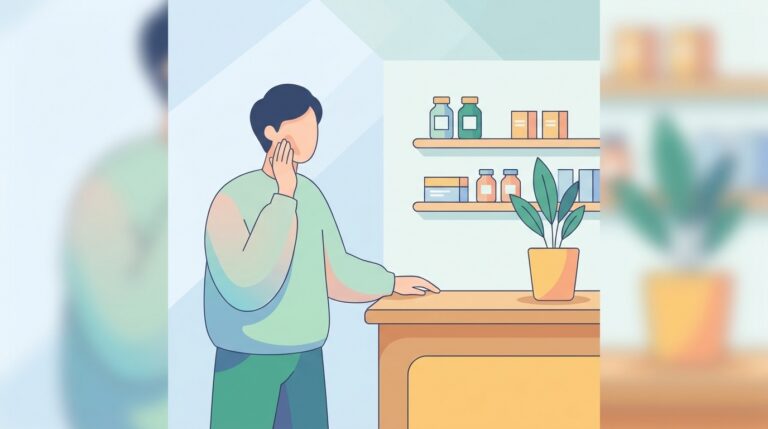
* The Gentle Cheek Cup: When saying 이가 시려요 (I-ga siryeoyo), cup your cheek softly with one hand and tilt your head slightly with a wincing face. This instantly signals localized tooth trouble before you even finish speaking.
* Two-Handed Delivery: When handing over your prescription, symptom note, or credit card at the pharmacy counter, always support your right forearm or wrist with your left hand, or hold the card with both hands. This shows respect (ye-ui) and immediately builds friendly rapport with the staff.
4-2. Cultural Code: The Office Toothbrush & “Eol-Juk-Ah”
Why are sensitive teeth such a hot topic in Korea? Two cultural pillars explain it:
1. The 3-3-3 Rule & Office Brushing: From kindergarten, Koreans are taught to brush within 3 minutes of finishing a meal, for 3 minutes, 3 times a day. Walk into any corporate office or university bathroom in Seoul at 12:45 PM, and you will see dozens of people brushing simultaneously with personal toothbrush sanitizers (sallogyun-gi). Overzealous brushing often leads to enamel wear and tooth sensitivity!
2. 얼죽아 (Eol-juk-ah): Short for “Even if I freeze to death, I drink Iced Americano.” Koreans love ice in their drinks 365 days a year. The combination of scorching summer heat or freezing sub-zero winter temperatures with iced coffee makes tooth sensitivity a national collective experience.
Phase 5: Real-Life Roleplay Scenario
Setting: A clean, brightly lit pharmacy (yakguk) right next to Exit 3 of Hongik University Station in Seoul. Rain taps against the window. Pharmacist Min-ji is organizing oral care products behind the counter.
- Turn 1 (Learner): 안녕하세요! 저… 약사님. (Annyeonghaseyo! Jeo… yaksa-nim. / “Hello! Uh… Pharmacist.”)
🎭 Approaches counter holding left cheek lightly - Turn 2 (Pharmacist Min-ji): 네, 안녕하세요! 어디 불편하세요? (Ne, annyeonghaseyo! Eodi bulpyeonhaseyo? / “Yes, hello! Where does it feel uncomfortable?”)
🎭 Smiles warmly, looking up from computer - Turn 3 (Learner): 양치할 때 이가 너무 시려요. (Yangchihal ttae i-ga neomu siryeoyo. / “When I brush my teeth, my teeth feel so sensitive.”)
🎭 Points gently toward lower left jaw - Turn 4 (Pharmacist Min-ji): 아, 차가운 물 닿을 때 찌릿찌릿해요? (A, chagaun mul daheul ttae jjirit-jjirithaeyo? / “Ah, does it sting sharply when cold water touches it?”)
🎭 Nods empathetically - Turn 5 (Learner): 네, 맞아요! 찬물 마실 때도 아파요. (Ne, majayo! Chanmul masil ttaedo apayo. / “Yes, that’s right! It hurts when drinking cold water, too.”)
🎭 Furrows brow slightly to express discomfort - Turn 6 (Pharmacist Min-ji): 시린 이 전용 치약이랑 소염진통제 드릴게요. (Sirin i jeonyong chiyagirang soyeom-jintongje deurilkeyo. / “I’ll give you a toothpaste for sensitive teeth and an anti-inflammatory painkiller.”)
🎭 Picks up toothpaste and a small medicine box - Turn 7 (Learner): 감사합니다. 치과에 가야 해요? (Gamsahamnida. Chigwa-e gaya haeyo? / “Thank you. Do I need to go to a dentist?”)
🎭 Receives items with both hands attentively - Turn 8 (Pharmacist Min-ji): 이틀 써보시고 계속 아프면 꼭 치과 가세요! (Iteul sseobosigo gyesok apeumyeon kkok chigwa gaseyo! / “Try it for two days, and if it continues to hurt, definitely visit a dental clinic!”)
🎭 Gives an encouraging nod
🔀 Interactive Decision Point
Suppose the pharmacist asks: “많이 아파요? (Mani apayo? / Does it hurt a lot?)” How do you respond?
* Option A: “아니요, 그냥 시려요.” (Aniyo, geunyang siryeoyo. / “No, it just feels cold and sensitive.”)
* Feedback (Best!): Perfect! This distinguishes dull throbbing ache from sharp cold sensitivity, ensuring you don’t get prescribed heavy unnecessary painkillers.
* Option B: “몰라요. 죽겠어요!” (Mollayo. Jukgesseoyo! / “I don’t know. I’m dying!”)
* Feedback (Risk): While dramatic expressions like 죽겠어요 are common in K-dramas, using it with a medical professional might alarm them into thinking you have an acute emergency!
* Option C: “이 아파.” (I apa. / “Tooth hurts.”)
* Feedback (Bad): This is informal, flat talk (banmal). Speaking without polite endings (-yo) to an elder or pharmacist can sound blunt and rude.
Phase 6: 10-Second Emotion Shadowing Drill
Read these aloud, pausing at the slashes (/) and channeling the bracketed emotion!
[😖 Wincing in discomfort]- 양치할 때 / 이가 / 너무 시려요.
- (Yangchihal ttae / i-ga / neomu siryeoyo.)
- “When brushing teeth… my teeth… sting so cold.”
[🥺 Seeking helpful advice politely]- 시린 이에 좋은 / 치약 있어요?
- (Sirin i-e joeun / chiyak isseoyo?)
- “Toothpaste good for sensitive teeth… do you have it?”
[🤔 Curious and slightly worried]- 치과에 / 바로 가야 해요?
- (Chigwa-e / baro gaya haeyo?)
- “To a dentist… should I go right away?”
Phase 7: K-Culture Mini Dictionary
- 이 (I) | Tooth / Teeth
- Usage: The pure Korean everyday word for teeth. For polite or medical contexts, people may use 치아 (chia), but in conversation, 이 (i) is overwhelmingly preferred (e.g., 이 닦았어? = Did you brush your teeth?).
- 시리다 (Sirida) | To feel sensitive / piercingly cold
- Usage: A sensory verb used for teeth reacting to cold or for cold wind biting into your knees/fingers during winter (e.g., 손이 시려워요 = My hands are freezing cold).
- 양치질 (Yangchijil) | Brushing teeth / Oral rinse
- Usage: Often shortened to 양치 (yangchi). Combined with the verb 하다 (hada) as 양치하다 (to brush teeth). Always heard after meals in homes and offices.
- 치과 (Chigwa) | Dental clinic
- Usage: Dentists in Korea are ubiquitous and high-tech. If you ever need to search for one on a map, search for 치과의원 (chigwa-uiwon) or simply 치과.
Phase 8: Traveler’s Survival Kit
Top 3 Survival Expressions
- 찬물 마실 때 시려요. (Chanmul masil ttae siryeoyo.)
- Romanization: Chan-mul ma-sil ttae si-ryeo-yo.
- Pro Tip: Use this at restaurants or cafes if you want room temperature water: “찬물 마실 때 시려서요, 미지근한 물 주세요.” (My teeth are sensitive to cold water, so please give me lukewarm water.)
- 진통제 주세요. (Jintongje juseyo.)
- Romanization: Jin-tong-je ju-se-yo.
- Pro Tip: The universal phrase for “Painkillers, please” at any Korean pharmacy.
- 가장 가까운 치과가 어디예요? (Gajang gakkaun chigwa-ga eodiyeyo?)
- Romanization: Ga-jang ga-kka-un chi-gwa-ga eo-di-ye-yo?
- Pro Tip: Essential emergency phrase for asking hotel concierges or subway info booths for the nearest dental clinic.
Editor’s Travel Note
- Pharmacy Signs: Look for the bold red or green letter 약 (Yak) on storefronts. Pharmacies in Korea are plentiful, especially near subway exits.
- Finding Open Clinics on Weekends: Download and use the Naver Map application rather than international maps. Search for 휴일지킴이약국 (holiday duty pharmacy) or simply 야간 치과 (night dental clinic) to find spots open after 7 PM or on Sundays.
Phase 9: “One Step Deeper” (Cultural Reflection)
In the Korean language, physical discomfort is perceived through fine-tuned sensory distinctions. While English often defaults to blanket words like “it hurts” or “it’s sensitive,” Korean differentiates sharp cold pain (시리다), dull throbbing pain (욱신거리다), and stinging surface pain (따끔거리다). Recognizing 시리다 (sirida) is your gateway into the Korean mindset of bodily harmony—acknowledging how external temperatures interact directly with your vitality.
💬 Your Turn: Have you ever experienced sudden tooth sensitivity after enjoying a cold dessert or drink while traveling? Share your experience in the comments below!
Phase 10: FAQ & Common Mistakes
Q: Can I buy sensitive toothpaste at Korean convenience stores like GS25 or CU?
A: Yes! Most Korean convenience stores carry standard sensitive toothpastes (such as Sensodyne, localized as 센소다인). Look for the phrase 시린이 케어 (Sensitive Teeth Care) on the tube.
Q: How much does a basic emergency dental consultation cost in Korea for foreign tourists without NHIS insurance?
A: A walk-in consultation and X-ray examination without Korean National Health Insurance typically costs around 25,000 KRW to 50,000 KRW (approx. $18–$38 USD), which is remarkably affordable compared to many Western countries.
Q: Is “이 (i)” used for just one tooth or all teeth?
A: Korean rarely forces strict singular and plural distinctions for body parts unless necessary. 이 (i) can mean a single tooth or teeth in general depending on context!
🚨 Common Mistakes Warning Board
- Mistake: Saying “치아가 추워요” (Chia-ga chuwoyo) to mean “My teeth feel cold.”
- Correction: 춥다 (chupda) is only used for weather or full-body chill. Always use 시리다 (sirida) for teeth or localized body parts!
- Mistake: Forgetting the polite ending -yo and shouting “이 아파! (I apa!)” at a pharmacy.
- Correction: Always add -yo: 이가 아파요 (I-ga apayo) or 이가 시려요 (I-ga siryeoyo).
- Mistake: Confusing 약국 (yakguk = pharmacy) with 치과 (chigwa = dental clinic) when you need urgent procedural treatment rather than temporary toothpaste or pills.
Phase 11: Action Missions
- 🥉 Bronze Mission (Solo Practice): Stand in front of your bathroom mirror tonight. While holding your toothbrush, practice saying “양치할 때 이가 시려요!” three times out loud.
- 🥈 Silver Mission (Social Sharing): Post a photo of your favorite iced drink on Instagram or X with the caption: “얼죽아지만 이가 시려요 ❄️ (Eol-juk-ah-ji-man i-ga siryeoyo – I love iced drinks even if I freeze, but my teeth are sensitive!)”.
- 🥇 Gold Mission (Real-life Execution): Visit a Korean mart or pharmacy (or your local H-Mart) and locate a toothpaste designed for sensitive teeth by spotting the characters 시린이.
- 🎮 K-Culture Mission: Watch an episode of a Korean workplace drama (like Misaeng or Business Proposal). Spot a scene where colleagues brush their teeth together in the office restroom after lunch!
Phase 12: Interactive Quiz Challenge
Question 1: Situational Judgment
You take a sip of freezing ice water and your front teeth hurt with a cold, stinging sensation. What is the most natural Korean expression to tell your friend?
* (A) 이가 더워요. (I-ga deowoyo.)
* (B) 이가 시려요. (I-ga siryeoyo.)
* (C) 이가 배고파요. (I-ga baegopayo.)
Question 2: Fill-in-the-Blank
Complete the sentence to ask for sensitive toothpaste at a pharmacy:
* “시린 이에 좋은 ________ 있어요?” (Do you have toothpaste good for sensitive teeth?)
Question 3: True or False
* In Korea, it is considered rude or unusual to brush your teeth in the public restroom of an office or school after lunch. (True / False)
👉 Click to view answers and explanations!
- Question 1 Answer: (B) 이가 시려요.
- Explanation: 시려요 (siryeoyo) comes from 시리다, specifically describing cold-sensitive dental twinges. Option (A) means hot, and Option (C) means hungry!
- Question 2 Answer: 치약 (chiyak)
- Explanation: 치 (tooth) + 약 (medicine) forms the word for toothpaste: 치약 (chiyak).
- Question 3 Answer: False
- Explanation: Brushing your teeth after lunch in office and school restrooms is a respected, standard hygiene etiquette across South Korea!
- Explanation: Brushing your teeth after lunch in office and school restrooms is a respected, standard hygiene etiquette across South Korea!
🎬 Watch Our Daily Videos! (Daily Hangul Official Instagram)
Review the expressions you learned in this article with our fun daily short videos! Check out native pronunciation and real-life nuances in action.
- Instagram @dailyhangul_en







