

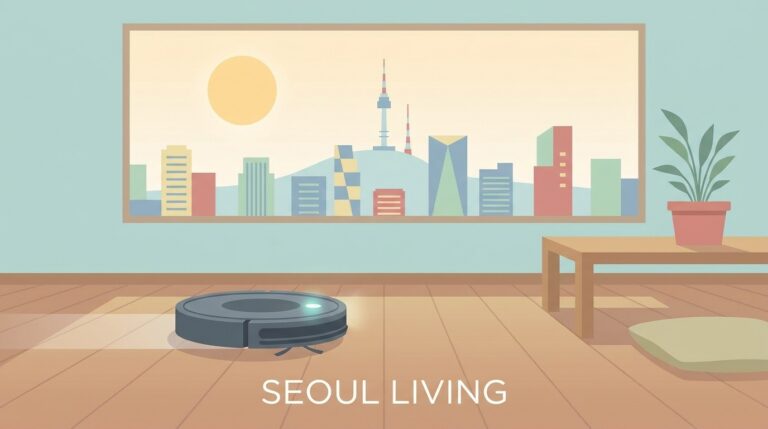
Phase 1: 공감 (Story Opening)
안녕하세요! 매일한글 에디터입니다. Have you ever survived a grueling 9-hour workday in Seoul, squeezed your way through the humid crowds of Line 2 subway, and dragged your exhausted body home—only to be greeted by dust bunnies drifting across the living room floor like tumbleweeds?
In modern Korean culture, where long hours and fast-paced living are standard, maintaining a clean home used to feel like a second job. But if you have been watching Korean lifestyle vlogs or reality shows like I Live Alone (나 혼자 산다 – Na Honja Sanda), you might have noticed a massive cultural shift: young Koreans don’t spend their weeknights sweeping anymore. Instead, they proudly say: “출근할 때 스마트폰 앱으로 로봇청소기를 돌려놓으면 퇴근했을 때 집 안이 반짝반짝 깨끗해요” (When I set the robot vacuum to run via my smartphone app on my way to work, the house is sparkling clean when I get off work).
Connecting smart home devices isn’t just about gadgetry in Korea; it’s practically a lifestyle survival hack. In this guide, tested and refined with dozens of intermediate learners living or staying in Korea, you will learn the exact conversational patterns, cultural nuances, and real-life phrases Korean adults use when bragging about their beloved home automation life-savers. Get ready to elevate your Korean from textbook-stiff to apartment-smart!
Phase 2: 핵심 표현 3선 심층 분석 (Top 3 Key Expressions)
1. 돌려놓다 (dollyeonota)
- Pronunciation: [dollyeonota] (Sounds like “dole-yeo-noh-tah”—imagine rolling a ball and leaving it where it stops)
- Meaning: Literally “to turn and place/leave,” but in real nuance: “to set an appliance running in advance so the task continues while you do something else.”
- K-Culture Moment: Commonly heard in K-dramas when a career-driven protagonist taps their phone screen before a morning meeting: “세탁기 돌려놓고 나왔어” (I started the washing machine before heading out).
- Editor’s Insight: The auxiliary verb pattern
-아/어 놓다means performing an action ahead of time to keep that resulting state. When combined with 돌리다 (to run a machine), it creates that deeply satisfying feeling of passive productivity. - Situation Spectrum: Casual ✅ | Semi-formal ✅ | Formal ⚠️
- 🤔 Think About It: In English, we usually say “I ran the vacuum.” Why do Koreans place so much linguistic emphasis on the preparatory aspect (
-어 놓다) of daily chores?
2. 반짝반짝하다 (banjjakbanjjakada)
- Pronunciation: [banjjakbanjjakada] (Rhythmic pop sound: “bahn-tjak-bahn-tjak-ha-dah”)
- Meaning: Literally “sparkling” or “twinkling,” but used here to describe pristine, mirror-like cleanliness where floors reflect light without a grain of dust.
- K-Culture Moment: On home makeover shows, hosts exclaim this the second they take off their shoes at the front entryway: “와, 바닥이 반짝반짝하네요!” (Wow, the floor is sparkling clean!).
- Editor’s Insight: Korean has rich onomatopoeia and mimetic words (의성어/의태어). Doubling the root (반짝 -> 반짝반짝) adds vivid sensory imagery that instantly signals your emotional relief and satisfaction.
- Situation Spectrum: Casual ✅ | Semi-formal ✅ | Formal ✅
- 🤔 Think About It: While English speakers might say “squeaky clean” (sound-focused), Koreans visualize light reflecting off surfaces (“반짝반짝”). What does this reveal about cultural sensory preferences?
3. 삶의 질이 수직 상승하다 (salm-ui jil-i sujiksangsanghada)
- Pronunciation: [salmui jiri sujiksangsanghada] (“sahlm-wee jeel-ee soo-jeek-sahng-seung-ha-dah”)
- Meaning: “Quality of life skyrockets (vertically rises).”
- K-Culture Moment: The golden phrase of modern Korean product reviews on YouTube and Instagram! Whenever an influencer reviews a dishwasher or robot vacuum, this caption flashes across the screen in bold neon font.
- Editor’s Insight: While “삶의 질” is a formal term, pairing it with “수직 상승” (vertical rise) turns it into trendy, emphatic slang that captures dramatic life upgrades.
- Situation Spectrum: Casual ✅ | Semi-formal ✅ | Formal ⚠️
- 🤔 Think About It: Korean work culture can be demanding, which makes tools that purchase personal leisure time celebrated with dramatic expressions like “vertical rise.”
Phase 3: 교과서 한국어 vs 진짜 한국어 (Textbook vs. Real Korean)
Situation 1: Talking about scheduling your automated appliances
- 📖 교과서 한국어: 저는 집 밖에서 애플리케이션으로 청소기를 원격 조종합니다. (Jeoneun jip bakk-eseo aepeullikeisyeon-euro cheongsogireul wongyeok jojonghamnida. / I remotely control the vacuum cleaner outside my house using an application.)
- 🗣️ 진짜 한국어: 출근길에 앱으로 이모님 돌려놓고 와요. (Chulgeungil-e aep-euro imonim dollyeonoko wayo. / On my way to work, I just run the ‘cleaning auntie’ via the app.)
- 💡 왜 다를까?: In modern Korea, Koreans affectionately call top-tier automated appliances (robot vacuums, dishwashers, dryers) “가전 3대 이모님” (The 3 Home Appliance Aunties), recognizing them as indispensable helpers.
Situation 2: Describing a clean floor when you return
- 📖 교과서 한국어: 청소가 완료되어 바닥의 먼지가 모두 제거되었습니다. (Cheongsoga wallyeodoe-eo badak-ui meonjiga modu jegeodoeeossseumnida. / The cleaning is completed, and all dust on the floor has been removed.)
- 🗣️ 진짜 한국어: 퇴근하고 문 열면 바닥이 아주 반짝반짝 광이 나요! (Toegeunhago mun yeolmyeon badak-i aju banjjakbanjjak gwang-i nayo! / When I open the door after work, the floor is literally gleaming with a glossy shine!)
- 💡 왜 다를까?: Native speakers prefer visual idioms like “광이 나다” (to radiate a gloss) coupled with mimetic adverbs over dry passive technical reporting.
Phase 4: K-Culture 딥다이브 & 비언어적 매너 (Deep Dive & Manners)
4-1. 눈치 (Nunchi) & Gestures
When showing someone your smart home app during a coffee break in Korea, avoid waving your screen aggressively in their face. Instead, hold your smartphone slightly tilted toward them at chest height with both hands, lightly tapping the screen with your index finger while maintaining a mild, self-deprecating smile. If you boast too intensely about having high-end IoT appliances, you might come off as showing off (자랑질). Using humble phrasing like “이거 없었으면 저 쓰러졌어요” (Without this, I would have collapsed from exhaustion) builds relatable camaraderie.
4-2. Cultural Code: The Rise of “신세계” (A Whole New World)
In urban Korea, apartment living and long office commutes make automated home appliances not luxury toys, but essential mental-health investments. The word 신세계 (shinsegye – literally, a new world) is constantly applied to smart appliances. When you hear a Korean friend say, “식기세척기 샀는데 진짜 신세계야!” (I bought a dishwasher and it is truly a new world!), it means the gadget freed them from mundane daily friction. Participating in this conversation shows you understand modern Korean adulthood beyond the surface.
Phase 5: 실전 롤플레이 시나리오 (Real-Life Roleplay)
Setting: A break room at an IT startup in Pangyo. 3:30 PM coffee break.
Character: Jiwon (지원), your exhausted colleague holding an iced Americano.
- 지원 (Jiwon): 아, 오늘 야근 각인데… 집에 가면 청소 언제 다 하죠? (A, oneul yageun gak-inde… jibe gamyeon cheongso eonje da hajyo? / Ah, looks like overtime today… When will I ever clean the house when I get home?)
🎭 Sighs deeply and rubs her temples. -
You: 혹시 로봇청소기 안 쓰세요? (Hoksi robotcheongsogi an sseuseyo? / By any chance, don’t you use a robot vacuum?)
🎭 Tilts head curiously while holding your mug. -
지원 (Jiwon): 그거 진짜 쓸 만해요? 앱으로 켜도 구석구석 잘 닦이나요? (Geugeo jinjja sseul manhaeyo? Aep-euro kyeodo guseokguseok jal dakk-inayo? / Is that really worth using? Does it wipe every nook and cranny well even if you start it from an app?)
🎭 Eyes widen with skeptical curiosity. -
You: 완전요! 출근할 때 스마트폰 앱으로 로봇청소기를 돌려놓으면 퇴근했을 때 집 안이 반짝반짝 깨끗해요. (Wanjeonyo! Chulgeunhal ttae seumateupon aep-euro robotcheongsogireul dollyeonokeumyeon toegeunhaesseul ttae jip an-i banjjakbanjjak kkaekkeuthaeyo. / Totally! If you set the robot vacuum via the smartphone app when heading to work, the house is sparkling clean when you get off work.)
🎭 Smiles enthusiastically and demonstrates swiping on an imaginary phone screen. -
지원 (Jiwon): 와, 진짜요? 퇴근하고 먼지 밟히면 진짜 피곤하잖아요. (Wa, jinjyayo? Toegeunhago meonji balphimyeon jinjja pigonhajanayo. / Wow, really? You know how exhausting it is stepping on dust when you come home from work.)
🎭 Nods vigorously in agreement. -
You: 맞아요. 원격으로 예약해 두면 삶의 질이 수직 상승해요! (Majayo. Wongyeog-euro yeyakhaedu-myeon salm-ui jil-i sujiksangsanghaeyo! / Exactly. If you schedule it remotely, your quality of life skyrockets!)
🎭 Gives a confident thumbs-up. -
지원 (Jiwon): 대박… 저 오늘 퇴근길에 바로 최저가 검색해 봐야겠어요. (Daebak… jeo oneul toegeungil-e baro choejeoga geomsaekhae bwayagesseoyo. / Awesome… I should search for the lowest price right on my commute home today.)
🎭 Laughs and pulls out her smartphone with renewed energy. -
You: 링크 보내드릴게요. 꼭 스마트홈 연동되는 모델로 사세요! (Lingkeu bonaedeurilgeyo. Kkok seumateuhom yeondongdoeneun model-ro saseyo! / I’ll send you a link. Make sure to buy a model that connects to smart home systems!)
🎭 Winks and takes a sip of coffee.
🔀 Interactive Choice Point
After Jiwon says she wants to buy one right away, how do you respond to keep the conversation going?
- Choice A: “식기세척기도 같이 사세요. 둘이 합치면 신세계예요!” (Sikkisecheokgido gachi saseyo. Duri hapchimyeon shinsegye-yeyo! / Buy a dishwasher too. Together, they are a whole new world!)
- Choice B: “청소기는 시끄러우니까 그냥 빗자루 쓰세요.” (Cheongsogineun sikkeureounikka geunyang bitjaru sseuseyo. / Vacuums are noisy, so just use a broom.)
- Choice C: “돈도 많은데 가사도우미를 매일 부르세요.” (Dondo maneunde gasadoumireul maeil bureuseyo. / You have plenty of money, just hire a housekeeper every day.)
Feedback:
- Choice A (Best): Perfect! It taps right into the “smart appliances upgrade life” theme and recommends another staple item of the appliance trio.
- Choice B (Bad): You kill the tech excitement and sound dismissive of her modern lifestyle.
- Choice C (Risk): Presuming a colleague’s financial status is overly personal and awkward in a Korean workplace setting.
Phase 6: 10초 감정 섀도잉 드릴 (10-Second Emotion Drill)
Practice reading these out loud, observing the intonation slashes (/) and feeling the emotional marker.
[😊 기쁘고 신나게 / Cheerful & Relieved]
출근할 때 / 스마트폰 앱으로 / 로봇청소기를 돌려놓으면 / 퇴근했을 때 / 집 안이 반짝반짝 깨끗해요!
(Chulgeunhal ttae / seumateupon aep-euro / robotcheongsogireul dollyeonokeumyeon / toegeunhaesseul ttae / jip an-i banjjakbanjjak kkaekkeuthaeyo!)
Tip: Raise your pitch slightly on “반짝반짝” to express visual delight.-
[🤩 감탄하며 뿌듯하게 / Amazed & Proud]
이거 하나 샀을 뿐인데 / 삶의 질이 / 수직 상승했어요!
(Igeo hana sasseul ppun-inde / salm-ui jil-i / sujiksangsanghaesseoyo!)
Tip: Pause after “삶의 질이” and emphasize “수직 상승” with an upbeat finish. -
[🤝 공감하며 추천하듯 / Empathetic & Persuasive]
퇴근하고 집안일 안 해도 되니까 / 진짜 신세계예요!
(Toegeunhago jib-an-il an haedo doenikka / jinjja shinsegye-yeyo!)
Tip: Soften the ending on “-예요” to make your advice sound friendly and caring.
Phase 7: K-Culture 미니 사전 (Mini Dictionary)
-
스마트홈 연동 (seumateuhom yeondong) | Smart Home Integration
Connecting household appliances via Wi-Fi or Matter/Zigbee to apps like Samsung SmartThings or LG ThinQ so you can control them anywhere. -
이모님 가전 (imonim gajeon) | Appliance ‘Auntie’
A culturally unique slang term honoring time-saving gadgets (robot vacuum, dishwasher, dryer) that take over domestic labor just like an experienced household helper. -
퇴근길 (toegeungil) | The Evening Commute Home
More than just travel; it symbolizes decompression, switching off work mode, and looking forward to domestic peace. -
칼퇴 (kaltwoe) | Leaving Work Right on Time (Sharp Departure)
Compound of “칼” (knife/sharp) and “퇴근” (leaving work). Running home appliances in advance helps you enjoy your precious 칼퇴 evening to the fullest.
Phase 8: 여행자를 위한 생존 키트 (Traveler’s Survival Kit)
Survival Expressions TOP 3
-
와이파이 어떻게 연결해요? (Waipai eotteoke yeongyeolhaeyo?)
How do I connect to the Wi-Fi?
Pro Tip: Crucial when checking into an Airbnb or smart officetel to set up your IoT devices or app controls. -
이거 원격 조작 돼요? (Igeo wongyeok jojak dwaeyo?)
Can this be operated remotely?
Pro Tip: Use this when shopping for electronics at Hi-Mart (하이마트) or ElectroMart. -
청소 모드 좀 바꿔 주세요. (Cheongso modeu jom bakkwo juseyo.)
Please change the cleaning mode.
Pro Tip: Handy if staying in shared Korean coliving spaces where residents manage smart chore schedules.
Editor’s Travel Note
If you are renting a modern long-stay studio in Seoul, download the LG ThinQ 공식 앱 다운로드 or 삼성 SmartThings 앱 설치 depending on your apartment’s appliances. Many modern officetels allow you to turn on air conditioning or floor heating (보일러) 20 minutes before you arrive via your phone, ensuring you never step into an icebox in winter or a sauna in July!
Phase 9: “한 발 더 깊이” (Reflective Question)
In many Western cultures, home chores are considered personal rituals or weekend routines. However, in South Korea’s fast-paced metropolis, the extreme density of daily life combined with rapid tech infrastructure has created a national drive to automate domestic labor. By outsourcing repetitive physical exhaustion to intelligent algorithms, modern Koreans aren’t being lazy—they are actively reclaiming their mental bandwidth and preserving energy for self-care, social bonding, and creative pursuits.
💬 Your Turn: In your home country, do people embrace smart home automation for household chores, or is manual cleaning still seen as a virtue? Leave a comment below comparing your perspective!
Phase 10: FAQ & 흔한 실수 (FAQ & Common Mistakes)
Q: Why do Koreans say “돌리다” (to turn/rotate) for appliances like vacuums or washing machines?
A: Historically, early household machinery had rotating drums or knobs (like early wash tubs or dials). Over time, “돌리다” became the universal colloquial verb for operating any machine that runs a motorized cycle (세탁기를 돌리다, 전자레인지를 돌리다, 로봇청소기를 돌리다).
Q: Is calling a robot vacuum “이모님” considered disrespectful to actual cleaning workers?
A: Not at all! In Korea, “이모” or “이모님” is an affectionate term of deep trust used for friendly restaurant staff and reliable caretakers. Calling an appliance “이모님” humorously expresses genuine reverence and gratitude for how much hard work it saves.
Q: Can I use “반짝반짝하다” for people?
A: Yes! When someone’s eyes shine with curiosity or passion, you can say: “눈이 반짝반짝해요” (Their eyes are sparkling). However, do not use it to describe clean skin; for glowing skin, Koreans say “피부에서 물광이 나요” or “피부가 꿀피부예요.”
🚨 외국인 학습자의 흔한 실수 (Common Mistakes TOP 3)
- Mistake: Using “켜 놓다” (to leave turned on) instead of “돌려놓다” (to set running) for robot vacuums.
Correct Action: “켜 놓다” only means leaving the power switch on. To say the vacuum is actively cleaning while you’re away, use 돌려놓다. - Mistake: Confusing “출근할 때” (when going to work) with “퇴근할 때” (when leaving work).
Correct Action: Remember: 출 (出 – exit home to work) vs. 퇴 (退 – retreat from work back home). - Mistake: Saying “집이 빛나요” for a clean room.
Correct Action: “빛나다” sounds like a star shining or a glorious achievement. For clean floors, use 반짝반짝 깨끗해요 or 광이 나요.
Phase 11: 액션 미션 & 참여 유도 (Action Missions)
- 🥉 Bronze Mission (Solo Shadowing): Stand in front of your mirror and practice saying: “출근할 때 돌려놓으면 퇴근했을 때 반짝반짝 깨끗해요!” three times with a proud, beaming face.
- 🥈 Silver Mission (Social Share): Post a photo of your vacuum cleaner or clean living room on your social media or language exchange app with the caption: #삶의질수직상승 #스마트홈.
- 🥇 Gold Mission (Real-world Chat): Next time you talk with a Korean friend, ask: “혹시 집에서 로봇청소기 돌려놓고 출근하세요?” and see if their eyes light up!
🎮 K-Culture Mission: Watch a recent episode of I Live Alone (나 혼자 산다) or a Korean room tour vlog on YouTube. Listen closely for any moment they mention an appliance and see if you can catch the word 돌리다 or 이모님!
Phase 12: 인터랙티브 퀴즈 챌린지 (Interactive Quiz Challenge)
1. Situational Judgment
Your Korean coworker complains: “집에 가면 바닥 청소할 힘도 없어요…” (I don’t even have the energy to sweep the floor when I get home…). What is the most natural, empathetic recommendation?
* A) “그럼 그냥 청소하지 마세요.” (Then just don’t clean.)
* B) “스마트폰으로 로봇청소기 돌려놓고 퇴근해 보세요. 신세계예요!” (Try running a robot vacuum with your phone before leaving work. It’s a whole new world!)
* C) “매일 빗자루질을 열심히 하세요.” (Sweep diligently every day with a broom.)
2. Fill-in-the-Blank
“아침에 세탁기를 (________) 퇴근하고 바로 빨래를 널 수 있어요.”
(Hint: Which form means ‘to run a machine in advance and leave it that way’?)
* A) 켜 버리면
* B) 돌려놓으면
* C) 멈춰 놓으면
3. True or False Cultural Quiz
In Korean apartment life, running a noisy robot vacuum late at night (after 10 PM) is considered acceptable because the apartment door is closed.
* True / False
👉 Click to reveal answers & explanations!
- Answer: B
Explanation: Suggesting smart automation using modern buzzwords like “돌려놓다” and “신세계” is empathetic and culturally on-point. -
Answer: B (돌려놓으면)
Explanation: The structure-어 놓다conveys completing an action in advance so that the results are ready later. -
Answer: False
Explanation: Inter-floor noise (층간소음 – cheong-gan-soeum) is a very sensitive issue in Korean apartment complexes. Robot vacuums rolling across hard wooden floors or bumping into baseboards can vibrate through the ceiling below, so they are almost always scheduled during daytime working hours!
🎬 Watch Our Daily Videos! (Daily Hangul Official Instagram)
Review the expressions you learned in this article with our fun daily short videos! Check out native pronunciation and real-life nuances in action.
- Instagram @dailyhangul_en







