

Phase 1: Empathy (Story-Immersive Opening)
안녕하세요! 매일한글 에디터입니다.
Have you ever watched an acclaimed Korean historical drama like Mr. Sunshine or the award-winning film The King and the Clown (왕의 남자) and felt completely stranded during a scene where the audience erupted in laughter, yet the literal English subtitles felt utterly flat? You understood the dictionary definitions of the words, but the razor-sharp, subversive thrill of the moment completely vanished. As an advanced C2 learner, this linguistic bottleneck is deeply familiar: you know how to be polite and formal, but cracking the code of high-context, double-edged Korean satire feels like trying to catch mist with your bare hands.
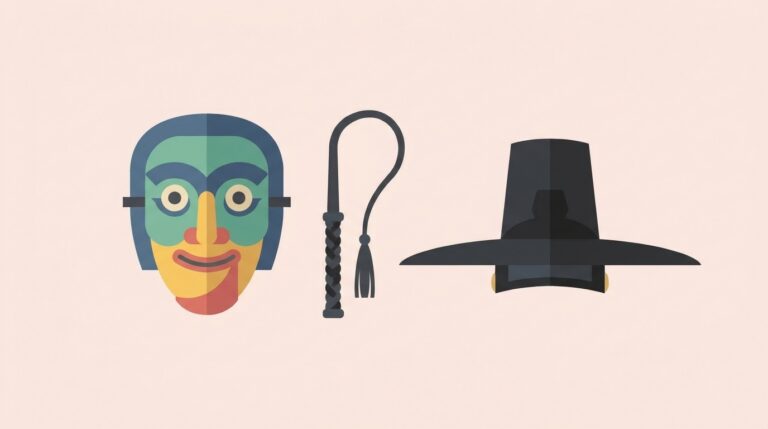
In classical Korean aesthetics, tragedy and comedy do not exist in separate vacuums. Instead, they collide in a breathtaking aesthetic polarity: Bijangmi (비장미, tragic grandeur born of collective grief or Han) intertwined with Golgyemi (골계미, subversive comic satire fueled by resilient joy or Heung). Nowhere is this dynamic more electric than in traditional Talchum (탈춤, mask dance), where the servant character Malttugi (말뚝이) steps into the dusty village courtyard. Armed with nothing but a whip and an unmatched arsenal of linguistic acrobatics, Malttugi humiliates pompous, hypocritical aristocrats (Yangban, 양반) right to their faces—all while making them dance to their own demise.
This guide is curated from our decade of fieldwork coaching diplomats, literary translators, and top-tier Korean scholars. By mastering the rhetorical architecture of Malttugi’s wit, you won’t just analyze Korean folk theater; you will acquire the highest level of linguistic nuance: the ability to wield biting irony, deliver subtle social commentary, and command respect in any sophisticated Korean conversation.
Phase 2: Core Expressions Deep Dive
1. 뼈 있는 농담을 던지다 (Ppyeo inneun nongdameul deonjida)
- Pronunciation: [Ppyeo in-neun nong-da-meul deon-ji-da] (Think of ‘ppyeo’ snapping sharply like a dried twig, followed by the flowing cadence of ‘nongdam’)
- Meaning: Literally “to throw a joke that has bones in it”; actually means to deliver a sharp, satirical remark disguised as playful banter, containing a profound, often uncomfortable truth.
- K-Culture Moment: Echoing Malttugi’s classic monologue where he calls for a “Yangban” (aristocrat) but immediately puns it with “dog-skin merchant” or a stray mongrel, this expression is frequently used by investigative journalists in Korean media and screenwriters in political satire dramas like Chief of Staff (보좌관) when an underling exposes a politician’s hypocrisy with a pleasant smile.
- Editor’s Insight: At the C2 level, distinguish this from simple sarcasm (비아냥, bianyang). A ppyeo inneun nongdam possesses structural elegance; it invites laughter from the crowd while delivering an intellectual sting to the target.
- Situation Spectrum: Casual ✅ | Semi-formal ✅ | Formal ⚠️
- 🤔 Think About It: Why does Korean culture, historically bound by strict neo-Confucian hierarchies, revere wit that conceals sharp “bones” beneath softness rather than blunt, confrontational opposition?
2. 말장난으로 허를 찌르다 (Maljangnaneuro heoreul jjireuda)
- Pronunciation: [Mal-jang-na-neu-ro heo-reul jji-reu-da] (Pronounce ‘heo’ as a sudden, breathless puff, and ‘jji-reu-da’ with a piercing, crisp double-j)
- Meaning: Literally “to stab someone in their void/unprepared spot through wordplay”; functionally means to exploit phonetic ambiguity and linguistic double entendres (eoneoyuhui) to disarm and outwit an opponent.
- K-Culture Moment: In Bong Joon-ho’s Parasite (기생충), Ki-taek’s family subtly parodies high-society jargon to maneuver around the wealthy Park family—a modern cinematic reincarnation of Malttugi disorienting his aristocratic masters with linguistic sleight of hand.
- Editor’s Insight: Heo (허, 虛) refers to an uncovered defensive flank in martial arts. Using wordplay to pierce this weakness demonstrates supreme intellectual superiority over someone who holds nominal socio-political power.
- Situation Spectrum: Casual ✅ | Semi-formal ✅ | Formal ✅
- 🤔 Think About It: In English satire, punning is often relegated to “dad jokes,” yet in Joseon folk art, homophonic puns were lethal socio-political weapons. What does this reveal about the power of the Korean phonetic script and syllable-block architecture?
3. 권위의 허상을 허물어뜨리다 (Gwonwiui heosangeul heomureotteurida)
- Pronunciation: [Gwon-wi-ui heo-sang-eul heo-mu-reo-tteu-ri-da] (Glide through ‘gwon-wi’ smoothly, building resonance into the rhythmic collapse of ‘heomureotteurida’)
- Meaning: Literally “to cause the phantom/mirage of authority to crumble down”; used in high-register literary and critical discourse to describe the total deconstruction of pretentious social standing.
- K-Culture Moment: This phrase dominates critical reviews of historical period films whenever a corrupt minister’s grand posture collapses into complete public ridicule before a crowd of commoners.
- Editor’s Insight: Notice the pairing of heosang (illusion/mirage) with heomureotteurida (dismantling a physical structure). It asserts that illegitimate authority is merely a fragile psychological facade waiting for a witty mind to push it over.
- Situation Spectrum: Casual 🚫 | Semi-formal ⚠️ | Formal ✅
- 🤔 Think About It: How does deconstructing authority through public communal laughter (Haehak, 해학) differ from destroying it through violent political revolt?
Phase 3: Textbook Korean vs. Real Korean
Situation 1: Calling out someone’s pompous hypocrisy
- 📖 교과서 한국어 (Textbook Korean):
“당신의 태도는 매우 위선적이며 겉과 속이 일치하지 않습니다.”
(Dangsinui taedoneun maeu wiseonjeogimyeo geotgwa sogi ilchihaji anseumnida. / “Your attitude is very hypocritical, and your exterior does not match your interior.”) - 🗣️ 진짜 한국어 (Real Korean – C2 Satirical Register):
“양반 행세는 혼자 다 하시더니, 정작 필요할 땐 밑천이 훤히 드러나네요.”
(Yangban haengsaneun honja da hasideoni, jeongjak piryohal ttaen mitcheoni hwonhi deureonaneyo. / “You put on the whole noble scholar act all by yourself, yet when the moment of truth comes, your intellectual poverty is glaringly exposed.”) - 💡 왜 다를까? (Cultural Context):
Directly accusing an interlocutor of hypocrisy (wiseon) feels pedantic, academic, and emotionally dry. Evoking traditional tropes like Yangban haengse (acting like an aristocrat) paired with idiomatic phrases like mitcheoni deureonada (revealing one’s empty reserves) delivers an artistic, razor-sharp critique celebrated in mature Korean discourse.
Situation 2: Witty rebuttal to an authority figure’s nonsensical demand
- 📖 교과서 한국어 (Textbook Korean):
“상사님의 논리에는 심각한 모순이 있으므로 따를 수 없습니다.”
(Sangnimsaui nollieneun simgakan mosuni isseumeuro ttareul su eopseumnida. / “Because there is a serious contradiction in your logic, I cannot obey.”) - 🗣️ 진짜 한국어 (Real Korean – C2 Satirical Register):
“겉포장은 그럴듯한데 속은 텅 빈 말장난에 불과하니, 이걸 칭찬으로 받아들여야 할지 참 난감합니다.”
(Geotpojangeun georeoldeuthande sogeun teong bin maljangnane bulgwahani, igeol chingchaneuro badadeuryeoya halji cham nangamhamnida. / “The packaging looks splendid, but the interior is nothing more than hollow wordplay; I’m genuinely bewildered whether to take this as a compliment or not.”) - 💡 왜 다를까? (Cultural Context):
High-level Korean never resorts to childish tantrums. It mimics the Malttugi technique: feign deferential politeness on the lexical surface (jondaemal), while gutting the opposing argument’s substance from the inside out.
Phase 4: K-Culture Deep Dive & Non-Verbal Manners
4-1. Nunchi & Physical Irony (눈치와 비언어적 제스처)
In traditional mask dance performance, Malttugi’s rebellion is fundamentally physical before it is verbal. He wields a horse whip (chaejjik), symbolizing physical mastery, while his mask bears an insolent grin, wide asymmetrical eyes, and a prominent, rustic nose—contrasting with the pale, sickly, deformed masks of the Yangban brothers (Saennim and Seobangnim).
When deploying biting satire in modern high-context Korean conversations:
1. The Feigned Bow & Eye Shift: Notice how native speakers feign complete compliance by lowering their chin in a pseudo-bow, only to slightly tilt the head sideways with a playful smirk right as the punchline lands. This physical dissonance cushions the blow while magnifying the intellectual sting.
2. The Theatrical Freeze (Meomchum): Just as Talchum performers freeze suddenly to let the audience absorb a scandalous punchline before resuming the drumbeat (Jangdan), master speakers of Korean deliberately insert a 1.5-second vocal pause after delivering a ppyeo inneun nongdam.
4-2. Cultural Code Analysis: The Dialectic of Han (한) and Heung (흥)
To comprehend Malttugi is to understand the soul of Korean folk literature. The commoners (minjung) endured systemic oppression, devastating famines, and rigid class immobility. This chronic suffering crystallized into Han (한, 恨)—a deep, resonant, collective ache.
However, Koreans did not drown in nihilistic despair. Instead, they forged Heung (흥, 興)—an explosive, Dionysian joy that transforms grief into dynamic communal laughter. This creates the aesthetic of Golgyemi (골계미): comedic satire that strips the powerful of their sacred mystique. Today, this exact aesthetic DNA pulsates through modern Korean entertainment—from the cathartic underground rap disses in Show Me The Money to the biting class-conscious satire found in the screenplays of Park Chan-wook and Bong Joon-ho.
Phase 5: Real-World Roleplay Scenario
Setting: An immersive traditional arts workshop near Namsangol Hanok Village. You are participating in a historical recreation reenactment, playing the modern equivalent of Malttugi. Your counterpart is Director Park, a pompous senior executive who takes his roleplay as a haughty Joseon nobleman far too seriously.
- Director Park: “이놈 말뚝아! 양반이 행차하시는데 어찌 길을 비키지 않고 건방지게 채찍을 휘두르느냐?”
(Inom Malttuga! Yangbani haengchahasineunde eojji gireul bikiji anko geonbangjige chaejjigeul hwidureuneunya?)
“You rascal Malttugi! An aristocrat is proceeding; how dare you swing your whip insolently instead of clearing the way?”
🎭 Standing with hands behind his back, chest puffed out in self-important indignation. -
You: “예이-! 양반인지 쌍반인지 모르겠으나, 제가 아는 양반은 개다리소반에 쓰러진 개살구 같은 분들이 아니온지요?”
(Yei-! Yangbaninji ssangbaninji moreugesseuna, jega aneun yangbaneun gaedarisobane sseureojin gaesalgu gateun bundeuri anionjiyo?)
“Yessir! Whether you are a Yangban or a double-ban, isn’t the kind of nobleman I know like a wild, inedible apricot rolled onto a broken dog-leg dining tray?”
🎭 Bowing deeply from the waist while spinning your practice whip with theatrical flamboyance. -
Director Park: “네 이놈! 감히 가문과 학식을 자랑하는 명문 양반을 능멸하려 들다니 당장 무릎을 꿇지 못할까!”
(Ne inom! Gamhi gamungwa haksigeul jaranghaneun myeongmun yangbaneul neungmyeolharyeo deuldani dangjang mureupeul kkulji mothalkka!)
“How dare you! Insolently mocking a prestigious clan renowned for lineage and scholarship—get down on your knees this instant!”
🎭 Stomping the ground, pointing a quivering finger with wide eyes. -
You: “아이구, 나으리! 귀가 어두우셔서 제 충정을 곡해하셨습니다. 학식 높은 양반 나으리들이 백성의 고혈을 빨지 않고 덕을 베푸신다 칭송한 것뿐이옵니다!”
(Aigu, naeuri! Gwiga eoduusyeoseo je chungjeongeul gokhaehasyeotseumnida. Haksik nopeun yangban naeurideuri baekseongui gohyeoreul ppalji anko deogeul bepusinda chingsonghan geotppuniomnida!)
“Oh goodness, Milord! Your ears must be dim, for you have misread my deep loyalty. I was merely praising noble scholars who refrain from sucking the people’s lifeblood and instead bestow virtue!”
🎭 Stepping backward, waving both hands with exaggerated innocence and a wink to the crowd. -
Director Park: “음… 그래? 허허, 내 덕망을 칭송한 것이라면 내 너그럽게 용서하겠다만… 어째 뒷맛이 개운치 않구나.”
(Eum… geurae? Heoheo, nae deongmangeul chingsonghan geosiramyeon nae neogeureopge yongseohagetdaman… eojjae dwinmasi gaeunchi ankuna.)
“Hmm… is that so? Haha, if you were praising my virtuous reputation, I shall generously pardon you… yet why does this leave such an uncomfortable aftertaste?”
🎭 Stroking his fake beard, visibly bewildered yet struggling to maintain his dignity. -
You: “그것이 바로 참된 양반의 풍모 아니겠습니까? 겉으로는 위엄을 차리시되, 속으로는 백성의 농담 한마디에 안절부절못하시는 그 깊은 아량 말입니다!”
(Geugeosi baro chamdoen yangbanui pungmo anigesseumnikka? Geoteoroneun wieomeul charisidoe, sogeuroneun baekseongui nongdam hanmadie anjeolbujeolmotasineun geu gipeun aryang marimnida!)
“Isn’t that precisely the true demeanor of an aristocrat? Maintaining exterior dignity while internally fidgeting in unease over a commoner’s single joke—such profound magnanimity!”
🎭 Striding around Director Park in a wide, sweeping dance circle. -
Director Park: “이, 이놈이 끝까지 나를 쥐락펴락 농락하는구나!”
(I, inom-i kkeutkkaji nareul jwirakpyeorak nongnakhaneukuna!)
“Y-You rascal, you are twisting me around your little finger and making a fool of me until the very end!”
🎭 Red-faced, dropping his fan as the surrounding spectators erupt into applause. -
You: “얼쑤! 장단 맞추어 춤이나 한판 춥시다, 나으리!”
(Eolssu! Jangdan matchueo chumina hanpan chupsida, naeuri!)
“Eolssu! Let us simply dance together to the rhythmic beat, Milord!”
🎭 Striking the final comic pose with arms outstretched, inviting the entire room into the festivity.
🔀 Interactive Branching Point
After Director Park yells: “이, 이놈이 끝까지 나를 쥐락펴락 농락하는구나!” (You are making a fool of me until the very end!), how do you seal your victory?
- Option A: “죄송합니다, 나으리. 제가 분수를 모르고 지나쳤습니다. 용서해 주십시오.” (Apologize immediately and kneel.)
- Option B: “나으리께서 허세만 부리시니, 제 말 한마디에 밑천이 드러나 화를 내시는 것 아닙니까!” (Directly accuse him of being empty-headed and arrogant.)
- Option C: “호랑이를 보고 짖는 개는 보았어도, 농담을 진담으로 받아 화를 내는 대인배는 내 생전 처음 봅니다 그려!” (Deliver a witty proverbial paradox framing his anger as pettiness.)
Detailed Branch Feedback:
- Option A (Bad): You completely break the character of Malttugi. Submitting to authority dissolves the entire satirical tension of Talchum and forfeits the aesthetic of Golgyemi.
- Option B (Risk): This crosses the line from satire (haehak) into raw verbal abuse (myeolsi). Stripping away the humor breaks the communal dance and triggers genuine real-world hostility rather than collective catharsis.
- Option C (Best!): Brilliant! By ironically complimenting him as a “great man” (daeinbae) while comparing his overreaction to a startled dog, you completely neutralize his authority while retaining the comic frame. Pure C2 mastery!
Phase 6: 10-Second Emotional Shadowing Drill
Practice reading these lines aloud, matching the rhythmic pauses marked with / and internalizing the emotional waypoints:
[😏 능청스럽고 뻔뻔한 조롱을 담아]
“양반인지 / 개다리소반인지, / 제 눈에는 / 그저 허울 좋은 껍데기만 / 보입니다요!”
(Yangbaninji / gaedarisoban-inji, / je nun-eneun / geujeo heoul joeun kkeopdegiman / boimnidayo!)
“Whether you are a nobleman / or a broken dog-leg tray, / to my humble eyes / I see nothing / but an empty, well-decorated shell!”-
[🎭 능글맞게 위기를 모면하며]
“아이구 나으리! / 어찌 충언을 / 모욕으로 들으십니까? / 뼈 있는 농담이야말로 / 가장 진실된 법입니다.”
(Aigu naeuri! / eojji chungeoneul / moyogeuro deureusimnikka? / ppyeo inneun nongdamiya-mallo / gajang jinsildoen beobimnida.)
“Oh heavens, Milord! / Why do you hear loyal counsel / as an insult? / A joke with sharp bones inside / is the most honest truth of all.” -
[🎉 통쾌하게 권위를 해체하며]
“체통은 던져 버리고, / 이 신명 나는 장단에 맞춰 / 다 함께 / 어깨춤이나 춥시다!”
(Chetong-eun deonjyeo beorigo, / i sinmyeong naneun jangdane matchwo / da hamkke / eokkaechumina chupsida!)
“Toss away your hollow dignity, / and to this ecstatic, exhilarating rhythm, / let us all / dance shoulder to shoulder!”
Phase 7: K-Culture Mini Dictionary
- 골계미 (Golgyemi / Comic Satirical Beauty)
Literary term: The aesthetic value achieved when artificial, hypocritical, or oppressive societal norms are unmasked and overturned through wit, caricatured humor, and parody. - 언어유희 (Eoneoyuhui / Rhetorical Wordplay)
Linguistic device: Sophisticated puns utilizing homophones, syntactic ambiguities, or phonetic shifts to deliver dual meanings—the bedrock of Malttugi’s banter. - 파격 (Pagyeok / Subversive Rule-Breaking)
Cultural concept: Breaking conventional boundaries, social decorum, or artistic forms to establish a fresh, liberating reality. Frequently used in modern Korean design and cinema. - 해학 (Haehak / Compassionate Satire)
Aesthetic principle: Humor devoid of cynicism or malicious cruelty. Unlike cold sarcasm, haehak embraces human fallibility with warm empathy and communal inclusion.
Phase 8: Survival Kit for Travelers
Survival Expressions TOP 3 (For Theater, Art, & Witty Encounters)
- “풍자가 아주 표독스러우면서도 통쾌하네요!”
(Pungjaga aju pyodokseureoumyeonseodo tongkwaehaneyo!)
Pro Tip: Use this when reviewing a high-concept Korean theatrical play or indie film to express that the satire was incisive, biting, yet deeply cathartic. - “뼈 때리는 대사 때문에 정신이 번쩍 듭니다.”
(Ppyeo ttaerineun daesa ttaemune jeongsini beonjjeok deumnida.)
Pro Tip: A modern colloquial spin on ppyeo inneun nongdam. Use it during a debate or panel when someone makes an uncomfortably accurate, sharp observation. - “체면 차리지 말고 신명 나게 놀아봅시다!”
(Chaemyeon chariji malgo sinmyeong nage norabopsida!)
Pro Tip: Perfect at social gatherings or Noraebang to dispel social stiffness and invite everyone into uninhibited celebration.
Editor’s Travel Note: Living the Heritage
If you want to experience the raw electricity of Malttugi in person, time your trip for autumn and head to the Andong Maskdance Festival (안동국제탈춤페스티벌). You can easily reserve intercity transport and festival passes by utilizing the 네이버 지도 앱 다운로드 to chart express bus routes straight from Seoul Express Bus Terminal to Andong. For cultural venues in Seoul, monitor the 국립국악원 예매 사이트 to catch weekend performances of Bongsan Talchum (봉산탈춤) or Songpa Sandae Noli (송파산대놀이). When attending outdoor folk performances (Madangnori), avoid sitting silently like you’re at a Western symphony; lean in, shout traditional exclamations like “Jot-ta!” (좋다!) and “Eolssu!” (얼쑤!), and become an active accomplice in the subversion of authority!
Phase 9: “One Step Deeper” (Philosophical Essay)
In Western classical tragedy, the downfall of the elite often demands royal blood and cosmic doom. In the Korean cultural universe, however, social subversion takes the form of a communal circle. When Malttugi strips the Yangban of their dignity, he does not execute them; he invites them to dance. This dynamic reveals a profound truth about traditional Korean collectivism: satire (Golgyemi) is not an instrument of permanent ostracization, but a therapeutic mechanism to purge societal toxicity and restore harmonious balance. By laughing together at the ridiculousness of rigid status symbols, both oppressor and oppressed are temporarily freed from the straitjacket of caste. In a hyper-competitive contemporary Korea still wrestling with modern status hierarchies and corporate feudalism, Malttugi’s irreverent smirk remains an indispensable sanctuary of mental survival.
💬 Your Turn: Have you ever witnessed or used humor to disarm an authoritarian situation in your own culture? How does it compare to Malttugi’s linguistic double-play? Share your thoughts below!
Phase 10: FAQ & Common Pitfalls
Q: Isn’t Malttugi just being blatantly disrespectful to his social superiors?
A: On the surface, yes. However, within the protected liminal space of the Talchum performance ground (Madang), ordinary social rules were officially suspended. The village courtyard functioned as a government-sanctioned carnival where commoners could purge their grievances (Han) through performance, preventing actual violent rebellions. Malttugi’s insolence was accepted because it was theatrical, witty, and communal.
Q: Can I use Malttugi-style biting wordplay in a modern Korean business setting?
A: Extreme caution is required! While high-level managers and executives appreciate dry wit (wit-eu) and sophisticated humor, applying biting wordplay (maljangnan) to your direct superiors without impeccable nunchi can easily be interpreted as insolence (hageuksang, 하극상). Reserve these linguistic devices for literary commentary, mutual peer debates, or playful banter among close colleagues.
Q: How do I distinguish between Haehak (해학) and Satire (풍자)?
A: Pungja (satire) points its dagger outward at corrupt power structures with biting, critical intent to expose societal contradictions. Haehak (humor), on the other hand, embraces human weakness with warmth, laughter, and self-deprecating affection. Talchum masterfully balances both: pungja targets the Yangban, while haehak blankets the collective human experience.
🚨 흔한 실수 (Common Mistakes) Warning Board
- Mistake: Dropping into casual speech (Banmal) when trying to deliver satire to a senior.
Correct Action: True Korean satire relies on the tension between ultra-polite honorifics (Hapsyoche) and subversive content. Keep your grammar polite while letting the irony do the work! - Mistake: Confusing homophones without understanding the cultural connotation (e.g., confusing Yangban the noble with Yangban the commercial dried seaweed brand in a serious discussion).
Correct Action: Study the historical context before using classical puns so your wordplay resonates with depth rather than sounding like accidental confusion. - Mistake: Delivering aggressive insults and labeling it “satire.”
Correct Action: Remember the golden rule of Korean aesthetics: Golgyemi must always resolve in communal Heung (ecstatic celebration), never in bitter alienation.
Phase 11: Action Mission & Engagement
- 🥉 Bronze Level Mission: Practice the 3 shadowing sentences from Phase 6 aloud in front of a mirror. Focus on nailing the transition from the feigned humble bow to the mischievous eye shift.
- 🥈 Silver Level Mission: Write a 2-sentence micro-satire in Korean critiquing modern “smartphones addiction” using a homophonic pun (eoneoyuhui), and share it in our comments section.
- 🥇 Gold Level Mission: Watch a clip of Bongsan Talchum (Malttugi scene) on YouTube without subtitles. Identify at least two moments where Malttugi uses wordplay to deceive the Yangban brothers, and transcribe the specific punchlines.
🎮 K-Culture Mission: Next time you watch a modern K-Drama (like Vincenzo or One Dollar Lawyer), spot the “Malttugi archetype” character! Notice how they use bureaucratic jargon or pseudo-polite speech to utterly dismantle wealthy antagonists. Take notes on how the script constructs their verbal traps!
Phase 12: Interactive Quiz Challenge
Test your mastery of Korean satire and Talchum aesthetics below!
1. Situational Judgment:
You want to critique a senior colleague’s impractical, overly convoluted project proposal during an informal brainstorming session without creating bitter animosity. Which response best embodies Golgyemi and Malttugi-style wit?
(A) “부장님, 그 계획은 정말 한심하고 비논리적입니다.”
(B) “말씀은 대궐 같은데, 막상 지어놓으면 들어갈 방 한 칸 없을까 두렵습니다 그려!”
(C) “저는 부장님이 시키는 대로 무조건 복종하겠습니다.”
(D) “그건 틀렸으니 제가 처음부터 다시 짜겠습니다.”
2. Fill-in-the-Blank:
탈춤에서 말뚝이는 표면적으로는 양반을 칭송하는 척하면서도, 교묘한 ( ________ )을/를 구사하여 지배 계급의 권위를 철저히 해체한다.
(A) 침묵주의
(B) 언어유희
(C) 사대주의
(D) 무저항주의
3. True or False:
In traditional Korean aesthetics, Han (tragic grief) and Heung (joyous ecstasy) are completely mutually exclusive, meaning a performance cannot contain both simultaneously.
[True / False]
👉 Click to reveal answers & deep explanations!
Answer Key & Explanations:
- Correct Answer: (B)
Explanation: Option (B) translates to: “Your words sound like a grand palace, yet I fear that once built, there won’t even be a single room to step into!” It uses classic architectural metaphor and figurative humor to expose hollow pretension without resorting to childish insults (A/D) or spineless submission (C). -
Correct Answer: (B) 언어유희 (Eoneoyuhui / Rhetorical Wordplay)
Explanation: Malttugi consistently exploits homophonic wordplay to mock the aristocrats while pretending to offer loyalty. -
Correct Answer: False
Explanation: The very heart of Korean folk aesthetics lies in the transformative collision of Han and Heung. Grief (Han) is not suppressed; it is dynamically converted into ecstatic social release and healing laughter (Heung). You’ve mastered the philosophy!
🎬 Watch Our Daily Videos! (Daily Hangul Official Instagram)
Review the expressions you learned in this article with our fun daily short videos! Check out native pronunciation and real-life nuances in action.
- Instagram @dailyhangul_en







