

Stop Hiding the Sky with Your Palm: Master ‘Josammosa’ and Spot Transparent Excuses Like a Local
Phase 1: Empathy (Story-Immersive Opening)
안녕하세요! 매일한글 에디터입니다. (Hello! I’m your Daily Hangul editor.)
Picture this classic K-drama office scene: an overconfident junior employee messes up a key client presentation slide. Instead of confessing honestly, they sneakily swap slide 3 and slide 4, fiddle with the font colors, and present it back to the team manager as a “revolutionary revamp.” The manager pushes their glasses up their nose, lets out a dry sigh, and remarks, “지금 눈 가리고 아웅 해요? (Jigeum nun garigo aung haeyo? / Are you covering your eyes and saying meow right now?)”
We have all encountered that cringeworthy moment—someone tries to mask an obvious blunder with a paper-thin excuse, believing nobody will notice. In Korean culture, calling out this transparent trickery without causing unnecessary drama requires sharp wit and the right cultural vocabulary. You might hear people sigh and whisper 조삼모사 (朝三暮四 – Josammosa) or scoff at someone attempting 손바닥으로 하늘 가리기 (hiding the sky with their palm).
Intermediate (B2) learners often struggle here. You might know words like 거짓말 (geojitmal / lie) or 실수 (silsu / mistake), but using these blunt words can sound either childish or overly aggressive. By mastering these idiomatic situation-describers, you unlock the ability to deliver razor-sharp, natural commentary just like native Koreans do around the water cooler.
Phase 2: Top 3 Core Expressions Deep Dive
1. 조삼모사 (Josammosa / 朝三暮四)
- Pronunciation: [Jo-sam-mo-sa] (Sounds like Joe-sahm-moh-sah)
- Meaning: Literal: “Three in the morning, four in the evening.” | Nuance: Calling out superficial trickery or reshuffling that changes nothing in substance; shallow deceit.
- K-Culture Moment: Widely used in Korean variety shows and corporate satire webtoons when bosses change working hours from 9-to-6 to 8-to-5 and call it “worker welfare improvement.”
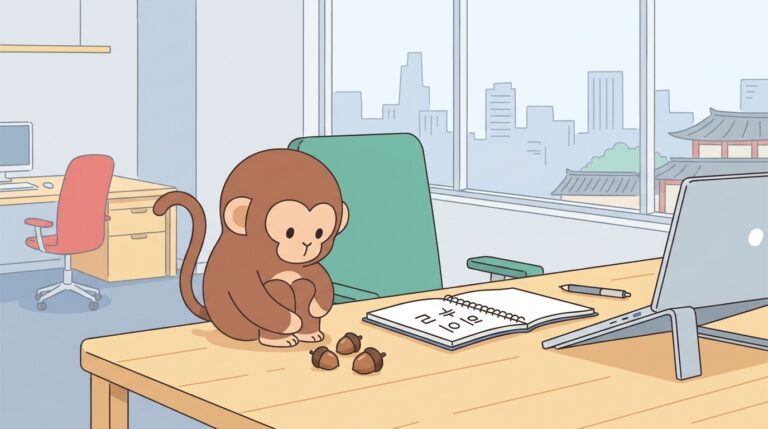
- Editor’s Insight: Originating from an ancient Chinese fable where a keeper pacifies angry monkeys by giving them three acorns in the morning and four in the evening instead of four in the morning and three in the evening, this term mocks deceptive illusions that only fool the naive.
- Situation Spectrum: Casual: ✅ | Semi-formal: ✅ | Formal: ✅ (Frequently appears in news editorials and business meetings)
- 🤔 Think About It: Does your native culture have an idiom for reshuffling deckchairs on the Titanic, or shifting pennies to fool someone?
2. 눈 가리고 아웅 (Nun garigo aung)
- Pronunciation: [Nun ga-ri-go a-ung] (Sounds like Noon gah-ree-go ah-oong)
- Meaning: Literal: “Covering one’s eyes and saying meow.” | Nuance: Playing peek-a-boo with reality; pulling an ostrich maneuver or pretending an obvious problem is hidden.
- K-Culture Moment: Often heard in family dramas when a child hides a bad test score under a stack of comic books, thinking Mom will never check.
- Editor’s Insight: “아웅 (Aung)” mimicked the sound adults made during playful peek-a-boo games with babies. Saying this to an adult conveys: “Who do you think you’re kidding? We all see it!”
- Situation Spectrum: Casual: ✅ | Semi-formal: ✅ | Formal: ⚠️ (Use with caution around strict executives)
- 🤔 Think About It: Why do humans across cultures default to childish denial when caught red-handed?
3. 손바닥으로 하늘을 가리다 (Sonbadageuro haneureul garida)
- Pronunciation: [Son-ba-da-geu-ro ha-neu-reul ga-ri-da] (Sounds like Sohn-bah-dah-geu-roh hah-neul-eul gah-ree-dah)
- Meaning: Literal: “Trying to cover the vast sky with one’s own palm.” | Nuance: A futile, delusional attempt to hide undeniable truths or widespread scandals.
- K-Culture Moment: Frequently cited in investigative journalism and political thrillers like Stranger (비밀의 숲) when a corrupt official issues an awkward press apology.
- Editor’s Insight: While Josammosa focuses on shallow shifting of conditions, this proverb emphasizes the sheer impossibility and arrogance of trying to silence the truth.
- Situation Spectrum: Casual: ✅ | Semi-formal: ✅ | Formal: ✅
- 🤔 Think About It: Notice how Korean idioms often lean on vivid physical imagery (palms, eyes, sky) to emphasize moral clarity.
Phase 3: Textbook Korean vs. Real Korean
Situation 1: Calling out a sneaky discount scheme
- 📖 Textbook Korean: 이것은 소비자를 속이려는 비합리적인 전략입니다. (Igeoseun sobijareul sogiryeoneun bihamrijeogin jeollyagimnida. / This is an irrational strategy aimed at deceiving consumers.)
- 🗣️ Real Korean: 가격 100원 깎아주고 배송비 올리면 완전 조삼모사 아니에요? (Gagyeok baegwon kkak-ajugo baesongbi ollimyeon wanjeon josammosa anieyo? / Cutting the price by 100 won and jacking up the shipping fee is pure Josammosa, isn’t it?)
- 💡 Why it differs: Native Koreans rarely recite academic definitions of deceit; they drop Josammosa directly into practical comparisons like price vs. shipping fees.
Situation 2: Catching a coworker trying to conceal an error
- 📖 Textbook Korean: 당신의 실수를 거짓말로 은폐하려고 하지 마세요. (Dangsinui silsureul geojinmallo eunpyeharyeogo haji maseyo. / Do not attempt to cover up your mistake with lies.)
- 🗣️ Real Korean: 그렇게 둘러대 봤자 눈 가리고 아웅 하는 격이에요. 솔직하게 말해요. (Geureoke dulleodae bwatja nun garigo aung haneun gyeogieyo. Soljik-hage malhaeyo. / Making up excuses like that is just like playing peek-a-boo. Just be honest.)
- 💡 Why it differs: Using 은폐 (concealment) sounds like a police interrogation. Phrases like “눈 가리고 아웅 하는 격 (like covering eyes and saying meow)” strike a balanced tone of directness and idiomatic flair.
Phase 4: K-Culture Deep Dive & Non-Verbal Manners
4-1. Nunchi (눈치) & Gestures
When someone drops a “눈 가리고 아웅” in a group setting, observe the room’s non-verbal dynamics:
* The Head Tilt and Narrowed Eyes: Native speakers often tilt their head slightly (about 15 degrees) with narrowed eyes and a soft smirk. This silently signals: “I know what you’re doing, so stop embarrassing yourself.”
* The Palm Flap: Shaking your hand side to side at chest level while uttering this phrase emphasizes that the excuse does not hold water.
* Saving Face (체면): Never shout this in front of a senior boss. Koreans use these expressions to poke at transparency among peers. Using it upward against an executive without extreme caution destroys workplace etiquette (Nunchi 101).
4-2. Cultural Code Analysis: The Reality of Office Politics
In Korean corporate culture (직장 문화), accountability is communal. When one member covers up an issue with Josammosa tactics, the entire department risks collective embarrassment. That is why sharp, witty idioms serve as social regulation tools. Rather than filing an HR report immediately, Koreans use satirical four-character idioms (사자성어) to encourage colleagues to fix their errors before things spiral out of control.
Phase 5: Real-Life Roleplay Scenario
Setting: A trendy marketing agency in Gangnam, Seoul. Project deadline is 6 PM.
Characters:
* 대리 민준 (Assistant Manager Minjun): Stressed, trying to mask uncompleted work by rearranging folders.
* 과장 수현 (Manager Suhyeon): Sharp-eyed, supportive but hates lazy excuses.
수현: 민준 씨, 3차 기획안 수정본 제출했나요?
      (Minjun ssi, sam-cha gihoegan sujeongbon jechulhaennayo?)
      [Minjun, did you submit the revised 3rd project draft?]
      🎭 Leans against the partition, checking her smart tablet.

민준: 아, 네! 목차 순서를 바꾸고 표 디자인을 완전히 새로 손봤습니다!
      (A, ne! Mokcha sunseoreul bakkugo pyo dijaineul wanjeonhi saero sonbwasseumnida!)
      [Ah, yes! I rearranged the table of contents and revamped the chart design completely!]
      🎭 Sweat drops, clicking his mouse frantically.

수현: (파일을 열어보며) 음... 알맹이 내용은 그대로인데 제목만 바꿨네요?
      ((Paireul yeorobomyeo) Eum... almaengi naeyongeun geudaeroinde jemongman bakkweonneyo?)
      [(Opening the file) Hmm... the core content is identical, you only swapped the section titles?]
      🎭 Glances over her spectacles with a skeptical grin.

민준: 시간 배분을 위해 우선 시각적 요소를 강화한 전략입니다...
      (Sigan baebuneul wihae useon sigakjeok yosoreul ganghwahan jeollyagimnida...)
      [It was a strategic choice to enhance visual elements first to save time...]
      🎭 Avoids eye contact, tapping his pen nervously.

수현: 민준 씨, 이건 솔직히 조삼모사잖아요.
      (Minjun ssi, igeon soljik-hi josammosajanayo.)
      [Minjun, honestly, this is classic Josammosa.]
      🎭 Crosses arms lightly, keeping the tone collegial but firm.

민준: 죄송합니다... 핵심 데이터 분석이 아직 덜 끝났습니다.
      (Joesonghamnida... haeksim deiteo bunseogi ajik deol kkeutnatseumnida.)
      [I apologize... the core data analysis isn't finished yet.]
      🎭 Shoulders drop, bowing his head respectfully.

수현: 뻔히 보이는 걸 눈 가리고 아웅 하면 팀 전체가 곤란해져요.
      (Ppeonhi boineun geol nun garigo aung hamyeon tim jeonchega gonranhaejyeoyo.)
      [Hiding what everyone can clearly see just harms the whole team.]
      🎭 Pulls over an office stool to sit beside him.

수현: 솔직하게 말해줘서 고마워요. 남은 파트는 내가 도와줄 테니 1시간만 집중합시다.
      (Soljik-hage malhaejwoseo gomawoyo. Nameun pateuneun naega dowajul teni han siganman jipjunghapsida.)
      [Thanks for being honest. I'll help you finish the remaining section, let's focus for one hour.]
      🎭 Hands him a canned iced coffee with an encouraging smile.
🔀 Interactive Choice Point
How would you respond if your supervisor caught you shuffling shallow details?
* Choice A: “과장님, 진짜 바뀐 게 맞는데요! 다시 보세요! (Manager, things really did change! Look again!)”
* Choice B: “죄송합니다, 제 대처가 조삼모사 같았습니다. 보완해서 30분 내로 올리겠습니다. (I apologize, my handling was just like Josammosa. I will supplement the core content and upload it within 30 minutes.)”
* Choice C: “(침묵하며 딴청 피우기) (Remain completely silent and look out the window)”
- Feedback Breakdown:
- Choice A (Bad): Escalates conflict and proves you lack professional maturity.
- Choice B (Best): Demonstrates self-awareness, acknowledges the cultural nuance gracefully, and presents an immediate action plan.
- Choice C (Risk): Passive aggression destroys trust (신뢰) in Korean teamwork settings instantly.
Phase 6: 10-Second Emotion Shadowing Drill
Practice matching sentence cadence and stress markers (/ indicates micro-pauses):
[😏 능청스럽고 뻔뻔하게 / Sunk in mild denial]
순서만 바꾼 게 / 아니라 / 진짜 혁신적인 개편이라니까요?
(Sunseoman bakkeun ge / anira / jinjja hyeoksinjeogin gaepyeon-iranikkayo? / I didn’t just swap the order, it’s a truly revolutionary restructuring!)-
[🤦♂️ 기가 막히고 어이없어서 / Flabbergasted and amused]
그걸 변명이라고 해요? / 완전 / 눈 가리고 아웅이지!
(Geugeol byeonmyeong-irago haeyo? / Wanjeon / nun garigo aung-iji! / You call that an excuse? That’s totally covering your eyes and saying meow!) -
[🧐 차분하고 날카롭게 / Calm and piercingly analytical]
결국 총비용은 똑같은데 / 겉만 바꾼 / 조삼모사 정책입니다.
(Gyeolguk chongbiyongeun ttokgateunde / geotman bakkun / josammosa jeongchaegimnida. / In the end the total cost is identical; it’s a Josammosa policy that only changes the facade.)
Phase 7: K-Culture Mini Dictionary
- 꼼수 (Kkomsu) | Petty trick / Cheap shortcut | Unlike strategic wisdom, kkomsu refers to cheap maneuvers designed to evade responsibility or rules.
- 밑장빼기 (Mitjangppaegi) | Cheating from the bottom of the deck | Popularized by classic gambling thriller films like Tazza, this slang describes covert, sneaky manipulations carried out behind people’s backs.
- 핑계 (Pinggye) | Excuse / Pretext | The everyday bread-and-butter word for justifying shortcomings. Koreans often contrast pinggye with haegyeolchaek (solution).
- 팩트폭행 (Ppaektu-pokhaeng) | Fact violence (hitting someone with brutal facts) | Slang for shutting down shallow tricks or lies by laying out irrefutable, undeniable evidence.
Phase 8: Traveler’s Survival Kit
If you find yourself navigating street markets, taxis, or boutique accommodations in South Korea, keep these ready:
- TOP 1: 이거 추가 비용 없는 거 맞죠? 조삼모사 아니죠? (Igeo chuga biyong eomneun geo matjyo? Josammosa anijyo? / There are no hidden fees, right? It’s not a three-in-the-morning, four-in-the-evening trick, right?)
- Pro Tip: Use playfully with friendly market vendors to show you know your Korean expressions.
- TOP 2: 솔직하게 말씀해 주세요. (Soljik-hage malsseumhae juseyo. / Please speak to me honestly.)
- Pro Tip: A polite, direct phrase when an itinerary or booking seems unclear.
- TOP 3: 아, 눈 가리고 아웅 하지 마시고요! (A, nun garigo aung haji masigoyo! / Ah, don’t try to pull a peek-a-boo trick on me!)
- Pro Tip: Keep a laughing tone to deflect tourist markups without turning hostile.
Editor’s Travel Note:
When navigating Korea’s transit or ordering delivery, transparent pricing is essential. Avoid confusing taxi negotiations by pre-checking rates on the official 네이버 지도 앱 다운로드 (Naver Map app download). For cashless foreign traveler transit ease, set up your mobile card via the T-money payment system before departing Incheon Airport.
Phase 9: Going One Step Deeper (Reflective Prompt)
In traditional Korean communities (품앗이 and 향약 culture), transparency was tied directly to survival. Because farming hamlets worked as one giant organism, deceit did not merely inconvenience one person—it sabotaged the collective harvest. Calling out transparent pretense via colorful sayings like 눈 가리고 아웅 is not about cruelty; it is the Korean linguistic mechanism for preserving social integrity and pulling people back toward community harmony.
💬 Your Turn: Have you ever caught someone (or yourself!) pulling a classic Josammosa trick at work, school, or home? Tell us your funniest story in the comments below!
Phase 10: FAQ & Mistake Prevention
Q: Can I use ‘조삼모사’ toward my company CEO during an official presentation?
A: Not unless you are deliberately criticizing a rival brand’s policy. Using Josammosa directly against your own leadership implies they are manipulating their workforce like the monkeys in the fable, which breaks hierarchical deference protocols.
Q: Is ‘눈 가리고 아웅’ an insult?
A: It is an informal, idiomatic critique rather than profanity. However, because it originates from peek-a-boo baby talk, it carries a slightly mocking undertone if directed at elders or seniors.
Q: How does ‘손바닥으로 하늘 가리기’ differ from ‘조삼모사’?
A: Josammosa highlights the manipulation of numbers, terms, or packaging to create a fake advantage. 손바닥으로 하늘 가리기 highlights the utter futility of denying a massive, undeniable truth that everybody already knows.
🚨 Common Mistakes Warning Board
- Mistake 1: Using 눈 가리고 아웅 to describe an accidental mistake. (Correction: Only use it when someone deliberately tries to cover up something obvious.)
- Mistake 2: Assuming 조삼모사 means changing one’s mind frequently. (Correction: Changing one’s mind often is 변덕 (byeondeok) or 작심삼일 (jaksimsamil); Josammosa requires a manipulative reorganization of terms.)
- Mistake 3: Pronouncing 아웅 as 아옹 or 아우. (Correction: Pronounce clearly as ah-oong, matching the mimetic nursery cat sound.)
Phase 11: Action Missions & Community Engagement
- 🥉 Bronze Mission: Pronounce all three core expressions aloud three times using the emotion markers from Phase 6.
- 🥈 Silver Mission: Write a two-sentence comment below using 조삼모사 to describe a subscription service or gym membership plan you encountered recently.
- 🥇 Gold Mission: Next time you watch a K-drama and see a villain or clumsy sidekick try to hide their tracks, say out loud: “완전 눈 가리고 아웅 하네! (Wanjeon nun garigo aung hane!)”
🎮 K-Culture Mission: Watch an episode of a Korean variety show like Running Man or Knowing Bros. Count how many times the cast members accuse each other of 꼼수 or 조삼모사 during game rule discussions!
Phase 12: Interactive Quiz Challenge
Q1. Situational Judgment:
A cafe owner increases the price of an Americano from 3,000 won to 4,000 won, but simultaneously adds a coupon that gives 1,000 won off if you buy two cups. What idiomatic reaction fits best?
* A) 전화위복 (Jeonhwawibok – Turning misfortune into blessing)
* B) 조삼모사 (Josammosa – Superficial redistribution of benefits)
* C) 동문서답 (Dongmunseodap – Irrelevant answer)
Q2. Fill in the Blank:
다 알고 있는데 모른 척 숨기려고 해 봤자, 손바닥으로 ( ) 가리는 격이에요.
* Words: 땅 (earth) / 바다 (sea) / 하늘 (sky) / 구름 (cloud)
Q3. True or False:
Saying “눈 가리고 아웅” implies that the person’s trick was extremely clever, sophisticated, and fooled everyone successfully. (True / False)
👉 Click to reveal answers and explanations
- Q1 Answer: B) 조삼모사 — The owner merely reshuffled the numbers to create the illusion of a discount, making it a textbook example of Josammosa.
- Q2 Answer: 하늘 (sky) — The standard Korean proverb is 손바닥으로 하늘 가리기 (trying to cover the sky with one’s palm).
- Q3 Answer: False — It means the exact opposite! It describes childish, transparent cover-ups where everyone sees the truth, like covering your eyes and thinking nobody can see you.







