

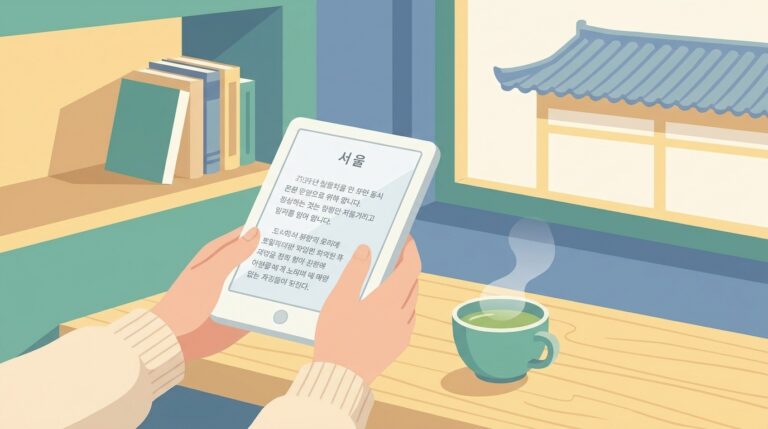
Why Korean Book Lovers Are Swapping Paper for E-Readers (And How to Talk About It)
Phase 1: 공감 (Story-Driven Opening)
안녕하세요! 매일한글 에디터입니다. (Hello! It’s your Daily Hangul editor!)
Picture this: You are riding Seoul Subway Line 2 during morning rush hour. People are packed shoulder to shoulder like dried anchovies, yet right across from you, someone is peacefully lost in a novel. But wait—they aren’t wrestling with a 600-page bestseller or squinting at a bright, battery-draining smartphone screen. Instead, they’re holding a feather-light e-reader with one hand, flipping pages with a subtle flick of their thumb.
Later, you meet your Korean friend Minji at a quiet book cafe in Yeonnam-dong. You mention that you love the feel of physical paper, but your eyes ache after scrolling webtoons and PDFs on your tablet. Minji smiles, pulls out her matte e-ink device, and says:
“전자잉크 디스플레이 덕분에 눈이 부시지 않고 글자 크기와 줄 간격을 내 눈에 맞게 조절할 수 있어요.”
(Thanks to the e-ink display, there is no glare and you can adjust the font size and line spacing to suit your eyes.)
If you have ever felt trapped between the romantic charm of heavy paper books and the convenience of digital screens, you are not alone! Korean learners often struggle when moving past beginner textbook basics like 책을 읽어요 (I read a book) into nuanced, adult conversations about digital lifestyle gadgets, comfort, and personal preferences.
Today’s guide is crafted from real classroom feedback and coffee-shop chats with intermediate learners just like you. By the end of this lesson, you won’t just memorize tech words—you’ll be able to explain exactly why you prefer reading on paper or screens in smooth, natural B1-level Korean that sounds like you’ve lived in Seoul for years!
Phase 2: 핵심 표현 3선 심층 분석 (Top 3 Expressions Deep Dive)
Let’s break down the essential building blocks of our theme phrase so you can adapt them into dozens of everyday conversations.
1. 전자잉크 디스플레이 덕분에 눈이 안 부셔요 (Jeonja-ing-keu di-seu-peul-le-i deok-bu-ne nun-i an bu-syeo-yo)
- Pronunciation: Jeon-ja-ing-keu di-seu-peul-le-i deok-bu-ne nun-i an bu-syeo-yo
(Sound Analogy: “Deok-bun-e” sounds like “duck-boon-eh”—say it smoothly with warm gratitude!) - Meaning:
Literal: Thanks to the electronic ink display, my eyes are not dazzled.
Real Nuance: “Thanks to the e-ink screen, there is no harsh glare, so my eyes feel completely fine.” - K-Culture Moment: You will hear tech-savvy lifestyle vloggers on YouTube unboxing Korean e-readers (like Crema or Ridibooks Paper) saying this while showing how the display reflects natural sunlight instead of emitting blue light.
- Editor’s Insight: Notice the grammar pattern [Noun] + 덕분에 (deok-bu-ne). In Korean, 덕분에 is strictly reserved for positive causes, meaning “thanks to [something good]”. If you use it for negative outcomes, it becomes sarcastic! Combine it with 눈이 부시다 (nun-i bu-si-da), which means light is blindingly bright or causing glare.
- Situation Spectrum:
- Casual (반말): 전자잉크 덕분에 눈 안 부셔. (✅)
- Semi-formal (존댓말): 전자잉크 디스플레이 덕분에 눈이 안 부셔요. (✅)
- Formal (격식체): 전자잉크 디스플레이 덕분에 눈부심이 적습니다. (✅)
- 🤔 Think About It: In English, we simply say “it’s not glaring” or “it has anti-glare.” But in Korean, 눈이 부시다 is sensory-first, putting the speaker’s physical sensation (눈, eyes) right at the center of the action.
2. 내 눈에 맞게 조절할 수 있어요 (Nae nun-e mat-ge jo-jeol-hal su iss-eo-yo)
- Pronunciation: Nae nun-e mat-ge jo-jeol-hal su iss-eo-yo
(Sound Analogy: “Mat-ge” sounds like “mott-geh”, rhyming with “hot day” without the /d/ sound!) - Meaning:
Literal: I can adjust it to match my eyes.
Real Nuance: “I can customize it so it feels perfectly comfortable for my vision.” - K-Culture Moment: In K-Dramas featuring studious characters or exhausted office workers, people frequently ask about monitor brightness or chair height using the ~에 맞게 (suited to / tailored for) pattern.
- Editor’s Insight: The phrase ~에 맞게 (suited to / customized for) comes from the verb 맞다 (to fit, to match). Pair it with 조절하다 (jo-jeol-ha-da), which means “to adjust or fine-tune.” You can use this for font size, room temperature (온도에 맞게), or even volume (귀에 맞게)!
- Situation Spectrum:
- Casual: 내 눈에 맞게 조절할 수 있어. (✅)
- Semi-formal: 제 눈에 맞게 조절할 수 있어요. (✅)
- Formal: 사용자의 시력에 맞게 조절이 가능합니다. (✅)
- 🤔 Think About It: Why say 내 눈에 맞게 instead of just 편하게 (comfortably)? Specifying “to my eyes” conveys thoughtful customization, reflecting Korean culture’s attention to tailored personal wellness.
3. 글자 크기랑 줄 간격을 바꿨어요 (Geul-ja keu-gi-rang jul gan-gyeok-eul ba-kkwoss-eo-yo)
- Pronunciation: Geul-ja keu-gi-rang jul gan-gyeok-eul ba-kkwoss-eo-yo
(Sound Analogy: “Jul gan-gyeok” flows like “jool gahn-gyuk”—keep the ‘jul’ round and soft.) - Meaning:
Literal: I changed the letter size and line gap.
Real Nuance: “I tweaked the font size and line spacing.” - K-Culture Moment: In Korean digital reading clubs on KakaoTalk Open Chat, members often exchange screenshots asking, “줄 간격 몇으로 설정하셨어요?” (What line spacing do you have it set to?).
- Editor’s Insight: When speaking naturally, Koreans prefer ~랑/이랑 (~rang/i-rang) over textbook conjunctions like ~와/과. Also, using 바꾸다 (ba-kku-da) gives a more casual, everyday feel than the technical Sino-Korean verb 변경하다 (byeon-gyeong-ha-da).
- Situation Spectrum:
- Casual: 글자 크기랑 줄 간격 좀 바꿨어. (✅)
- Semi-formal: 글자 크기랑 줄 간격을 바꿨어요. (✅)
- Formal: 글꼴 크기와 행간을 설정하였습니다. (⚠️ Sounds like a user manual)
- 🤔 Think About It: English-speaking UI often uses technical terms like “typography settings” or “leading,” whereas conversational Korean keeps it vivid: 글자 크기 (character size) and 줄 간격 (the space between lines).
Phase 3: 교과서 한국어 vs 진짜 한국어 (Textbook vs. Real Korean)
Let’s compare stiff classroom textbook phrasing with the snappy, authentic expressions you’ll actually hear from native Korean speakers.
Situation 1: Explaining you customized device settings
- 📖 교과서 한국어 (Textbook):
기기 설정을 통하여 글자 폰트와 간격을 조정하십시오.
(Gi-gi seol-jeong-eul tong-ha-yeo geul-ja pon-teu-wa gan-gyeok-eul jo-jeong-ha-sip-si-o.)
“Please adjust the letter font and interval through the device configuration.” - 🗣️ 진짜 한국어 (Real-life Korean):
내 눈 편하게 폰트 좀 키우고 줄 간격 벌려놨어.
(Nae nun pyeon-ha-ge pon-teu jom ki-u-go jul gan-gyeok beol-lyeo-nwass-eo.)
“I enlarged the font a bit and widened the line spacing so my eyes are comfy.” - 💡 왜 다를까? (Why the difference?):
Textbooks love Sino-Korean nouns (조정, 통하여). Real people use dynamic compound verbs like 키우다 (to enlarge) and 벌려놓다 (to space out), making your Korean sound relaxed and effortless.
Situation 2: Talking about eye comfort
- 📖 교과서 한국어 (Textbook):
전자책은 액정이 발광하지 않아서 안구 피로도가 낮습니다.
(Jeon-ja-chaek-eun aek-jeong-i bal-gwang-ha-ji an-a-seo an-gu pi-ro-do-ga nat-seum-ni-da.)
“Since the liquid crystal display does not emit light, ocular fatigue is low in e-books.” - 🗣️ 진짜 한국어 (Real-life Korean):
이거 눈이 덜 시려. 조명 켜도 눈부심이 아예 없거든!
(I-geo nun-i deol si-ryeo. Jo-myeong kyeo-do nun-bu-sim-i a-ye eop-geo-deun!)
“This doesn’t strain my eyes as much. Even with the lights on, there’s zero glare!” - 💡 왜 다를까? (Why the difference?):
Instead of medical-sounding 안구 피로 (ocular fatigue), Koreans instinctively say 눈이 시리다 (eyes feel stinging/dry/sensitive) or 눈이 편하다 (eyes feel at ease).
Phase 4: K-Culture 딥다이브 & 비언어적 매너 (Culture Deep Dive & Etiquette)
4-1. Nunchi & Body Language: Quiet Reading Spaces
When you enter a Korean book cafe (북카페), quiet study room (독서실), or library, Nunchi (눈치—social situational awareness) kicks into high gear.
* The Silent Touch: Physical books can rustle when turned rapidly. E-reader users are expected to set their page-turn click sound (터치 효과음) to mute! If your e-reader makes a sharp digital “click-click” sound every 20 seconds, nearby patrons will exchange subtle glances (눈치를 주다).
* Hand Strap Posture: Notice how young Seoulites hold their devices. Most use an elastic finger strap (밴드 스트랩) on the back, keeping the screen at eye level rather than looking down on their lap, preserving posture and staying mindful of personal space on tight subway seats.
4-2. Culture Code: The Korean Reading Resurgence
While smartphones dominate modern life, Korea has embraced a cozy cultural wave known as 텍스트 힙 (Text Hip)—the trend where reading physical books or carrying an aesthetic, palm-sized e-reader is viewed as cool, mindful, and stylish.
Major platforms like 밀리의 서재 (Millie’s Library) and 리디북스 (Ridibooks) allow readers to rent thousands of titles on an all-you-can-read subscription. Yet, visiting mega-stores like the iconic Kyobo Book Centre in Gwanghwamun remains a pilgrimage. Many Koreans enjoy a hybrid reading life: browsing covers and smelling ink at Kyobo, then purchasing the digital file for everyday commuting convenience!
Phase 5: 실전 롤플레이 시나리오 (Real-Life Roleplay Scenario)
Setting: You are at a trendy cafe in Sangsu-dong with your Korean language exchange partner, Minji. Minji has a thick paperback on the table, while you just set down your compact white e-reader.
- Turn 1: Minji
너도 책 읽는 중이었어? 그 하얀 기계는 뭐야? 태블릿이야?
(Neo-do chaek ilg-neun jung-i-eoss-eo? Geu ha-yan gi-gye-neun mwo-ya? Tae-beul-lit-i-ya?)
“Were you reading too? What’s that white gadget? Is it a tablet?”
🎭 Looking over curiously with wide eyes, pointing at your device. -
Turn 2: You
아, 이거 이북 리더기예요! 종이책처럼 전자잉크를 써요.
(A, i-geo i-buk ri-deo-gi-ye-yo! Jong-i-chaek-cheo-reom jeon-ja-ing-keu-reul sseo-yo.)
“Ah, this is an e-book reader! It uses electronic ink, just like real paper.”
🎭 Smiling gently, sliding the device slightly closer to show the screen. -
Turn 3: Minji
우와, 화면이 진짜 신기하다! 안 번쩍거리네? 일반 화면이랑 뭐가 달라?
(U-wa, hwa-myeon-i jin-jja sin-gi-ha-da! An beon-jjeok-geo-ri-ne? Il-ban hwa-myeon-i-rang mwo-ga dal-la?)
“Wow, the screen looks fascinating! It doesn’t flicker at all. How is it different from a normal screen?”
🎭 Tapping her fingers softly on her chin, leaning in closer. -
Turn 4: You
전자잉크 디스플레이 덕분에 눈이 부시지 않고 편안해요.
(Jeon-ja-ing-keu di-seu-peul-le-i deok-bu-ne nun-i bu-si-ji an-go pyeon-an-hae-yo.)
“Thanks to the e-ink display, there’s no glare and it feels really comfortable.”
🎭 Pointing at the matte screen under the bright cafe pendant lamp. -
Turn 5: Minji
그렇구나! 난 종이책 글씨가 너무 작으면 눈이 금방 피곤해지던데…
(Geu-reoh-gu-na! Nan jong-i-chaek geul-ssi-ga neo-mu jag-eu-myeon nun-i geum-bang pi-gon-hae-ji-deon-de…)
“I see! Whenever paperback font is too small, my eyes get exhausted so fast…”
🎭 Rubbing the bridge of her nose playfully. -
Turn 6: You
맞아요! 이건 글자 크기와 줄 간격을 내 눈에 맞게 조절할 수 있어요.
(Mat-a-yo! I-geon geul-ja keu-gi-wa jul gan-gyeok-eul nae nun-e mat-ge jo-jeol-hal su iss-eo-yo.)
“Exactly! With this, you can adjust the font size and line spacing to suit your eyes.”
🎭 Tapping the screen menu to demonstrate the font slider going up and down. -
Turn 7: Minji
대박! 줄 간격 벌리니까 훨씬 읽기 편하다. 나도 하나 사고 싶어지네.
(Dae-bak! Jul gan-gyeok beol-li-ni-kka hwol-ssin ilg-gi pyeon-ha-da. Na-do ha-na sa-go sip-eo-ji-ne.)
“Awesome! Spacing out the lines makes it way easier to read. Now I feel like buying one too!”
🎭 Nodding approvingly while looking at the adjusted page. -
Turn 8: You
한번 만져보실래요? 가벼워서 손목도 전혀 안 아파요!
(Han-beon man-jyeo-bo-sil-lae-yo? Ga-byeo-wa-seo son-mok-do jeon-hyeo an a-pa-yo!)
“Want to hold it? It’s so light that your wrists won’t hurt at all!”
🎭 Handing the device over with both hands politely.
🔀 인터랙티브 분기점 (Interactive Decision Point)
Imagine Minji asks you: “그래도 종이책 넘기는 손맛은 없지 않아?” (Still, doesn’t it lack the tactile joy of turning real paper pages?)
How would you respond?
- Choice A:
종이책 손맛도 좋은데, 지하철에서 서서 읽기엔 이게 최고예요.
(I love the tactile feel of paper too, but for reading standing up on the subway, this is unbeatable.)- Feedback: [Best Choice! 🏆] Polite, empathetic to her love of paper, and highlights an undeniable practical everyday advantage. You will sound like an articulate native speaker!
- Choice B:
종이책은 무겁고 시대에 뒤떨어졌어요.
(Paper books are heavy and outdated.)- Feedback: [Risk / Off-putting ⚠️] Too aggressive! Many Koreans treasure physical paper books and stationery aesthetics. Demeaning them risks creating awkward tension.
- Choice C:
모르겠어요. 그냥 샀어요.
(I don’t know. I just bought it.)- Feedback: [Bad / Conversation Killer 🛑] This ends the friendly exchange instantly and leaves your partner wondering if you are uninterested in talking.
Phase 6: 10초 감정 섀도잉 드릴 (10-Second Shadowing Drill)
Read these sentences aloud with the indicated pause markers (/) and emotional tone!
[😌 편안하고 차분하게 - Calm & Relaxed]
전자잉크 디스플레이 덕분에 / 햇빛 아래에서도 / 눈이 전혀 부시지 않아요.
(Jeon-ja-ing-keu di-seu-peul-le-i deok-bu-ne / haet-bit a-rae-e-seo-do / nun-i jeon-hyeo bu-si-ji an-a-yo.)
“Thanks to the e-ink display / even under sunlight / there is no glare at all.”-
[💡 깨달은 듯 친절하게 - Informative & Warm]
글자 크기랑 / 줄 간격을 / 내 눈에 딱 맞게 조절할 수 있어요.
(Geul-ja keu-gi-rang / jul gan-gyeok-eul / nae nun-e ttak mat-ge jo-jeol-hal su iss-eo-yo.)
“You can adjust / the font size and line spacing / to fit your eyes perfectly.” -
[😍 신나고 강력 추천하듯이 - Enthusiastic Recommendation]
무거운 종이책 대신 / 이거 하나만 들고 다니면 / 출퇴근길 독서 끝이에요!
(Mu-geo-un jong-i-chaek dae-sin / i-geo ha-na-man deul-go da-ni-myeon / chul-twae-geun-gil dok-seo kkeut-i-e-yo!)
“Instead of heavy paper books / if you carry just this one / your commute reading is all set!”
Phase 7: K-Culture 미니 사전 (Mini Culture Dictionary)
-
이북 리더기 (I-buk ri-deo-gi)
Meaning: E-reader / Digital reader device.
Usage: Koreans use this loan-word compound rather than “tablet” when specifically referring to dedicated e-ink gadgets like Crema (크레마) or Kobo. -
완독 (Wan-dok)
Meaning: Reading a book completely from first page to last.
Usage: A popular goal on Korean reading apps. People proudly share on Instagram: “이번 달 두 번째 완독 성공!” (Completed my 2nd full book read of the month!). -
활자중독 (Hwal-ja-jung-dok)
Meaning: “Type/print addiction” (a voracious reader).
Usage: Often used affectionately in self-deprecating humor: “저 활자중독이라 샴푸 뒷면 성분표도 정독해요.” (I read so obsessively I even examine shampoo ingredient labels!). -
눈부심 (Nun-bu-sim)
Meaning: Glare / Dazzling brightness.
Usage: The noun form of 눈이 부시다. Common in tech specs, sunglasses shopping, and lamp reviews (눈부심 방지 기능 = anti-glare function).
Phase 8: 여행자를 위한 생존 키트 (Traveler’s Survival Kit)
TOP 3 Survival Phrases for Book Lovers in Seoul
-
이 책 전자책 버전도 있나요? (I chaek jeon-ja-chaek beon-jeon-do inn-a-yo?)
Translation: “Is there an e-book version of this book as well?”
Pro Tip: Use this at large bookstores when you find a book you love but don’t want to carry in your suitcase. -
조용한 독서 카페 추천해 주실 수 있어요? (Jo-yong-han dok-seo ka-pe chu-cheon-hae ju-sil su iss-eo-yo?)
Translation: “Could you recommend a quiet reading cafe?”
Pro Tip: Perfect question for guesthouse hosts in Mapo or Jongno! -
글씨가 너무 작아서 그런데 돋보기 있나요? (Geul-ssi-ga neo-mu jag-a-seo geu-reon-de dot-bo-gi inn-a-yo?)
Translation: “The font is a bit too small; do you happen to have a magnifying glass?”
Pro Tip: Most Korean public libraries and older independent bookstores keep reading glasses (돋보기) at the front desk for visitors.
🧳 Editor’s Travel Note: Reading on the Go in Korea
If you want to read Korean bestsellers or bilingual web novels without packing 10 kilograms of books, test-drive Korean subscription apps. We suggest checking the 알라딘 e-Book 어플리케이션 안내 for purchasing Korean eBooks internationally, or explore the 밀리의 서재 독서 플랫폼 to browse thousands of audiobooks and digital editions right on your phone or e-reader before stepping onto the train.
Phase 9: “한 발 더 깊이” (One Step Deeper)
In Korean culture, the phrase 소확행 (So-hwak-haeng — small but certain happiness) defines the modern lifestyle. For previous generations, reading meant quiet sacrifice in cramped library cubicles (독서실) preparing for civil service or university entrance exams.
Today, reading has transformed into a restorative sensory sanctuary. Customizing an e-reader—picking a warm backlight tone, selecting a clean font like KoPub 바탕체, and settling into a sunlit cafe with an Iced Americano—is considered an act of self-care. It reflects a shift from collective academic pressure to individual peace of mind.
💬 Your Turn:
Are you Team Paper Books (종이책 파) or Team E-Readers (전자책 파)? In your mother tongue, what is the first thing you adjust when reading digitally? Leave your thoughts in the comments below using today’s grammar: “~덕분에 [sentence]”!
Phase 10: FAQ & 오해 방지 (FAQ & Common Mistakes)
Q: Can I use “~덕분에” when an e-reader ran out of battery and caused a problem?
A: No! ~덕분에 is solely used for happy, fortunate reasons (e.g., 선생님 덕분에 합격했어요 = Thanks to my teacher, I passed). For bad results or problems, use ~때문에 (because of / due to), such as: 배터리가 방전된 것 때문에 책을 못 읽었어요 (I couldn’t read because the battery died).
Q: Is “글자 크기” the same as “폰트 크기”?
A: Yes! 글자 크기 is the native Korean expression, whereas 폰트 크기 (font size) is a widely used English loanword. Both are instantly understood by Koreans.
Q: Can “눈이 부시다” also describe people?
A: Absolutely! It is often used figuratively as a compliment for someone looking stunning, radiant, or angelic: “오늘 너무 눈부시게 예쁘네요!” (You look dazzlingly pretty today!).
🚨 Common Mistakes foreign learners make
- Mistake: Saying “스크린이 안 밝아요” (The screen isn’t bright) to mean “there’s no glare.”
- Correct Action: Say “눈이 안 부셔요” (It doesn’t hurt/dazzle my eyes). 안 밝다 just sounds like your screen is dim or broken!
- Mistake: Confusing 맞게 (suited to) with 맞게 맞다 or 맞아요.
- Correct Action: Keep the formula [Noun] + 에 맞게: e.g., 내 취향에 맞게 (to suit my taste), 내 눈에 맞게 (to suit my eyes).
- Mistake: Overusing 변경하다 in casual chats.
- Correct Action: Use 바꾸다 (to change/swap) when talking with friends: 글자 크기 좀 바꿨어.
Phase 11: 액션 미션 & 참여 유도 (Action Missions)
- 🥉 Bronze Mission (Solo Practice):
Look at your current phone or computer screen right now and say aloud 3 times:
“내 눈에 맞게 글자 크기를 조절할 수 있어요.” -
🥈 Silver Mission (Social Challenge):
Take a photo of your current book or digital reading setup. Post it on your Instagram Stories or community feed with the Korean caption:
“전자잉크 덕분에 눈이 편안해요 📖✨ #매일한글 #ReadingTime” -
🥇 Gold Mission (Real Interaction):
Visit a Korean bookstore, electronic store (like Kyobo or ElectroMart), or chat with your Korean language partner. Ask them:
“종이책이랑 전자책 중에 어떤 걸 더 좋아하세요?” (Which do you prefer, paper books or e-books?) -
🎮 K-Culture Mission:
Watch a Korean study-with-me vlog on YouTube. Listen for whether they use 종이책 (paper book) or an 이북 리더기, and note down any time you hear words related to 눈 (eyes) or 편하다 (comfortable)!
Phase 12: 인터랙티브 퀴즈 챌린지 (Interactive Quiz Challenge)
1. 상황 판단 (Situational Judgment)
You want to tell your coworker that thanks to your new device settings, you can read comfortably without eye strain. Which sentence is most natural?
* (A) 전자잉크 때문에 눈이 너무 피로해요.
* (B) 화면 덕분에 눈이 시려 죽겠어요.
* (C) 설정 덕분에 내 눈에 맞게 편하게 읽을 수 있어요.
* (D) 책 덕분에 글씨가 아주 작아졌어요.
2. 빈칸 채우기 (Fill in the Blank)
“이 기기는 글자 크기와 줄 ( )을/를 자유롭게 조절할 수 있습니다.”
* (A) 간격 (gan-gyeok)
* (B) 안경 (an-gyeong)
* (C) 조명 (jo-myeong)
* (D) 배터리 (bae-teo-ri)
3. True / False 문화 퀴즈
True or False: In Korean, 덕분에 can be used naturally to complain about someone making you late.
👉 정답 및 해설 (Click to view answers and explanations)
-
Answer: (C)
Explanation: (C) correctly uses ~덕분에 with a positive outcome (편하게 읽을 수 있어요). (A) and (B) misuse cause-effect relations or negative vocabulary. -
Answer: (A) 간격 (Spacing)
Explanation: 줄 간격 means line spacing. 안경 means glasses, 조명 means lighting, and 배터리 means battery. -
Answer: False
Explanation: 덕분에 is specifically for positive events. For negative blame or complaints, Koreans use 때문에 or 탓에.







