

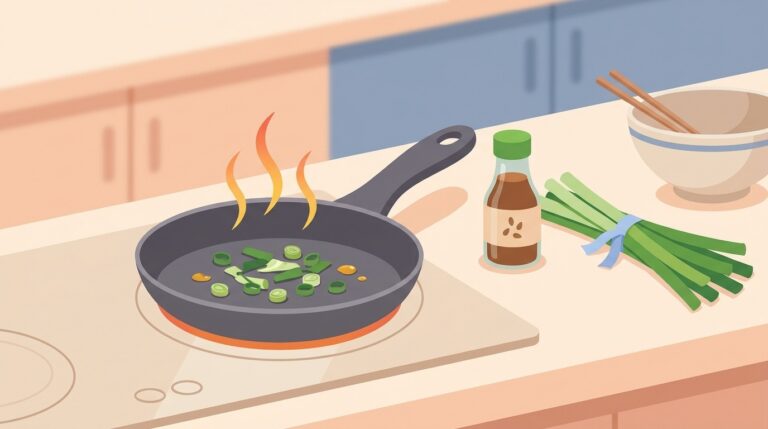
Master Easy Korean Cooking Steps: Why Even Beginners Can Cook Like a K-Drama Star
Phase 1: Empathy (Story-Driven Opening)
안녕하세요! 매일한글 에디터입니다. (Hello! This is your Daily Hangul editor.)
Picture this: It is 11:30 PM on a rainy Thursday night. You are curled up on your sofa watching a heartwarming K-Drama episode. The main characters sit down around a bubbling, ruby-red pot of Tteokbokki (spicy rice cakes) topped with melty cheese and golden fish cakes. Your stomach gives an audible rumble. You pause the show, sprint into your kitchen, and pull out ingredients you picked up at the local Asian grocery store. But suddenly, kitchen paralysis strikes.
What if I burn the gochujang? Isn’t authentic Korean food supposed to require twenty secret fermented sauces and hours of simmering like a Korean grandmother’s soup? What does ‘볶다’ (stir-fry) actually entail here?
If you have ever felt terrified of trying your hand at Korean cooking because you thought the recipes were too complicated, take a deep breath. At Daily Hangul, we hear this exact concern from beginner students every single week. Many learners believe that unless you possess the legendary culinary instincts of a master chef, Korean cooking is out of reach.
Here is the real insider truth: everyday Korean home food (집밥, jipbap) was designed by busy university students, working parents, and roommates who want explosive flavor in under fifteen minutes! By learning just a few foundational conversational phrases, you won’t just follow recipes with ease—you will be able to share and explain simple Korean recipes to your friends, proudly declaring that even a complete kitchen rookie can make it. Let’s step into the warm, comforting kitchen together!
Phase 2: Core Expressions (Top 3 Breakdown)
Here are the three must-know phrases that will transform your kitchen confidence at an A2 level.
1. 생각보다 간단해요 (Saeng-gak-boda gandanhaeyo)
- Pronunciation:
[Saeng-gak-boda gan-dan-hae-yo](Sound metaphor: think “sang-guck-boh-dah gahn-dahn-heh-yoh”—flow through the ‘gandan’ like gentle claps). - Meaning:
- Literal: Compared to thought, it is simple.
- Real Nuance: “It’s way easier than you’d expect! / It looks fancy, but it’s actually super simple!”
- K-Culture Moment: Seen repeatedly on cooking reality programs like Seojin’s (Jinny’s Kitchen) or Paik Jong-won’s YouTube channel when a guest hesitates before flipping a pancake, only to find it glides effortlessly.
- Editor’s Insight: The particle ~보다 (boda) means “compared to,” and 생각 (saeng-gak) means “thought” or “expectation.” Use this phrase whenever you want to disarm someone’s cooking anxiety.
- Situation Spectrum:
- Casual (Friends): 생각보다 간단해 (Saeng-gak-boda gandanhae) ✅
- Semi-formal (Polite/Standard): 생각보다 간단해요 (Saeng-gak-boda gandanhaeyo) ✅
- Formal (Broadcast/Elder): 생각보다 매우 간단합니다 (Saeng-gak-boda maeu gandanhamnida) ✅
- 🤔 Think About It: In English, we often say “It’s a piece of cake.” Korean instead anchors the feeling directly against your prior worry (생각보다). How does acknowledging someone’s preconceptions create an instant feeling of relief?
2. 요리 초보도 할 수 있어요 (Yori chobodo hal su isseoyo)
- Pronunciation:
[Yo-ri cho-bo-do hal su i-sseo-yo](Sound metaphor: “yoh-ree choh-boh-doh hahl soo eess-uh-yoh”—crisp ‘ch’ and bouncy ‘bo’). - Meaning:
- Literal: Even a cooking beginner can do it.
- Real Nuance: “Anyone, even a complete kitchen rookie, can pull this off!”
- K-Culture Moment: The favorite tagline of Korean food vloggers demonstrating “one-pan kimchi fried rice” (김치볶음밥) for university students living alone in studio flats (원룸).
- Editor’s Insight: 초보 (chobo) means “novice/beginner,” and attaching the particle ~도 (-do, meaning “even / also”) creates an encouraging bridge. You are saying, Zero experience required!
- Situation Spectrum:
- Casual: 요리 초보도 할 수 있어 (Yori chobodo hal su isseo) ✅
- Semi-formal: 요리 초보도 할 수 있어요 (Yori chobodo hal su isseoyo) ✅
- Formal: 요리 초보자도 쉽게 하실 수 있습니다 (Yori chobojado swipge hasil su itseumnida) ✅
- 🤔 Think About It: In Korea, “초보” is used warmly across hobbies—from cooking to driving to mobile gaming. What words does your native language use to describe a beginner without sounding patronizing?
3. 먼저 볶은 다음에 물을 넣어요 (Meonjeo bokkeun da-eume mureul neoeoyo)
- Pronunciation:
[Meon-jeo bok-keun da-eu-me mu-reul neo-eo-yo](Sound metaphor: “mun-juh bohk-koon dah-oo-meh moo-rool nuh-uh-yoh”). - Meaning:
- Literal: First, in the time after stir-frying, add water.
- Real Nuance: “First stir-fry it, and then pour in the water.”
- K-Culture Moment: The golden formula when cooking staple Korean stews like Kimchi Jjigae or Miyeok-guk (seaweed soup), where aromatics and meat are always sautéed before broth is introduced.
- Editor’s Insight: The pattern [Verb Stem + ~(으)ㄴ 다음에] means “after doing [action].” Combined with 먼저 (meonjeo, first), it creates clear, chronological cooking steps.
- Situation Spectrum:
- Casual: 먼저 볶은 다음에 물 넣어 (Meonjeo bokkeun da-eume mul neoeo) ✅
- Semi-formal: 먼저 볶은 다음에 물을 넣어요 (Meonjeo bokkeun da-eume mureul neoeoyo) ✅
- Formal: 먼저 볶으신 후에 물을 붓습니다 (Meonjeo bok-geusin hue mureul butseumnida) ✅
- 🤔 Think About It: Korean recipes emphasize sequence heavily. Why does organizing steps with “먼저” (first) and “다음에” (after) reduce kitchen stress?
Phase 3: Textbook Korean vs. Real Korean
When foreign learners read old cookbooks or formal language apps, the phrasing often sounds like a cold medical journal. Let’s compare the stiffness of classroom Korean with what people actually say at home!
Situation 1: Describing the recipe difficulty
- 📖 교과서 한국어 (Textbook Korean):
이 조리법은 대단히 용이합니다.
(I joribeobeun daedanhi yong-ihamnida. / “This culinary methodology is remarkably facile.”) - 🗣️ 진짜 한국어 (Real Korean):
라면 끓이는 것만큼 쉬워요!
(Ramyeon kkeurhineun geotmankeum swiwoyo! / “It’s as easy as making instant ramen!”) - 💡 왜 다를까? (Why the difference?):
Koreans treat making ramen (라면) as the absolute baseline benchmark for kitchen simplicity. If a recipe is simple, nobody says “용이하다”; they instinctively measure it against ramen!
Situation 2: Giving instructions for seasoning sauces
- 📖 교과서 한국어 (Textbook Korean):
간장을 정확히 15밀리리터 첨가하십시오.
(Ganjang-eul jeonghwakhi sib-o-milliriteo cheomgahasipsio. / “Please incorporate precisely 15 milliliters of soy sauce.”) - 🗣️ 진짜 한국어 (Real Korean):
간장 한 스푼만 쓱 둘러주세요.
(Ganjang han seupun-man sseuk dulleojuseyo. / “Just swirl around one spoonful of soy sauce.”) - 💡 왜 다를까? (Why the difference?):
Everyday Korean cooking relies heavily on expressive mimetic words (의태어). 쓱 둘러요 (sseuk dulleoyo) depicts the swift circular wrist motion around the hot wok. It gives natural sensory rhythm to instructions!
Phase 4: K-Culture Deep Dive & Non-Verbal Manners
4-1. 눈치 (Nunchi) & Kitchen Body Language
When you are explaining a recipe in a Korean kitchen, posture matters just as much as grammar:
* The Reassuring Hand Flutter: When uttering “생각보다 간단해요”, relax your shoulders, open your palms facing upward, and give a subtle two-second nod. This non-verbally signals, “Don’t be nervous, you’re doing great.”
* Tasting Etiquette (The Cupped Hand): If your friend offers you a sample spoonful of the broth from the pot, place your opposite hand flat or cupped slightly beneath your chin or under their spoon. This polite gesture prevents messy drips on the floor and conveys deep respect for their effort.
* The Sincerity Nod: Before saying “맛있어요!” (It’s delicious!), take a breath and nod twice with eyes wide. In Korea, genuine enjoyment is shown on the face first before words leave the mouth.
4-2. Cultural Code: The Magic of “손맛” (Son-mat)
You might hear Koreans talk about 손맛 (son-mat, literally “hand-taste”). This doesn’t mean unwashed hands! It refers to the intuitive culinary touch, devotion, and experience of the cook who seasons by feeling, smell, and love rather than sterile measuring beakers.
In modern pop culture, this legacy lives on through “자취 요리” (solo-living cooking hacks). From webtoons to trending K-pop idol YouTube vlogs where members cook for each other in dorms, knowing how to whip up an effortless dish with leftover rice, canned tuna (참치), and well-fermented kimchi is considered a major green flag and life skill!
Phase 5: Real-Life Roleplay Scenario
Setting: You are hanging out in your Korean friend Minji’s apartment kitchen in Mapo-gu, Seoul on a Sunday afternoon. You want to cook Kimchi Bokkeumbap (Kimchi Fried Rice), but you look intimidated by the hot pan.
- 민지 (Minji): 배고프다! 우리 김치볶음밥 만들어 먹을까?
(Baegopeuda! Uri gimchibokkeumbap mandeureo meogeulkka?)
“I’m hungry! Shall we make kimchi fried rice together?”
🎭 냉장고에서 잘 익은 김치와 밥을 꺼내며 환하게 웃는다. (Takes well-fermented kimchi and rice from the fridge with a bright smile.) -
You (Learner): 김치볶음밥이요? 저는 요리 잘 못하는데 괜찮을까요?
(Gimchibokkeumbapiyo? Jeoneun yori jal mothaneunde gwaenchaneulkkayo?)
“Kimchi fried rice? I’m not good at cooking… will it be okay?”
🎭 프라이팬을 쳐다보며 조금 머뭇거린다. (Looks at the frying pan hesitantly.) -
민지 (Minji): 걱정하지 마! 생각보다 레시피가 진짜 간단해요.
(Geokjeonghaji ma! Saeng-gak-boda resipiga jinjja gandanhaeyo.)
“Don’t worry! The recipe is really simpler than you think.”
🎭 어깨를 톡톡 두드리며 격려한다. (Gently pats your shoulder to encourage you.) -
You (Learner): 진짜요? 저 같은 요리 초보도 할 수 있어요?
(Jinjjayo? Jeogateun yori chobodo hal su isseoyo?)
“Really? Even a cooking beginner like me can do it?”
🎭 두 눈을 동그랗게 뜨며 안도한다. (Eyes widen with relief.) -
민지 (Minji): 당연하죠! 먼저 파와 김치를 볶은 다음에 밥을 넣으면 돼요.
(Dang-yeonhajyo! Meonjeo pawa gimchireul bokkeun da-eume babeul neoeumyeon dwaeyo.)
“Of course! First stir-fry the scallions and kimchi, and after that, just put the rice in.”
🎭 프라이팬에 식용유를 두르고 주걱을 건넨다. (Drizzles oil into the pan and hands over the spatula.) -
You (Learner): 와, 정말 순서가 쉬워요! 불은 어떻게 해요?
(Wa, jeongmal sunseoga swiwoyo! Bureun eotteoke haeyo?)
“Wow, the steps are really easy! How should I manage the heat?”
🎭 주걱을 쥐고 불 조절 손잡이를 바라본다. (Grips the spatula and looks at the stove knob.) -
민지 (Minji): 중불로 볶다가 마지막에 참기름을 살짝 둘러주세요!
(Jungbullo bokkdaga majimage chamgireumeul saljjak dulleojuseyo!)
“Stir-fry over medium heat, and at the very end, lightly swirl in sesame oil!”
🎭 참기름 병을 가리키며 윙크한다. (Points to the sesame oil bottle with a wink.) -
You (Learner): 생각보다 정말 간단하네요. 저도 이제 할 수 있을 것 같아요!
(Saeng-gak-boda jeongmal gandanhaneyo. Jeodo ije hal su isseul geot gat-ayo!)
“It really is simpler than I thought. I think I can do this now!”
🎭 신나게 김치를 볶기 시작한다. (Starts cheerfully stir-frying the kimchi.)
🔀 Interactive Decision Point
Minji hands you the spatula, but the pan starts crackling loud and smoke begins to rise quickly because the stove heat is on high! What do you say?
- Option A: “불이 너무 세요! 먼저 불을 줄인 다음에 볶을게요.” (The heat is too high! I’ll lower the flame first, then sauté.)
- Option B: “너무 복잡해요! 저는 그냥 구경만 할게요.” (It’s too complicated! I’ll just watch.)
- Option C: “몰라요! 빨리 물을 부을게요!” (I don’t know! I’ll just pour water right now!)
Feedback:
- Option A (Best!): 🌟 Perfect response! You identified the culinary need (heat control) and applied the A2 sequence pattern (먼저 ~ㄴ 다음에). Minji will be thrilled by your practical kitchen Korean!
- Option B (Risk): ⚠️ While grammatically understandable, pulling out completely dampens the collaborative cooking fun (정, jeong). Don’t give up—remember 요리 초보도 할 수 있어요!
- Option C (Bad): 🚫 Disastrous outcome! Pouring water into blazing oil creates dangerous hot oil splatters, and soggy kimchi fried rice is ruined. Always adjust the flame first!
Phase 6: 10-Second Emotion Shadowing Drill
Practice these lines out loud with the emotional tags to nail native Korean cadence!
- [😊 Cheerful and Encouraging]
생각보다 / 레시피가 / 진짜 간단해요!
(Saeng-gak-boda / resipiga / jinjja gandanhaeyo!)
“It’s simpler / than you think / seriously easy!” -
[🍳 Confident and Friendly]
걱정 마세요, / 요리 초보도 / 쉽게 할 수 있어요!
(Geokjeong maseyo, / yori chobodo / swipge hal su isseoyo!)
“Don’t worry, / even a cooking beginner / can easily do it!” -
[😋 Anticipatory and Hungry]
먼저 김치를 볶은 다음에 / 밥을 넣을게요!
(Meonjeo gimchireul bokkeun da-eume / babeul neoeulgeyo!)
“First I will stir-fry the kimchi, / and after that / I will add the rice!”
Phase 7: K-Culture Mini Dictionary
-
손맛 (Son-mat) | Noun
Meaning: Intuitive seasoning touch / culinary warmth.
Daily Usage: When someone’s dish tastes unexpectedly deep and comforting without strict recipes, Koreans compliment them: “역시 손맛이 좋아요!” (As expected, you have great hand-taste!). -
황금 레시피 (Hwang-geum re-si-pi) | Noun
Meaning: Golden foolproof recipe.
Daily Usage: Frequently searched on Korean internet portals (e.g., “떡볶이 황금 레시피”) for fail-proof ratios that guarantee restaurant-grade taste. -
요린이 (Yo-rin-i) | Noun (Slang)
Meaning: Kitchen toddler / novice cook (blend of 요리 [cooking] + 어린이 [child]).
Daily Usage: Extremely popular self-deprecating slang online: “저 완전 요린이인데 이거 만들 수 있을까요?” (I’m a complete kitchen toddler, can I make this?). -
불 조절 (Bul jo-jeol) | Noun
Meaning: Heat management / temperature regulation.
Daily Usage: The secret to Korean stir-fries and stews. Shifting between 강불 (high), 중불 (medium), and 약불 (low heat).
Phase 8: Traveler’s Survival Kit
Survival Phrases TOP 3
-
이거 덜 맵게 해 주실 수 있어요?
(Igeo deol maepge hae jusil su isseoyo?)
Translation: “Could you make this less spicy, please?”
Pro Tip: Essential when ordering food at traditional night markets or street stalls if your spice tolerance is still developing. -
재료가 뭐 들어가요?
(Jaeryoga mwo deureogayo?)
Translation: “What ingredients go into this?”
Pro Tip: Great for food allergies or dietary restrictions (vegetarian/halal/seafood allergies). -
레시피 물어봐도 돼요?
(Resipi mureobwado dwaeyo?)
Translation: “May I ask for the recipe?”
Pro Tip: The ultimate compliment to an elderly restaurant owner (이모님, auntie). It will earn you free side dishes (서비스) with a giant grin!
Editor’s Travel Note
When shopping for pantry essentials in Korea, avoid overpriced tourist souvenir markets. Download the Coupang delivery app service or step inside local supermarket chains like E-Mart, Homeplus, or your nearest neighborhood Nonghyup Hanaro Mart. Look for the pre-portioned “밀키트” (Meal-kit) section! Korea’s meal-kit technology is world-class: all vegetables come pre-washed, chopped, and accompanied by numbered step cards showing phrases like “먼저 볶은 다음에”!
Phase 9: One Step Deeper (Reflective Thinking)
In many Western cultures, a recipe is treated like a precise legal contract: cups, ounces, grams, and strict timers. In Korea, cooking has historically been rooted in communal sharing and empathetic care (정, Jeong). Making food for someone isn’t a demonstration of technical perfection; it’s an act of affection. Even when you are a complete beginner making basic fried rice, the effort to stir-fry and serve it warm is deeply appreciated.
💬 Your Turn: Think about your own home culture. Do people cook strictly by recipe books, or do they cook with intuitive “hand-taste” like Korean 손맛? Share your favorite simple comfort dish in the comments!
Phase 10: FAQ & Common Mistakes
Q: What is the grammatical difference between “~은 다음에” and “~고 나서”?
A: Both express sequential actions (“after doing”). However, ~(으)ㄴ 다음에 (-eun da-eume) is more versatile for recipes, theoretical directions, and general steps, whereas ~고 나서 (-go naseo) emphasizes that the first action is thoroughly, completely completed before starting the next.
Q: Can I use “생각보다 간단해요” in formal business settings?
A: Yes! When presenting a newly streamlined workflow, software feature, or onboarding process to your colleagues, saying “생각보다 절차가 간단합니다” (The procedure is simpler than expected) sounds natural, reassuring, and professional.
Q: Is “요린이” considered offensive if I say it to someone else?
A: While it is an affectionate slang term, you should primarily use it for yourself (e.g., “제가 요린이라서요” – Because I’m a kitchen rookie). Calling an older person or an acquaintance a 요린이 might sound slightly condescending. For others, stick to 요리 초보 (cooking beginner).
🚨 Common Mistakes Alert
- Mistake: Confusing 볶다 (to stir-fry/sauté in oil) with 끓이다 (to boil a liquid/soup).
Wrong: 라면을 볶아요. (Unless you are making stir-fried buldak noodles!)
Correct Action: Use 끓여요 (kkeuryeoyo) for soups/ramen with water, and reserve 볶아요 (bokkayo) for pans with oil like fried rice or stir-fried pork. -
Mistake: Dropping the particle in “생각보다” and just saying “생각 간단해요”.
Correct Action: Always keep ~보다 attached! It provides the vital comparison: 생각보다 (than thought). -
Mistake: Using high-level written terms like 첨가하다 (to incorporate/add) in casual conversation.
Correct Action: Simply say 넣어요 (neoeoyo, add/put in) or 둘러요 (dulleoyo, drizzle/swirl).
Phase 11: Action Missions
- 🥉 Bronze Mission (Solo Practice): Stand in your kitchen, hold up any cooking sauce or ingredient, and recite out loud 3 times: “생각보다 레시피가 간단해요!”
- 🥈 Silver Mission (Social Share): Snap a photo of a simple Korean dish you made (or plan to make) and post it to Instagram or X with the caption: “요리 초보도 할 수 있어요! #DailyHangul #KoreanCooking”
- 🥇 Gold Mission (Real-Life Application): Explain the 2-step sequence of your favorite snack to a Korean friend or language exchange partner using “먼저 [Action] 다음에 [Action]”!
🎮 K-Culture Mission: Watch an episode of a Korean cooking show or K-pop dorm vlog this week. Keep your ears peeled for the words 초보, 간단, or 먼저. Drop the timestamp in our student community!
Phase 12: Interactive Quiz Challenge
Test your skills below! Click each dropdown toggle to reveal the correct answer and detailed explanation.
1. Situation Judgment
Your friend wants to try making Korean Tteokbokki for the first time, but says, “한국 요리는 너무 어려울 것 같아요…” (I think Korean food will be too difficult…). What is the best, most encouraging response?
* ① 요리 하지 말고 그냥 배달 시켜요. (Don’t cook, just order delivery.)
* ② 생각보다 레시피가 간단해서 요리 초보도 할 수 있어요! (The recipe is simpler than expected, so even cooking beginners can do it!)
* ③ 네, 한국 요리는 전문가만 할 수 있어요. (Yes, only experts can cook Korean food.)
🔍 Click to view Answer & Explanation
Correct Answer: ②
Explanation: Option ② uses our core unit phrases to reassure your friend empathetically. Option ① is unnecessarily dismissive, and Option ③ is culturally and practically false!
2. Fill-in-the-Blank Grammar
Complete the chronological cooking instruction:
“먼저 고기를 ________ (볶다: to stir-fry) 다음에 물을 넣으세요.”
🔍 Click to view Answer & Explanation
Correct Answer: 볶은 (bokkeun)
Explanation: To express “after doing [Verb]”, attach ~(으)ㄴ 다음에 to the verb stem. Since 볶다 ends in a consonant (받침 ㄲ), it becomes 볶은 다음에 (after stir-frying).
3. True / False Cultural Check
“In Korean kitchens, using exact digital scales and gram measurements is always considered more authentic than relying on 손맛 (hand-taste).” (True / False)
🔍 Click to view Answer & Explanation
Correct Answer: False!
Explanation: Traditional and everyday Korean home cooking celebrates 손맛 (son-mat)—the intuitive, heartfelt seasoning and flavor built through care and tasting rather than mechanical scale measurements.







