

Phase 1: Empathy (Story-Driven Opening)
안녕하세요! 매일한글 에디터입니다. (Hello! This is your Daily Hangul editor.)
Picture this: It’s 10:45 PM on Seoul Metro Line 2. The carriage is humming with exhausted salary workers staring blankly into their smartphone screens. You might recognize this scene from K-dramas like Misaeng or My Liberation Notes. In South Korea, life often feels like a relentless sprint to live a Godsaeng (갓생, a hyper-productive ‘god-level’ life). But underneath the polished Instagram feeds and 6:00 AM study-vlogs lies a silent crisis: the exhaustion of the Piro Sahoe (피로사회, The Burnout Society). We turn self-improvement into self-exploitation, believing that any moment spent resting is a personal moral failure.
Many of our advanced C1 learners tell me: “Editor, whenever I feel overwhelmed in Korea, I don’t know how to express it without sounding either overly dramatic or like a stiff textbook robot!” If you’ve been berating yourself for dropping the ball or feeling emotionally drained, take a deep breath. Today, we’re setting aside toxic perfectionism. We are exploring the language of Jagi-jabi (자기자비, self-compassion)—authentic, nuanced Korean expressions that will help you dismantle inner guilt, set healthy emotional boundaries, and speak to your exhausted soul like a loving friend.
Phase 2: Top 3 Core Expressions in Depth
1. 내려놓다 (Naeryeonota)
- Pronunciation: [Nae-ryeo-no-ta] (Think of saying nay-ryo-no-tah smoothly, releasing your breath on the final syllable).
- Meaning: Literally “to put down / lay down.” In psychological contexts, it means to release control, surrender unattainable perfection, or unburden your mind.
- K-Culture Moment: Frequently heard in introspective reality shows like Begin Again or healing dramas when an artist or athlete admits they performed their best only after abandoning the pressure to win.
- Editor’s Insight: Unlike the English phrase “to give up” (which carries a negative connotation of quitting), 내려놓다 carries profound Zen-like maturity. It signifies an intentional, brave decision to let go of expectations that are crushing you.
- Situation Spectrum:
- Casual: ✅ (내려놓으니까 한결 편해 – Now that I let it go, I feel so much lighter)
- Semi-formal: ✅ (조금은 마음을 내려놓아도 괜찮아요 – It’s okay to ease your mind a little)
- Formal: ✅ (과도한 욕심을 내려놓는 태도가 필요합니다 – An attitude of letting go of excessive greed is necessary)
- 🤔 Think About It: In your native culture, is “letting go” viewed as weakness or wisdom? How does Korean treat relinquishing control as a form of emotional mastery?
2. 애쓰지 않아도 돼 (Aesseuji anado dwae)
- Pronunciation: [Aes-seu-ji a-na-do dwae] (Sounds like es-soo-jee ah-nah-doh dway).
- Meaning: “You don’t have to strain so desperately.” (Root: 애쓰다, to exert painful mental/physical effort).
- K-Culture Moment: In heartfelt ballads or slow indie tracks (think of Sunwoo Jung-a or Lee Hi), this phrase appears right at the emotional climax when comforting someone on the verge of tears.
- Editor’s Insight: Korean has multiple words for hard work. While Noryeok (노력) refers to standard diligent effort, Aesseuda (애쓰다) implies painful friction—straining until your nerves fray. Saying “애쓰지 않아도 돼” tells the other person that their worth isn’t tied to their endless struggle.
- Situation Spectrum:
- Casual: ✅ (너무 애쓰지 마. 충분해 – Don’t strain so hard. It’s enough)
- Semi-formal: ✅ (너무 애쓰지 않으셔도 돼요 – You really don’t have to push yourself that hard)
- Formal: ⚠️ (Formal business settings usually demand polite reframing: 무리하지 않으셔도 됩니다)
- 🤔 Think About It: Why does modern society equate constant struggle with virtue? What changes inside you when someone tells you to stop struggling?
3. 나를 온전히 보듬다 (Nareul onjeonhi bodeumda)
- Pronunciation: [Na-reul on-jeon-hi bo-deum-da] (Pronounced nah-reul on-jon-hee boh-deum-dah).
- Meaning: Literally “To fully embrace and cradle oneself.” Nuance: Practicing radical self-acceptance and self-compassion without harsh self-criticism.
- K-Culture Moment: Found in healing essays and psychiatric counsel books dominating Korean bestseller lists at Kyobo Bookstore, such as works by Dr. Oh Eun-young.
- Editor’s Insight: Bodeumda (보듬다) is the motion of holding a shivering child or an injured creature warmly against your chest. Using this toward oneself (나를 보듬다) marks high-level, reflective Korean that transcends casual slang to touch poetic vulnerability.
- Situation Spectrum:
- Casual: ✅ (나를 먼저 보듬어주기로 했어 – I decided to embrace myself first)
- Semi-formal: ✅ (스스로를 따뜻하게 보듬어 줄 시간이에요 – It’s time to warmly cradle yourself)
- Formal: ✅ (자기 비난을 멈추고 자신을 온전히 보듬어야 합니다 – We must stop self-blame and wholly nurture ourselves)
- 🤔 Think About It: Contrast the harsh internal monologue many of us carry with the physical warmth implied by 보듬다. Can you speak this gently to yourself?
Phase 3: Textbook Korean vs. Real Korean
Situation 1: Expressing that you are completely burned out
- 📖 교과서 한국어 (Textbook Korean): 저는 현재 과도한 업무로 인해 스트레스와 피로가 누적되었습니다. (Jeoneun hyeonjae gwadohan eommuro inhye seuteureseuwa piroga nujeokdoe-eotsseumnida. / “Currently, due to excessive work, my stress and fatigue have accumulated.”)
- 🗣️ 진짜 한국어 (Real Korean): 요즘 갓생 살겠다고 달리다가 번아웃 와서 멘탈이 완전히 털렸어요. (Yojeum gatsaeng salgetdago dallidaga beon-aut waseo mentari wanjeonhi teollyeosseoyo. / “I was sprinting trying to live a hyper-productive life, and now I’ve hit burnout and my mental state is completely shredded.”)
- 💡 왜 다를까? (Why is it different?): Textbook Korean treats burnout like a clinical report. Real Koreans use vivid modern idioms like 멘탈이 털리다 (to have one’s mental energy shaken out and emptied) and refer directly to the trendy Godsaeng culture.
Situation 2: Telling someone to stop being such a harsh perfectionist
- 📖 교과서 한국어 (Textbook Korean): 완벽주의적인 성격을 고치고 휴식을 취하십시오. (Wanbyeokjueuijeogin seonggyeogeul gochigo hyusigeul chwihasipsio. / “Fix your perfectionist personality and take a rest.”)
- 🗣️ 진짜 한국어 (Real Korean): 뭐든 완벽하게 해내려고 너무 아등바등 살지 마. 숨 좀 돌려. (Mwodeun wanbyeokhage haenaeryeogo neomu adeungbadeung salji ma. Sum jom dollyeo. / “Stop desperately clinging to perfection in everything. Catch your breath.”)
- 💡 왜 다를까? (Why is it different?): The native descriptive verb 아등바등하다 (adeungbadeunghada) captures the image of scrambling desperately with short limbs. It delivers far warmer, raw empathetic realism than a dry grammatical command.
Phase 4: K-Culture Deep Dive & Non-Verbal Manners
4-1. 눈치 (Nunchi) & Emotional Posture
In high-context Korean communication, discussing burnout requires subtle non-verbal calibration:
* The Heavy Sigh vs. The Shared Exhale: Dropping a sharp, audible sigh (Hanseum, 한숨) in a group setting can be perceived as passive-aggressive or draining everyone’s collective energy. However, when practicing mutual self-compassion, a soft, shared exhale paired with lowering dropped shoulders signals vulnerability.
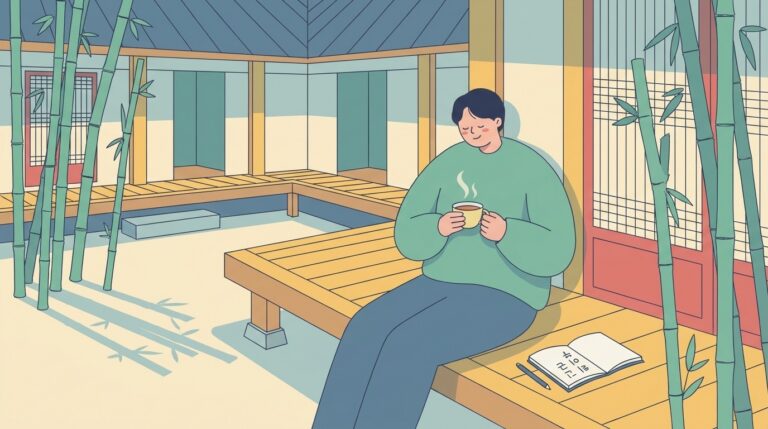
* The Double-Hand Warm Beverage Hold: When having a serious heart-to-heart (Simsimhan daehwa, 진솔한 대화) in a café, wrapping both hands around your mug while looking down momentarily before making eye contact creates an inviting, humble space for emotional intimacy.
* Refraining from Over-Apology: Foreigners often apologize incessantly when burned out (죄송합니다! 제가 부족해서…). In mindful Korean self-compassion, replace excessive apologies with gratitude: 기다려주셔서 감사해요 (Thank you for waiting for me).
4-2. Cultural Code: The Paradox of ‘Godsaeng’ and ‘Chudae’
South Korea’s modern zeitgeist is caught between two cultural poles: the hyper-disciplined Godsaeng (갓생) trend and the desperate yearning for unconditional acceptance depicted as Chudae (추대 / worship-support) in the acclaimed drama My Liberation Notes (나의 해방일지).
While societal pressures urge young Koreans to study until 2 AM in Euljiro study-cafés, cultural counter-movements are celebrating Mong-ttaerigi (멍때리기, spaced-out zoning competitions at the Han River) and silent meditation retreats in Gangwon-do. Understanding this tension will allow you to see that when Koreans talk about burnout, they aren’t just tired—they are questioning the foundational narrative of national development and collective hustle.
Phase 5: Real-World Roleplay Scenario
Setting: A dimly lit, quiet rooftop café in Seongsu-dong overlooking the subway line. Minji (민지), your Korean colleague and creative lead, has been pulling 70-hour weeks for a corporate rebrand and is visibly trembling with exhaustion.
- 민지: (커피잔을 만지작거리며 멍하니 허공을 응시한다) 벌써 마감 사흘 전인데 기획안이 마음에 찰 때까지 안 나와. 팀원들한테 민폐 끼칠까 봐 잠도 안 와. (Beolsseo magam saheul jeoninde gihoegani maeume chal ttaekkaji an nawa. Tim-wondeulhante minpye kkichilkka bwa jamdo an wa.)
- 🎭 Action: Minji fidgets with her coffee cup, staring blankly into empty space. “It’s three days before deadline and the draft isn’t good enough. I can’t sleep thinking I’ll become a burden to the team.”
- 나 (You): (민지의 손을 살며시 바라보며 나직한 목소리로) 민지 씨, 스스로한테 너무 가혹한 거 알아요? (Minji ssi, seuseurohante neomu gahokan geo arayo?)
- 🎭 Action: Looking softly at Minji’s hands, speaking in a low, gentle voice. “Minji, do you know you’re being far too harsh on yourself?”
- 민지: (자조적으로 쓴웃음을 지으며) 가혹하긴… 남들은 더 열심히 치열하게 사는데, 나만 나약한 것 같아서 자꾸 자책하게 돼. (Gahokhagin… Namdeureun deo yeolsimhi chiyeolhage saneunde, naman nayakan geot gataseo jakku jachaekhage dwae.)
- 🎭 Action: Smiling with bitter self-mockery. “Harsh? Everyone else lives so fiercely. I feel like I’m the only weak one, so I keep blaming myself.”
- 나 (You): (고개를 가로저으며 눈을 맞춘다) 비교하지 마요. 그동안 쉼 없이 달렸잖아요. 이제 기준을 조금 내려놓아도 돼요. (Bigyohaji mayo. Geudong-an swim eopsi dallyeotjannayo. Ije gijuneul jogeum naeryeonoado dwaeyo.)
- 🎭 Action: Shaking your head gently and meeting her eyes. “Don’t compare. You’ve run without a break all this time. It’s okay to lower your standards a bit now.”
- 민지: (한숨을 푹 내쉬며 어깨를 떨군다) 기준을 낮추면 모든 게 무너져 내릴 것 같아 두려워. (Gijuneul natchumyeon modeun ge muneojyeo naeril geot gata duryeowo.)
- 🎭 Action: Sinking her shoulders with a deep sigh. “I’m terrified that if I lower my standards, everything will collapse.”
- 나 (You): (따뜻하게 미소 지으며) 무너지지 않아요. 지금 민지 씨한테 필요한 건 자책이 아니라 스스로를 보듬어주는 시간이에요. (Muneojiji anayo. Jigeum Minji ssihante piryohan geon jachaegi anira seuseuroreul bodeumeojuneun siganieyo.)
- 🎭 Action: Smiling warmly. “It won’t collapse. What you need right now isn’t self-reproach, but time to cradle yourself.”
- 민지: (눈가가 촉촉해지며 말을 잇지 못한다) …내가 나한테 너무 모질었나 봐. (Naega nahante neomu mojireonna bwa.)
- 🎭 Action: Tearing up slightly, speaking quietly. “…I guess I was too cruel to myself.”
- 나 (You): (민지의 어깨를 가볍게 토닥이며) 그래요. 완벽하지 않아도 민지 씨는 이미 충분히 빛나요. 오늘은 다 잊고 푹 쉬어요. (Geuraeyo. Wanbyeokhaji anado Minji ssineun imi chungbunhi binnayo. Oneureun da itgo puk swieoyo.)
- 🎭 Action: Patting Minji’s shoulder reassuringly. “That’s right. Even without being perfect, you shine enough already. Forget everything today and get some deep rest.”
🔀 Interactive Branching Moment
If Minji suddenly says: “내일 당장 팀장님한테 기획안 못 하겠다고 던져버릴까 봐요.” (I feel like throwing this draft at my team lead tomorrow and saying I quit.) How do you reply?
- Option A: “에이, 그래도 어른인데 끝까지 책임은 져야죠! 포기하면 평생 후회해요.” (Come on, you’re an adult, take responsibility! You’ll regret it for life if you give up.)
- Feedback: ❌ Bad. Invalidates her acute crisis, heaps toxic shame onto someone already drowning in self-blame, and kills relational trust.
- Option B: “진짜 속상했으면 그렇게 질러도 돼요! 회사 따위가 뭐라고, 당장 사표 써요!” (If you’re upset, go smash it! What is a company anyway, write your resignation right now!)
- Feedback: ⚠️ Risk. While empathetic in sentiment, it incites impulsive and irreversible professional harm during a vulnerable emotional state.
- Option C: “얼마나 버거우면 그런 마음까지 들었을까요. 던지고 싶을 만큼 힘든 그 마음, 제가 알아요. 오늘은 결정을 멈추고 쉬어요.” (How burdensome it must have been for you to feel that way. I recognize your pain in wanting to throw it all away. Let’s pause decisions today and just rest.)
- Feedback: 🏆 Best! Demonstrates advanced psychological mirroring, validates her extreme exhaustion without encouraging reckless actions, and guides her toward emotional stabilization.
Phase 6: 10-Second Emotional Shadowing Drill
Practice breathing through these pauses (/). Mirror the emotional indicator before vocalizing.
[🌿 차분하고 단호하게 - Calm and grounded]
남들의 기대에 맞추느라 / 나 자신을 갉아먹는 짓은 / 이제 그만둘래요.
(Namdeurui gidaee matchuneura / na jasineul galgameongneun jiseun / ije geomandullaeyo.)
“I will stop eroding myself / just to meet the expectations / of others.”-
[🫂 따뜻하게 위로하며 - Warm and deeply comforting]
완벽하지 않아도 괜찮아. / 너는 존재 자체로 / 이미 충분히 가치 있어.
(Wanbyeokhaji anado gwaenchana. / Neoneun jonjae jache-ro / imi chungbunhi gachi isseo.)
“It’s completely fine not to be perfect. / In your very existence / you are already profoundly worthy.” -
[🧘 깊은 한숨을 비워내듯 - Releasing a deep breath]
더 잘하려고 애쓰지 않아도 돼. / 그냥 이대로 / 잠시 숨을 고르자.
(Deo jalharyeogo aesseuji anado dwae. / Geunyang idaero / jamsi sumeul goreuja.)
“You don’t have to strain so hard to do better. / Just as you are / let’s catch our breath for a while.”
Phase 7: K-Culture Mini Dictionary
- 번아웃 (Beon-aut) | Burnout Syndrome
- Usage: Widely accepted loanword used across corporate workplaces and media. Often paired with verbs like 오다 (burnout arrived) or 겪다 (to undergo burnout).
- 자기자비 (Jagi-jabi) | Self-Compassion
- Usage: Pure Sino-Korean academic and psychological concept (自己慈悲). Increasingly popular in mindfulness literature to contrast against Jagi-gyebal (자기개발, self-improvement).
- 갓생 피로증 (Gat-saeng Piro-jeung) | God-Life Fatigue Syndrome
- Usage: Neologism describing psychological collapse caused by obsessive attempts to maintain extreme daily productive habits without rest.
- 마음챙김 (Ma-eum-chaeng-gim) | Mindfulness
- Usage: Native Korean rendering of “mindfulness.” Used extensively in mental health clinics, yoga studios in Hannam-dong, and corporate wellness programs.
Phase 8: Traveler’s Survival Kit for Mental Rest
Top 3 Rest & Healing Phrases
- 조용한 자리로 부탁드려요. (Joyonghan jariro butakdeuryeoyo.)
- Pro Tip: Use this when entering spacious traditional tea houses in Insadong or Bukchon to secure a quiet corner away from chatty tour groups.
- 핸드폰 알림 끄고 템플스테이 다녀오려고요. (Haendeupon allim kkeugo tempeulseutei danyeo-oryeogoyo.)
- Pro Tip: A sophisticated, natural sentence to tell Korean acquaintances why you will be unreachable over the weekend.
- 혼자 사색할 시간이 좀 필요해요. (Honja sasaek-hal sigani jom piryohaeyo.)
- Pro Tip: High-register way of saying “I need some alone time to contemplate,” preventing hurt feelings when turning down social invitations.
Editor’s Travel Note
When Seoul’s fast pace overwhelms your nervous system, ditch Myeongdong and head to serene sanctuary spots. You can plan quiet wellness retreats and historic sanctuary walks through the 네이버 지도 앱 다운로드. Take Line 4 to Hansung University Station and walk along the quiet Seongbuk-dong mountain paths, or book a silent temple weekend via the official 한국 템플스테이 예약 사이트.
Phase 9: A Step Deeper (한 발 더 깊이)
Korean culture has long celebrated Cheol (철), a concept denoting communal maturity and knowing when to suppress personal whims for the family or group. However, South Korea’s rapid transformation into Han Byung-Chul’s The Burnout Society exposed the danger of this mindset: we no longer need an external master to whip us into submission—we become our own ruthless overseers. Self-compassion (자기자비) in modern Korea is not an indulgence or laziness; it is a revolutionary act of reclaiming one’s humanity from the altar of endless productivity.
💬 Your Turn: Have you ever felt like taking a break was a sign of defeat? What sentence would you say to your exhausted self in Korean today? Drop your thoughts in the comments below!
Phase 10: FAQ & Common Mistakes
Q: Isn’t telling someone to ‘내려놓다’ seen as telling them to give up and fail?
A: Not at all! In Korean, giving up is 포기하다 (which suggests admitting defeat). 내려놓다 is viewed with Buddhist-rooted admiration—it means relinquishing toxic attachment to specific results so that you can protect your peace.
Q: Can I use ‘자기자비’ in a casual conversation with friends?
A: 자기자비 is somewhat formal and conceptual. In casual conversation with friends, it sounds much more natural to say: “나 자신을 좀 더 아껴주려고” (I’m trying to cherish myself a bit more) or “스스로를 너무 몰아세우지 말자” (Let’s not corner ourselves so harshly).
Q: How do I respond if my boss notices my burnout and asks if I’m having a hard time?
A: Balance politeness with professional boundaries. Say: “최근 업무 몰입도가 높아서 피로가 조금 쌓였지만, 이번 주말에 충분히 재충전하고 오겠습니다.” (Fatigue has accumulated due to intense engagement recently, but I will recharge fully this weekend).
🚨 Common Mistakes Alert!
- Mistake: Using 포기해 (Pogihae) when trying to comfort a stressed friend.
- Why it’s wrong: It means “Give up/Throw in the towel,” which can sound insulting.
- Correct Action: Say “조금 내려놓아도 돼” (You can let go a little) or “숨 좀 돌려” (Catch your breath).
- Mistake: Confusing 쉬다 (swida – to rest) with 게으르다 (geeureuda – to be lazy).
- Why it’s wrong: Burned-out learners often say “저 요즘 너무 게을러요” (I’m so lazy lately) when they are actually clinically exhausted.
- Correct Action: Reframe your state: “게으른 게 아니라 에너지가 고갈된 상태예요” (I’m not lazy; my energy is just depleted).
- Mistake: Overusing the stiff imperative 무리하지 마십시오 with intimate friends.
- Why it’s wrong: It creates emotional distance like a doctor speaking to a patient.
- Correct Action: Say warmly: “너무 무리하지 마, 몸 상할라” (Don’t overdo it, you’ll ruin your health).
Phase 11: Action Missions
- 🥉 Bronze Mission (Solo Practice): Stand before a mirror, place a hand over your heart, and speak this aloud 3 times: “오늘 하루도 고생 많았어. 완벽하지 않아도 난 내 편이야.” (You worked hard today too. Even if not perfect, I am on my own side.)
- 🥈 Silver Mission (Social Connection): Send a message to a busy friend using the phrase: “요즘 너무 애쓰지 말고, 틈틈이 숨 좀 돌리면서 일해!” (Don’t strain yourself too hard these days, take regular breaths while working!)
- 🥇 Gold Mission (Real Life Application): The next time you make a minor mistake at work or school, catch your inner critic and replace “난 왜 이 모양일까?” (Why am I like this?) with “그럴 수도 있지. 실수하면서 배우는 거지.” (That can happen. We learn through mistakes.)
- 🎮 K-Culture Mission: Listen to Lee Hi’s song Breathe (한숨, written by the late Jonghyun). Identify the line “당신의 그 한숨 / 그 깊은 뜻을 다 헤아릴 수는 없겠지만 / 괜찮아요 / 내가 안아줄게요” and write down how it feels to hear it.
Phase 12: Interactive Quiz Challenge
Question 1 (Situation Assessment)
Your close junior coworker is crying at her desk because her presentation had a minor typo. Which phrase best demonstrates deep 자기자비 (self-compassion) guidance?
1. “정신을 바짝 차렸어야지!”
2. “그 작은 오타 하나로 너의 노력이 사라지는 건 아니야. 너무 자책하지 마.”
3. “빨리 부장님한테 무릎 꿇고 빌어.”
👉 Click to reveal Answer & Explanation
- Correct Answer: 2번
- Explanation: Option 2 (That tiny typo doesn’t erase your hard work. Don’t blame yourself so much) provides empathetic reframing. Option 1 adds harsh pressure, and Option 3 is unnecessarily humiliating.
Question 2 (Fill in the Blank)
Complete the sentence to mean: “I decided to stop desperately pushing myself and embrace my flaws warmly.”
* 문장: “더 이상 너무 ______________ 살지 않고, 내 부족함도 따뜻하게 ______________ 결심했어.”
👉 Click to reveal Answer & Explanation
- Correct Answer: 아등바등 / 보듬기로 (or 보듬어주기로)
- Explanation: 아등바등 describes struggling frantically with anxiety, while 보듬다 conveys cradling and accepting oneself warmly.
Question 3 (True or False Cultural Quiz)
In contemporary Korean culture, taking part in a ‘멍때리기 대회’ (Spaced-out daydreaming competition) is considered shameful because it violates the principle of productivity.
* True / False?
👉 Click to reveal Answer & Explanation
- Correct Answer: False
- Explanation: The Han River Spaced-Out Contest is a celebrated public art event in Seoul! It was created specifically to encourage over-stressed citizens to give their hyperactive brains a break without guilt.







