

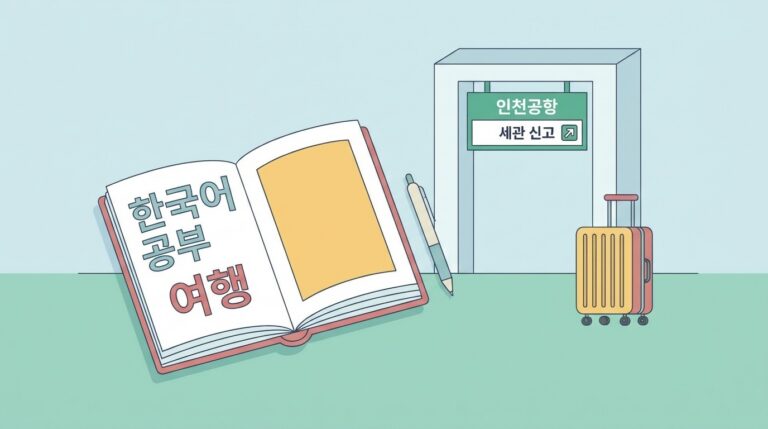
Incheon Airport Customs Survival: How to Say I Have Nothing to Declare Like a Local
Phase 1: Empathy & Story Opening
안녕하세요! 매일한글 에디터입니다. (Hello! This is your Daily Hangul editor.)
Picture this: You have finally landed at Incheon International Airport after a grueling 14-hour flight. Your eyes are slightly puffy, you’re craving your very first carton of chilled banana milk, and you’ve successfully wrestled your oversized suitcase off baggage carousel number 16. You feel like a seasoned globetrotter. But as you roll your luggage cart toward the bright arrival hall doors, you spot them: the customs officers standing under the prominent green and red signs.
One officer in a sharp dark uniform catches your eye. Your heart does a mini backflip. “Wait… do those sheet masks and freeze-dried ramen cups in my luggage count as commercial imports? What if they ask me something in rapid-fire Korean?!”
Take a deep breath! Over the past decade coaching hundreds of fresh travelers heading to South Korea, I have seen this exact airport freeze happen countless times. You do not need a law degree or fluent grammar to walk past border control with total calm. In this practical A1 beginner guide, we will master the magical, effortless phrases you need to declare nothing, smile politely, and step out into Seoul with zero stress.
Phase 2: Core Expressions Deep Dive
1. 신고할 것 없어요 (Singohal geot eopseoyo)
- Pronunciation:
seen-go-hal got up-soh-yo(Think of: seen + go + hal, followed by gut and up-seo-yo) - Meaning: Literal: “There is nothing to declare.” / Natural: “I have nothing to declare.”
- K-Culture Moment: The quintessential scene in modern K-dramas where the returning lead walks smoothly out of Terminal 2, rolling sunglasses on, breezing past customs without missing a beat.
- Editor’s Insight: The word 없어요 (eopseoyo) is one of the most useful beginner words in the Korean language. It simply means “it does not exist” or “I do not have.” When combined with 신고할 것 (things to declare), it creates an instant, complete sentence that sounds polite yet completely natural.
- Situation Spectrum: Casual: 🚫 | Semi-formal: ✅ (
신고할 거 없어요) | Formal: ✅ (신고할 것 없습니다) - 🤔 Think About It: Notice how natural Korean completely drops the subject “I” (저는). In English, we always state “I have nothing to declare.” Why do you think Korean culture favors leaving out “I” when the context is already obvious?
2. 그냥 제 가방이에요 (Geunyang je gabang-i-e-yo)
- Pronunciation:
geun-yang jeh gah-bahng-ee-eh-yo(Say geun like ‘good’ without the d + young + je + gah-bahng + ee-eh-yo) - Meaning: Literal: “It is just my bag.” / Natural: “These are just my personal belongings.”
- K-Culture Moment: Travel reality shows where K-pop idols giggle when customs checks their luggage, revealing half their suitcase is just instant cup noodles and oversized plushies.
- Editor’s Insight: 그냥 (geunyang) translates to “just” or “simply.” It is an essential conversational cushion in Korean. Saying 그냥 softens your tone and instantly reassures the officer that you’re carrying personal travel gear rather than taxable merchandise.
- Situation Spectrum: Casual: ⚠️ | Semi-formal: ✅ | Formal: ⚠️
- 🤔 Think About It: English travelers often over-explain: “These are all my personal effects and used garments.” Korean prefers simple, direct clarity: “It’s just my bag.”
3. 감사합니다 (Gamsahamnida)
- Pronunciation:
gahm-sah-hahm-nee-dah(Sounds like: calm-saw-palm-knee-dah) - Meaning: Literal: “Gratitude is being done.” / Natural: “Thank you very much.”
- K-Culture Moment: Accompanied by a quick, crisp 15-degree head bow as you cross the threshold into the arrival concourse.
- Editor’s Insight: Never underestimate this classic. Dropping a warm, crisp Gamsahamnida right as the officer gestures you forward wraps up the interaction on a high note and marks your official, polite entry into Korean society.
- Situation Spectrum: Casual: 🚫 | Semi-formal: ⚠️ | Formal: ✅
- 🤔 Think About It: Korean has distinct hierarchical tiers for gratitude (고마워 vs 고마워요 vs 감사합니다). Why is the highest formal ending (-합니다) ideal when interacting with civil servants?
Phase 3: Textbook Korean vs Real Korean
Situation 1: Responding to a customs query
- 📖 교과서 한국어 (Textbook Korean): 저는 세관에 신고할 물품을 소지하고 있지 않습니다. (Jeoneun segwane singohal mulpumeul sohago itji anseumnida. – “I am not in possession of any items to declare to customs.”)
- 🗣️ 진짜 한국어 (Real-life Korean): 신고할 거 없어요. (Singohal geo eopseoyo. – “Nothing to declare.”)
- 💡 왜 다를까? (Why is it different?): Textbook sentences use stiff legal terms like 소지하다 (to possess) and 물품 (goods). Real speakers contract 것 (thing) into 거 (geo) and keep sentences short and punchy.
Situation 2: Explaining what is in your luggage
- 📖 교과서 한국어 (Textbook Korean): 이것들은 저의 개인 수하물 품목입니다. (Igeotdeureun jeoui gaein suhamul pummogimnida. – “These items are my personal baggage items.”)
- 🗣️ 진짜 한국어 (Real-life Korean): 다 제 짐이에요. (Da je jim-i-e-yo. – “It’s all just my luggage.”)
- 💡 왜 다를까? (Why is it different?): 수하물 is an airline/customs registry term. Everyday Koreans refer to their luggage, backpacks, and packages simply as 짐 (jim – baggage/belongings) and add 다 (da – all).
Phase 4: K-Culture Deep Dive & Non-Verbal Manners
4-1. 눈치 (Nunchi) & Customs Body Language
Navigating Korean customs smoothly is 50% language and 50% Nunchi (quick cultural situational awareness):
* The Relaxed Pace: If you have nothing to declare, follow the green lane marked 세관 신고 없음 (Nothing to Declare). Walk upright, keep a calm, forward gaze, and don’t fidget or glance sideways at the inspection tables.
* The Two-Handed Handover (두 손): If an officer asks to see your passport or phone declaration QR code, never flick it onto the counter with one hand. Present it using both hands, or support your right wrist lightly with your left hand. This tiny gesture communicates tremendous respect.
* The Departure Nod: After the officer waves you through, nod your head slightly (a 15-degree bow) as you say Gamsahamnida. Walking away silently can come off as curt.
4-2. The Modern Korean Customs Revolution
Did you know? In May 2023, South Korea abolished the mandatory paper customs declaration form for travelers with nothing to declare! Previously, every traveler had to fill out that small paper slip on the airplane. Today, if your luggage doesn’t exceed duty-free allowances ($800 USD, 2 bottles of liquor under 2L total, 200 cigarettes), you simply walk straight through the green gate. If you visit Incheon Terminal 1 or 2, you’re experiencing one of the world’s most digitized, streamlined border entries.
Phase 5: Real-Life Roleplay Scenario
- Location: Incheon Airport Terminal 2, Customs Exit Lane B
- Characters:
- Officer Kim (민호): Courteous, observant customs agent standing by the exit monitors.
- Alex (알렉스): An excited first-time visitor to Seoul, wheeling a purple suitcase.
- Turn 1 (Officer Kim): 안녕하세요. 여권 좀 보여주시겠어요? (Annyeonghaseyo. Yeogwon jom boyeojusigesseoyo? – Hello. May I please see your passport?) [🎭 Glances up from monitor with a polite, neutral expression]
- Turn 2 (Alex): 네, 여기 있어요. (Ne, yeogi itsseoyo. – Yes, here it is.) [🎭 Hands passport over with both hands]
- Turn 3 (Officer Kim): 한국에 세관 신고할 물건 있으세요? (Hanguge segwan singohal mulgeon itsseuseyo? – Do you have anything to declare for customs in Korea?) [🎭 Gestures gently toward the large bag]
- Turn 4 (Alex): 아니요, 신고할 거 없어요. (Aniyo, singohal geo eopseoyo. – No, I have nothing to declare.) [🎭 Shakes head gently with a calm, friendly smile]
- Turn 5 (Officer Kim): 가방 안에 든 건 다 뭐예요? (Gabang ane deun geon da mwoyeyo? – What’s inside your luggage?) [🎭 Points lightly at the taped side box]
- Turn 6 (Alex): 그냥 옷이랑 과자예요. 다 제 짐이에요. (Geunyang osirang gwajayeyo. Da je jim-i-e-yo. – Just clothes and snacks. It’s all my personal luggage.) [🎭 Pats luggage handle calmly]
- Turn 7 (Officer Kim): 네, 확인했습니다. 지나가세요. (Ne, hwaginhaetseumnida. Jinagaseyo. – Understood. You may pass through.) [🎭 Returns passport with a gentle nod]
- Turn 8 (Alex): 감사합니다! 수고하세요! (Gamsahamnida! Sugohaseyo! – Thank you! Have a good shift!) [🎭 Bows 15 degrees and cheerfully wheels cart toward the exit gates]
🔀 Interactive Choice Point
The customs officer asks: “신고할 것 있으세요?” (Do you have anything to declare?)
* Choice A: Say clearly: “신고할 거 없어요.” (Singohal geo eopseoyo.)
* Outcome (Best Choice): ⭐ The officer smiles, nods, and motions you to keep moving. Smooth sailing!
* Choice B: Panic and yell: “없어!” (Eopseo!) while rushing past the lane.
* Outcome (Bad Choice): ❌ Eopseo is informal banmal (반말). While understandable from a beginner, shouting informal Korean at a government officer sounds defensive and rude. They will likely pull your cart aside.
* Choice C: Wave your arms and say: “No, no, pass pass!” while avoiding eye contact.
* Outcome (Risk Choice): ⚠️ Acting nervous or evasive triggers the officer’s inspection radar, leading to a manual bag search.
Phase 6: 10-Second Emotional Shadowing Drill
Practice reading these out loud with rhythm and intention. Pause slightly at each slash (/):
[😊 Calm & Confident]- “아니요, / 신고할 거 / 없어요.” (Aniyo, / singohal geo / eopseoyo.)
[🙂 Relaxed & Reassuring]- “그냥 / 옷이에요. / 다 제 짐이에요.” (Geunyang / osi-e-yo. / Da je jim-i-e-yo.)
[✨ Cheerful & Respectful Departure]- “감사합니다! / 좋은 하루 보내세요!” (Gamsahamnida! / Joeun haru bonaeseyo!)
Phase 7: K-Culture Mini Dictionary
- 세관 (Segwan) | Customs Office / Border Control
- The official department regulating goods coming into Korea. You’ll see this word on the large overhead signs above exit lanes.
- 수하물 (Suhamul) | Luggage / Baggage
- Found on monitors and baggage claim carousels (수하물 수취대 = Baggage Claim).
- 면세 (Myeonse) | Duty-Free
- Essential vocabulary for Korean beauty lovers. Korea’s duty-free system allows up to $800 USD in general merchandise exemption.
- 반입 금지 (Banim Geumji) | Prohibited Items / Banned Import
- Crucial airport signage. Denotes strictly restricted items like raw meats, jerky, fresh fruits, and certain plants.
Phase 8: Traveler’s Survival Kit
Survival Expressions Top 3
- 여권 여기 있어요. (Yeogwon yeogi itsseoyo. – “Here is my passport.”)
- Pro Tip: Always pass your passport open to the photo page using two hands.
- 여행 왔어요. (Yeohaeng wasseoyo. – “I am here on travel / vacation.”)
- Pro Tip: If asked about the purpose of your visit, this clean A1 response immediately clarifies your tourist status.
- 화장실 어디예요? (Hwajangsil eodiyeyo? – “Where is the restroom?”)
- Pro Tip: Restrooms inside Incheon baggage claim are located right behind Carousels 6 and 18.
Editor’s Travel Note
- Essential Navigation: Do not rely on Google Maps for walking routes in South Korea due to local mapping regulations! Before stepping out of the customs area, tap into the free airport Wi-Fi and install the Naver Map App (네이버 지도 앱 다운로드) or look up the AREX Express Train Timetable (공항철도 시간표 안내).
- Transit Preparation: As soon as you exit the customs gates, head to any convenience store (CU, GS25, or 7-Eleven) inside the arrival hall to purchase your T-money card or WOWPASS.
Phase 9: One Step Deeper
In Korean culture, entering a shared space or crossing a boundary involves an unspoken mutual respect known as ye-ui (예의 – courtesy). Customs officers aren’t looking to interrogate you; their duty is keeping the national border safe. When a foreigner makes the effort to speak even three words of polite Korean (“신고할 거 없어요”) combined with a respectful bow, it instantly dissolves the tension of an official border crossing. Language here is not a test—it is an invitation to hospitality.
💬 Your Turn: Have you ever felt your stomach drop at an international customs checkpoint? What is your favorite snack you’re secretly worried customs might confiscate? Let me know in the comments below!
Phase 10: FAQ & Common Mistakes
Q: Do I need to fill out a paper customs form if I have nothing to declare at Incheon?
A: No! Since May 2023, travelers who do not exceed duty-free limits or carry restricted goods do not need to fill out any paper customs declaration slips. Simply walk through the green lane marked “세관 신고 없음 (Nothing to Declare).”
Q: What should I do if I brought beef jerky or instant ramen containing meat?
A: Meat products and fresh fruits are strictly regulated quarantine items in Korea. You must declare them! Go to the red declaration lane and tell the officer: “음식 있어요” (Eumsik itsseoyo – “I have food”). Failing to declare meat products can result in fines up to 10,000,000 KRW!
Q: Can customs officers at Incheon Airport speak English?
A: Yes! Most Incheon Airport officers speak functional English. However, speaking brief, polite Korean helps clear the line faster and earns you an appreciative, warm welcome.
🚨 Common Mistakes
- Dropping the “-yo” (Banmal slip): Saying 신고할 거 없어 instead of 신고할 거 없어요. Dropping 요 sounds like speaking down to the officer. Always keep the 요 (yo) intact!
- Tossing documents with one hand: Handing your phone or passport over single-handedly feels dismissive in Korea. Support your right forearm with your left hand.
- Panicking over baggage beagles: Incheon Airport has adorable quarantine detection beagles sniffing around baggage carousels. Don’t run away or scream; they are just sniffing for banned snacks!
Phase 11: Action Missions
- 🥉 Bronze Mission (Solo): Look into your mirror, smile, and say “신고할 거 없어요!” three times with a crisp 15-degree bow.
- 🥈 Silver Mission (Social): Write “신고할 거 없어요 (Nothing to declare)” in your travel journal or save it to your phone’s lock screen notes before boarding your flight.
- 🥇 Gold Mission (Real Life): When you land at Incheon Airport, walk into the customs lane and greet the officer with your best “안녕하세요!” and “신고할 거 없어요!”
- 🎮 K-Culture Mission: Watch the opening episode of a K-drama featuring an airport homecoming scene. Notice how luggage is moved and how people interact with airport staff!
Phase 12: Interactive Quiz Challenge
1. Situational Judgment: You arrive at the customs exit. The officer asks: “신고할 것 있으세요?” What is the most polite, natural response for a beginner traveler carrying only clothes?
* A) 없어! (Eopseo!)
* B) 신고할 거 없어요. (Singohal geo eopseoyo.)
* C) 저리 가세요. (Jeori gaseyo.)
2. Fill in the Blank: Complete the phrase meaning “It is all just my luggage.”
* “다 제 ____이에요.” (Da je ____-i-e-yo.)
3. True or False: In South Korea, all travelers must fill out a paper customs form upon arrival, even if they have no items to declare.
* [ True / False ]
👉 Click here to reveal the answers and explanations!
Answers:
1. B) 신고할 거 없어요. (Option A is informal banmal, and Option C means “Go away!”)
2. 짐 (Jim) -> “다 제 짐이에요.” (It’s all my luggage.)
3. False! South Korea abolished the mandatory paper declaration form for travelers with nothing to declare in May 2023.







